
Must Be 21 To Enter
By entering this site you are agreeing that you are at least 21 Years of Age or older.
I AM 21 OR OLDERCBD Tincture vs Oil: What's the Real Difference?
.svg)

.png)
You're standing at the dispensary counter, looking at two small dropper bottles. One says CBD tincture. The other says CBD oil. The labels look similar. The bottles look similar. The budtender asks what effect you want, and suddenly it feels like there's a quiz you didn't study for.
That confusion is normal.
A lot of people walk into a DC dispensary thinking these terms mean the same thing. Sometimes brands even blur the line. But if you're a medical patient trying to get steady daily support, or a new consumer who wants a simple routine without trial and error, the difference matters. It can affect how fast the product kicks in, how it tastes, how easy it is to dose, and whether it fits into your day.
The good news is that this isn't complicated once you know what to look for. Think of it less like memorizing cannabis terminology and more like choosing between two delivery styles. Same general goal. Different feel, different timing, different use cases.
The Tincture vs Oil Dilemma at the Dispensary Counter
A customer comes in after work. They want something non-smokable, easy to use, and gentle enough to start low. They've read about CBD helping people add calm to their routine, but they don't want to guess wrong. Then they see two bottles with droppers and nearly identical packaging.
That's where the hesitation starts.
One bottle says “tincture,” which sounds clinical. The other says “oil,” which sounds simpler. Many shoppers assume the difference is just branding. It often isn't. If you're choosing based on stress before bed, daytime focus, flavor sensitivity, or how quickly you want to feel effects, those labels can point to real differences.
Why people get stuck here
Most first-time buyers are really asking a practical question, not a technical one. They want to know:
- How fast will it work
- Will it taste harsh
- Can I add it to food
- Is it easy to measure
- Which one makes more sense for my routine
Those are the right questions.
A bottle can look familiar and still behave differently once you use it.
A patient dealing with sudden evening tension may care most about quicker sublingual absorption. Another person who wants to stir CBD into a smoothie may care more about a mild carrier oil and flexible use. Same shelf. Different priorities.
A simple way to think about it
If you're comparing CBD tincture vs oil, start with this idea: the main difference is the base liquid. That base influences the product's taste, formulation, and how people typically use it.
Once you understand that, the labels stop feeling mysterious. You can look at an ingredient list, ask sharper questions, and leave with something that fits your needs instead of just something that looked familiar.
What Is a CBD Tincture and What Is a CBD Oil
At the most basic level, CBD tinctures are commonly alcohol-based extracts, while CBD oils are CBD extracts blended into a carrier oil.
Modern guides consistently describe CBD oils as carrier-oil products using ingredients such as MCT oil, coconut oil, olive oil, hemp seed oil, or jojoba oil, while tinctures are described as alcohol-based extracts that may use ethanol or glycerin. The same guidance often gives about 10 mg per day as a common starting point for new users, with gradual adjustment from there, as noted by Greatist's guide to CBD oil and CBD tincture.
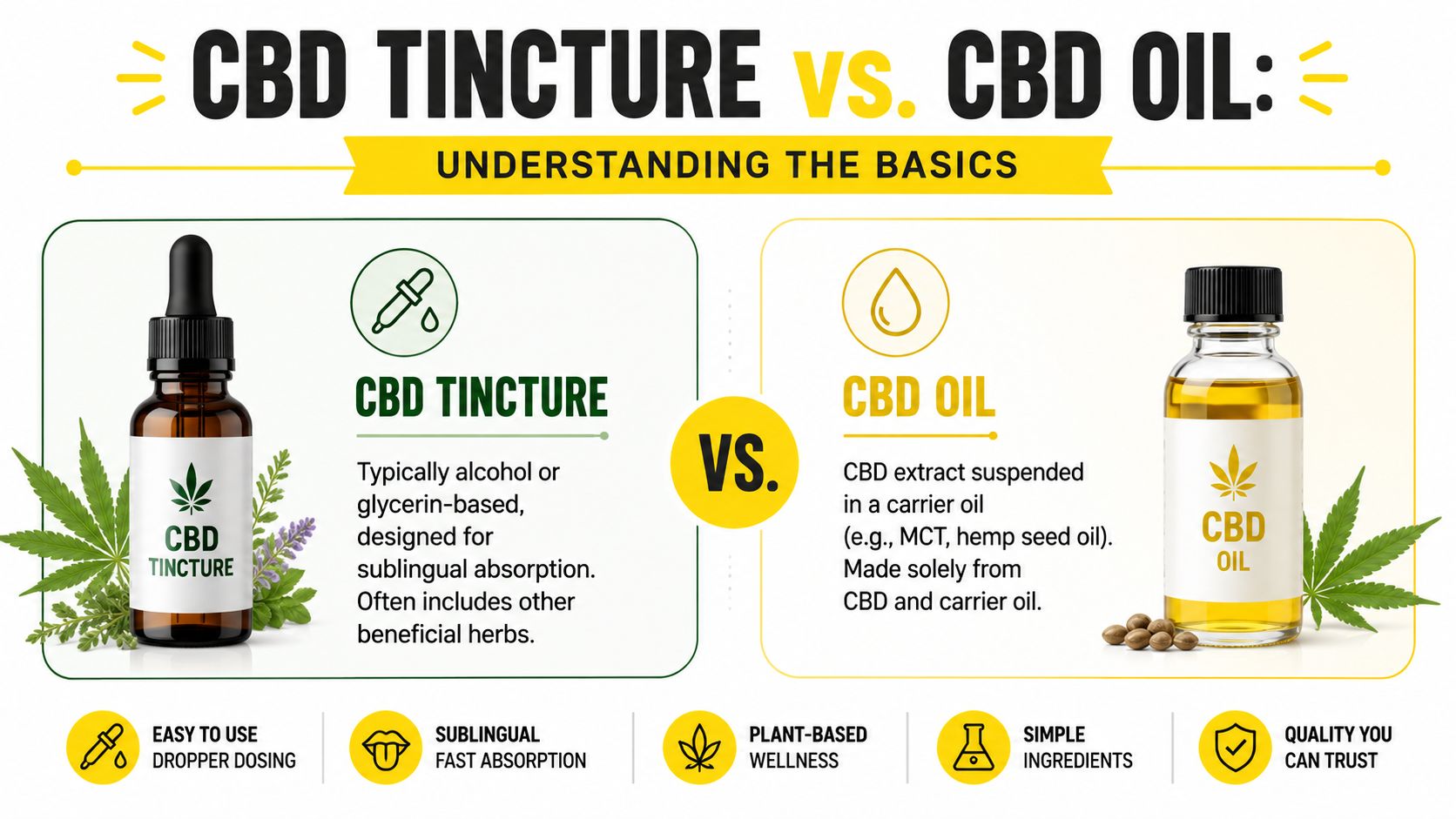
CBD Tincture vs. CBD Oil at a Glance
| Attribute | CBD Tincture | CBD Oil |
|---|---|---|
| Base | Usually alcohol or similar solvent base | Carrier oil base |
| Common ingredients | CBD extract, alcohol, sometimes glycerin or flavoring | CBD extract, MCT oil, coconut oil, olive oil, hemp seed oil, or jojoba oil |
| Common use | Often used under the tongue | Under the tongue, and often more flexible for mixed use |
| Taste profile | Can taste sharper or more herbal | Usually softer, richer, or more neutral depending on carrier oil |
| Shelf feel | Often viewed as traditional extract style | Often viewed as a modern everyday format |
What that looks like on a label
Let's say you pick up two sample bottles.
Bottle A ingredient list might read like this: hemp extract, ethanol, natural flavor. That points you toward a tincture-style product.
Bottle B might read: hemp extract, MCT oil. That points you toward a CBD oil.
That's why the ingredient panel matters more than the front label. Some brands use the word “tincture” loosely, even when the product is really an oil in a dropper bottle.
Why this distinction matters
The base changes the user experience. Alcohol-based products often feel more like traditional herbal extracts. Oil-based products tend to feel easier to fold into a daily wellness routine because they're often milder in texture and more versatile in use.
If you want a deeper primer on tincture formulation and effects, this article on the science behind marijuana tinctures and their effects gives helpful background.
Quick check: If the bottle uses a carrier oil like MCT or olive oil, think “CBD oil.” If it uses alcohol or a similar solvent base, think “CBD tincture.”
How Extraction and Carrier Ingredients Affect Your Experience
The bottle doesn't start on the shelf. It starts in how the CBD was pulled from the plant and what it was blended with afterward. That behind-the-scenes process helps explain why two products with similar-looking labels can feel different in your mouth, in your routine, and in your budget.
A foundational difference is the extraction base. CBD oils are typically made by separating CBD with carbon dioxide and then diluting the resin in a carrier oil, while tinctures are commonly made by soaking hemp in 60% to 70% distilled alcohol or a similar high-proof solvent. Industry explainers also note that CBD oils are generally more potent than tinctures when comparing equal amounts, according to Because Market's explanation of CBD oil and tinctures.
Why the extraction method matters
CO2-based oil production usually aims for a clean, concentrated extract. That extract is then blended into something like MCT oil or hemp seed oil to make it easier to measure and use. This often creates a product that feels smooth and straightforward.
Alcohol-based tinctures come from a more traditional extraction path. The alcohol helps pull compounds from the plant, and that can influence the finished taste and mouthfeel. Some people don't mind that herbal sharpness. Others notice it immediately.
If you want to understand why some labels highlight this method, this overview of CO2 extracted CBD oil helps connect the process to the product in the bottle.
How carrier oils shape the product
Carrier oils aren't filler. They help determine texture, flavor, and how easy the product is to work into daily life.
A few practical examples:
- MCT oil often feels light and neutral, which many people prefer for daily drops.
- Olive oil can taste more familiar to people who already use it in food.
- Hemp seed oil may appeal to shoppers who want a more plant-forward profile.
- Jojoba oil shows up in some formulations, especially when a product is designed with broader use in mind.
Why one bottle may cost more
Production style matters here too. Industry explainers note that oil production can take longer and require stricter controls, which is one reason oils are often priced higher than tinctures in the market noted earlier.
That doesn't automatically make oil the better choice. It means you're paying for a different formulation path.
If two products have the same headline CBD number but different bases, don't expect them to feel identical.
One patient may prefer a smoother oil they can use daily with breakfast. Another may accept a sharper tincture taste because they care more about the way it absorbs under the tongue.
Comparing Onset Time Bioavailability and Potency
For many medical patients, the question isn't “What's in it?” It's “How quickly will I notice it, and how much control do I have over the experience?”
That's where CBD tincture vs oil becomes more than a label difference.
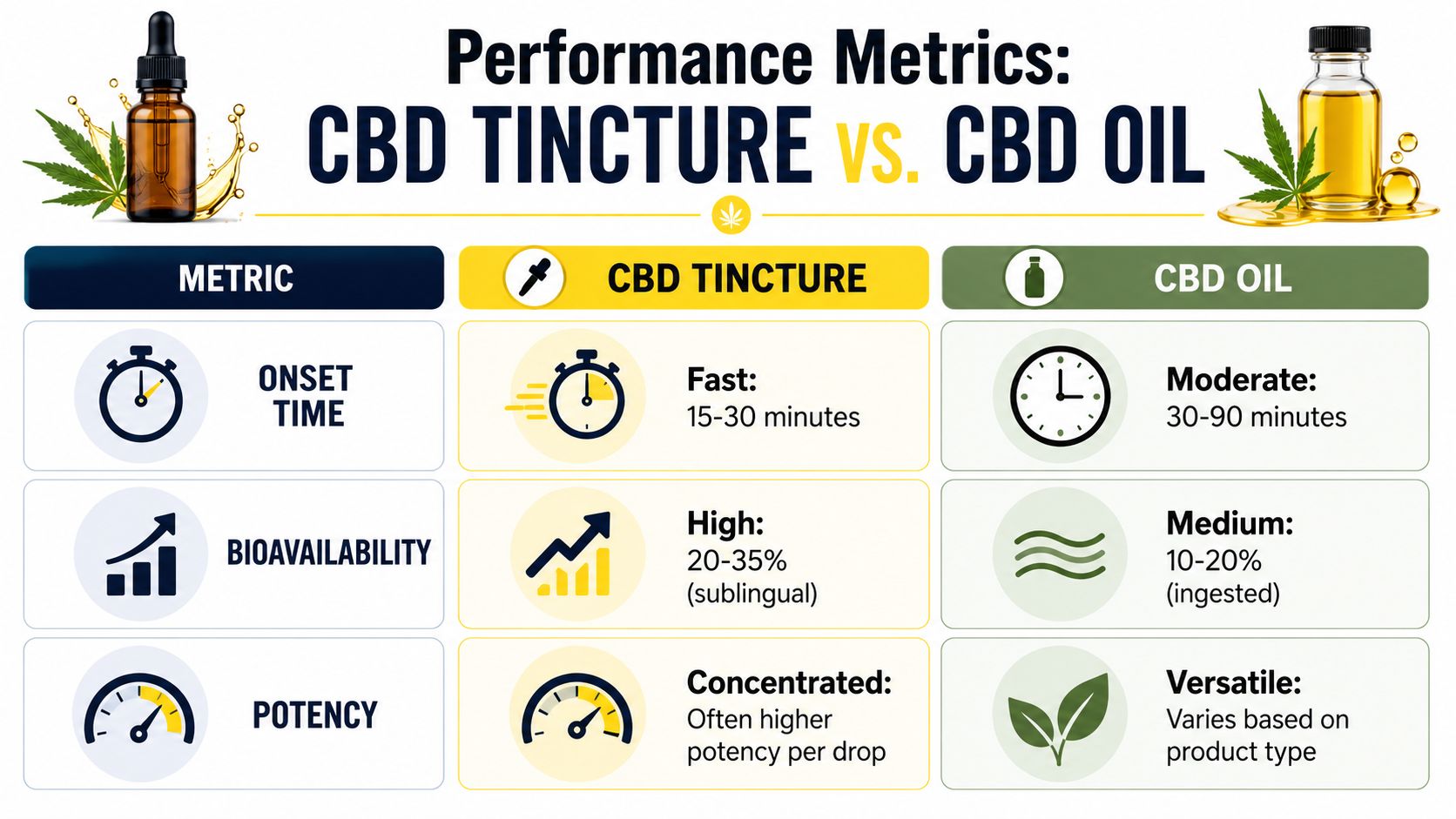
Expert sources note that sublingual absorption is usually faster for tinctures, often 15–45 minutes to noticeable onset, while swallowed oral dosing can take 30 minutes to 2 hours. One review also states that CBD oil generally has lower bioavailability and slower absorption than tincture, as explained in Open Mind Health's comparison of CBD oil and tincture.
What bioavailability means in plain English
Bioavailability is just a fancy way of asking: how much of what you took becomes available for your body to use?
For a new consumer, the takeaway is simple. A tincture taken under the tongue is often chosen when speed matters. An oil may still work well, but it may feel slower depending on how you use it.
A person who gets occasional waves of tension and wants a product they can place under the tongue before things escalate may lean toward a tincture. Someone building a steadier daily routine may care less about fast onset and more about concentration, taste, and flexibility.
Here's a short visual if you like seeing the comparison explained aloud:
Potency and daily needs
Potency can be another deciding factor. As noted earlier in the article, oils are often described as more potent than tinctures when comparing equal amounts. In practice, that can matter for patients who want fewer drops to reach their routine dose.
That doesn't mean tinctures are weak. It means the format may suit different goals.
- Fast support need: a tincture may fit better if quick sublingual onset is your priority.
- Higher concentration preference: an oil may fit better if you want a stronger concentration in a familiar carrier base.
- Precise titration: many people find dropper products in either format easy to adjust in small increments.
For more on how tinctures can feel in real use, this piece on weed tincture effects adds useful context.
Practical rule: If you need a product for moments when timing matters, start by asking about tinctures. If you want a concentrated daily format, ask to compare oils.
Dosing Administration and Practical Use Cases
Once you've picked a format, the next question is how to use it without overthinking every drop.
Both products are often used sublingually, which means placing the liquid under the tongue for a short hold before swallowing. That area has small blood vessels that can help with absorption. The tricky part is that hold-time advice isn't perfectly standardized. Mainstream explainers commonly suggest holding the liquid under the tongue for about 60 seconds to 90 seconds, according to CBD Genesis on tincture vs oil use.
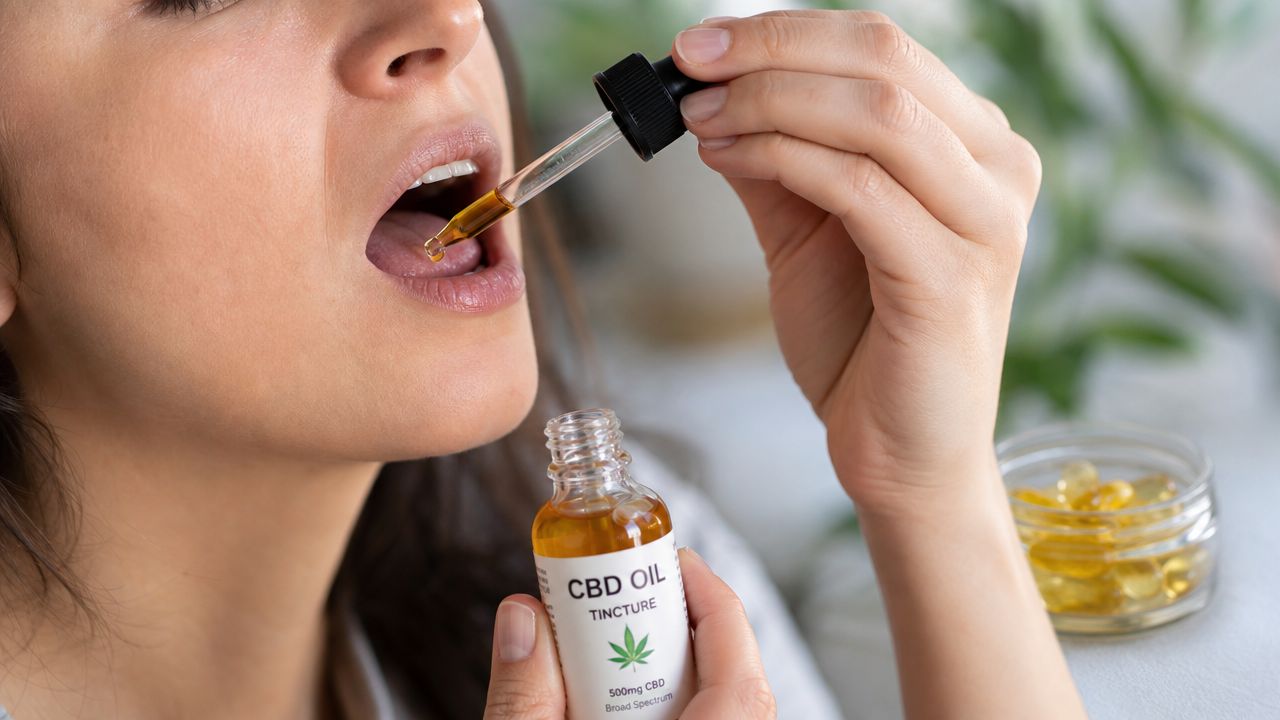
How to take them under the tongue
A simple routine works well:
- Measure your serving with the dropper.
- Place it under your tongue.
- Hold it there for somewhere in that 60 to 90 second window from the source above.
- Swallow and give it time before taking more.
If you're new, slower is better. Earlier in the article, we mentioned a commonly cited starting point of about 10 mg per day for new users.
Which format fits which use
Practical examples are helpful here.
- For bedtime support: A tincture may make sense if you want something you can take under the tongue and feel relatively quickly.
- For adding to food or drinks: An oil often feels easier to mix into a smoothie, yogurt, or tea because the carrier oil is already part of the formulation style.
- For direct skin use: Oils are often the more intuitive option because oil-based products tend to feel better suited to topical-style application than an alcohol-based tincture.
One easy example: if you want a few CBD drops with your morning routine, an oil may feel more natural mixed into something simple like oatmeal. If you want a faster sublingual option before a stressful appointment, a tincture may be the cleaner fit.
If you want help thinking through serving sizes, this guide to cannabis tincture dosage is useful.
A few beginner mistakes to avoid
- Taking more too quickly. Wait and observe before adjusting.
- Ignoring the ingredient list. The front label may not tell you whether it's an oil or tincture.
- Forgetting taste preference. If you dislike alcohol sharpness, that matters. You're more likely to stick with a product you don't dread taking.
How to Choose Your Product at Mr Nice Guys DC
At the buying stage, consumers don't need more theory. They need a short decision filter.
Start with your goal. Do you want something for quick support under the tongue, or something flexible that fits a daily wellness routine? Once you know that, the bottle category gets easier to narrow down.
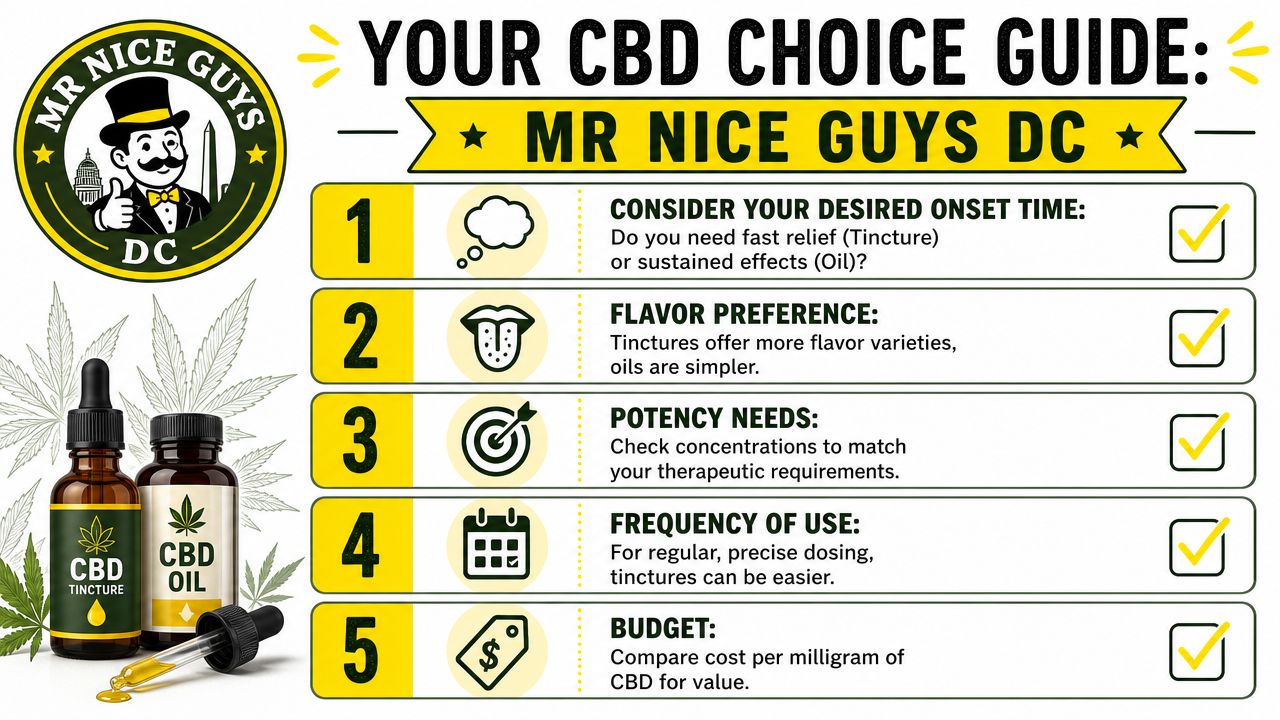
Read the label like a patient, not a marketer
When you compare products, check these details first:
- Base ingredient. Is it alcohol-based, or does it use MCT oil, olive oil, hemp seed oil, or another carrier?
- CBD amount per serving. Don't just look at the total in the bottle. Look for what you get in a measured dose.
- Spectrum type. Full-spectrum, broad-spectrum, and isolate tell you whether the formula contains just CBD or a wider cannabinoid profile.
- Intended use style. Some products are clearly built for sublingual use. Others make more sense for flexible daily use.
A dispensary menu like the one at Mr. Nice Guys DC product categories can help you compare formats before you buy.
Good questions to ask a budtender
You don't need to sound technical. Just be specific.
Try questions like these:
- I want something for fast sublingual use. Should I look at a tincture first?
- I'm sensitive to strong flavors. Which products have a milder taste?
- What is the carrier oil in this bottle?
- Can this one be used in food, or is it better kept for direct dosing?
- I'm new to CBD. What serving size makes sense for a cautious start?
- If I want a concentrated option, which oils should I compare?
The best dispensary conversation usually starts with your goal, not the product name.
A quick decision shortcut
If you're still stuck, use this:
- Choose tincture when speed and sublingual use are your top priorities.
- Choose oil when you want a carrier-oil formula that may feel more flexible for daily routines.
- If taste is a major issue, ask to compare ingredient lists before you choose.
That's how you make the CBD tincture vs oil decision without guessing.
Frequently Asked Questions About CBD Tinctures and Oils
Which usually tastes better
This depends on what you dislike more.
Alcohol-based tinctures can taste sharper or more herbal. Oils often taste earthier, softer, or richer depending on the carrier. If you're sensitive to that alcohol bite, oil may be easier to stick with. If you don't mind a stronger extract taste and want a traditional tincture feel, the opposite may be true.
Which lasts longer on the shelf
Mainstream guides often describe tinctures as longer-lasting on the shelf because alcohol-based formulations are commonly framed that way in consumer education. Oils can still be very stable, but shelf behavior depends on the ingredients and storage conditions. Keep either one sealed, out of heat, and away from direct light.
Can I use either one on my skin
Some people apply both, but oils usually make more practical sense for that purpose. An oil base tends to feel more natural on the skin, while an alcohol-based tincture may feel less comfortable depending on the formula.
Are they both taken under the tongue
Yes, both often can be. The difference is that tinctures are commonly framed as the faster-absorbing sublingual option, while oils are often treated as the more versatile everyday format.
What if the label uses the wrong word
It happens. Don't rely on the front of the bottle alone. Read the ingredient list. That usually tells you what you're buying much faster than the branding does.
If you want help choosing a dropper product that matches your routine, visit Mr. Nice Guys DC. Bring your goals, your taste preferences, and any questions about onset or dosing. A good budtender can help you compare formats, read labels clearly, and find a CBD option that fits how you want to use it.
Mr Nice Guys DC
At Mr. Nice Guys DC, we’re more than just a cannabis delivery service — we’re passionate advocates for quality, convenience, and community. With years of experience in the cannabis industry, our team is dedicated to educating and empowering customers across Washington, D.C. Whether you're a seasoned user or just starting your cannabis journey, our blog delivers trusted tips, product insights, and the latest updates from the world of weed. Stay informed, stay elevated.
