
Must Be 21 To Enter
By entering this site you are agreeing that you are at least 21 Years of Age or older.
I AM 21 OR OLDERCannabis for Arthritis Pain: A DC Patient's Guide
.svg)

.png)
Your hands hurt before your feet hit the floor. A jar lid feels like a test. Stairs take a quick mental calculation. By afternoon, the ache settles into your wrists, knees, or hips and starts shaping your day around what you can avoid.
That's usually the point when people start looking beyond their usual routine. Not because they want a miracle, but because they want enough relief to sleep better, move easier, and get through ordinary tasks without bracing for pain. If you're curious about cannabis for arthritis pain, you're not out on the edge of wellness culture. You're in a very common place.
Living with Arthritis Pain and Seeking Relief
For many people, arthritis isn't one dramatic moment. It's repetition. Morning stiffness. A sore thumb joint every time you open a door. A knee that talks back after a short walk. The pain can be loud, but the fatigue, poor sleep, and frustration are often just as draining.
A lot of first-time patients come in with the same concern. They're not looking to feel intoxicated. They want help getting dressed with less discomfort, sleeping through the night, or making it through errands without that familiar deep joint ache.
That interest is widespread. A major survey found that 57% of arthritis patients had tried marijuana or CBD for a medical reason, and among those who did, 97% of marijuana users and 93% of CBD users said it improved their symptoms, including pain, sleep, and mood, according to CreakyJoints' reporting on the arthritis cannabis survey.
Why patients keep asking about cannabis
People often arrive at cannabis after trying a mix of things that helped only partway. Maybe a topical from the pharmacy takes the edge off. Maybe prescription treatment helps inflammation but not nighttime discomfort. Maybe pain is manageable, but sleep isn't.
That's where cannabis sometimes enters the conversation. Not as a cure. More like another tool in the toolbox.
Practical rule: Think of cannabis for arthritis pain as symptom support. People usually explore it for pain, stiffness, rest, and comfort during flares.
If your pain is broad and ongoing, it can help to learn how different product types behave before buying anything. A basic guide to choosing cannabis for chronic pain can make that first dispensary visit much less overwhelming.
A simple real-life example
Say your arthritis pain shows up in two ways. Your fingers ache during the day when you type, and your knees throb at night once you finally sit down. You probably won't want one product for both problems in exactly the same way.
That's the key shift. Cannabis use tends to work better when you match the format and dose to the moment you need help.
Understanding Cannabinoids and the Science of Relief
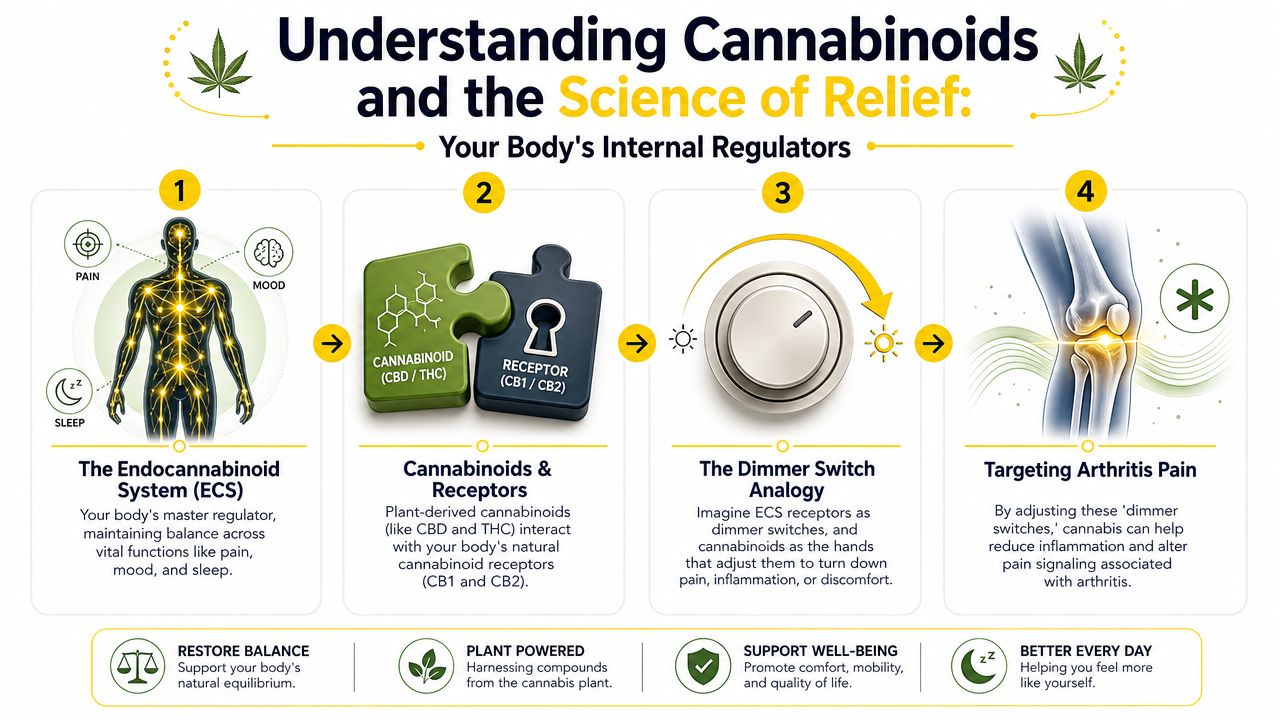
Cannabis sounds complicated until you strip it down to the basics. Your body already has a signaling network that helps regulate pain, mood, sleep, and immune activity. It's called the endocannabinoid system, or ECS.
A simple way to picture it is a wall of dimmer switches. When pain signaling or inflammation starts running too high, the ECS helps fine-tune those signals. Cannabis compounds interact with that system, which is why they may affect how pain feels and how the body responds to irritation.
CBD and THC do different jobs
The two cannabinoids most patients hear about are CBD and THC.
CBD is usually the easier starting point for arthritis questions. It doesn't produce the classic high people associate with cannabis. Patients often gravitate to it when they want a gentler option and hope to support inflammation-related discomfort.
THC is different. It's the cannabinoid associated with intoxication, but it's also the one many people find more noticeable for pain signaling and relaxation. That's why THC can be useful, but it also requires more care with dose and timing.
If you're still sorting out those labels, this plain-language breakdown of CBD versus THC is a helpful starting point.
Why combinations often make more sense
A lot of new patients assume CBD is the “safe” option and THC is the “strong” option. Real life is more nuanced. For arthritis pain, the strongest signal in the literature points toward combination products, not CBD alone.
Arthritis Australia notes that a 2022 randomized controlled trial found a THC/CBD oral mucosal spray significantly reduced pain and improved sleep, and it also describes research suggesting cannabinoids may reduce pain through anti-inflammatory mechanisms such as lowering pro-inflammatory cytokines and nitric oxide while inhibiting synovial fibroblast proliferation in its overview of medicinal cannabis for arthritis.
When a budtender suggests a balanced product with both CBD and THC, that isn't upselling by default. It may reflect what the current evidence seems to favor for symptom relief.
A practical way to think about it
If CBD is like turning down the irritation around the joint, THC is more like turning down the volume of the pain alarm. That's simplified, but it helps explain why some patients feel little from CBD alone and better from a balanced formula.
The takeaway is straightforward. You don't have to start with THC, but you also shouldn't assume it has no place in a careful arthritis plan.
Topicals Edibles Tinctures and Vapes Compared
Once people understand cannabinoids, the next question is usually more practical. What should I buy?
Format matters because arthritis pain shows up in different patterns. A sore knuckle after gardening is different from body-wide pain that keeps you awake. The product should fit the problem.
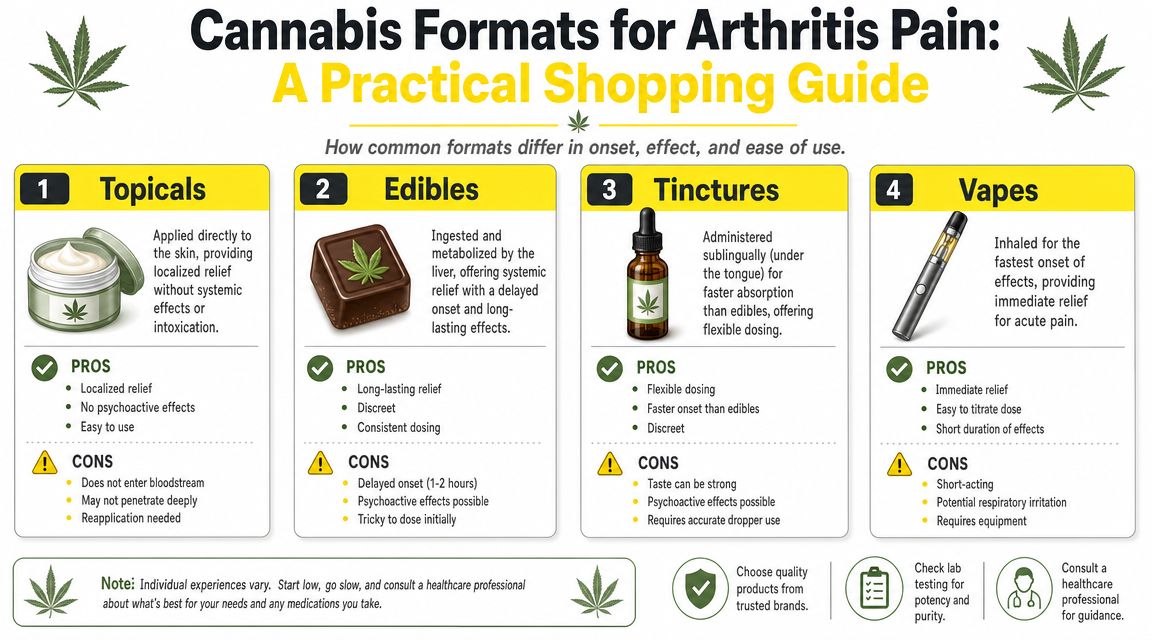
The fast comparison
| Cannabis Formats for Arthritis at a Glance | |||
|---|---|---|---|
| Format | Onset Time | Duration | Best For |
| Topicals | Varies by person and product | Shorter acting, often needs reapplication | One specific joint or area |
| Edibles | Slower onset | Longer-lasting | Overnight relief or all-over discomfort |
| Tinctures | Faster than edibles when used under the tongue | Moderate | Flexible dosing and easier adjustments |
| Vapes | Fastest onset | Short-acting | Sudden flare-ups and rapid relief |
Topicals for one stubborn spot
Topicals include creams, balms, salves, and roll-ons. You apply them directly where it hurts.
They're a strong fit when the problem is local. Think wrist pain while cooking, a swollen finger joint, or a knee that acts up before a walk. Many patients like topicals because they feel familiar and don't ask them to rethink their whole evening.
Best use case: before gardening, before a grocery run, or after a long day on your feet.
A realistic example: if your right thumb joint throbs every time you grip your phone or steering wheel, a topical makes more sense than taking a whole-body product first.
Edibles for long coverage
Edibles are useful when arthritis pain isn't confined to one joint or when your worst symptoms hit at night. They last longer, which is why many people reserve them for evening use.
The tradeoff is patience. You have to wait for them to kick in, and taking more too soon is one of the most common beginner mistakes.
Here's a quick visual overview of how common formats compare in practice:
Best use case: body-wide discomfort, trouble staying asleep, or pain that tends to build after dinner and linger overnight.
Tinctures for adjustable dosing
Tinctures sit in the middle. You place them under the tongue, which gives you more flexibility than an edible and usually a more predictable adjustment process.
This is the format many cautious beginners end up liking. A dropper lets you move slowly and stay organized. If you're trying to find your minimum helpful amount, tinctures are easier to work with than a gummy that comes in one fixed piece.
A detailed guide to edibles, vapes, and flower formats can help you narrow your choices before you shop.
Vapes for quick flares
Vapes act fast. That speed makes them useful for sudden spikes in pain, but they don't usually last as long as an edible.
If your pain comes in waves, a vape may help you respond in the moment. If your issue is persistent overnight discomfort, it may not be the most practical standalone choice.
A good shopping question is, “Do I need relief in one joint, across my whole body, or right now?” Your answer usually points to the right format.
The Golden Rule Start Low and Go Slow
Dosing is where many new patients get nervous, and that's reasonable. With arthritis, the goal isn't to take as much as possible. It's to find the smallest amount that gives you useful relief with the fewest unwanted effects.
Arthritis Society Canada says cannabis can't cure arthritis or slow disease progression, and the Arthritis Foundation recommends a low-and-slow approach that starts with 5 to 10 mg CBD twice daily, increasing every few days if needed, then considering a very low-dose THC product only if CBD alone isn't enough, as summarized by Arthritis Society Canada's guidance on medical cannabis.
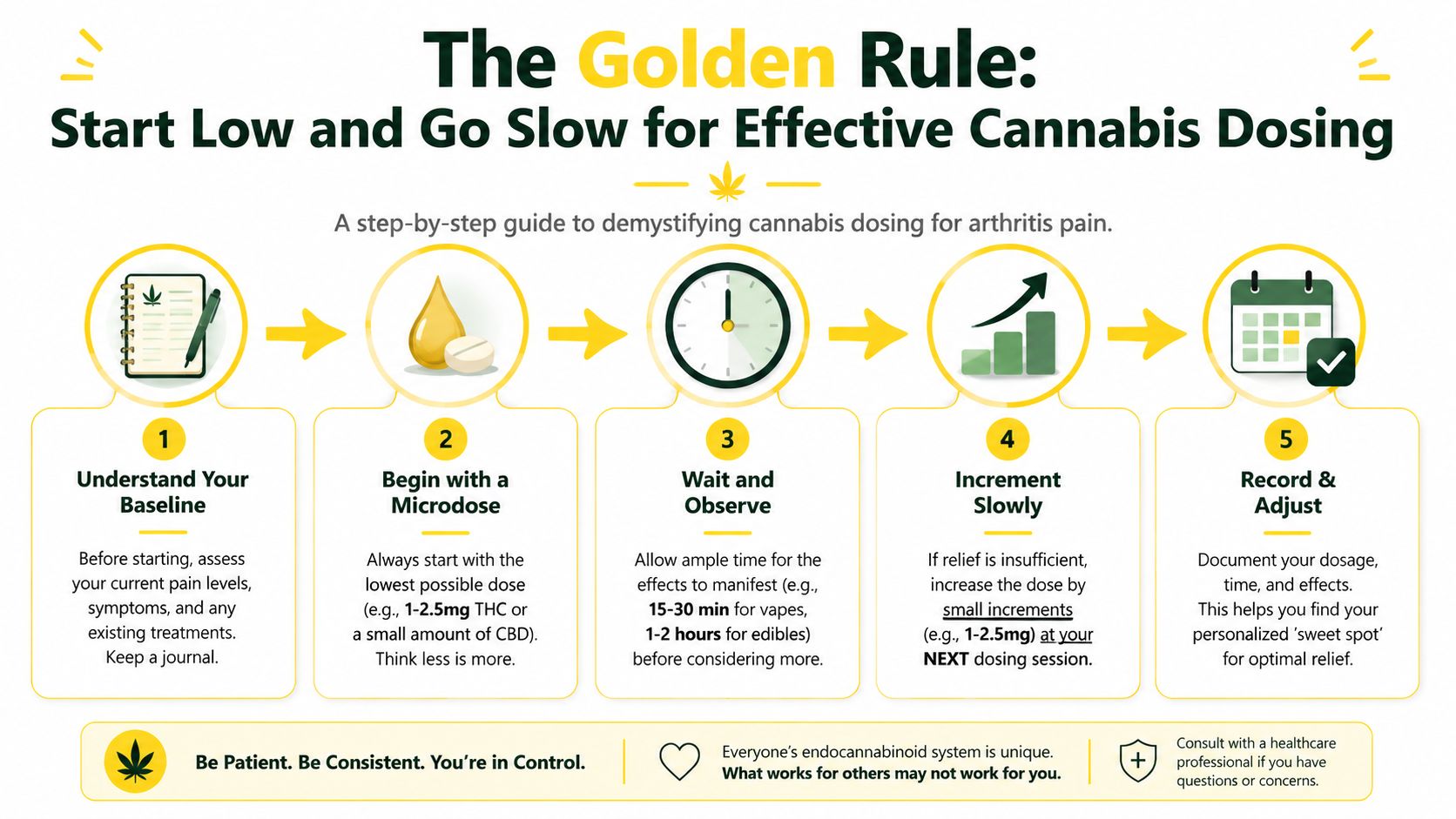
A beginner-friendly dosing path
If you're starting with CBD, keep it simple.
- Start at the low end. If your product allows it, begin with 5 mg CBD twice daily.
- Stay there for a few days. Don't change three things at once.
- Track what changes. Pain, stiffness, sleep, and side effects matter more than vague impressions.
- Increase gradually if needed. Move up every few days rather than every few hours.
- Only consider THC later. If CBD alone doesn't do enough, a very low-dose THC product may be the next discussion.
What to write down
A small notebook or phone note works fine. Keep it boring and consistent.
- Time used: Morning, afternoon, or bedtime.
- Product type: Tincture, edible, topical, or vape.
- Dose taken: Exactly what the label says you used.
- What changed: Less hand stiffness, easier sleep, no change, felt too groggy.
That record matters because memory gets fuzzy fast. “I think that gummy helped” is less useful than “I took this dose after dinner and woke up only once instead of three times.”
When THC enters the picture
Some people do well with CBD-only products. Others don't notice enough and need a small amount of THC added carefully. If that happens, think tiny and deliberate.
A common mistake is assuming impatience means the dose was too low. Sometimes the issue is that the format didn't match the symptom. A topical for your hands and a low evening tincture can be a smarter pairing than jumping straight to a stronger edible.
For patients using droppers, this guide to cannabis tincture dosing can make the process feel much less guesswork-heavy.
Keep your first goal modest. Better sleep, easier mornings, or less pain during one daily task are meaningful wins.
Navigating Safety and Potential Drug Interactions
Cannabis for arthritis pain can be helpful, but “helpful” doesn't mean casual. Products that affect pain, sleep, and mood deserve the same respect you'd give any other symptom-management tool.
One reason for that caution is variability. Different people respond differently to the same product. THC may leave one person relaxed and another person uncomfortable or foggy. CBD may seem gentle, but it can still matter medically if you take prescription drugs.
Where the evidence is encouraging but limited
The research is promising enough to take seriously and limited enough to stay careful. A scoping review reported that a questionnaire of 2,969 participants found medicinal cannabis was used for arthritis in 26% of respondents, with 68% reporting symptom improvement and another 27% reporting slight improvement. The same review also noted a study where pain intensity fell from 8.2 to 5.6 on a visual analog scale, discussed in the rheumatoid arthritis cannabis scoping review on PubMed Central.
Those numbers don't prove cannabis works for everyone. They do show why people keep exploring it and why dosing, monitoring, and product choice matter.
The medication question matters
The biggest safety conversation for many arthritis patients isn't about feeling high. It's about drug interactions.
CBD can affect how the body processes certain medications. A simple rule of thumb is this: if you take prescription medicine, especially drugs your doctor monitors closely, ask your doctor or pharmacist before adding cannabis. That's especially important with medications that carry a grapefruit warning and with blood thinners such as warfarin.
Watch for common red flags when starting any THC-containing product:
- Too much too fast: You feel anxious, overly sleepy, or mentally cloudy.
- Bad timing: You tried a new product before driving, working, or an important appointment.
- Mixing without guidance: You added cannabis while taking multiple prescriptions and didn't check first.
Bring your medication list with you when you talk to your clinician. That one habit can prevent a lot of avoidable problems.
Getting Medical Cannabis for Arthritis in DC
You wake up with stiff fingers, sore knees, or a hip that takes a few extra minutes to loosen up. By the time you decide to try cannabis, a new question shows up. How do you get it legally in DC, and how do you make sure what you buy is labeled clearly enough to use with confidence?
For arthritis patients, the medical system usually makes the process easier to handle because the products come through licensed dispensaries with regulated labeling. That matters in real life. If you are comparing a balm for a swollen knuckle joint with a low-dose tincture for evening pain, you need the label to act like a measuring cup, not a guess.
DC residents who are unsure about eligibility or paperwork can start with this guide to medical card requirements in DC. It lays out the steps so you can focus on symptom relief instead of hunting for rules.
Why the medical route helps with arthritis decisions
Arthritis rarely shows up in only one pattern. Some people have one stubborn joint. Others have all-day stiffness, nighttime pain, or flare-ups that make walking or sleeping harder. The medical route gives you a more reliable way to match those patterns to product types.
A labeled topical can make sense for pain centered in hands, knees, or wrists. A tincture may be easier if you want slow, measured dose changes. An edible may fit longer-lasting evening relief, but only if you start with a very small amount and wait long enough before taking more. That kind of comparison is hard to make if the product details are vague.
What to bring before your first dispensary visit
A short symptom snapshot helps a lot. You do not need a perfect journal. A few notes on your phone is enough.
Write down:
- Where the pain shows up: Hands, knees, hips, back, or several joints
- What the pattern looks like: Morning stiffness, pain after activity, or trouble sleeping because of pain
- What result you want first: Easier movement, better sleep, or relief in one specific area
- What you want to avoid: Feeling high, daytime drowsiness, or products that take too long to work
That information helps the dispensary team point you toward a realistic starting option instead of something too strong or too broad for your first try.
Mr. Nice Guys DC is one local medical dispensary in Washington where patients can ask about formats such as topicals, tinctures, edibles, cartridges, and flower while choosing products for therapeutic use.
Partnering with Your Budtender for Best Results
Even after you understand CBD, THC, and product formats, the menu can still feel crowded. That's normal. The label might tell you cannabinoid content, but it won't tell you whether a balm makes more sense than a tincture for your hands, or whether an evening edible is too much for a cautious beginner.
That's where a good budtender helps. Not by diagnosing arthritis, and not by replacing your doctor, but by translating your goals into practical choices.
What to say when you walk in
Specific questions get better answers than “What do you recommend?”
Try something like this:
“I have inflammatory pain in my hands, and I also need help sleeping. I'd like to start gently. I'm interested in CBD first, but I'm open to a little THC later if needed. What format makes the most sense?”
That short script tells the budtender four useful things. Where your pain is, when it bothers you, your comfort level with THC, and the outcome you care about.

Good budtender conversations are practical
A useful consultation usually covers:
- Symptom pattern: Is your pain localized, widespread, sudden, or mostly at night?
- Format preference: Do you want a cream, a dropper, a gummy, or something fast-acting?
- Comfort level: Are you avoiding intoxication, open to balanced products, or only exploring CBD right now?
- Daily routine: Do you need daytime clarity, bedtime support, or both?
A patient with stiff finger joints and no interest in feeling high may leave with a topical and a low-dose CBD tincture. Someone whose biggest issue is nighttime pain and broken sleep may be steered toward a different format entirely.
What success actually looks like
Success isn't always dramatic. Sometimes it's being able to button a shirt without wincing. Sometimes it's falling asleep without your knees throbbing. Sometimes it's getting enough relief to take a walk the next day.
That's why the budtender relationship matters. The first product is a starting point, not a final answer. If your notes show that one format helps your wrists but does nothing for sleep, that's useful information. Your next purchase gets smarter.
If you're ready to explore cannabis for arthritis pain with a careful, local, patient-first approach, Mr. Nice Guys DC can help you compare formats, understand labels, and choose a starting option that fits your symptoms and comfort level.
Mr Nice Guys DC
At Mr. Nice Guys DC, we’re more than just a cannabis delivery service — we’re passionate advocates for quality, convenience, and community. With years of experience in the cannabis industry, our team is dedicated to educating and empowering customers across Washington, D.C. Whether you're a seasoned user or just starting your cannabis journey, our blog delivers trusted tips, product insights, and the latest updates from the world of weed. Stay informed, stay elevated.
