
Must Be 21 To Enter
By entering this site you are agreeing that you are at least 21 Years of Age or older.
I AM 21 OR OLDERBest Oil Vape Pens: Safe Dosing & DC Compliance 2026
.svg)

.png)
The best oil vape pens are licensed DC dispensary products with batch-specific third-party testing, clear ingredients, and traceable hardware. CDC investigations found vitamin E acetate in 76% of THC products obtained from EVALI patients, linking unregulated cartridges to serious lung-injury concerns.
You're standing at a dispensary counter, comparing two cartridges that look almost identical. One advertises a higher THC percentage and a familiar strain name. The other shows a lot number, ingredients, test results, and a manufacturer you can verify. Choose the second one. A premium vape pen is defined by safety documentation and manufacturing controls, not by glossy hardware or the biggest number on the label.
For DC patients and adult consumers, that means evaluating the supply chain before the flavor profile. The practical shortlist is simple: licensed source, batch-specific certificate of analysis, transparent formulation, disclosed hardware materials, and a device that controls heat instead of merely producing large clouds.
| Vape option | Best fit | Main advantage | Main concern | My recommendation |
|---|---|---|---|---|
| Disposable pen | First-time or occasional user | Ready to use | Limited battery and less hardware flexibility | Choose only when the product has complete traceability |
| Rechargeable cartridge system | Regular users | Reusable battery and interchangeable cartridges | Compatibility and charging issues | Best general format for many patients |
| Temperature-controlled device | Users prioritizing consistency | More stable heating | Higher complexity | Strong choice when verified temperature control is available |
| Informal-market cartridge | No responsible use case | Often inexpensive or easy to find | Unknown ingredients, testing, and provenance | Avoid |
Why Vape Pen Safety Matters More Than You Think
A first-time buyer often starts with the wrong question: “Which pen has the highest THC?” A patient may choose a recognizable strain, notice a sleek glass cartridge, and assume the product is safe because it looks professional. That assumption fails if the oil contains an undisclosed additive or the cartridge came from a source that can't provide a verifiable lab report.
The 2019 to 2020 EVALI outbreak made that risk impossible to ignore. By January 14, 2020, the CDC had received reports of 2,668 hospitalized EVALI cases. Among patients with available information, 82% reported using a THC-containing vaping product, while 33% reported exclusive THC-product use. CDC investigations strongly linked vitamin E acetate, an additive used in some THC cartridges, to the outbreak and advised that it shouldn't be added to vaping products. Read the CDC outbreak investigation for the underlying findings.
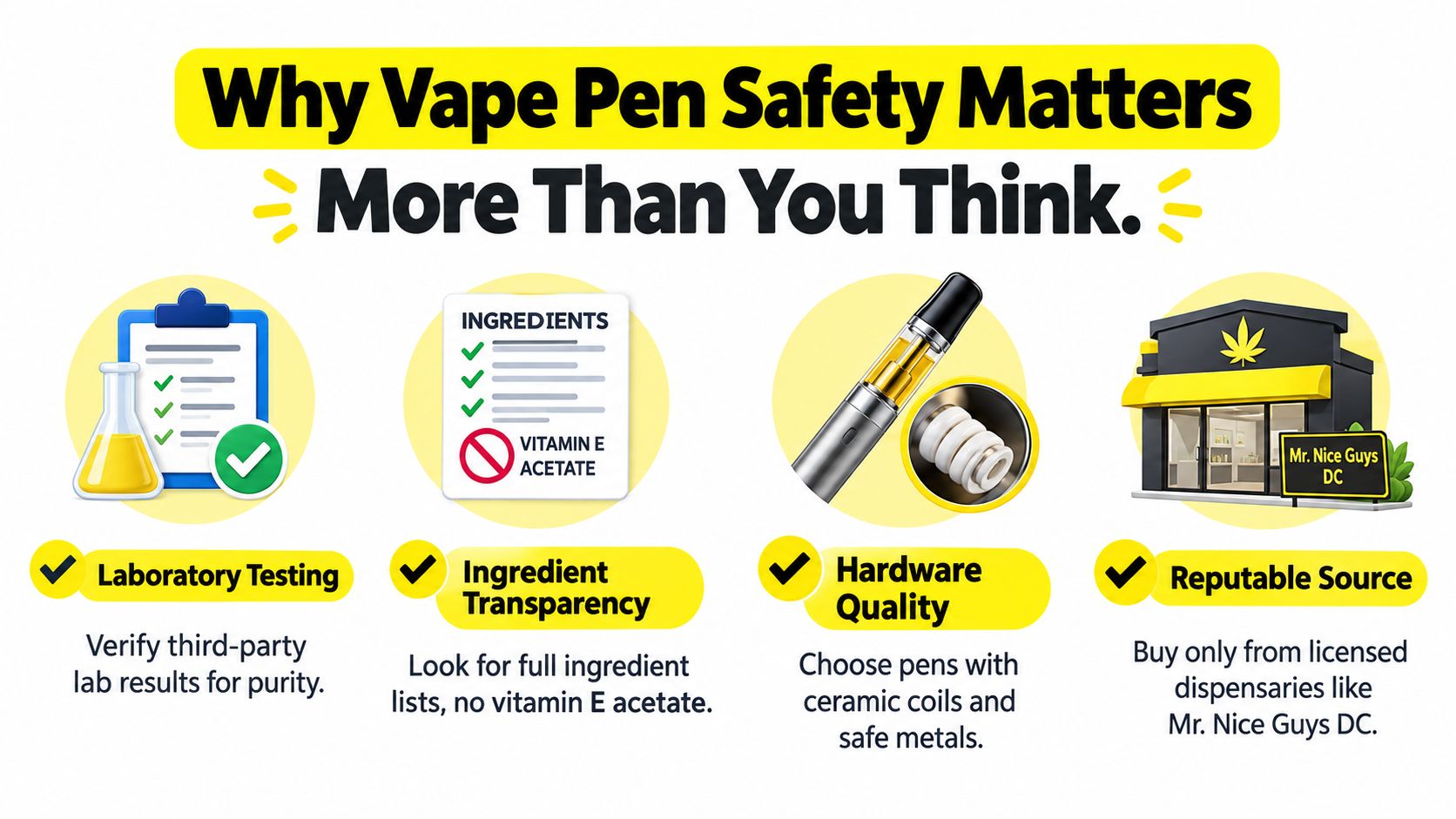
What a safe purchase should reveal
A certificate of analysis, or COA, should correspond to the product's batch or lot. I look for cannabinoid potency, pesticides, solvents, heavy metals, microbial contaminants, ingredients, testing laboratory, and a date that makes sense for the product's manufacturing timeline. A generic lab logo without a matching batch number isn't enough.
Packaging should identify the manufacturer, cannabinoid contents, lot or batch number, ingredients, manufacturing information, and use-by date when applicable. A leaking cartridge, damaged seal, unusually thick oil, inconsistent labeling, or missing documentation is a reason to stop the purchase, not a reason to negotiate.
Practical rule: If the retailer can't explain where the cartridge came from or show batch-specific testing, the THC percentage doesn't rescue the product.
The heavy-metal testing guide is useful background because hardware emissions can matter as much as the oil itself. A licensed dispensary gives you a meaningful point of accountability, while an informal seller usually can't verify manufacturing, storage, or testing history.
The FDA specifically warns that consumers may be unable to know whether a THC vape contains vitamin E acetate. Its guidance advises avoiding street products and never modifying or adding substances to store-bought cartridges. Don't refill a sealed cartridge with another oil, dilute it, or add flavoring. A “stronger” homemade mixture is an unknown inhalation experiment.
Understanding Vape Pen Types and Hardware Differences
Hardware changes how consistently a cartridge heats, how easily you can control a session, and how much maintenance you'll tolerate. I separate oil vape pens into three practical groups: disposables, rechargeable cartridge systems, and modular devices.
A disposable is pre-filled and simple. It suits someone who wants no charging cable, no cartridge swapping, and minimal setup. The tradeoff is that a dead battery can leave oil unused, and the user has little control over heating or replacement.
A rechargeable cartridge system uses a battery with a removable cartridge, often through a common 510 connection. That format makes it easier to switch between oils and replace the cartridge without discarding the battery. The vape pen cartridge types guide can help clarify the practical differences before you buy.
Heat control beats a high voltage number
Nominal voltage doesn't tell you what the coil reaches during a draw. In laboratory testing, a temperature-controlled device set to 420°C produced an average coil temperature of 420 ± 9.5°C, while a variable-voltage device at 4.0 V averaged 543 ± 95.9°C. A single-voltage 3.2 V device averaged 450 ± 60.8°C. See the laboratory temperature-control study for the measurements.
That difference matters. Excessive or unstable heat can make vapor harsher, change terpene and cannabinoid delivery, degrade oil, and increase concern about emissions from the cartridge. A device that reaches a target temperature briefly but overshoots throughout the puff is not fully controlled.
For most patients, I prefer a battery with closed-loop temperature control or clearly verified temperature presets. A 510 system with a conservative setting is more useful than a powerful device that produces thick vapor at unpredictable heat.
Match the format to the user
- Disposable pens: Choose this for travel-light simplicity, provided the product has complete labeling and testing.
- Rechargeable 510 systems: Choose this for regular use, cartridge variety, and less battery waste.
- Modular devices: Choose this only if you're comfortable managing settings, attachments, cleaning, and cartridge compatibility.
A practical example: a patient who takes occasional evening inhalations may prefer a draw-activated rechargeable system with a low setting. Someone who changes formulations and wants repeatable heat should choose a temperature-controlled battery, not a fixed-voltage pen.
Comparing Oil Formulations and Cartridge Materials
The oil formulation affects taste, viscosity, potency, and the kind of experience a patient gets. It doesn't prove safety by itself. Terms such as live resin, full-spectrum, distillate, and “natural flavor” describe formulation or marketing choices, not a substitute for contaminant testing.
| Formulation | THC range | Flavor profile | Safety considerations | Best for |
|---|---|---|---|---|
| Distillate | Varies by product | Usually clean, direct, and sometimes flavored | Check additives and terpene disclosure | Patients who want a straightforward cannabinoid profile |
| Live resin | Varies by product | More pronounced cannabis and terpene character | Check processing details, ingredients, and testing | Users who prioritize a fuller flavor profile |
| Rosin | Varies by product | Often rich and strain-forward | Viscosity can affect hardware performance; verify testing | Experienced users seeking solventless positioning |
| Flavored oil | Varies by product | Sweet, fruit, mint, or botanical notes | Review every added ingredient rather than trusting flavor language | Users who tolerate and specifically prefer flavor |
I don't rank oils by flavor alone. A highly aromatic cartridge with no batch-specific COA is a poor choice, while a less exciting distillate with transparent testing may be the more responsible option. For a clear explanation of the formulation distinction, see live resin versus distillate.
Cartridge materials deserve equal attention
Independent cartridge analyses detected chromium, copper, nickel, lead, manganese, and tin in oil and inhaled aerosol, with inhaled metal quantities potentially exceeding regulatory standards in some scenarios. The cartridge-materials research explains why the cartridge isn't just a flavor vessel.
I favor glass reservoirs, disclosed heating-element materials, ceramic components where the manufacturer can document their construction, and test reports that specifically address heavy metals in both oil and aerosol where available. Ceramic doesn't automatically guarantee low emissions, and stainless steel isn't automatically dangerous. Construction quality, temperature, oil chemistry, storage, and device age all matter.
Avoid judging a cartridge by vapor volume or advertised puff count. A cartridge that produces a large cloud through aggressive heating may be placing more thermal stress on the oil and hardware. Smooth, moderate vapor from a stable device is a better performance signal than spectacle.
How to Dose Properly with Oil Vape Pens
Concentrates can deliver far more THC per inhalation than traditional flower. NIDA reports that solvent-based marijuana concentrates average 54% to 69% THC, with reported levels exceeding 80%. A 1-gram cartridge at 70% THC contains approximately 700 milligrams of THC before losses during heating or inhalation, as explained in the NIDA guide to marijuana concentrates.
That doesn't mean every puff contains a predictable fraction of the cartridge. Draw length, airflow, temperature, oil viscosity, device design, and your inhalation technique all change the delivered amount. Treat the label as a potency warning, not as a promise of precise per-puff dosing.
Use a stop-and-assess routine
- Start with a brief draw. New or occasional users should avoid a long inhalation. A short draw gives you a chance to assess intensity without committing to a large dose.
- Put the pen down. Don't take repeated inhalations just because the effect hasn't appeared immediately.
- Assess impairment and comfort. Notice anxiety, dizziness, racing thoughts, dry mouth, nausea, sedation, or difficulty concentrating.
- Adjust the next session, not the current one. If the first draw felt too strong, reduce draw length or choose a lower-potency formulation next time.
- Don't drive or work while impaired. Keep the cartridge away from situations requiring quick judgment or coordination.
A practical example is a patient who buys a 70% THC cartridge and assumes one puff equals one puff of flower. That comparison is unreliable. The patient should use a brief draw, wait until the effects are clear, and avoid immediate redosing.
The cannabis concentrates guide offers additional context for patients comparing concentrated products. Body size and tolerance can influence the experience, but neither makes a high-potency cartridge predictable. Start low, go slowly, and choose a product whose potency matches your actual tolerance.
Making Smart Choices at Mr. Nice Guys DC
A safe purchase starts with traceability, not flavor or potency. A licensed DC dispensary should identify the manufacturer, explain the format, provide batch-linked documentation, and offer labeling that supports an informed decision.
Ask these questions before paying:
- Can I see the COA for this exact batch? The report should match the lot or batch number on the package.
- What ingredients are in the oil? A strain name does not identify every ingredient.
- What hardware does the cartridge use? Ask about the reservoir, heating element, and battery compatibility.
- How should I store and use it? Heat, sunlight, leakage, and extended storage can affect the product.
- What should I do if the cartridge leaks or tastes burnt? A clear return and safety process matters.
Mr. Nice Guys DC offers medical cannabis products, including cartridges and pens, with information for patients comparing formats. Its selection may include 510 cartridges, disposable pens, and rechargeable options. For a practical comparison of these formats, read the guide to cartridges, pens, and disposables at Mr. Nice Guys DC. Choose the documented product that fits your needs, rather than the one with the strongest marketing.
FDA guidance advises consumers to avoid street THC vape products and not add substances to store-bought cartridges. A product that looks regulated may still have an unknown origin, incomplete testing record, or no reliable batch identity. Those records matter more than packaging appearance.
The following video provides a practical visual reference for comparing cartridge and pen choices.
Before leaving the shop, confirm that the seal is intact, the label is legible, and the cartridge is free of cracks or leaks. Keep the receipt and packaging until the product is finished, especially when tracking how a specific formulation affects you.
Common Vaping Myths Debunked
Myth one, high THC means high quality. It doesn't. High potency can make dosing harder, particularly for a new or occasional consumer, while saying nothing about additives, heavy metals, manufacturing controls, or batch traceability. A lower-potency product with complete testing can be the more intelligent purchase.
Myth two, all vaping is equally safe. The evidence doesn't support that shortcut. Oil chemistry, additives, heating temperature, cartridge construction, storage, and source all affect the risk picture. CDC also says there isn't enough evidence to conclude that one cannabis-use method is safer than another, so “vaporized” isn't a safety guarantee.
Myth three, a legal-looking package proves compliance. Packaging can be copied or incomplete. In a 2025 study of 88 cannabis products, unlicensed products had significantly fewer essential information and safety features than licensed products, while licensed products more often supplied information needed for lower-risk decisions. Review the study of product labeling and safety features.
Myth four, disposables are always the most convenient. They're easy at the start, but a rechargeable system may suit a regular patient better because the battery remains usable when the cartridge is empty. Convenience includes reliable dosing, compatibility, charging, storage, and knowing what you'll do when the device fails.
The best oil vape pens aren't the ones with the loudest claims. They're the products you can trace, test, understand, and use conservatively.
Frequently Asked Questions About Oil Vape Pens
How can I tell whether a vape pen is safe?
Start with the source, then inspect the package. Look for a licensed retailer, manufacturer identity, batch number, ingredients, cannabinoid content, intact packaging, and a COA that matches the batch. Don't buy a cartridge that leaks, looks damaged, or has inconsistent labeling.
Is live resin safer than distillate?
Neither label proves safety. Live resin may offer a stronger terpene profile, while distillate may provide a simpler formulation, but both require ingredient disclosure and contaminant testing. Choose the product with better documentation and hardware transparency.
How long should a cartridge last?
There isn't a dependable universal answer. Draw length, inhalation frequency, oil volume, temperature, and device design change consumption. If a cartridge empties unusually quickly or develops a burnt taste, stop using it rather than increasing power.
Can I use a CBD-only cartridge?
You can consider a CBD-focused product if it's legally available and clearly labeled, but “CBD-only” still requires ingredient and contaminant testing. Verify that the product doesn't contain unexpected THC or undisclosed additives if avoiding THC matters to you.
What should I do if vaping causes coughing or discomfort?
Stop using the pen and don't test it with another draw. Coughing can have several causes, but chest pain, shortness of breath, nausea, or worsening symptoms after vaping warrant medical attention. Keep the packaging and batch information so you can identify the product.
Mr. Nice Guys DC offers cartridges, disposable pens, rechargeable vape options, and patient-oriented cannabis guidance for consumers comparing formats in Washington, DC. Visit Mr. Nice Guys DC to review available products and ask for a traceable option with clear testing before you buy.
Mr Nice Guys DC
At Mr. Nice Guys DC, we’re more than just a cannabis delivery service — we’re passionate advocates for quality, convenience, and community. With years of experience in the cannabis industry, our team is dedicated to educating and empowering customers across Washington, D.C. Whether you're a seasoned user or just starting your cannabis journey, our blog delivers trusted tips, product insights, and the latest updates from the world of weed. Stay informed, stay elevated.
