
Must Be 21 To Enter
By entering this site you are agreeing that you are at least 21 Years of Age or older.
I AM 21 OR OLDERBest CBD Pre Rolls: A DC Buyer's Guide for 2026
.svg)

.png)
You're probably here because you want the calm, familiar ritual of a pre-roll without the uncertainty that can come with stronger cannabis. That's a common question in DC. A lot of people walk in looking for something simple, low-friction, and easier to understand than a menu full of strains, acronyms, and bold claims.
The tricky part is that many “best CBD pre rolls” articles don't really help you choose well. They usually rank products by hype, flavor names, or a big CBD number on the label. That doesn't tell you what you need to know: what's in it, how it was made, how to read the lab results, and whether it fits your comfort level.
This guide takes a different approach. Instead of giving you a generic top list, I'm going to show you how to judge a CBD pre-roll the same way a careful budtender would. That matters even more in Washington, DC, where shoppers often have to sort through very different buying environments and product claims.
What Exactly Are CBD Pre Rolls
You walk into a DC shop wanting something familiar to smoke, but you do not want the strong, heady effect people often expect from a standard cannabis joint. That is the lane CBD pre-rolls are made for.
A CBD pre-roll is a ready-to-smoke joint filled with hemp flower that is naturally higher in CBD and kept very low in THC. The ritual can feel similar to a traditional pre-roll. The chemistry is different, and that difference shapes the experience.
A simple way to frame it is this. One pre-roll is built around THC being the main driver. A CBD pre-roll is built around CBD taking the lead, with only a small amount of THC present. If you want a clearer baseline on those two cannabinoids, this guide on CBD vs. THC differences helps.

Hemp flower is the foundation
The starting material matters. CBD pre-rolls are typically made from hemp flower, not high-THC cannabis flower. Under federal rules, hemp is defined by its THC limit. The FDA's overview of the Agriculture Improvement Act of 2018 explains that hemp cannot exceed 0.3% delta-9 THC on a dry-weight basis.
That legal definition gives you a useful first filter as a shopper. It helps explain why CBD pre-rolls are usually described as non-intoxicating or lightly intoxicating for some people, rather than producing the classic THC-heavy high many recreational consumers expect.
In the DC medical cannabis market, that distinction matters because labels and product language can blur together fast. “Pre-roll” only tells you the format. It does not tell you whether the flower inside is hemp, high-THC cannabis, or something poorly explained.
What the experience usually feels like
Smoking hemp flower tends to have a faster onset than edibles because inhalation works quickly. The National Cancer Institute's cannabis and cannabinoids summary notes that inhaled cannabinoids can produce effects within minutes.
That quick feedback is one reason cautious shoppers often prefer pre-rolls over gummies. You can take one or two puffs, pause, and check in with yourself. It is easier to adjust in small steps than it is with an edible that may take much longer to show its full effect.
Practical rule: If you want tighter control over pace and dose, a CBD pre-roll is often easier to judge puff by puff.
What buyers often misunderstand
A lot of shoppers hear “CBD” and assume every CBD pre-roll will feel about the same. That is like assuming every cup of tea tastes identical because the box says tea. The flower variety, terpene profile, freshness, grind, and rolling quality all affect how the session feels.
Two products can both qualify as CBD pre-rolls and still be miles apart in quality. One may use whole flower with clear lab testing and a clean, even burn. Another may use dry material, vague labeling, or no easy way to verify what is inside.
That is the key takeaway here, especially for DC patients and shoppers trying to make smart choices. A CBD pre-roll is not just a convenient format. It is a flower product with a specific cannabinoid profile, a legal category, and a safety story you should be able to verify for yourself.
Decoding Quality How to Judge a Pre-Roll
You are standing at the counter, holding two CBD pre-rolls that look nearly identical in the package. One burns clean, tastes like fresh flower, and matches its label. The other is dry, harsh, and gives you very little confidence about what you just bought. Learning the difference is a lot like learning how to pick good produce. You stop relying on the sticker and start checking the signs that matter.
That shift matters even more in DC, where medical cannabis shoppers often see a lot of product language and not enough plain-English explanation. A good pre-roll should be easy to judge with a simple framework: verify what is in it, check how it was made, and look for clues that it was stored well.
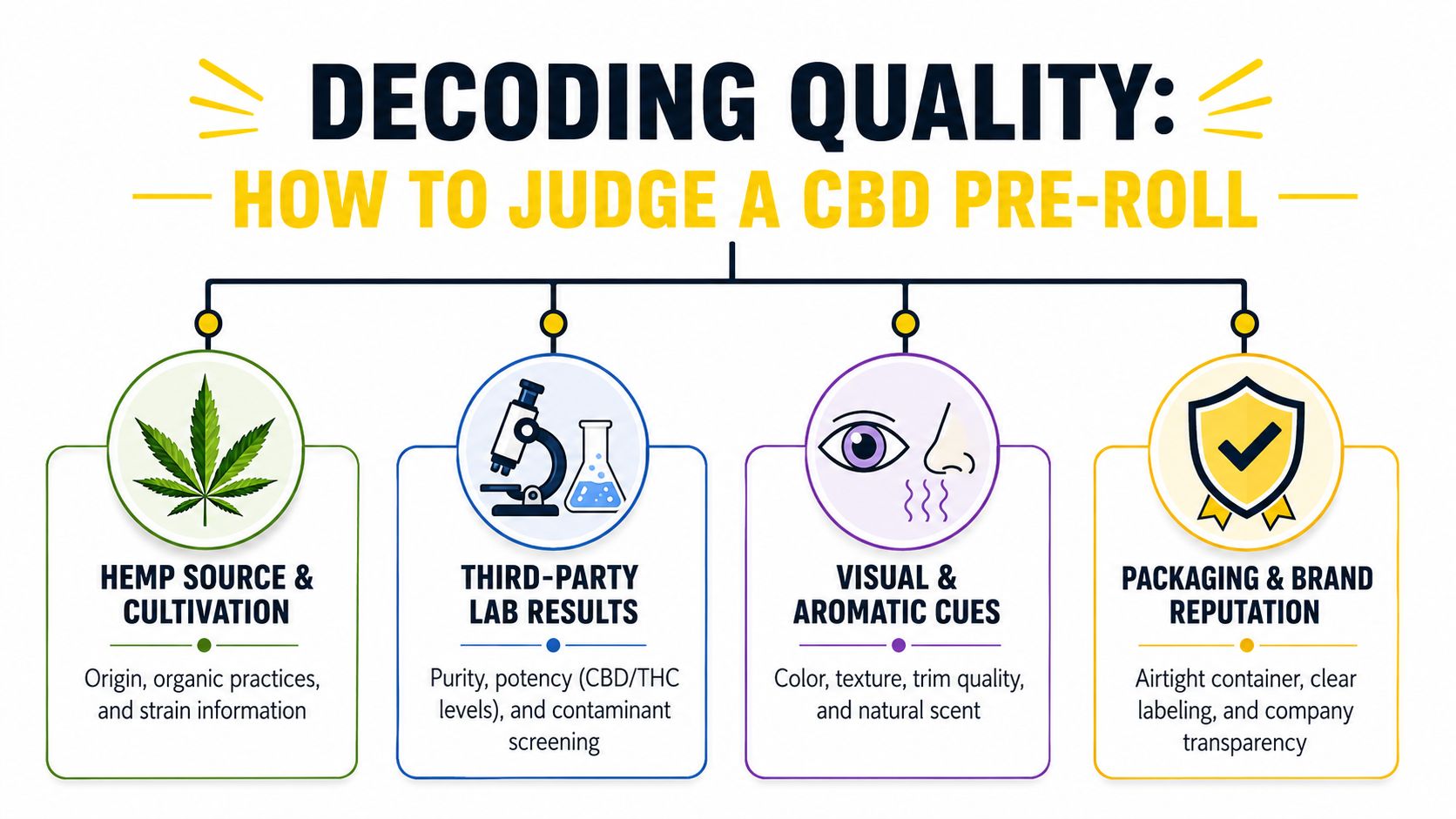
Start with the lab report
If a brand gives you a Certificate of Analysis, or COA, that is your first checkpoint. It is the product's report card. You are looking for confirmation that the pre-roll matches the label and that the testing came from an independent lab.
For CBD pre-rolls, check these basics first:
- CBD content, so you have a general sense of strength
- THC content, so you can confirm it fits the product category you expect
- Testing date, because old reports are less helpful for judging what is in the package now
- Lab identity, so you know someone outside the brand handled the testing
If the COA feels confusing, that is normal. A lot of shoppers see a page of numbers and freeze. This guide to how cannabis potency testing works can make those reports easier to read before you buy.
A useful rule at the counter is simple. If a seller cannot show testing, explain it, or tell you what the numbers mean, slow down.
Whole flower usually gives you a better starting point
Material quality matters more than flashy strain names. A pre-roll made from whole flower usually keeps more of the aroma and character people expect from hemp flower, while pre-rolls made from trim or shake can be flatter, harsher, or less consistent. Cornell University's cannabis terminology guide explains the difference between flower and lower-value leftover plant material in plain language, which helps when labels are vague: Cornell Cooperative Extension on cannabis flower terms.
Here's the practical version:
| Feature | Whole Flower | Trim/Shake |
|---|---|---|
| Material used | Ground buds | Loose leftover plant material |
| Aroma | More distinct and flower-like | Often muted or stale |
| Burn | Usually more even | Can canoe or burn rough |
| Consistency | More predictable from one pre-roll to the next | More variable |
If you crack open a tube and get a clear, natural flower smell, that is a good sign. If it smells like dry paper, dust, or almost nothing, the package may be doing more work than the product.
The CBD percentage is only one clue
A lot of online roundups treat CBD percentage like a winner's trophy. That shortcut causes confusion. Higher CBD does not automatically mean a better pre-roll, just like a higher caffeine number does not automatically mean a better cup of coffee.
A stronger buying framework is to ask:
- What plant material was used
- Can I see current, independent testing
- Does the label mention terpenes or other cannabinoids
- Is the brand clear about cultivation and handling
- Does the pre-roll look fresh and packed evenly
Project CBD's guide to reading hemp lab tests explains why cannabinoid totals are only part of the picture and why shoppers should also check for contaminants and overall product transparency: Project CBD on understanding hemp COAs.
That last point gets overlooked. A pre-roll can have a respectable CBD number and still disappoint if it is old, badly packed, or made from poor material.
Read the pre-roll like a detective
You do not need expert-level training for this. You need a short checklist and a willingness to ask one more question.
Look at the roll itself if the packaging allows it. It should feel evenly packed, not lumpy at one end and empty at the other. The paper should be intact. The tip should be secure. If the tube is packed with crumbs, that can hint at rough handling or dryness.
Then check the label language. “Whole flower” tells you more than a dramatic strain name by itself. Mentions of terpene profile, harvest or packaging details, and accessible lab testing are all helpful signs. Vague claims with no backup are not.
For DC medical cannabis shoppers, this is the primary goal. You are not trying to memorize every cannabinoid on the shelf. You are building a repeatable way to judge safety, quality, and fit for yourself, so “best CBD pre rolls” means the option that is clean, well-made, and appropriate for what you want from the session.
A Practical Guide to Usage and Dosing
You get home, sit down, and realize the part that feels hardest is not lighting the pre-roll. It is knowing how much is enough for the kind of evening you want.
That is why a simple plan helps.
CBD pre-rolls are useful for beginners because the feedback comes faster than it does with many edible products. You take a small puff, pause, and check in. That works a lot like adjusting the water in a shower. Small changes are easier to control than jumping straight to full blast.

A simple first-session plan
Keep your first session low-pressure. Pick a comfortable setting, have water nearby, and clear your schedule for a bit so you are not judging the experience while also trying to rush out the door.
Then use a short, repeatable process:
- Light the pre-roll gently and take one small puff.
- Pause for a few minutes and notice the basics. How does your throat feel? Do you feel relaxed, unchanged, or ready to stop?
- Take a second small puff only if you want more.
- Set it down again and give yourself time before deciding.
That pause matters. New consumers often make the mistake of stacking puffs too quickly, then trying to sort out what each one did. Slow pacing gives you cleaner feedback.
If you are still deciding whether inhalation is the right format for you, this guide on tincture versus smoking for cannabis use can help you compare the experience, timing, and tradeoffs.
Why the label does not give you a perfect dose
A pre-roll is not a pill. The package can tell you a lot about the flower, but it cannot predict your exact session.
Two pre-rolls with similar CBD numbers can still land differently because of the flower used, the terpene profile, how large your puffs are, and your own tolerance. Earlier in this guide, we covered why product quality and transparency matter. Dosing works the same way. The number on the label is one clue, not the whole answer.
Your body is the final measuring tool.
If two small puffs leave you feeling comfortable, stop there. You can always have more later.
A quick visual walkthrough can also help if you're new to handling pre-rolls:
A real-world way to judge your dose
Say you want to ease into the evening without feeling too altered. One puff may be enough. If, after a short wait, you feel nothing you dislike and want a little more, take a second puff and pause again.
That method gives you a framework you can reuse, which is the bigger goal of this article. For DC medical cannabis shoppers, the right dose is not the biggest amount you can tolerate. It is the smallest amount that matches your purpose, whether that is relaxing, staying clear-headed, or testing a new product carefully for the first time.
Safe Storage and Handling Best Practices
A good pre-roll can go downhill fast if you store it badly. People often focus so much on buying that they forget the last part of the chain: what happens after it leaves the shop.
Think of storage the way you'd think about keeping coffee fresh. If you leave it in heat, light, or moisture, you shouldn't be surprised when the flavor and overall experience fall off.

What preserves freshness
A few habits make a real difference:
- Use an airtight container. A small glass jar or a well-sealed tube helps protect aroma and smoke quality.
- Keep it cool and dark. A drawer, cabinet, or other low-light spot is better than a sunny windowsill.
- Store it dry. Bathrooms and other damp spaces can create problems.
- Keep pre-rolls upright when possible. That helps prevent crushing and keeps the roll intact.
If you've ever opened a pre-roll and found it dry, flaky, or harsh, poor storage is often the culprit.
What to avoid
A lot of handling mistakes happen because people treat pre-rolls like durable little objects. They're not.
- Don't leave them in the car. Heat and changing temperatures are rough on flower.
- Don't toss them loose in a bag or pocket. They can bend, crack, or compact unevenly.
- Don't leave them exposed for long stretches. Open air can dry them out.
- Don't store them where children or pets can access them. That's a basic safety rule, not a suggestion.
Storage shortcut: If the place would be bad for wine, coffee, or fresh herbs, it's probably bad for a CBD pre-roll too.
Handling matters too
When you light a pre-roll, avoid torching the tip aggressively. Rotate it gently so the burn starts evenly. If it goes out, relight carefully instead of charring one side.
And even if a product is chosen for a gentler effect profile, use common sense after consumption. Don't drive or handle anything risky until you know exactly how you respond.
Navigating CBD Legality in Washington DC
Washington, DC can confuse even experienced shoppers because not every cannabis buying environment works the same way. A CBD pre-roll may look simple on the surface, but legality, testing, and product transparency still matter.
At the federal level, hemp-derived CBD pre-rolls are generally discussed in relation to that below-0.3%-THC standard. But in real-world shopping, the harder question is often this: are you buying something that is clearly documented and easy to verify, or are you relying on vague claims?
Why labels can be misleading
One of the biggest points of confusion is the difference between a product marketed as non-intoxicating and one that still includes trace THC and other cannabinoids. According to BeeZBee's discussion of no-THC versus full-spectrum CBD pre-rolls, consumers are often unsure whether they're buying a non-intoxicating product, and the market now includes more nuanced blends such as CBD+CBC and CBD+CBG.
That matters because the label alone may not answer the questions you care about:
- Is this a straight CBD hemp flower pre-roll?
- Is there trace THC?
- Is it described as no-THC or full-spectrum?
- Can I see the COA and understand the cannabinoid profile?
Those aren't nitpicky details. They're the difference between informed buying and guesswork.
Why DC shoppers should be selective
In DC, people often hear a mix of terms around recreational access, gifting, hemp products, and medical cannabis. The result is that many shoppers assume all pre-rolls are being sold under the same standards. They aren't.
A regulated medical environment gives you more clarity around product handling, menu transparency, and staff guidance. An unregulated seller may still make attractive claims, but if the product information is thin or the testing isn't easy to verify, you're the one taking on the uncertainty.
If you want a broader overview of the local legal environment, this explainer on DC cannabis legalization rules helps sort through the basics.
A practical buying mindset for DC
If you're shopping for the best CBD pre rolls in Washington, don't stop at “is it legal enough?” Ask whether it's clear enough.
Use a short legal-safety checklist:
- Check the cannabinoid profile so you know whether it's straight CBD, full-spectrum, or a blend.
- Ask for the COA if it isn't already available.
- Read the wording carefully around THC and “non-intoxicating.”
- Choose environments where questions are welcome and product details aren't treated like a nuisance.
That approach won't just help you stay more compliant. It also makes it much more likely that you'll end up with a product you wanted.
How Mr Nice Guys DC Elevates Your Experience
You've checked the label, asked about testing, and made sure the product fits your comfort level. Now the practical question is simpler. Where can you buy CBD pre-rolls in DC without having to play detective every time?
A good dispensary improves the process by giving you context, not just inventory. In a medical cannabis market like Washington, DC, that matters. Products can look similar on a menu, but the details behind them, how they were sourced, how they were stored, and how clearly they're explained, often make all the difference.
Guidance that makes the menu easier to read
For a lot of shoppers, the hard part is not choosing between two pre-rolls. It's understanding what they're comparing.
One option may be closer to hemp flower with a CBD-forward profile. Another may be a fuller-spectrum product with trace cannabinoids that could feel different depending on your tolerance. A helpful staff conversation works like a translator between the label and your actual goal. If you want something calm, clear-headed, and less likely to feel too strong, those details matter more than a catchy strain name.
That kind of guidance helps new patients, but it also helps experienced buyers who want consistency instead of surprises.
A curated menu saves time and cuts down on weak options
A well-built menu should do some sorting before you ever add something to your cart. That does not replace your judgment. It gives you a cleaner starting point.
In plain terms, you should be able to compare formats, cannabinoid profiles, and product types without scrolling through a confusing pile of lookalike listings. If you want a clearer picture of how different formats are grouped, this guide to cannabis products available at Mr. Nice Guys DC shows where pre-rolls fit alongside flower, tinctures, edibles, vapes, and other options.
Good curation works like a shelf that has already been organized by someone who knows what belongs where.
Convenience matters because rushed buying leads to sloppy choices
Pickup, curbside, and delivery are not just nice extras. They can make it easier for medical patients and busy DC shoppers to place an order carefully, review the menu, and ask questions before buying.
That supports safer decision-making. Clear ordering, readable product information, and access to staff reduce the chance that you grab the first product that sounds close enough and hope for the best.
If you're trying to find the best CBD pre rolls for your needs, focus on the source as much as the product. Mr. Nice Guys DC gives medical cannabis patients and adult shoppers in DC a place to ask direct questions, compare options with more clarity, and choose with less guesswork.
Mr Nice Guys DC
At Mr. Nice Guys DC, we’re more than just a cannabis delivery service — we’re passionate advocates for quality, convenience, and community. With years of experience in the cannabis industry, our team is dedicated to educating and empowering customers across Washington, D.C. Whether you're a seasoned user or just starting your cannabis journey, our blog delivers trusted tips, product insights, and the latest updates from the world of weed. Stay informed, stay elevated.
