
Must Be 21 To Enter
By entering this site you are agreeing that you are at least 21 Years of Age or older.
I AM 21 OR OLDERDC Legalize Weed: A 2026 Guide to Cannabis Laws
.svg)

.png)
You’re probably here because you searched dc legalize weed, got a flood of conflicting answers, and still don’t know what you can do without stepping into a legal mess.
That confusion is normal in Washington, D.C. A person can legally possess cannabis under local law, then walk a few blocks and run into a totally different rule on federal property. You can also see stores that look recreational, even though D.C. still doesn’t have licensed adult-use retail sales. For a visitor, a new resident, or even a longtime local who hasn’t kept up, the gap between “weed is legal” and “weed is simple” is wide.
The practical answer in 2026 is this: cannabis is legal in D.C. in limited ways, but the safest and clearest path to access is the medical system, not the gifting gray market.
Welcome to DC Where Cannabis is Legal But Complicated
A common scenario goes like this. You land in D.C., ask a friend where to buy weed, and hear, “It’s legal here.” Then you search online, see a mix of “recreational,” “I-71,” “gifting,” and “medical,” and realize nobody is talking about the same thing.
That’s the core problem with dc legalize weed searches. People use “legal” to mean different things. Some mean legal to possess. Some mean legal to consume privately. Some mean legal to get through a licensed storefront like you would in other states. In D.C., those are not the same thing.
A tourist staying near Dupont Circle might assume they can walk into a standard adult-use shop and buy a pre-roll the way they could elsewhere. A new resident in Shaw might think Initiative 71 created full recreational retail. Both are understandable assumptions. Both are wrong.
D.C. is a place where cannabis can be legal in your apartment, prohibited on the sidewalk outside, and unavailable through a true recreational retail store all at once.
That’s why broad summaries aren’t enough. You need the on-the-ground version. Which rules matter in real life. Which options are compliant. Which ones create avoidable risk.
If you’ve seen debates about the city’s odd setup, including the difference between possession rights and retail access, this broader look at Washington, D.C. recreational cannabis helps explain why people keep talking past each other.
The good news is that the system is easier to understand once you separate myth from practice. The bad news is that a lot of casual advice people give each other is outdated.
How DC Cannabis Laws Became So Unique
D.C. ended up with one of the strangest cannabis setups in the country because local voters approved reform, but Congress still had the power to interfere. For customers, that history is not trivia. It explains why a city can allow possession, have plenty of cannabis-related storefronts, and still lack a standard adult-use retail system.
The early medical vote and the long delay
The story starts with medical cannabis. In 1998, D.C. voters approved Initiative 59, but Congress delayed implementation for years, as noted in this overview of cannabis legality by U.S. jurisdiction.
That delay shaped the market that exists now. Instead of building a clear system from one stage to the next, D.C. spent years in a stop-and-start process. Rules arrived in pieces. Public understanding did too.
Decriminalization and Initiative 71 changed possession, not retail
Later, the District reduced penalties for possession under local law. Then voters approved Initiative 71, which took effect in 2015. It allowed adults 21 and older to possess cannabis, gift limited amounts without payment, and grow plants at home within set limits. It did not create licensed recreational sales, according to D.C.’s marijuana law information from MPDC.
That gap is the key to understanding D.C. in practice. People hear that weed is legal and expect the usual adult-use model: walk in, show ID, buy product, leave. D.C. never got that version.
If you have been comparing storefronts and wondering why some businesses describe themselves so carefully, this guide to I-71 compliant shops in D.C. shows how that split developed.
Federal limits created the gray market split
Congress kept one major restriction in place through the budget process. The rider often called the Harris Rider prevents D.C. from using its own funds to set up a regulated adult-use sales system.
That single limit shaped the market more than anything else. It left the city with legal possession under local law, a functioning medical program, and no licensed recreational storefront model.
The result is the divide customers still run into now:
- Possession is allowed under D.C. law within local limits
- Home cultivation is allowed within local limits
- Licensed adult-use sales are still blocked
- Medical dispensaries can operate legally
- Gifting shops stepped into the gap, with less regulatory certainty and more day-to-day risk for shoppers
From a dispensary perspective, the trade-off is pretty straightforward. The gifting side may look convenient to someone visiting the city, but it exists because the cleaner retail path is blocked, not because it is the strongest consumer model. The medical system is the part of the market with actual licensing, oversight, and a clearer legal foundation.
That is what makes D.C. unusual. The law opened the door to possession and personal use, while federal restrictions kept the city from building the simple adult-use system many people assume already exists.
Understanding Initiative 71 The Rules of the Game
A visitor lands in D.C., sees cannabis shops on Google Maps, and assumes the rules work like any other legal market. That is where people get tripped up. Initiative 71 made personal possession and limited sharing lawful under D.C. law, but it did not create standard recreational sales.
That gap matters in practice. You can be within the possession rules and still make a poor choice about where you get product.
Possession means possession, not purchase
Initiative 71 covers what adults 21 and older may do for personal use. It allows possession of up to 2 ounces of cannabis and home grow of up to 6 plants, with no more than 3 mature at one time. What it does not do is authorize licensed adult-use storefront sales.
So if you are staying in a private home in Adams Morgan and carrying a legal amount, that can fall within local law. Walking into a shop and expecting a normal recreational retail sale is a different question. I-71 did not set up that kind of transaction.
If you want a clearer picture of how that confusion shows up on the ground, this guide to I-71 compliant shops in D.C. is a useful reference.
The part people misunderstand most
The rule that causes the most confusion is gifting.
D.C. law allows one adult 21 or older to transfer up to 1 ounce of cannabis to another adult 21 or older, as long as no money, goods, or services are exchanged for the cannabis. That is a narrow rule. It permits a true gift. It does not bless a dressed-up sale.
Here is the practical reading:
- Possession: Adults 21 and older may hold up to 2 ounces under local law.
- Home grow: Adults may grow up to 6 plants at a primary residence, with only 3 mature at one time.
- Gifting: An adult may transfer up to 1 ounce to another adult, but the transfer cannot involve payment or some other item of value tied to the cannabis.
That last point is where the gray market lives.
What the law allows, and what people try to call a gift
A real gift is simple. One adult gives another adult cannabis, and nothing of value changes hands for it. No cover charge. No sticker purchase. No “free” eighth attached to a digital download no one wanted.
Once a transaction is structured around buying something else to receive cannabis, the legal footing gets much weaker. From a dispensary perspective, that is the core divide customers should understand. Initiative 71 protects limited personal conduct. It does not create a reliable consumer retail system.
A quick comparison helps:
| Situation | Local-law reading |
|---|---|
| Adult possesses a legal amount in private | Generally allowed |
| Adult grows within plant limits at home | Generally allowed |
| Adult gives another adult cannabis with no payment | Allowed under the gifting rule |
| Store completes a standard recreational cannabis sale | Not licensed under D.C. adult-use retail rules |
The safest takeaway is straightforward. I-71 made some personal cannabis activity legal in D.C., but it left a real split between what an individual may do and what a business may lawfully sell. That is why visitors and residents who want a clearer, more regulated path usually end up looking at the medical program instead of the gifting market.
Medical Dispensaries vs Recreational Gifting Shops
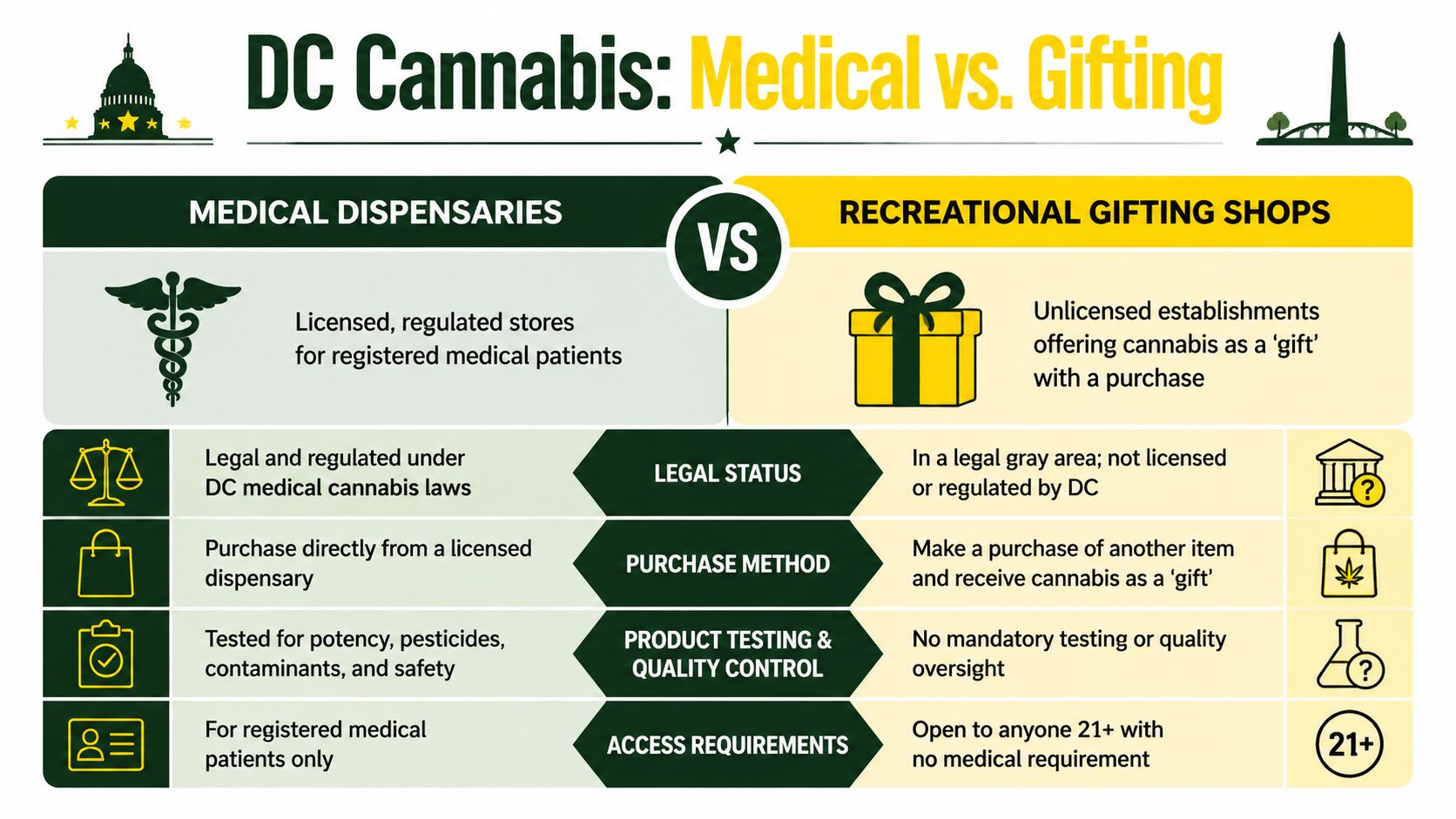
A visitor lands in D.C., sees signs that make cannabis look easy to buy, and assumes every storefront works the same way. It does not. The practical choice is between a licensed medical dispensary and a gifting shop operating in a gray area, and that difference affects product safety, legal clarity, and what kind of experience you can expect at the counter.
The side-by-side difference that matters
| Category | Medical dispensaries | Gifting shops |
|---|---|---|
| Legal footing | Licensed under D.C.’s medical cannabis program | Rely on gifting interpretations rather than standard retail sales |
| Access | Requires registration or self-certification | Usually tied to a workaround purchase structure |
| Product standards | Products move through a regulated system with testing and labeling rules | Testing, origin, and consistency may be harder to confirm |
| Shopping experience | Clear menus, defined purchase process, staff used to compliance questions | Process can vary from shop to shop |
| Risk profile | Lower legal and product uncertainty | More exposure to enforcement and product questions |
For anyone who wants a clear answer, the medical route is the safer channel.
That does not mean gifting shops are hard to find. It means the trade-off is real. What feels faster on the sidewalk can become less reassuring once you ask where the product came from, whether the label is accurate, or what happens if that storefront gets shut down.
What customers usually notice right away
Inside a medical dispensary, the process is structured. ID and registration are checked. Menus are posted clearly. Products are labeled by format and potency, and staff can answer practical questions about flower, pre-rolls, vapes, tinctures, edibles, and topicals without dancing around how the transaction works.
Inside a gifting shop, the weak point is often the transaction itself. Customers end up asking basic questions that should have straightforward answers.
- What am I buying?
- Is the cannabis tested?
- Is the label reliable?
- How consistent is the product from one visit to the next?
- Will this shop still be open next week?
That uncertainty is the whole problem. A gray-market purchase can look convenient right up until you need accountability.
Why the medical program keeps pulling people in
The appeal of medical dispensaries is not just legal theory. It is practical. Licensed shops offer clearer compliance, more predictable inventory standards, and a buying process that does not depend on pretending cannabis is an add-on to some unrelated item.
That matters even more for visitors and new consumers. If someone asks me which path creates fewer surprises, I point them toward the regulated system every time. A useful companion read is this guide to medical vs. recreational shopping in D.C., especially if you are weighing convenience against product trust and legal clarity.
A simple example helps. If you want a familiar strain like Gelato or Blue Dream, a licensed dispensary gives you a much better chance of getting a properly labeled product with a consistent presentation. In a gifting setting, you may still get cannabis, but you may not get much confidence about what it is, how it was handled, or whether the business itself is operating on stable ground.
The real-world divide
This split is why D.C. cannabis can confuse first-time buyers. The city allows personal possession and gifting under I-71, but the regulated purchase path runs through the medical program. That leaves gifting shops in a category that many customers try once and then reconsider after they experience the difference in transparency.
For residents and visitors alike, the low-risk choice is straightforward. If you want tested products, a defined process, and fewer legal question marks, medical dispensaries offer the better path.
How to Legally Obtain Cannabis in DC Today
A common DC scenario goes like this: someone lands in the city, sees cannabis advertised all over social media, and assumes buying is simple. Then they realize the safest purchase route is not the same as the most visible one.
If you want the clearest legal path today, use the medical program. D.C. allows adults 21 and older, including visitors, to self-certify for medical access. That means you can shop at a licensed dispensary without dealing with the old version of a medical program that felt harder to enter.
The practical legal route
The process is straightforward.
Confirm you are 21 or older
Self-certification is available to adults in that age group, including non-residents visiting D.C.Complete the medical registration online
The key benefit is access to licensed dispensaries through an established system, not a workaround.Bring your ID and registration confirmation
Have both ready before you go so check-in is easy.Buy from a licensed dispensary
You can shop from tested inventory with labeled products, defined purchase procedures, and staff who can answer basic questions clearly.
If you want a step-by-step consumer walkthrough, this guide on how to buy weed in D.C. legally covers the process in more detail.
Here’s a quick explainer that many first-time visitors find useful:
What this looks like in real life
Say you are in town for a few days and want pre-rolls or edibles without guessing whether a shop’s “gift” model will hold up. The cleaner option is to self-certify, bring your documents, and buy through a licensed dispensary.
That choice matters for more than legal comfort. It also affects product confidence. In a regulated shop, you are more likely to know what you are buying, how it is labeled, and what type of experience it is meant to deliver.
Why this route makes more sense for many people
The medical path solves the main problem created by D.C.’s split system. I-71 allows possession and gifting in limited circumstances, but licensed retail sales for adult use are still not the normal storefront experience many visitors expect. The medical program fills that gap with a process that is lawful, direct, and easier to verify.
It also gives you practical benefits that are easy to miss until something goes wrong:
- Clearer legal footing: You are buying through a recognized regulated channel.
- Better product information: Packaging and labeling are more consistent.
- More reliable staff guidance: Budtenders can explain differences between flower, vapes, tinctures, topicals, and edibles in a setting with defined rules.
- Less gray-area decision making: You do not have to decode “gifting” language or wonder whether the business will still be operating tomorrow.
For first-time buyers, that difference is real. If you are deciding between a vape for faster onset, an edible that takes longer, or flower for a more familiar format, a licensed dispensary gives you a better chance of making the right choice the first time.
Where You Can and Cannot Consume Legally
A lot of people focus on getting cannabis legally and forget the second half of the equation. Where you use it matters just as much.
D.C.’s legal situation is fragmented. Local police enforce decriminalization rules, but federal officers can still enforce federal prohibition on federal land, including places like Rock Creek Park and the National Mall, as explained in the ACLU of D.C.’s guide to marijuana laws in the District.
Places that create the most mistakes
These are the situations that catch people off guard:
- Federal land: National Mall areas, Rock Creek Park, and zones around federal buildings are not safe assumptions.
- The Metro system: Cannabis isn’t allowed there.
- Public space: Streets, sidewalks, alleys, and parks are not the place to smoke or consume.
- Public housing: Cannabis remains prohibited there, even in a private apartment.
- Inside a vehicle: Don’t smoke in a car, don’t sit in a parked car and use it, and never drive under the influence.
A lot of visitors make the same error. They buy legally through the medical system, then think an outdoor bench near a monument or a quiet park path is “close enough” to private use. It isn’t.
Private space is the safer standard
The general rule is simple. Private property with permission is the safer lane. A private residence is not the same as the sidewalk, stoop, lobby, hotel entrance, or street corner outside it.
If you’re trying to sort out the practical etiquette and legal lines, this guide to smoking in Washington, D.C. is useful.
Here’s a quick comparison:
| Location | Better assumption |
|---|---|
| Private residence with permission | Lower risk |
| Sidewalk outside that residence | Not a safe assumption |
| National Mall lawn | Federal risk |
| Rock Creek Park trail | Federal risk |
| Metro platform or train | Prohibited |
| Parked car | Bad idea |
Crossing from local space to federal space can change the legal picture fast. In D.C., that line isn’t always obvious from what you see around you.
If you want one habit that prevents most problems, use cannabis only in a clearly private, permitted location.
Navigating DC Cannabis Safely and Smartly
The phrase dc legalize weed makes D.C. sound simpler than it is. Cannabis is legal here in limited, specific ways. That’s the truth people need, especially when online advice gets reduced to “yes, it’s legal” or “no, it isn’t.”
A fundamental divide in D.C. is not just legal versus illegal. It’s regulated versus gray market, clear rules versus workaround culture, and predictable access versus avoidable uncertainty.
For most adults, especially visitors and newer consumers, the smartest choice is straightforward. Use the medical pathway, follow the possession and use rules carefully, and keep consumption private and away from federal land. That approach works because it lines up with how D.C.’s laws function on the ground, not how people wish they functioned.
The gifting market may stay visible. It may stay tempting. But visibility isn’t the same as reliability. If you want tested products, clearer compliance, and fewer surprises, the regulated medical system is the stronger option.
If you want a compliant, low-stress way to shop in D.C., Mr. Nice Guys DC helps adults 21+ understand the medical process and shop tested cannabis with professional guidance. Whether you’re looking for flower, pre-rolls, vapes, edibles, tinctures, or delivery options, the team makes legal access easier for residents and visitors who want clarity instead of guesswork.
Mr Nice Guys DC
At Mr. Nice Guys DC, we’re more than just a cannabis delivery service — we’re passionate advocates for quality, convenience, and community. With years of experience in the cannabis industry, our team is dedicated to educating and empowering customers across Washington, D.C. Whether you're a seasoned user or just starting your cannabis journey, our blog delivers trusted tips, product insights, and the latest updates from the world of weed. Stay informed, stay elevated.
