
Must Be 21 To Enter
By entering this site you are agreeing that you are at least 21 Years of Age or older.
I AM 21 OR OLDERBest Cannabis Vape Guide for 2026: Safety and Testing


The most popular advice for choosing a cannabis vape is to chase the highest THC percentage or the most appealing strain name. Neither tells you how the cartridge heats, what its metal components release, or whether the lab report covers the oil alone. The best cannabis vape is the one that fits your routine, offers manageable delivery, and comes with meaningful product and hardware documentation.
For a DC buyer, that means making three separate decisions: which format suits your use, what evidence supports the product, and whether the purchase meets current medical-cannabis requirements. Start with the format, but let the lot records and heating controls decide whether it belongs in your bag.
Quick Picks by Buyer Situation and Routine
Quick picks by buyer situation
| Situation | Starting format | Why it fits | Watch for |
|---|---|---|---|
| Daily medical use at home | 510-thread cartridge on a rechargeable battery | Replaceable cartridges, repeatable settings, potentially lower ongoing cost | Buy batch-tested cartridges and replace when the oil runs low |
| Travel and discretion | Sealed disposable or pod | Compact, little hardware to manage; a ready-to-use disposable may need no charging during a short stay | Confirm the seal, licensed seller, and charging requirements |
| First-time use | Low-voltage rechargeable pen with preset levels | Easy to start low and repeat the same setting | Use small draws, pause, and follow patient-specific guidance |
| Frequent daytime use | Rechargeable pen with a larger battery | Fewer charging interruptions | Watch for burnt taste, which can signal overheating |
| Budget-focused use | Replacement cartridges on a reusable battery | Reuses the battery rather than buying another complete device | Documented testing for each lot matters more than sticker price |
A 510-thread cartridge is a sensible starting point for regular home use, provided the battery and cartridge are compatible. For a short, occasional-use routine, an all-in-one may be simpler. Neither format is automatically better tested.
Vape pens offer discreet delivery and convenient storage, but portability doesn't establish where use or transport is permitted. A device that fits in a pocket still requires a compliant purchase and a suitable place to use it.
Match the Device to the Routine
Daily medical use at home. Say an evening patient uses a few small draws at a low setting, following their care plan. A rechargeable battery lets that person retain the same controls while replacing the cartridge, rather than learning a different device each time.
The trade-off is battery maintenance. Replacement cartridges may cost less per gram than complete disposables on the current menu, but check the actual prices rather than assuming they will.
Travel and discretion. A visitor from Alexandria spending a long weekend in DC might prefer a sealed all-in-one kept securely in the hotel room, after confirming the property's rules. Verify the seller before buying and check whether the device arrives charged.
The trade-off is limited flexibility. A non-rechargeable disposable can't be revived with a charger, while a pod usually requires its matching battery.
First-time use. A pen with preset power levels removes some guesswork. In a cautious hypothetical first session, a patient might take one small draw on the lowest setting and pause rather than repeatedly inhaling because the effect isn't immediately obvious.
The trade-off is that preset power isn't measured dosing. Draw length, oil formulation, and device behavior still affect delivery.
Practical rule: Choose controls you can use consistently, not controls you won't understand until something goes wrong.
Balance Convenience Against Ongoing Cost
A desk worker using a vape outside working hours may prefer a larger rechargeable battery to avoid carrying a charger. That convenience comes with a bulkier device, and more battery capacity isn't permission to keep drawing through an unpleasant taste.
For a budget buyer, compare replacement cartridges with disposables using the current menu's labeled oil weight. Reusing a battery can reduce repeat hardware purchases, but an inexpensive cartridge without identifiable lot records isn't a useful saving.
At Mr. Nice Guys DC, our staff can also recommend flower, tinctures, topicals, capsules, or edibles according to a customer's needs. If inhalation isn't a good fit, the answer isn't necessarily a different pen.
For a buying decision, focus next on whichever detail remains unresolved: hardware specifications, test coverage, or source verification.
How Heating Hardware Shapes Safety and Vapor Quality
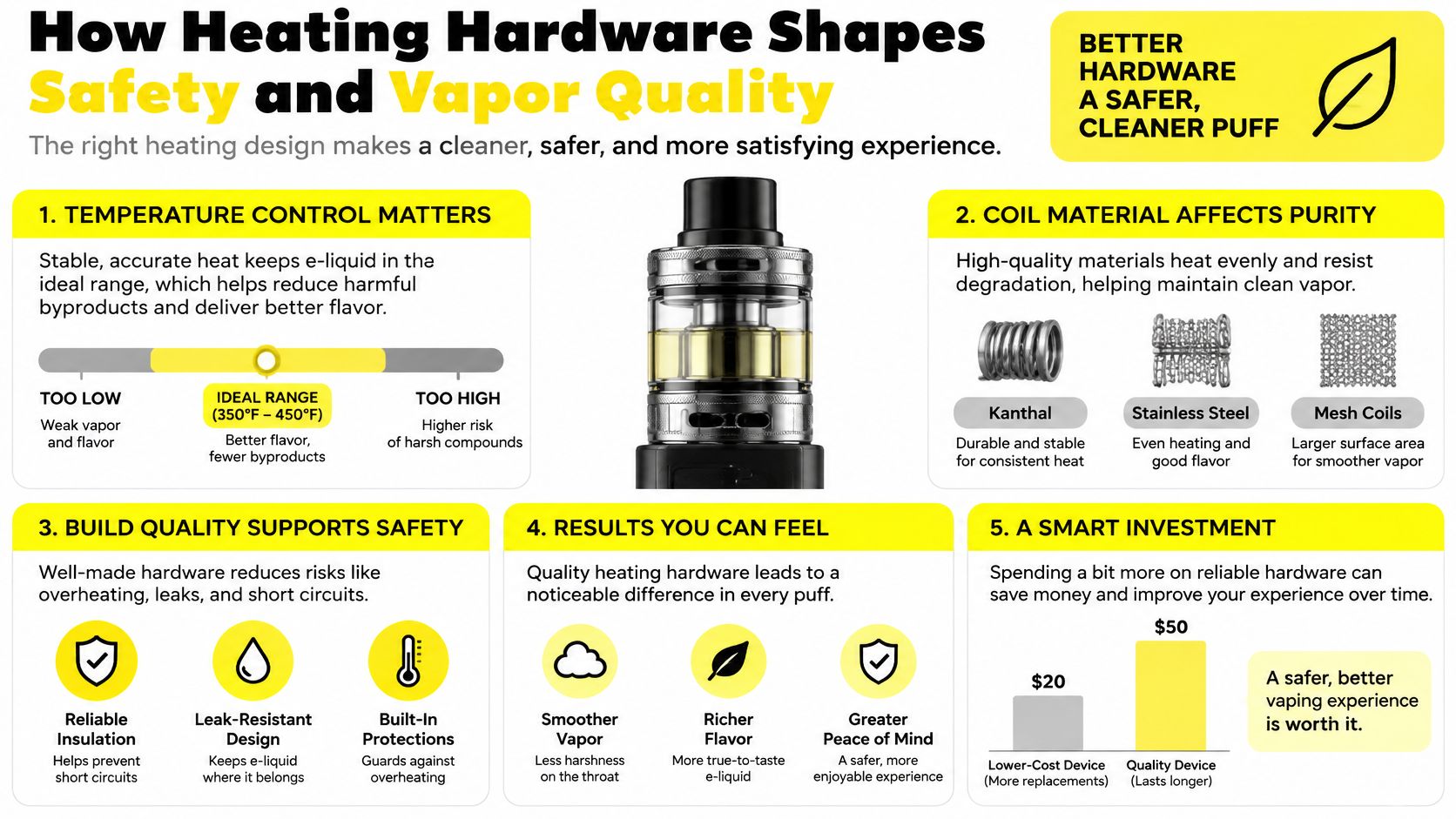
The heating assembly deserves attention before the strain name. Power reaches the element, the element heats the oil, and the resulting aerosol passes through the device. Excess heat can change both the oil and the materials in contact with it.
Use this visual as a reminder of what to examine beyond the cartridge label.
Heating conditions and reported temperatures
The metal-particle study hosted by Vermont's Cannabis Control Board describes typical cannabis-oil vaporization around 200–350°C, temperatures above 600°C in some variable-voltage devices, and dry-coil temperatures reaching 1,000°C.
| Heating condition | Reported temperature | Practical concern |
|---|---|---|
| Typical cannabis-oil vaporization | About 200–350°C | Effective vaporization, but degradation risk remains |
| Variable-voltage device on a high setting | Above 600°C in some devices | Faster oil breakdown and potentially greater metal release |
| Dry coil after the oil runs out | Up to 1,000°C | Harsh aerosol and strong degradation; stop using the cartridge |
These are reported operating conditions, not universal settings or safety thresholds. A voltage number on a battery doesn't tell you the exact temperature inside every compatible cartridge.
What to Check on the Specification Sheet
Look for concrete operating information rather than a ceramic or premium label:
- Operating range: The manufacturer should identify suitable settings for that cartridge and battery.
- Regulated power and voltage: Output should be controlled rather than left unexplained.
- Overheat protection: Check whether the device has thermal protection, not just a charging indicator.
- Airflow and cutoff behavior: Look for clear draw instructions and an automatic activation cutoff.
Academic testing of THC-cartridge heating elements identified nickel and chromium in all examined elements, with other materials present in some devices. That finding doesn't establish identical exposure from every cartridge, but it makes documented construction more useful than an unsupported material claim.
If weak vapor tempts you to turn the pen to maximum, first check the charge, connection, airflow, and remaining oil. Use the lowest manufacturer-supported setting that produces adequate vapor; don't keep testing a cartridge that already tastes burnt. Our guide to vaping temperature adds context for comparing heat settings.
This video provides another visual reference for the heating discussion.
Heat exposure, storage time, and oil formulation can also influence metal release. Keep cartridges sealed, upright, and cool, away from vehicles and direct sunlight. Unusual darkening, burnt taste, leaks, or inconsistent vapor are reasons to stop using the product, not reasons to increase power.
Cartridges, Disposables and Pens Compared
| Format | Battery type | Draw style | Refill or replace | Discretion |
|---|---|---|---|---|
| 510-thread cartridge system | Separate rechargeable battery | Button or draw activation, depending on battery | Replace the prefilled cartridge; retain the battery | Compact, with a visible cartridge on many models |
| Disposable all-in-one | Integrated battery, rechargeable on some models | Commonly draw activated; verify the model | Replace the complete unit when finished | Minimal separate hardware |
| Rechargeable pod pen | Dedicated rechargeable battery | Draw or button activation | Replace with a compatible pod | Often enclosed and compact |
At Mr. Nice Guys DC, our vape selection includes 510 cartridges, disposables, and rechargeable vape pens. Compare the actual models in person, because the word pen describes a shape, not a single operating system.
What You Keep and What You Replace
A 510 cartridge system separates the oil container from the battery. Button activation lets you control when heating begins and ends; draw activation fires when you inhale. Although many cartridges share this threading, check the manufacturer's compatibility guidance, including supported power, rather than relying on physical fit alone.
A disposable all-in-one combines the oil, heater, and battery. It can suit someone who wants fewer parts, but don't assume every disposable is non-rechargeable: check for a charging port and instructions. Once its oil is finished, replace the unit rather than opening it or transferring another oil into it.
A rechargeable pod pen retains the battery while using proprietary replacement pods. For someone who dislikes exposed cartridges, an enclosed pod can be convenient, but it ties future purchases to a particular compatible system. Confirm replacement-pod availability before buying the battery.
A reusable battery doesn't mean the cartridge itself should be opened and refilled.
Compare a Month, Not Just a Device
Consider a patient who replaces cartridges several times during a hypothetical month. Compare their replacement-cartridge spending, plus any initial battery purchase, with the spending of someone buying complete disposables at the same frequency.
Use price divided by labeled grams of oil for each product, then apply your own expected replacement count. That comparison is more useful than comparing package prices when the packages contain different amounts.
When the oil runs low, the cartridge user retains the battery and replaces the cartridge; the disposable user replaces the complete device. Neither should try to extract the last visible residue by repeatedly heating a nearly empty unit.
Choose a cartridge system for reusable hardware, an all-in-one for fewer components, or a pod for a dedicated matched system. If you're also deciding whether inhalation suits your routine, our smoking-versus-vaping comparison addresses that separate choice without making either approach risk-free.
What Lab Results Prove and What They Miss
A potency result isn't a safety certificate. It describes cannabinoid content in the tested sample, not every substance a finished device could release during use.
The California cannabis regulations require testing categories that include cannabinoids, foreign material, heavy metals, microbial impurities, mycotoxins, moisture or water activity, pesticides, and residual solvents or processing chemicals. That's a broader assessment than THC percentage, but it still matters which sample was tested and under what conditions.
What each lab test covers and what it misses
| Test | What it covers | What it does not show |
|---|---|---|
| Potency | THC and other cannabinoid percentages | Heating-element behavior or metal release |
| Pesticides and foreign material | Specified residues and contaminants | Emissions from the heating element |
| Heavy metals | Metals detected in the tested sample | Whether the finished device, rather than only oil, was tested unless the report specifies it |
| Residual solvents | Specified processing chemicals remaining in oil | Stability over weeks of storage |
| Stability | Specified quality measures over time | Performance at high temperature unless included |
| Device emissions | Aerosol from the tested cartridge or pen under stated conditions | Results for other lots or devices from the same brand |
Read the Sample Description
Say a cartridge has a report showing cannabinoid percentages and pesticide results. That's useful documentation, but it doesn't answer whether the laboratory tested metals in the oil, the assembled cartridge, or the aerosol.
Ask for the certificate of analysis, often called a COA, matching the package's lot number. Then read the sample description, test date, analytes, and pass/fail criteria. Our heavy-metal testing guide can help frame questions about sample coverage.
Our store statement is that every product is tested for pesticides, potency, and more. Confirm which additional tests apply to the specific lot rather than treating that statement as a guarantee covering every possible inhalation risk.
Jurisdiction Matters
Testing rules aren't interchangeable across markets. Maryland separately addresses device safety and stability, while New York addresses temperature controls where oil cannot be separated from its device and retention of lot certificates. Those examples aren't a substitute for the current DC requirements or documentation for the product in front of you.
For a DC purchase, ask which jurisdiction governed the testing and whether the report addresses storage, the complete device, or only the formulation. Don't assume an out-of-state compliance statement establishes local compliance.
The strongest purchase case combines identifiable lot testing, storage guidance, and documented device controls. A report can support a narrower claim, such as passing the listed contaminant tests, without proving the product is universally safe.
Checking Ingredients and Sources Before You Buy
Start with the seller, not the packaging design. The CDC's Minnesota EVALI investigation found vitamin E acetate in illicit THC products submitted by 11 of 12 EVALI patients, while 10 products seized in 2018 before the outbreak didn't contain it.
That finding supports a practical distinction: recognizable branding isn't the same thing as a traceable source. It doesn't mean every regulated vape is harmless or every unfamiliar package is contaminated.
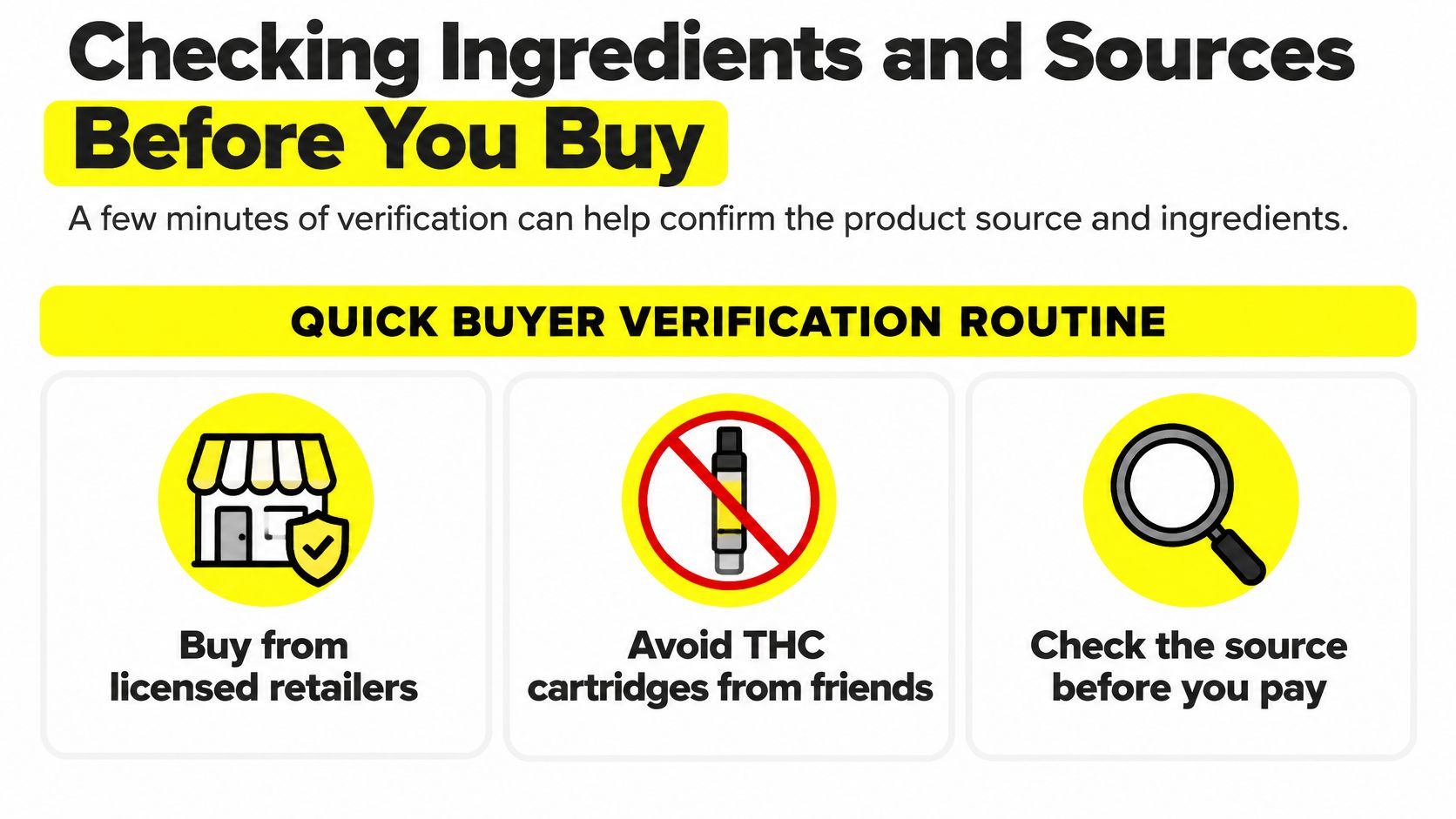
Use this checklist at the counter or when a delivery arrives.
Verify Before Opening
- Confirm the retailer: Buy through licensed retail channels, not friends, informal online dealers, or unlicensed sellers.
- Match the identity: Check the manufacturer name and batch or lot number against the accompanying documentation.
- Read the ingredients: Reject vitamin E acetate and question any unexplained thinning agent rather than accepting a verbal reassurance.
- Inspect the seal: Broken seals, oil around closures, or signs of refilling justify holding the product aside.
- Examine the branding: Misspellings and mismatched names are warning signs, although polished packaging alone proves nothing.
- Request the lot report: A seller who can't connect the product to its COA hasn't completed the verification.
- Leave the formulation intact: Never add oil, thinners, or other substances to a finished cartridge.
For example, a delivered cartridge might have the expected brand name but a different lot number from the attached report. Don't open it to see whether it tastes normal; ask the seller to resolve the mismatch first.
Terms such as live resin and distillate describe formulation choices, not proof of authenticity. Our live-resin-versus-distillate guide helps distinguish those labels after the source checks out.
If a product fails verification, don't use it. Keep the packaging and receipt, contact the seller, and arrange a return through the seller's process rather than passing it to someone else.
DC Medical Card Fees and Purchase Limits
DC card fees and purchase limits
| Situation | Purchase rule or note |
|---|---|
| DC resident | Our card guidance lists a free application and resident self-certification; confirm current official terms |
| Non-DC resident | Our guidance lists $10 for 3 days; confirm current visitor eligibility and card terms |
| Medical patient purchase limit | Our guidance lists up to 8 ounces every 30 days; confirm the current limit and how vape products count |
Treat these fees, processing expectations, and purchase limits as unverified until you confirm current official DC rules. Store guidance can help you prepare, but it isn't a substitute for the issuing authority's current application and purchasing requirements.
Our medical-card requirements guide provides a starting point for that conversation. Confirm which DC agency and official application portal currently handle your application before submitting identification or payment.
Check Eligibility Before Choosing Products
Our card guidance describes DC residents as able to self-certify their need for medical cannabis without a healthcare provider's recommendation. Patients who prefer a recommendation can consult a licensed healthcare provider instead.
It also describes an online application through the DC Department of Health website and approved cards arriving within minutes. Verify both the current application route and processing time directly; don't plan a purchase around immediate approval.
Say a Maryland visitor needs access for a three-day DC stay. That person should confirm the visitor-card terms and accepted credentials rather than assuming the resident application applies to them. A DC resident should separately confirm eligibility for the free, self-certification route.
Budget for the Format You Will Actually Use
Ask how the purchase allowance applies to vape oil and other product types, including any equivalency calculation. Don't translate a flower-weight allowance into cartridge quantities yourself.
Then compare the current menu, because prices and product availability change with rotations. Divide each candidate's price by its labeled oil weight, then estimate monthly spending using your own replacement count:
- Cartridge plan: Replacement-cartridge price multiplied by expected purchases, plus any battery purchase.
- Disposable plan: Complete-device price multiplied by expected purchases.
- Pod plan: Compatible-pod spending plus the initial battery, if needed.
Keep card costs separate from product costs. That makes it easier to compare formats without mistaking an access fee or initial battery purchase for the ongoing price of the oil.
Confirm Your Choice Before You Buy
The best cannabis vape should make sense as a complete purchase, not just as an appealing cartridge. You should know why the format fits, which report applies, and how to operate the device without improvising.
Use a final decision check:
- Format fit: Choose the system that matches your routine and charging tolerance.
- Product identity: Confirm the sealed package and matching batch documentation.
- First-use plan: Begin with the lowest supported setting and patient-appropriate guidance.
- Stop rule: Don't continue through burnt taste, leaks, inconsistent vapor, or unusual irritation.
Use the source-verification routine and heating criteria as your final checks, rather than adding more products to compare.
If a product needs an explanation for missing documentation, resolve that explanation before paying.
Symptoms need a different response from equipment problems. The CDC's EVALI guidance identifies chest pain and shortness of breath among possible symptoms: stop using the product and seek medical care rather than trying another cartridge.
Check the current menu for your chosen format, confirm your medical-card status, and ask our staff which lot and test records apply. Confirm pickup, curbside, and delivery availability with staff, including whether service is available to your address in Alexandria, VA, or Bethesda, MD; don't assume an advertised service area establishes eligibility for a particular order.
Decide from format fit, lot records, and clear stop rules, not the highest THC number.
We offer 510 cartridges, disposables, and rechargeable vape pens, with staff guidance to help you compare compatible hardware and product documentation. Visit Mr. Nice Guys DC to check the current selection, then ask our team to match your chosen product with its lot records and confirm your purchase and fulfillment options.
Mr Nice Guys DC
At Mr. Nice Guys DC, we’re more than just a cannabis delivery service — we’re passionate advocates for quality, convenience, and community. With years of experience in the cannabis industry, our team is dedicated to educating and empowering customers across Washington, D.C. Whether you're a seasoned user or just starting your cannabis journey, our blog delivers trusted tips, product insights, and the latest updates from the world of weed. Stay informed, stay elevated.
