
Must Be 21 To Enter
By entering this site you are agreeing that you are at least 21 Years of Age or older.
I AM 21 OR OLDERWhere Can I Grow Weed? 2026 Legal Guide for DC, MD, VA
.svg)

.png)
You're probably here because the idea sounds simple. Maybe you live in DC, maybe you're in Bethesda, Silver Spring, Arlington, or Alexandria, and you're wondering whether growing your own cannabis is finally an option.
That question gets tricky fast.
A lot of people search “where can I grow weed” expecting a clean map and a quick yes or no. In real life, the answer depends on your exact address, your lease, who else lives with you, whether your plants are visible, and whether your building has its own rules. In the DC metro area, crossing one border can change the legal answer.
Is It Legal to Grow Weed Where You Live
Let's start with a familiar DMV scenario.
You live in a DC rowhouse and have a small back patio. Your friend in Maryland has a townhouse with a basement. Another friend rents a condo in Northern Virginia. All three of you might assume the rules are basically the same because you live in the same metro area. They aren't.
One of the biggest gaps in most home grow guides is that legal permission and practical permission are not the same thing. A state or district may allow home cultivation, but your landlord, condo board, HOA, or housing rules may still block it. That real-world problem is often missed in simple state summaries, as noted in this discussion of housing restrictions and home cannabis cultivation.
The three questions that matter first
Before you buy seeds, lights, or a tent, ask these:
What jurisdiction is your home in
DC, Maryland, and Virginia don't use one shared rulebook.What kind of housing do you live in
A detached house gives you different options than an apartment, condo, or subsidized unit.Who controls the property
You may have local permission to grow and still be blocked by a lease or building policy.
A lot of readers are also trying to sort out DC's unusual system for legal access more broadly, not just home growing. If that's you, this overview of how DC legalized weed helps put the local rules in context.
Most legal trouble starts with assumptions. People hear “weed is legal” and skip the fine print about residence limits, visibility, and property rules.
If you remember one thing early on, make it this: your zip code matters, but your housing paperwork matters too.
Understanding the Federal and State Law Conflict
A DC resident can be allowed to grow at home under local law and still run into trouble if the apartment sits on federal property or follows federal housing rules. That is the part that feels confusing, especially in the DC metro area, where people move between the District, Maryland, and Virginia all the time and may live in buildings with very different ownership and oversight.
Cannabis law operates on two levels at once. State or district law may permit adult use or home cultivation. Federal law still prohibits cannabis, which means the permission you have close to home does not erase every other risk.
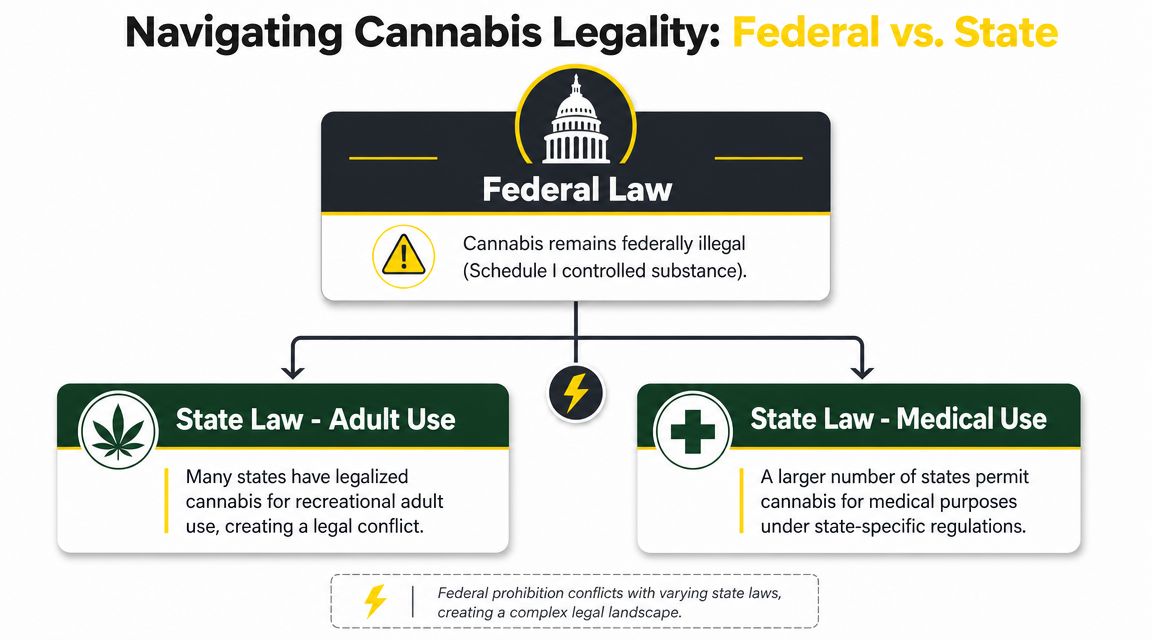
For a home grower, the easiest way to read this conflict is to separate local permission from federal exposure. Local law answers, "Does my city, state, or district allow this at home?" Federal law answers, "Is there any federal rule tied to this property, housing program, or location that changes the answer?"
That distinction matters a lot in the DMV. A person living in a private DC rowhouse faces a different set of issues than someone in federally assisted housing in Maryland or on property with federal oversight in Virginia. The plant may be the same. The legal setting is not.
What this means in practice
A few real-world examples make the split clearer:
Local law usually sets the baseline for home grow
If DC or another nearby jurisdiction allows home cultivation, that is your starting point.Federal property changes the risk fast
Growing on federal land, in some federal housing situations, or in places controlled by federal rules can create problems even if local law is more forgiving.Crossing borders changes the rulebook
Commuting between DC, Maryland, and Virginia is normal. Cannabis laws do not follow your commute. Your rights at home in one jurisdiction do not automatically carry over to another.
One practical example: someone may read about DC's home grow rules, buy equipment, and assume the same setup is fine after moving to Northern Virginia or suburban Maryland. That assumption can lead to mistakes. Another common problem is living in DC but renting in a building with federal ties or strict housing rules that override what the resident expected from local cannabis law alone.
If you want the District-specific legal background that shaped those home grow rules, this explanation of Initiative 71 in Washington DC gives helpful context.
Practical rule: Ask two separate questions every time. Is home grow allowed where I live, and does this property have any federal connection that changes the answer?
That is why simple state-by-state lists often leave readers with the wrong takeaway. For people in the DC metro area, staying compliant means checking both the local law and the type of property you live on before you set up a single plant.
Home Cultivation Rules in Washington DC
If you live in the District, DC law is more permissive than many nearby areas on home grow. But the plant limits still matter, and the mature plant limits matter even more.
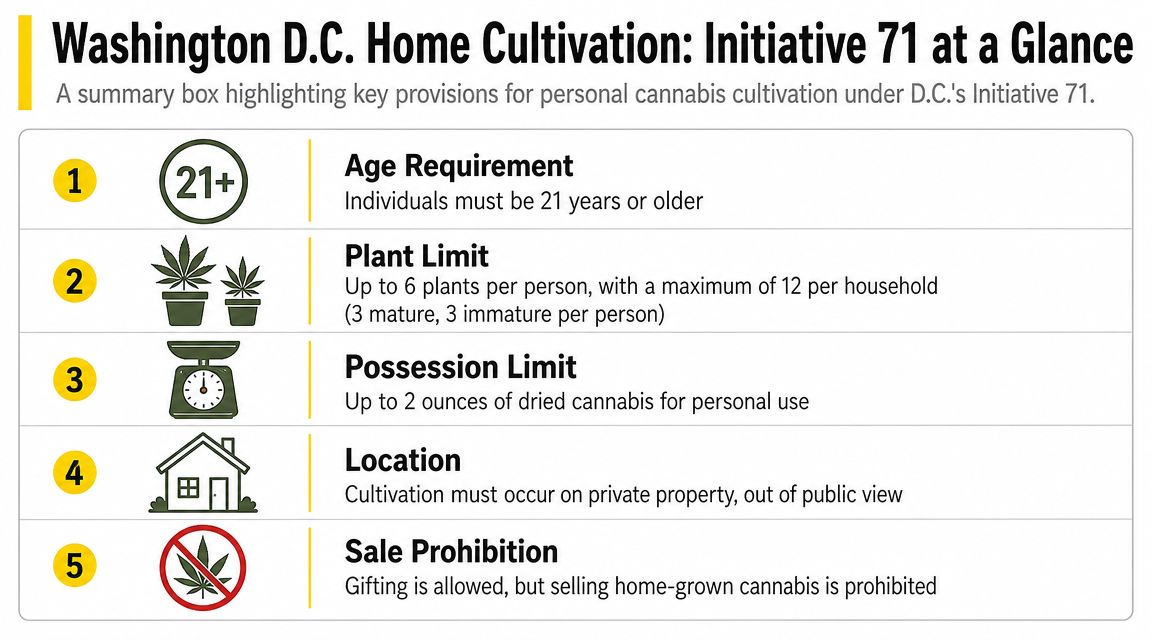
Washington, D.C. allows adults 21+ to grow up to six plants per person, with no more than three mature plants at a time. If two or more adults live in the home, the residence can have up to 12 total plants. Those DC-specific limits are summarized in this state-by-state home grow review.
If you want the broader legal background behind home cultivation in the District, this guide to Initiative 71 in Washington DC is useful context.
What the plant limits actually mean
The part that trips people up is the split between total plants and mature plants.
A practical example helps:
You live alone in DC and you're over 21.
You may grow up to six plants total, but only three can be mature at one time.You live with one other adult who is also over 21.
Your household may have up to 12 plants total.Mature flowering plants still need attention.
If too many plants are in the mature stage at once, you can have a compliance problem even if your total count looks acceptable.
What counts as staying compliant
A safe DC checklist looks like this:
Keep the grow on private property
This isn't the place for a visible balcony setup.Keep plants out of public view
If someone can easily see your plants from the street or shared public space, you're asking for trouble.Treat the grow as personal use only
Home grow permission is not a license to start selling.
If you're in a two-adult DC household, “12 plants allowed” doesn't mean “anything goes.” The mature-plant cap still shapes how you stage the grow.
Common DC mistakes
A lot of first-time growers make one of these errors:
| Common mistake | Why it matters |
|---|---|
| Growing on a visible porch | Visibility can create compliance issues and unwanted attention |
| Counting only total plants | Mature plant limits matter separately |
| Assuming roommates automatically increase flexibility | Household rules and shared space can make compliance harder |
| Treating gifted or shared cannabis like a side hustle | Personal cultivation isn't a green light for sales |
Another point worth keeping straight is the difference between home cultivation rights and store access rules. They're related, but they aren't the same legal question. You can legally ask about growing in DC and still need to follow a separate set of rules for buying through compliant channels.
For many DC residents, the cleanest setup is a private indoor space that isn't visible from outside, has controlled access, and keeps the plant count easy to track. That usually works better than trying to improvise on a balcony, rooftop, or shared yard.
How Maryland and Virginia Compare to DC
You can cross from DC into Maryland or Virginia in less time than it takes to water a grow tent. The law can still change the moment you cross that line.
For people in the DC metro area, that is the part that causes trouble. A person might live in Silver Spring, work in Arlington, and spend weekends in the District. Home grow rules do not follow your commute, your friend group, or the dispensary you visit. They follow the address where the plants are kept.
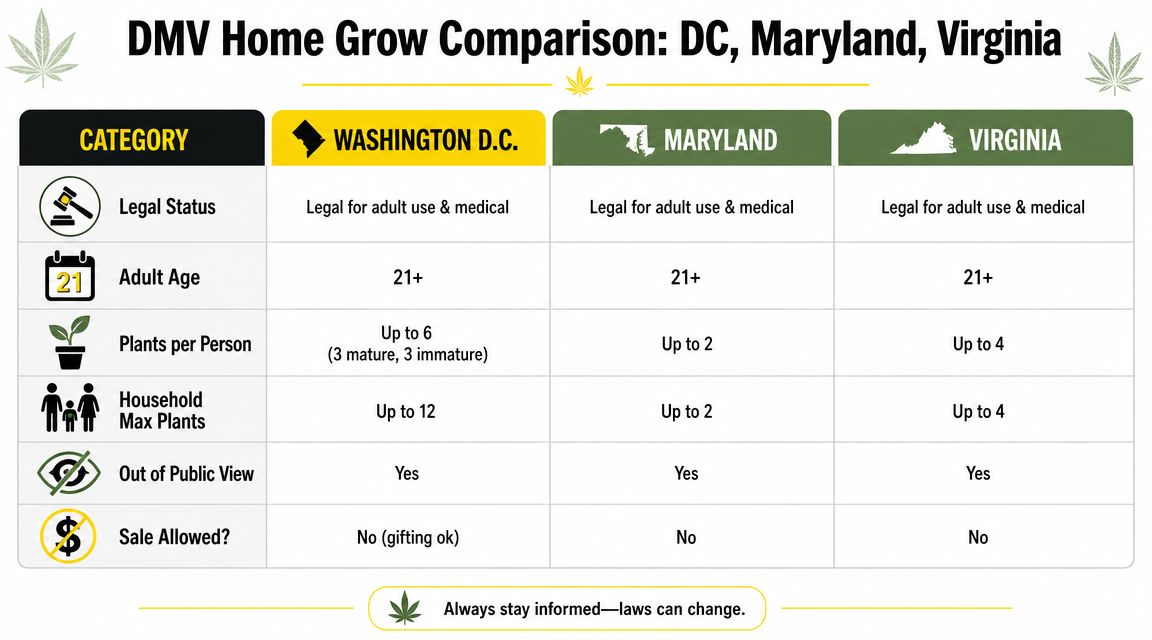
The fast comparison
Start with the address, then check the local cap.
| Jurisdiction | Adult-Use Plant Limit (per residence) | Medical Patient Exception | Key Restriction |
|---|---|---|---|
| DC | Up to 12 in a residence with two or more adults | Not covered here as a separate home-grow exception | Mature plant limits and private property rules matter |
| Maryland | Up to 2 per household | Registered medical patients can add 2 more plants for a maximum of 4 per residence, per the Maryland cannabis FAQ | Must be out of public view |
| Virginia | Up to 4 per household | Not covered here as a separate exception in the verified data | State law differs from both DC and Maryland |
That difference matters more than many DMV residents expect. If you move from a DC row house to a Maryland apartment, or from Bethesda to Alexandria, your legal setup can change even if your grow plan stays exactly the same.
Maryland gives less room than DC
Maryland is stricter for adult-use home growing than DC. Under the Maryland FAQ linked above, adults 21 and older can cultivate up to 2 plants per household.
The word "household" is the key. It works like one speed limit sign for the whole home, not one sign for each adult in the home. Two adults in a Maryland townhouse do not each get their own separate adult-use allotment.
That catches people relocating between DC and Montgomery County all the time. In DC, a shared home may have a higher total cap. In Maryland, the adult-use cap stays at 2 for the household. The same FAQ also says a registered medical patient may add 2 more plants, bringing the total to 4 per residence.
If you are comparing shopping rules and access on the Maryland side, this guide to a dispensary near Bethesda MD can help with the retail side, which is a separate question from home cultivation.
Virginia has its own rules, too
Virginia does not mirror DC, and it does not match Maryland either. In the verified material used for this article, Virginia is treated as allowing up to 4 plants per household in this DMV comparison.
The practical lesson is simple. Do not copy a friend's setup just because they live nearby.
A DC resident, a Prince George's County resident, and a Northern Virginia resident may all describe themselves as living "close to DC." For home cultivation, "close" does not matter much. The governing rule is the state or district tied to the home itself.
What this looks like in real life
A few examples make the differences easier to spot:
A couple in DC
Their local plant limit may be higher than a similar household in Maryland, but they still need to track the rules tied to that DC residence.A renter in Maryland
They may have a larger spare room than they had in the District, yet Maryland adult-use law still gives them a smaller household plant count.A homeowner in Virginia
More privacy does not mean DC rules apply. Virginia's own home-grow rules control the setup.
For people in the DC metro area, this section is the big takeaway. "Where can I grow weed" is not just a state-by-state trivia question. It is a home-address question first, and a housing-rules question right after that.
The Biggest Hurdle Landlords and HOAs
For many people, the hardest part of home growing isn't state law. It's the contract they already signed.
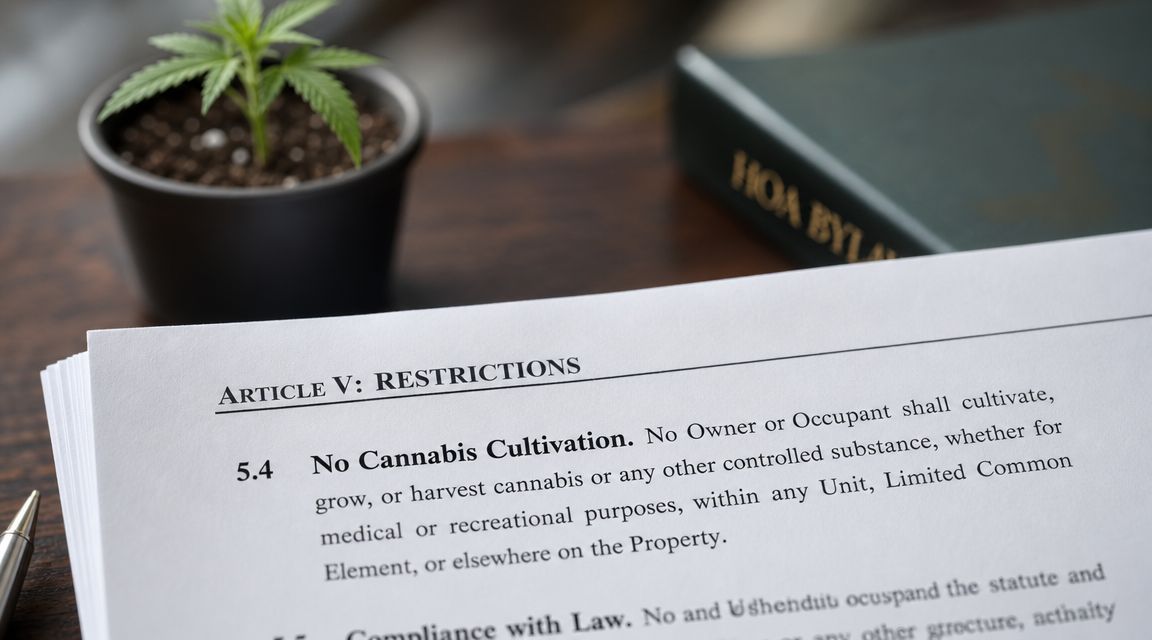
Maryland is a clear example. Maryland permits cultivation only out of public view and explicitly allows landlords or property owners to prohibit it on their premises, as described in this home cultivation policy map from MPP. That's the rule a lot of renters miss.
Why lease language can beat your plans
If your lease says no cultivation, no smoke, no nuisance odors, no unauthorized electrical modifications, or no illegal activity under federal law, your landlord may already have multiple ways to object.
That means a person can be locally allowed to grow and still violate their housing agreement.
A practical example:
- A DC renter reads that adults can grow at home.
- They set up a tent in a spare room.
- The building manager smells it, checks the lease, and points to a cultivation or nuisance clause.
- The issue becomes a housing problem, not just a cannabis question.
HOAs and condo boards create a second layer
Homeowners sometimes assume they're in the clear because they don't rent. Not always.
Condo associations and HOAs may regulate:
Odor and nuisance complaints
Neighbors don't have to like what drifts into hallways or shared walls.Exterior visibility
A greenhouse, deck grow, or balcony plants may create immediate rule issues.Building modifications
Venting, wiring, or moisture-related changes can trigger disputes even before cannabis enters the conversation.
Your local law may say yes. Your housing agreement may still say no.
What to check before you buy anything
Read these documents first:
- Your lease or occupancy agreement
- Condo or co-op bylaws
- HOA rules and architectural guidelines
- Any building smoking, odor, or nuisance policy
If the language is unclear, ask in writing. It's much better to get an uncomfortable answer before you spend money than after a complaint lands on your door.
Practical Considerations for Your Grow Space
If you've cleared the legal and housing hurdles, the next job is keeping the grow discreet, safe, and boring. That last part matters more than people think. A boring grow creates fewer problems.
Keep the space secure
Your grow area should stay out of public view and out of easy reach.
That usually means a private room, closet, tent, or enclosed area where children, pets, guests, and maintenance workers can't casually wander in. If you're in a shared home, everyone should know the boundaries.
Control odor before odor controls you
A grow that smells strong can pull attention from neighbors, landlords, and visitors you didn't plan to brief on your hobby.
Good odor control usually starts with:
A carbon filter
This is one of the most common tools growers use to manage smell indoors.Proper ventilation
Stale, trapped air tends to make everything more noticeable.A realistic setup size
People often run into trouble by starting bigger than their space can handle.
If you're trying to make apartment growing work, this guide on growing weed in an apartment covers some of the practical tradeoffs.
Be a good neighbor
You don't need your neighbors to approve of cannabis. You do want to avoid giving them reasons to complain.
Keep your grow quiet, contained, and hard to notice. Compliance is easier when your setup doesn't spill into other people's lives.
A responsible home grower thinks about light leaks, hallway smells, visible equipment, and who enters the unit for repairs. Those details don't sound glamorous, but they're often what separates a smooth experience from a stressful one.
Smart Alternatives to Growing Your Own Weed
After reading the rules, a lot of adults reach the same conclusion. Growing sounds interesting, but it also sounds like work, paperwork, and risk.
That's a fair read.
Home cultivation can be rewarding if you have the right address, the right housing setup, and enough time to stay organized. But if you rent, live in a condo, travel often, or just don't want to manage odor, security, and plant counts, buying through compliant channels is often the simpler path.
Why some people skip the grow setup
Instead of building a home operation, many consumers prefer access to:
Lab-tested flower and products
You know what you're buying, and you don't need to guess how the harvest turned out.More format choices
Flower isn't the only option. Some adults prefer edibles, vapes, tinctures, topicals, or pre-rolls.Guidance from staff
If you're deciding between strains like Gelato, Runtz, Blue Dream, Wedding Cake, or OG Kush, it helps to talk with someone who can explain the differences in plain language.
For people in DC and nearby areas, options also include delivery and pickup rather than trying to become a hobby grower by necessity. If you're comparing that route, this overview of how weed delivery works in Washington DC explains the process.
One practical option is Mr. Nice Guys DC, which provides medical cannabis access in Washington, DC, including flower, edibles, cartridges, pre-rolls, concentrates, topicals, and tinctures, along with pickup, curbside, and delivery for eligible customers in DC and some nearby areas.
For a lot of readers, that's the clean answer to “where can I grow weed?” Sometimes you can. Sometimes you legally could but your building says no. And sometimes the most compliant move is not to grow at all.
If you want a simpler way to access cannabis in DC without dealing with plant counts, lease issues, or home grow logistics, Mr. Nice Guys DC offers medical cannabis products, pickup, curbside, and delivery options, plus straightforward guidance for patients who want help choosing the right format.
Mr Nice Guys DC
At Mr. Nice Guys DC, we’re more than just a cannabis delivery service — we’re passionate advocates for quality, convenience, and community. With years of experience in the cannabis industry, our team is dedicated to educating and empowering customers across Washington, D.C. Whether you're a seasoned user or just starting your cannabis journey, our blog delivers trusted tips, product insights, and the latest updates from the world of weed. Stay informed, stay elevated.
