
Must Be 21 To Enter
By entering this site you are agreeing that you are at least 21 Years of Age or older.
I AM 21 OR OLDERYour Guide to Growing Weed in an Apartment: grow weed in an apartment safely
.svg)

.png)
Yes, you can grow weed in an apartment, but let's be real—it's not as simple as sticking a seed in a pot on your windowsill. Success hinges on juggling some pretty big factors like staying on the right side of the law, keeping smells under control, and making the most of a tiny space. It’s a project that demands solid planning, from digging into your lease agreement to picking out the right gear to keep things safe and discreet.
Growing Cannabis in an Apartment: The Real Story
The whole idea of growing your own stash is catching on. Just look at Canada, where the number of cannabis users growing their own jumped from 5.8% in 2018 to 8.8% in 2020. That’s a pretty clear sign that more people want to be self-sufficient. You can get the full scoop on this trend from the International Cannabis Policy Study.
But here’s the thing: growing in an apartment is a whole different ballgame compared to having a house with a garage or a backyard.
Before you even think about buying a single seed, you need to seriously weigh the commitment against the pure convenience of hitting up a professional spot. Growing cannabis can be an awesome hobby, but it’s also a big responsibility that costs time, money, and comes with real risks.
Weighing Your Options
So, should you grow weed in your apartment or just buy it from a licensed dispensary? It really boils down to a classic trade-off: total control versus total convenience. Let's break down what each path actually looks like.
On one hand, growing your own means you call all the shots. You pick the strain, control the nutrients, and decide on every single cultivation method. For a lot of people, that hands-on process is a super satisfying way to connect with the plant. But all that control comes with constant demands.
- The Daily Grind: You’ll be checking on your plants every single day—watering, tweaking lights, and watching for any sign of pests or problems. A practical example: your pH meter needs calibrating weekly, and you might spend 20 minutes each evening mixing nutrients and checking for spider mites under the leaves.
- The Upfront Cost: A basic setup with a tent, light, and ventilation system will easily set you back $300-$500 right out of the gate. For instance, a quality Mars Hydro TS 600W light is about $90, a VIVOSUN 2'x2' tent is $60, and a 4-inch fan/filter combo is another $100. Add pots, soil, and seeds, and you're already at that $300 mark.
- The Discretion Dilemma: Odor control is non-negotiable. In a shared building, it’s a constant worry. The smell doesn't just happen during harvest; it starts to build about three weeks into the flowering stage, meaning you have over a month of potent aroma to manage 24/7.
On the other hand, just grabbing what you need from a pro dispensary like Mr. Nice Guys DC completely sidesteps all those headaches. You get instant access to a huge variety of lab-tested products without any of the work or risk.
The biggest win for a dispensary is guaranteed quality and consistency. Every single product has been grown by experts and tested for potency and purity—a level of quality assurance that’s pretty much impossible to match with a small home grow.
Think about it: instead of spending months babying a single strain, you can just decide you’re in the mood for an expertly grown classic like Gelato or OG Kush and have it that day. That convenience lets you focus on actually enjoying the final product instead of troubleshooting the tricky process of growing it.
Here's a straightforward breakdown of the pros and cons to weigh before you decide between growing at home or buying from a professional source.
Apartment Growing vs Dispensary Buying: A Quick Comparison
At the end of the day, both paths have their perks. But if your goal is to enjoy high-quality cannabis without turning your life (and your apartment) upside down, the convenience and reliability of a trusted dispensary are tough to beat.
Navigating the Legal and Practical Hurdles
Before you get lost in the fun of picking out strains and gear, let's pump the brakes and cover the less exciting—but absolutely critical—groundwork. A successful apartment grow isn't just about having a green thumb. It's about carefully navigating a maze of rules, risks, and responsibilities that can get you in serious trouble if you ignore them.
First things first: you have to know the local laws cold. Here in Washington, DC, the rules are very specific. Adults 21 and over are allowed to grow their own cannabis at home, but there are tight restrictions.
You can have a maximum of six cannabis plants, and no more than three of them can be mature, flowering plants at any given time. That limit is per person, but a single household is capped at twelve plants total, no matter how many adults live there. So, no, you and your partner can't each grow six plants in the same apartment.
One of the most overlooked yet crucial DC regulations is the visibility rule. Your plants must not be visible from any public space. That means no growing on your balcony, in a street-facing windowsill, or anywhere else a neighbor or passerby could spot them. Discretion isn't just a good idea—it's the law.
Your Lease Is Just as Important as the Law
Even if you're following every city cultivation law to the letter, your landlord has the final say. The vast majority of standard lease agreements have clauses that forbid illegal activities or specifically ban growing any plants, especially cannabis. Violating your lease is a fast track to an eviction notice.
Don't ever assume that because home growing is legal in DC, you're automatically in the clear with your building's management.
- Scour Your Lease Agreement: Read through your rental contract for any language about illegal drug use, cultivation, or even clauses about property modifications. For example, a clause might state, "Tenant shall not make any alterations, additions, or improvements to the premises without prior written consent." Installing a ventilation duct could be considered an alteration.
- "No Smoking" Policies: Many leases have broad "no smoking" policies that can easily extend to the smell of cannabis. A practical example: if a neighbor complains about a "skunky" smell in the hallway, your landlord can issue a lease violation notice for disturbing the quiet enjoyment of other tenants, even if you aren't smoking.
- Property Inspections: Remember, landlords have the right to conduct periodic inspections. An unexpected visit for a routine maintenance check on the fire alarm could expose your entire setup, leaving you with very few options.
Think about it this way: you set up a small 2'x2' grow tent in a spare closet. It seems perfectly discreet, but the spike in your electricity bill, the constant hum of a fan, and any potential odor leaks could all tip off your landlord, putting you in direct violation of your lease. If you're looking for a completely legal and hassle-free way to get cannabis in the city, you can learn more about how to buy weed in DC through compliant services.
Don't Ignore the Safety Concerns
Beyond the legal and lease headaches, you have to put safety first. A DIY grow setup in an apartment brings real risks that can endanger you, your neighbors, and the whole building.
Electrical safety is a huge one. High-intensity grow lights, fans, and timers can put a serious strain on your apartment's electrical circuits. Older buildings, in particular, might have wiring that just isn't built to handle that kind of sustained power draw, creating a genuine fire hazard. Never, ever overload a single outlet by daisy-chaining power strips for all your equipment. A practical example of a mistake would be plugging a 200W light, an inline fan, and an oscillating fan all into one cheap power strip connected to a single outlet. This could easily overheat the strip or trip the circuit breaker.
On top of that, the combination of intense heat from lights, water for your plants, and all that wiring creates a dangerous environment if it's not managed perfectly. A small water spill near a faulty power strip or a light overheating in a cramped, unventilated closet could spell disaster. Before you even start, you need to honestly ask yourself if you can create a setup that is 100% safe and secure.
Designing Your Discreet Apartment Grow Space
Setting up a dedicated, discreet space is the absolute foundation for successfully growing weed in an apartment. We're not just talking about sticking a plant in a spare corner. This is about building a self-contained environment where you have total control over light, air, temperature, and—most importantly—smell, all without tipping off your neighbors or landlord.
The great news is that modern indoor growing gear has made this easier than ever. Indoor cultivation is booming for a reason. As of 2024, it takes up about 49% of the market share and is expected to grow at a compound annual rate of 20.73%. Why? Because it gives growers precise control over the entire process.
Your Grow Space: The Tent or the Closet
First things first: you need to decide where your plants will live. For apartment growers, it pretty much boils down to two practical options: a grow tent or a converted closet.
A grow tent is basically a self-contained room for your plants. They’re designed for this. The inside walls are reflective to maximize light, they have built-in ports for ventilation, and they’re light-proof. A small 2'x2' or 2'x4' tent can easily tuck into a closet or an empty corner, making it the best bet for beginners who want a plug-and-play setup.
The other route is converting a spare closet. This can be super stealthy, but it takes more DIY work. You'll need to make the door completely light-proof, probably drill some holes for ventilation, and line the walls with a reflective material like Mylar. It's a solid option, but a tent is usually simpler and won't risk permanent damage to the apartment.
Mastering Light and Heat with LEDs
Lighting is probably the single most important part of your setup. Your plants need a ton of light to grow dense buds, but powerful lights create a lot of heat—and that's a big problem in a small, enclosed space.
This is where LED (Light Emitting Diode) grow lights are a game-changer. Old-school High-Pressure Sodium (HPS) lights run incredibly hot and need serious ventilation to keep things from overheating. Modern full-spectrum LEDs, on the other hand, are way more efficient. A quality 100W LED can light up a 2'x2' space perfectly fine while giving off very little heat. This keeps your tent's temperature stable and your power bill from getting out of hand.
The biggest win for LEDs in an apartment is heat management. An HPS light can easily crank the temperature in a small tent by 15-20°F, which means your fan will be running nonstop and your fire risk goes up. A comparable LED might only raise it by 5-7°F, which makes for a much safer and quieter grow.
Before you even think about buying gear, you need to get these foundational steps right.
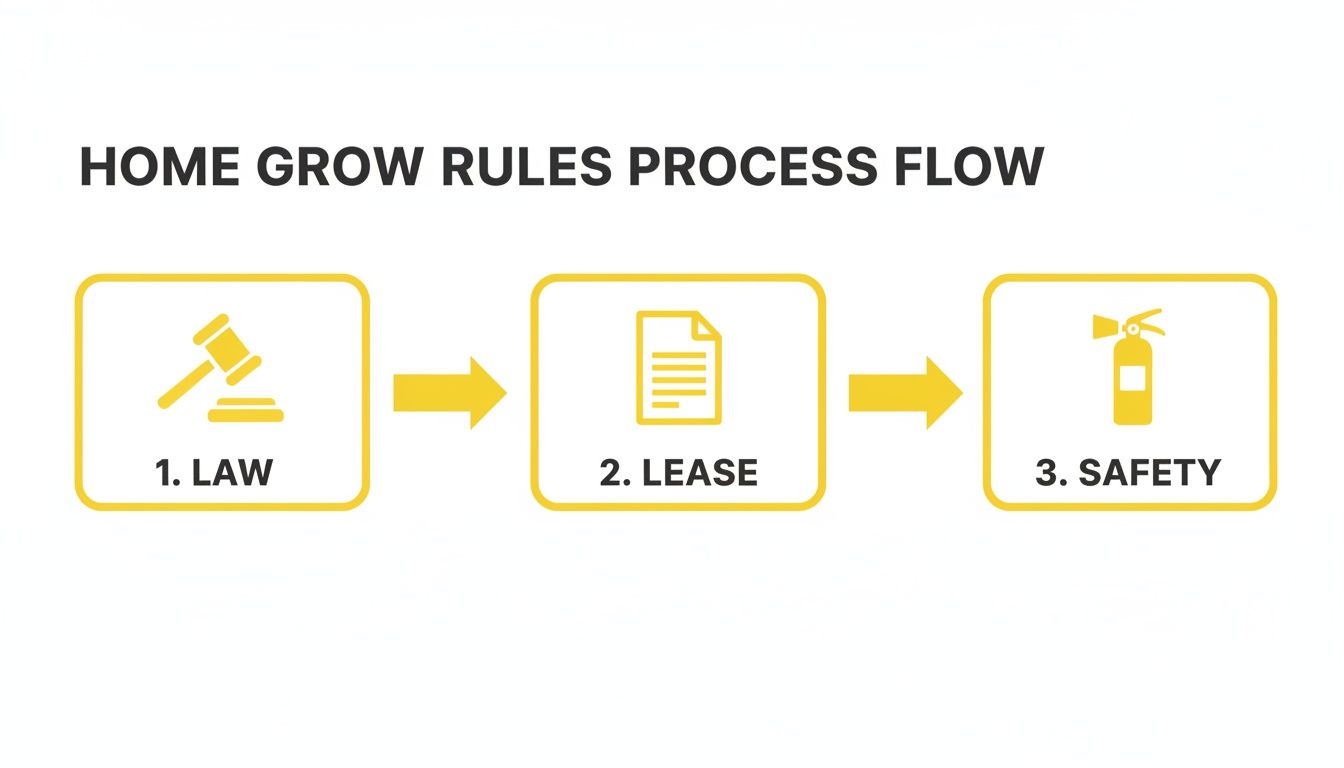
This chart makes it clear: check your local laws, read your lease agreement carefully, and plan for safety. These are the pillars of a responsible home grow.
Eliminating Odor Before It Starts
Let's be real: odor control isn't a suggestion when you grow weed in an apartment; it’s mandatory. A flowering cannabis plant is loud, and that smell will find its way out of your apartment and down the hall. Your number one line of defense here is a carbon filter paired with an inline fan.
The inline fan sucks the air out of your grow tent, and the carbon filter scrubs the smell from the air before it's released. The trick is to match the fan's power—measured in Cubic Feet per Minute (CFM)—to the size of your tent and filter.
Here's a quick, real-world example of how to figure out the CFM you need:
- Find Your Tent's Volume: A 2'x4'x5' tent has a volume of 40 cubic feet (2 x 4 x 5).
- Figure Out Air Exchange: You want to swap out all the air in the tent at least once a minute. So, you need a base of 40 CFM.
- Account for Inefficiency: Add about 25% for the drag from the carbon filter and another 25% for any bends in your ducting. That brings your target to around 60 CFM (40 + 10 + 10). A 4-inch inline fan rated for 100-200 CFM is more than enough and lets you run it at a lower, quieter speed.
Choosing Your Growing Medium: Soil vs. Coco Coir
The last piece of the puzzle is what your plants will actually grow in. For first-timers, the choice usually comes down to either classic soil or a soilless mix like coco coir.
- Soil: This is the most forgiving route. A good quality potting soil, like Fox Farm Ocean Forest, comes with some nutrients already mixed in and is great at buffering pH, meaning it's less touchy if you make mistakes with feeding or watering. It's a fantastic way to learn the basics.
- Coco Coir: This stuff is made from coconut husks and is an inert medium that gives roots great aeration and holds water well. You can get faster growth with coco, but it means you have to supply all the nutrients from day one and keep a closer eye on pH levels using a product like Cal-Mag.
Your choice really depends on your style. If you want something a bit more hands-off, soil is a great place to start. If you're excited to have more control over feeding and want to push for faster growth, give coco coir a shot.
Once you have your setup dialed in, it's time to pick the right seeds for your space. You can learn all about that in our ultimate guide to buying weed seeds.
Choosing The Right Strains for Small Spaces

Not all cannabis plants are created equal, especially when you plan to grow weed in an apartment. Trying to cram a strain that wants to be six feet tall into a four-foot tent is a classic rookie mistake and a recipe for failure. The genetics you choose can literally make or break your entire project, making this decision just as critical as your lighting or ventilation setup.
Your mission is to find plants that are naturally compact, finish flowering quickly, and don't reek to high heaven. This is where Indica-dominant and autoflowering strains will quickly become your best friends.
Why Plant Structure Matters
Sativa strains, beloved for their energetic effects, have a tendency to grow tall and lanky, with a ton of space between branches. While that’s perfect for an outdoor garden, it's a nightmare in a small grow tent. They’ll stretch right into your light, get burned, and become an overgrown, unmanageable mess before you know it.
Indica strains, on the other hand, are the polar opposite. They typically grow short, dense, and bushy—think of a classic Christmas tree shape. This compact structure is perfectly suited for height-restricted spaces like a closet or a small tent, making them infinitely easier to control.
Practical Example: A pure Sativa like a classic Haze can easily stretch to over six feet tall indoors. In contrast, an Indica like Northern Lights often stays under three feet. When every vertical inch counts, the choice is pretty clear.
Meet Your New Best Friend: Autoflowers
Autoflowering strains are another game-changer for apartment growers. Unlike traditional (photoperiod) plants that need a specific light schedule to trigger flowering, autoflowers do it all on their own. They automatically begin to bud after just a few weeks of growth, no matter the light cycle.
This offers a couple of massive advantages for a small, discreet grow:
- Speed: Most autoflowers race from seed to harvest in just 8-10 weeks. That rapid turnaround minimizes the time your operation is running, which means less risk and lower electricity bills. A practical example is a strain like 24 Carat from Mephisto Genetics, which can be harvested just 60-70 days after sprouting.
- Size: They are genetically wired to stay small. The majority top out around two to three feet tall, making them absolutely ideal for micro-grows.
Managing The Unavoidable Odor
Let's be real: odor is the number one giveaway when you grow weed in an apartment. While a good carbon filter is non-negotiable, picking a lower-odor strain adds a crucial layer of discretion. Some strains, like the notoriously pungent Sour Diesel, are so loud they can overwhelm even a high-quality filter.
Do some research and look for strains known for more subtle, less "skunky" aromas. Strains like Blue Mystic or Northern Lights, for example, are often reported to have a milder scent profile during their flowering stage. This small choice can make a huge difference in keeping your hobby on the down-low. We've even put together a list of the best cannabis strains for beginners that often have more manageable traits for new growers.
To help you get started, here are some key characteristics to look for when choosing a strain for your apartment grow.
Apartment-Friendly Cannabis Strain Characteristics
Picking a strain with these traits will set you up for a much smoother and more successful grow.
Ultimately, this is another area where the simplicity of a dispensary shines. When you buy a professionally grown strain like Gelato or OG Kush from Mr. Nice Guys DC, you're getting a finished product with perfected characteristics. There's no guesswork about its size, smell, or potency—just consistent quality every single time, without any of the cultivation headaches.
Mastering Daily Care and Solving Common Problems

You’ve designed your stealthy grow space and picked your seeds. Now the real fun begins. At this point, you shift from being an architect to being a gardener, and the daily attention you give your plants will directly shape your final harvest. This phase isn’t about buying more gear; it's about building a relationship with your plants—learning what they're telling you and responding to their needs.
Consistency is your best friend here. A few minutes of hands-on care each day goes way further than trying to fix a big problem that’s spun out of control. This is where you learn the fundamentals that make the difference between a sad-looking plant and a thriving one when you grow weed in an apartment.
The Art of Proper Watering
The number one mistake new growers make? Overwatering. It’s easy to do. You want to nurture your plant, but cannabis roots need oxygen just as much as they need water. When the soil is perpetually soaked, the roots can't breathe, which is a fast track to root rot and a whole list of other problems.
So, how do you know when it’s time to water? Ditch the rigid schedule and get to know the "lift the pot" method.
After you've given your plant a good soak, get a feel for how heavy the container is. A few days later, lift it again. When it feels noticeably lighter—almost airy by comparison—it’s time for another drink. This simple check ensures you’re watering based on what the plant actually needs, not just what the calendar says.
When you do water, be thorough. Pour it slowly and evenly around the base until you see about 10-20% of the water drain out of the bottom. For a 3-gallon pot, this might mean slowly pouring in a full gallon of water and seeing a cup or two of runoff in the saucer below. This runoff is important because it flushes out any buildup of nutrient salts and makes sure the entire root system gets hydrated.
Demystifying Plant Nutrients
Think of plant food like a balanced diet. Your plants need a mix of nutrients to be healthy, but the big three you need to know are N-P-K: Nitrogen (N), Phosphorus (P), and Potassium (K). The ideal ratio of these three changes depending on what stage of life your plant is in.
- Vegetative Stage: During this initial growth spurt, your plant is all about getting big and leafy. It’s hungry for Nitrogen (N). You’ll want to look for a nutrient formula with a higher first number, like a 3-1-2 ratio, to fuel strong stems and foliage.
- Flowering Stage: As soon as your plant starts showing signs of budding, its needs change. It’s now focused on producing dense, resinous flowers and craves Phosphorus (P) and Potassium (K). You'll switch to a "bloom" nutrient with a lower first number, maybe something like 1-3-2.
A pro tip: always start with a half-dose of whatever the bottle recommends. For example, if the instructions for General Hydroponics FloraGro say 1 teaspoon per gallon, start with only 1/2 teaspoon per gallon to avoid burning your plants. You can always add more, but it’s much harder to fix a plant you’ve accidentally "burned" with too many nutrients.
Maximizing Yield with Low-Stress Training
When you’re working with a cramped apartment closet or tent, you can't just let your plants grow wild toward the ceiling. The goal is to create a flat, even canopy where every single bud site gets an equal share of light. The best way to do this is with Low-Stress Training (LST).
LST is a simple technique where you gently bend and tie down the main stem and any dominant side branches, encouraging them to grow horizontally instead of straight up. This breaks the plant's natural tendency to send all its energy to the very top (a trait called "apical dominance") and redistributes it to the lower branches.
Picture tying the main stem down so it's parallel with the soil using soft garden wire. Within a couple of days, you'll see all those smaller side branches turn and start reaching for the light. Those are your future main colas. You'll end up with a wide, flat canopy that makes the most of every photon your light puts out. All it takes is some soft plant wire and a gentle touch.
Solving Common Problems Before They Escalate
Even the best growers run into issues. The trick is to spot them early.
Troubleshooting Guide for Apartment Growers
This kind of constant vigilance is the reality of growing at home. You're the one in charge, and your plants are counting on you. It's a demanding process, for sure, but it’s also incredibly rewarding and highlights the daily commitment needed to successfully grow weed in an apartment.
The Simpler Alternative: Why a Dispensary Wins
After walking through the intense effort and constant worry that comes with trying to grow weed in an apartment, the alternative looks a lot more appealing. Choosing a trusted dispensary like Mr. Nice Guys DC means swapping out all that uncertainty and daily labor for guaranteed quality, variety, and safety. It’s that simple.
Every single product you get from a professional dispensary is lab-tested for potency and purity. This is your guarantee that you’re getting a clean, consistent product without any mold or pesticides—a level of quality control that’s just plain impossible for a home grower to match. Forget being locked into one or two strains for months; you get instant access to a huge menu of expertly grown flower, edibles, and concentrates.
Convenience and Variety on Your Terms
Imagine being able to choose a strain based on your mood or needs at a moment's notice. That’s the reality when you shop at a dispensary. This access is backed by a massive industry; the global cannabis cultivation market was valued at USD 549.64 billion in 2024 and is projected to hit a staggering USD 2,903.64 billion by 2034. North America, with its 64% market share, is driving this growth, which means better products and prices for DC consumers. You can read more on the expanding cannabis market and its impact here.
The peace of mind that comes with buying from a dispensary is unmatched. You completely sidestep the risks of lease violations, neighbor complaints, pests, or a failed crop—all the things that keep an apartment grower up at night.
Services like curbside pickup and discreet delivery just add to the convenience, saving you a ton of time and hassle. At the end of the day, going the dispensary route removes every single headache tied to an apartment grow. You can learn more about the specific benefits of shopping at a dispensary in DC in our detailed guide. If you value your time, safety, and access to consistently great products, it's really no contest. A dispensary is the smarter choice.
Answering Your Top Questions
Deciding to grow weed in your apartment is a big step, and it's totally normal for a ton of questions to pop up. Let's get straight to the point and tackle the most common ones you're probably thinking about.
What’s the Real Cost to Get a Small Grow Tent Running?
For a solid starter kit that can handle one or two plants, you’re looking at an upfront cost between $300 and $500. That gets you a 2'x2' tent, a decent LED light, a carbon filter with an inline fan, and some soil. That price tag doesn't even touch the ongoing costs for electricity, nutrients, or the seeds themselves. While you might save money in the long run, it's a real investment compared to just grabbing what you need from a dispensary.
Remember, the initial cash outlay is just one part of the equation. The time and effort you'll pour into this daily is another huge resource you need to consider.
Will My Neighbors Smell My Grow?
Oh, absolutely. Without top-notch odor control, they will definitely smell it. A quality carbon filter and an inline fan aren't just suggestions; they are non-negotiable essentials for keeping the peace and staying discreet. Even with the best filter money can buy, that potent smell is going to sneak out every single time you open the tent to water or check on your ladies. In a shared building, the smell is easily one of your biggest risks.
Is It Better to Use a Grow Tent or Just Convert a Closet?
For anyone growing in an apartment, a tent is almost always the way to go. Tents are specifically designed to be light-proof, come with built-in ports for ventilation, and make managing your environment a whole lot simpler. Trying to convert a closet means more DIY work and could lead to damaging the property—think drilling holes for fans. That could violate your lease and kiss your security deposit goodbye. A tent is a self-contained setup you can easily remove later.
If you're curious about what kind of cannabis you might want to grow, our guide comparing Indica vs Sativa effects can help you decide.
Instead of getting tangled up in the costs and complexities of a home grow, why not check out the premium, lab-tested selection at Mr. Nice Guys DC? We've got a huge variety of top-shelf strains and products ready for pickup or discreet delivery. It's the safe, legal, and hassle-free way to go. Take a look at our menu today.
Mr Nice Guys DC
At Mr. Nice Guys DC, we’re more than just a cannabis delivery service — we’re passionate advocates for quality, convenience, and community. With years of experience in the cannabis industry, our team is dedicated to educating and empowering customers across Washington, D.C. Whether you're a seasoned user or just starting your cannabis journey, our blog delivers trusted tips, product insights, and the latest updates from the world of weed. Stay informed, stay elevated.
