
Must Be 21 To Enter
By entering this site you are agreeing that you are at least 21 Years of Age or older.
I AM 21 OR OLDERWhat Is Better Sativa or Indica: A Practical Guide
.svg)

.png)
If the jar says sativa or indica, can that label really tell you whether you'll feel focused, creative, calm, or sleepy? The familiar answer treats those words as reliable effect categories, but the more useful question is different: what chemistry and use case fit you today?
Cannabis effects depend on the interaction of cannabinoids, terpenes, dose, product format, tolerance, and setting. The traditional label can offer context, but it can't replace a lab panel or your own experience. This guide explains how to move from a broad menu category to a more confident, chemistry-first choice.
Why the Sativa or Indica Question Needs Reframing
Many shoppers use sativa as shorthand for energy and indica as shorthand for relaxation. That shortcut can be convenient, but it often hides the information that matters most. Two flowers marketed as sativa may contain different THC levels, different minor cannabinoids, and very different terpene profiles. Their effects may not feel alike at all.
The same problem appears on the indica side. An indica label doesn't guarantee a particular potency, aroma, body sensation, or duration. Commercially available products labeled indica and sativa generally show similar concentrations of major cannabinoids such as THC and CBD, so the category alone isn't a dependable potency guide, as described in this cross-sectional cannabis survey.
Practical rule: Treat sativa and indica as menu language, not a promise about how your body will respond.
A chemistry-first approach doesn't make shopping harder. It gives you more useful signals. Instead of asking only whether a product is sativa or indica, ask whether its measured profile suits your purpose.
The better question
Before choosing, identify the experience you want:
- Focus: Do you want a clear-headed, functional feeling?
- Creativity: Are you looking for a lifted mood without a heavy body sensation?
- Relaxation: Do you want to settle down after work?
- Relief: Are you seeking support while keeping intoxication mild?
- Duration: Do you need a shorter experience from a vape, or a longer one from an edible?
Then inspect the label for THC, CBD, minor cannabinoids, and dominant terpenes. A product with a citrus-forward terpene profile and a moderate THC level may fit an afternoon task better than a product chosen because it says sativa. Conversely, an earthy, myrcene-associated flower may appeal to someone seeking a calmer evening profile, while still requiring attention to dose and individual response.
For broader context on how cannabinoids work together in a product, this full-spectrum cannabis guide offers useful background. The central idea is simple: choose the profile, then use the label category as secondary context.
The 18th-Century Roots of Sativa and Indica Labels
The words began as botanical descriptions, not as a menu of predictable moods. In 1753, Carl Linnaeus classified cannabis as Cannabis sativa. Historical accounts describe sativa-type plants as taller, narrow-leaved, and associated with longer flowering periods and warmer regions. Linnaeus's classification focused on the plant itself, including its form and use as a fibrous hemp plant.
In 1785, Jean-Baptiste Lamarck proposed Cannabis indica after studying cannabis from India. Indica-type plants were described as shorter, broader-leaved, and associated with regions including Central and South Asia. Those distinctions reflected geography and morphology, meaning visible traits such as height, leaf shape, and growth pattern, rather than a guaranteed psychoactive experience. These historical details are documented in this review of cannabis taxonomy and classification.
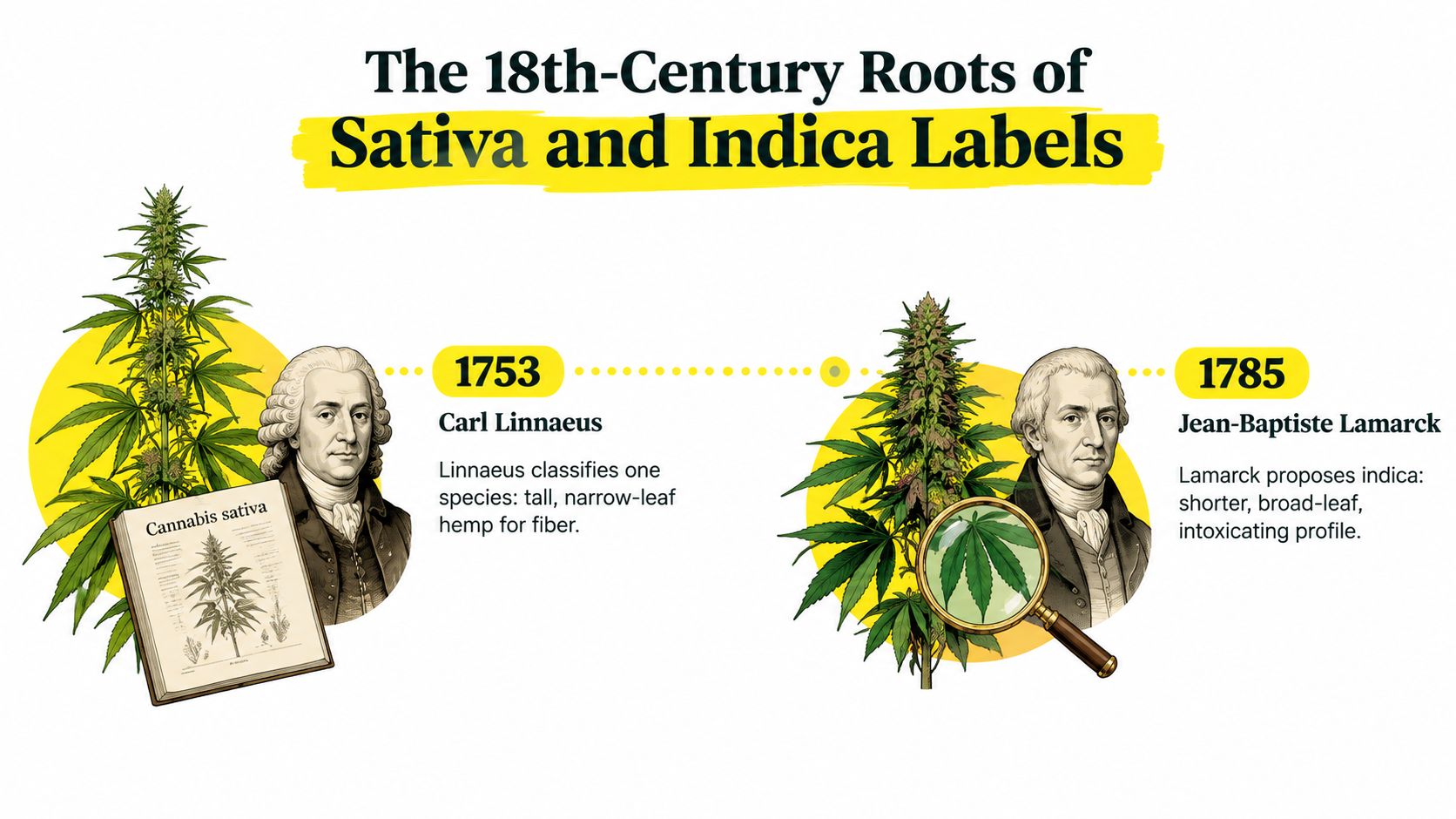
How botanical terms became effect shorthand
Over time, breeders and underground growers reused the labels in less formal ways. The words began signaling expected growth patterns, resin production, regional ancestry, and rumored effects. As breeding expanded, the original categories became increasingly mixed. Scholarship notes that decades of breeding have blurred the distinction so extensively that identifying a commercial plant as purely sativa or indica can be nearly impossible.
The meaning also shifted through the breeding culture of the 1980s and 1990s, when vernacular cannabis taxonomy was reshaped by breeders, according to the same historical review. The names stayed familiar because they helped people communicate quickly, even as the underlying plants became more genetically and chemically complicated.
Consider a shopper choosing a product called Chocolate Thai. The name may suggest a particular lineage or traditional category, but the product on a modern menu is the result of cultivation, breeding, harvest, curing, and testing. The label doesn't reveal the full chemical profile. A closer look at Chocolate Thai and its cannabis background can help explain why names carry cultural and botanical associations without guaranteeing identical effects.
The historical lesson matters because it explains why the labels remain influential. They started by describing where a plant came from and what it looked like. Later consumers began using them to predict how cannabis would feel. That migration from botany to marketing created the assumption behind the question, “Which is better?”
What Modern Research Says About the Labels
Which label should guide your choice, sativa or indica? Modern research suggests a better starting point: examine the product's chemistry and intended use. A 2021 Nature Plants analysis of more than 100 cannabis samples found that products carrying the two labels were genetically indistinct on a genome-wide scale. The labels therefore provide limited information about lineage or chemistry, as reported in this genomic and chemical analysis.
The product can still produce a distinct experience. Cannabinoid levels, terpene balance, cultivation history, dose, and delivery method all contribute to that result. The category name leaves too much of this variation unexplained.
What the label does and doesn't tell you
The clearest label-associated pattern in the Nature Plants analysis involved terpene composition, especially myrcene in indica-labeled samples. Myrcene explained 21.2% of the variation in labeling in that same analysis. Guaiol, γ-eudesmol, and β-eudesmol also correlated positively with indica labeling. These findings describe an association, not a rule. An indica-labeled product may not be myrcene-heavy, and a myrcene-heavy product will not necessarily feel sedating.
A separate 2021 ACS report found similar correlations between indica labels and specific terpenoids, including myrcene, guaiol, γ-eudesmol, and β-eudesmol. That evidence gives the labels some chemical context, but it does not make them reliable clinical predictions. One preliminary study associated indica-dominant cultivars with greater low-arousal effects after accounting for individual and cultivar variation. Dose and chemistry still offer more useful guidance than the label by itself. The broader evidence is summarized in this National Geographic discussion of cannabis labeling.
| Dimension | Sativa or Indica Label | Modern Chemovar View |
|---|---|---|
| Main meaning | Broad marketing and botanical shorthand | A description based on measured chemistry |
| Genetic value | Doesn't cleanly separate modern products | Considers chemical and genetic data together |
| Effect prediction | Offers a rough expectation at most | Uses cannabinoids, terpenes, dose, and format |
| Potency guidance | Doesn't reliably predict THC or CBD levels | Starts with the actual lab results |
| Best use | Initial menu orientation | Product selection and personal tracking |
A medical cannabis user survey found statistically significant preferences for indica in several conditions, including insomnia, neuropathy, glaucoma, spasticity, seizures, and joint pain. The reported p-values were p<0.001 for insomnia, p=0.024 for neuropathy, p=0.036 for glaucoma, p=0.048 for spasticity, p=0.031 for seizures, and p=0.048 for joint pain. Because the survey was conducted online rather than as a controlled clinical trial, those preferences may reflect patient experience, purchasing habits, or expectations. They do not establish that one label is medically superior.
Labels remain useful as quick menu shorthand, especially when no fuller information is available. Treat them as incomplete maps. A modern chemovar approach asks which cannabinoids and terpenes are present, then connects that profile with your goal, dose, and preferred format.
Terpenes and Cannabinoids That Actually Drive Effects
Start with cannabinoids, then use terpenes to refine the choice. THC is the main intoxicating cannabinoid in most familiar cannabis products. Its concentration helps you estimate potency, but the number alone doesn't determine whether the experience will feel bright, calm, focused, or heavy.
CBD isn't intoxicating in the same way as THC and may change how a product feels for some people. Minor cannabinoids such as CBG, CBN, and THCV are also appearing in product discussions, although their effects and practical significance are still more individualized than the simple sativa-indica story suggests.
Terpenes add another layer. They contribute to aroma and may help explain why two products with similar THC levels feel different. Research on cannabis effects has found that subjective responses tracked terpene profiles more closely than indica or sativa naming, while products grouped under the traditional labels often had similar major cannabinoid levels, as reported in this Cannabis and Cannabinoid Research study.
| Compound | Typical Effect | Common Sources |
|---|---|---|
| THC | Intoxication and changes in perception, mood, and body sensation | Flower, vapes, concentrates, edibles |
| CBD | Non-intoxicating cannabinoid that may moderate the overall profile for some users | Tinctures, flower, capsules, balanced products |
| CBG | Emerging minor-cannabinoid profile often selected by shoppers exploring daytime formulas | Specialty flower, tinctures, extracts |
| CBN | Emerging minor-cannabinoid profile commonly considered in evening products | Edibles, tinctures, formulated extracts |
| THCV | Emerging profile that some shoppers associate with a more alert experience | Selected cultivars and specialty formulations |
| Myrcene | Earthy aroma and a profile often associated with calm or heaviness | Mango-like, earthy, herbal cultivars |
| Limonene | Citrus aroma and an uplifting direction for some users | Citrus-forward cultivars and extracts |
| Pinene | Pine aroma and a clear, fresh profile for some users | Pine-scented flower and extracts |
| Linalool | Floral aroma and a calming direction | Lavender-like cultivars |
| Terpinolene | Fresh, complex aroma often chosen for a lifted or creative profile | Certain aromatic flower varieties |
| Beta-caryophyllene | Peppery aroma and a profile some users explore for stress or discomfort | Peppery, spicy cultivars |
The table describes typical associations, not guarantees. A caryophyllene-primary cultivar was associated with higher pain ratings and more negative effects in one clinical and ecological study, so even a commonly discussed terpene can produce a different response depending on the person and product.
For a plain-language explanation of aroma compounds and their role in product selection, see this guide to terpenes in weed.
Try this comparison at a dispensary. Two products may both carry a sativa label. One could be THC-dominant with limonene and pinene near the top of the terpene panel. Another could carry a different THC level and a myrcene-forward profile. The first may suit an afternoon errand for one person, while the second may feel slower or more body-focused. The lab panel gives you a clearer starting point than the category name.
Matching Common Scenarios to the Right Profile
A useful choice begins with the situation, not the strain family. The same person may prefer a clear, short-acting product during afternoon work and a longer-lasting, calmer format in the evening. Timing, tolerance, dose, and delivery method can matter more than whether the package says sativa or indica.
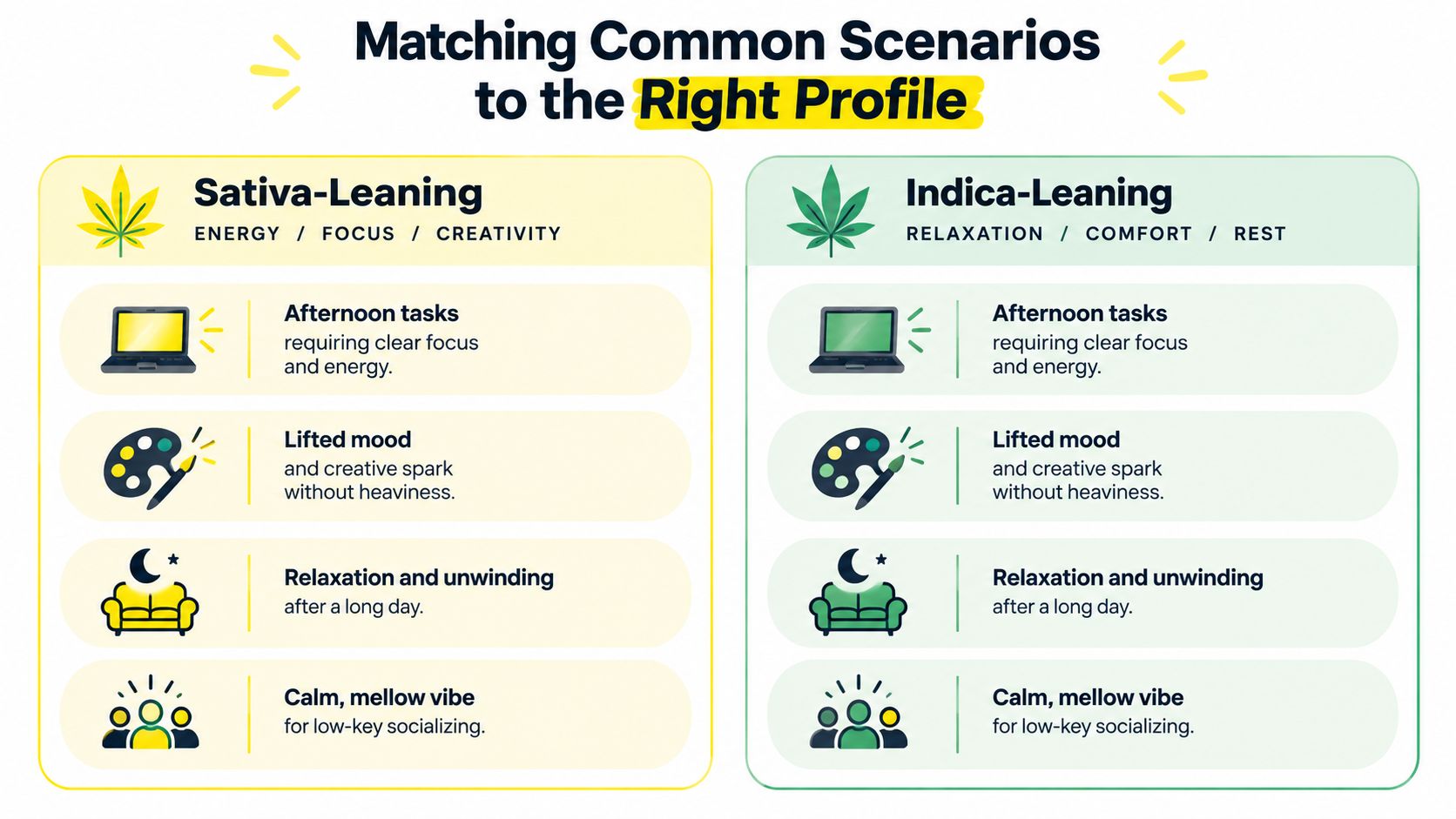
Scenario one, focused afternoon work
A remote worker handling emails or planning tasks may prefer a measured, THC-dominant product with a limonene-forward or pinene-forward terpene profile. A cartridge can offer a more controllable, shorter session than an edible, but the user should still begin cautiously and avoid driving or safety-sensitive work.
A product labeled sativa may fit the shopper's initial search, yet the useful filter is the actual cannabinoid and terpene panel. If the product feels too stimulating or distracting, the person can record that response and try a different profile rather than assuming all sativas will behave the same way.
Scenario two, creative work and social energy
Someone seeking a lifted mood without a heavy body sensation might explore a product with terpinolene, limonene, or pinene among its dominant terpenes. A small amount of flower or a controlled vape session may offer easier adjustment than a long-lasting edible.
The goal isn't to chase the strongest product. A high-potency option can overwhelm the intended creative or social experience, especially for a sensitive user. The better match combines an appropriate THC level with an aroma and effect profile the person has tolerated before.
Scenario three, evening decompression
After a long shift, a shopper may want a calmer body profile. Myrcene or linalool may be useful selection clues, particularly in a flower or edible marketed for evening use. An edible can last longer, while flower or a vape may allow the user to stop sooner if the effects arrive faster than expected.
Scenario four, mild relief with less intoxication
A sensitive patient may consider a product with more CBD relative to THC, or a lower-THC option, depending on personal and medical guidance. A tincture can make measured use easier for some people, while a topical may suit localized use without the same whole-body experience. Product choice should account for medications, health conditions, and advice from a qualified clinician.
For a concise review of the compounds involved, this cannabinoid breakdown can help you interpret the label before purchasing.
The embedded video below provides another visual way to compare common profile expectations.
A Practical Framework for Choosing Your Next Product
A dispensary menu can feel crowded until you reduce the decision to a few questions. You don't need to predict your entire experience from a strain name. You need a reasonable starting profile, a suitable format, and a way to learn from the result.
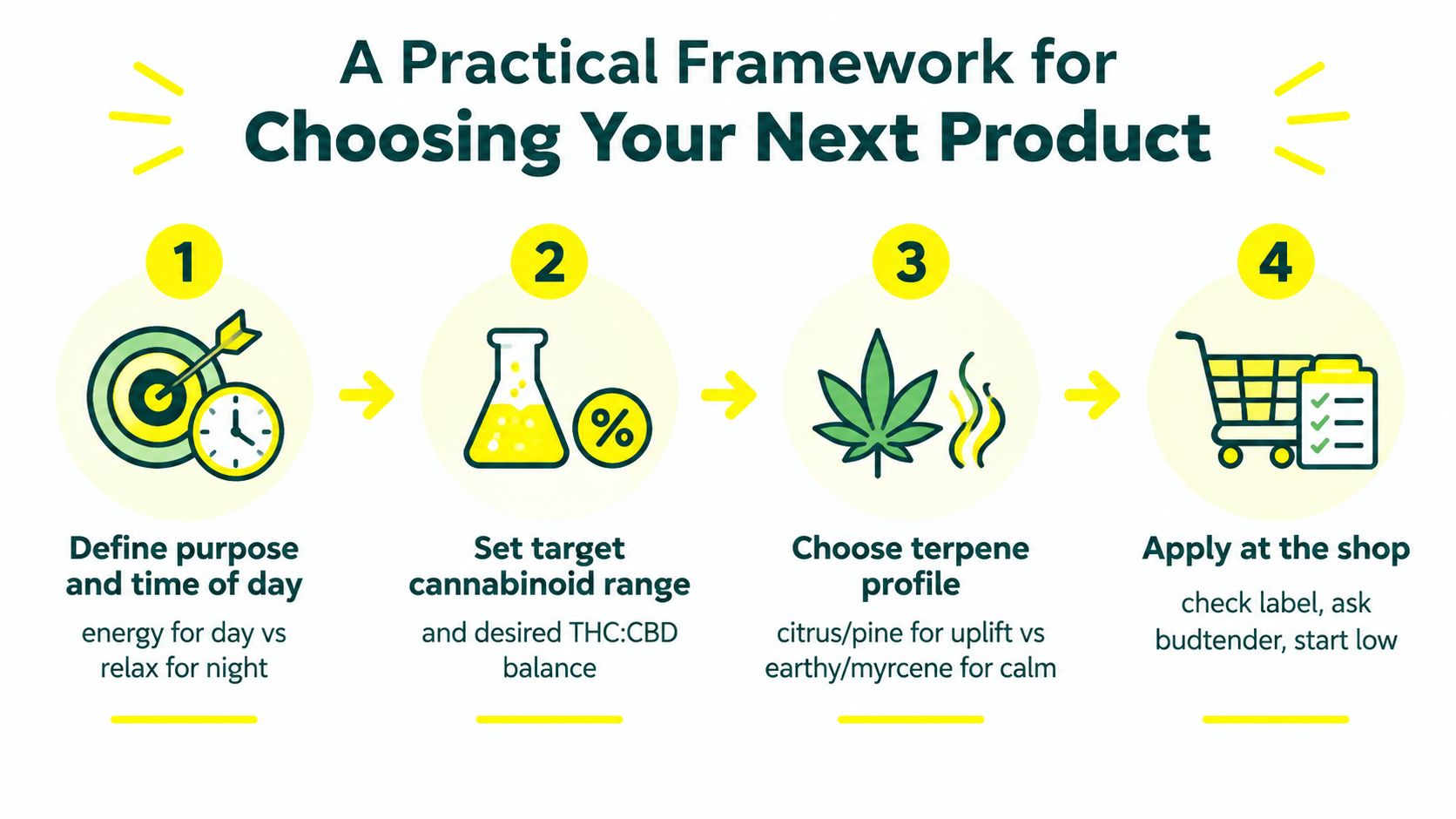
Start with purpose and timing
Ask, “Is this for focus, relaxation, creativity, or relief?” Then ask when you'll use it. A daytime goal may call for a more functional profile and a shorter delivery method. A nighttime goal may justify a longer-lasting format, provided you understand how slowly edible effects can develop and how long they may remain noticeable.
Set a cannabinoid target
Look at THC and CBD first. Decide whether you want THC-forward, CBD-forward, or a balanced product. If the label lists CBG, CBN, or THCV, treat those details as additional context rather than a guarantee.
Filter by chemistry
Compare terpene panels instead of stopping at sativa or indica. Citrus and pine aromas may appeal to someone seeking an uplifted direction, while earthy or myrcene-associated profiles may suit someone exploring calm. The actual result still depends on dose and personal response.
Match the format and begin cautiously
Flower, vape, edible, tincture, and topical products create different timing and control considerations. Choose a format that matches how quickly you need feedback and how long you want the experience to last. Start with a conservative amount, especially when trying a new product, and avoid combining cannabis with alcohol or driving.
A useful shopping script: “I want a clear-headed evening profile, moderate THC, and a terpene panel led by limonene. What products match that chemistry?”
Record what happened. Your response, dose, setting, and expectations may predict your next choice better than a generic category. Personal chemistry often outweighs inherited assumptions about a plant name.
Dispensary Tips for Reading Labels and Tracking Results
Read the product label from the chemistry panel outward. First, check THC and CBD, then look for listed minor cannabinoids such as CBG or CBN. A higher THC percentage generally signals greater potency, but it doesn't tell you how the product will feel or how much you personally should use.
Next, find the terpene listing. Some products identify only the dominant terpenes, while others provide a fuller profile. Note whether the product is citrus-forward, pine-forward, floral, earthy, or peppery, and compare that description with your previous experiences. The aim isn't to assign every terpene a fixed effect. It's to build useful personal patterns.
Questions to ask at the dispensary
A budtender can help you interpret information that isn't obvious from the front of the package. Ask:
- Test timing: When was the product harvested, and when was it lab tested?
- Cultivation: Was it grown indoors or outdoors?
- Chemistry: Which cannabinoids and terpenes dominate the profile?
- Experience: What effects have previous customers commonly reported?
- Format: Would flower, a vape, tincture, edible, or topical better match my timing and goals?
Keep expectations realistic. A report from another customer can guide your first choice, but it can't predict your response with certainty. Two products carrying the same sativa or indica label can still differ in potency, aroma, freshness, and effects.
Create a personal product record
Use a notes app or journal to capture:
- Product identity: Strain name, brand, format, and label category.
- Chemovar details: THC, CBD, minor cannabinoids, and dominant terpenes.
- Use conditions: Dose, time, food, setting, and whether you combined anything else.
- Response: Effects you noticed within 30, 60, and 120 minutes, when those time points fit the product format.
- Next decision: What you would repeat, reduce, or avoid.
This record becomes more useful with each entry. A product-consistency guide such as this cannabis product consistency resource can add context when you're comparing batches or formats. For medical use, discuss persistent symptoms, medication interactions, or unwanted effects with a qualified healthcare professional.
Mr. Nice Guys DC offers flower, edibles, cartridges and pens, pre-rolls, concentrates, topicals, and tinctures, with menu guidance for patients and adults 21+ in Washington, DC and nearby areas. Visit Mr. Nice Guys DC to compare available products by format and explore a choice based on cannabinoids, terpenes, and your intended use rather than the label alone.
Mr Nice Guys DC
At Mr. Nice Guys DC, we’re more than just a cannabis delivery service — we’re passionate advocates for quality, convenience, and community. With years of experience in the cannabis industry, our team is dedicated to educating and empowering customers across Washington, D.C. Whether you're a seasoned user or just starting your cannabis journey, our blog delivers trusted tips, product insights, and the latest updates from the world of weed. Stay informed, stay elevated.
