
Must Be 21 To Enter
By entering this site you are agreeing that you are at least 21 Years of Age or older.
I AM 21 OR OLDERWeed Legalized in DC: A 2026 Resident and Visitor Guide
.svg)

.png)
Yes, weed is legalized in DC for personal use if you're 21 or older. You can legally possess up to 2 ounces, grow up to 6 plants at home with no more than 3 mature, and transfer up to 1 ounce to another adult without payment, but you still can't walk into a normal recreational dispensary and legally buy it the way you can in some other places.
That's where people get tripped up. They hear "weed legalized in DC," assume it works like a standard adult-use state, then realize DC runs on a very different setup. Personal possession is legal under District law, but sales remain illegal, and that one rule changes almost everything about how people access cannabis here.
If you're visiting, moving here, or just trying to avoid a dumb mistake, the biggest thing to understand is that DC cannabis law isn't confusing because the basic rules are hidden. It's confusing because the city has legal possession, no standard recreational retail market, a medical system that does operate, and federal property all over the place. You can be following the rules in one spot and break them a few blocks later.
Navigating DC's Unique Cannabis Landscape
You land at Union Station, meet a friend, and hear, "Yeah, weed is legal here." That sounds simple until the next questions show up. Can you carry it? Can you buy it? Can you bring it on Metro? In DC, each of those has a different answer, and that gap is where visitors and new residents get tripped up.
The cleanest way to understand DC is this. Local law allows personal possession and home growing for adults 21 and older, but it does not create the same normal recreational shopping experience you may know from places like Colorado or California. Sales are still restricted, and federal property is woven all through the city. So the rule is not just "is cannabis legal?" The better question is "legal where, legal how, and under whose rules?"
A practical guide to Initiative 71 in Washington, DC helps frame that split. District law can permit something in a private home, while federal rules can make the same conduct a problem a few blocks away on federal land or inside the Metro system.
Legal possession does not mean open retail access
DC works more like a city with legal possession attached to tight access rules than a city with a broad adult-use store system. If you are used to walking into a licensed recreational dispensary, showing ID, and checking out at a counter, that expectation can lead you in the wrong direction here.
That confusion matters in real life.
A person can be within DC's possession rules and still make a bad decision about where they carry or use cannabis. National parks, federal buildings, many memorial areas, and other federally controlled spaces follow federal law. Metro creates another gray area people often underestimate. The result is simple: being allowed to possess cannabis under District law is not the same as being protected everywhere you go in the city.
What this means for you day to day
Here is the practical version:
- At a private residence: You may be on much safer ground under DC law, assuming you are old enough and staying within local limits.
- At a normal-looking storefront: Do not assume it operates like a standard recreational dispensary in another state.
- On federal property or in places touched by federal rules: Local legalization may not help you.
- While getting around the city: Your route matters. A legal plan can turn into a problem if it passes through the wrong place.
From our experience, many preventable problems in DC start when someone treats partial legalization like full retail legalization. The smart approach is to read the city block by block, not just headline by headline.
Understanding Initiative 71 The Core Rules
A lot of visitors hear "weed legalized in DC" and assume the rules work like a regular adult-use state. Initiative 71 is narrower than that. It gives adults some clear permissions for personal cannabis use under District law, but those permissions have edges, and those edges matter.
Here is the practical baseline.
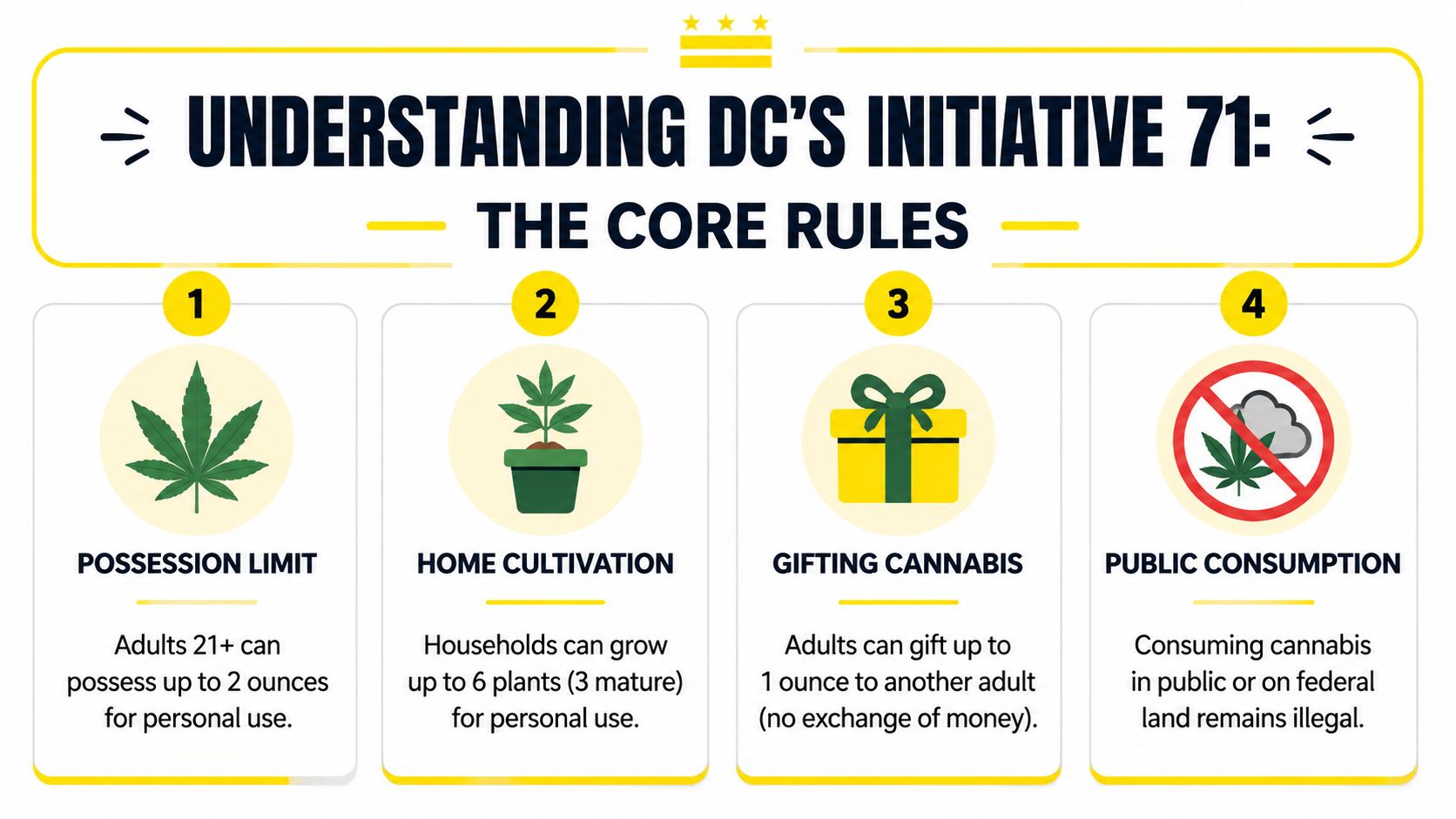
The core rules: Adults 21 and older may possess up to 2 ounces of marijuana, grow up to 6 plants at home with no more than 3 mature, transfer up to 1 ounce to another adult without payment, and possess marijuana paraphernalia.
Possession is legal under local law, up to the limit
If you are 21 or older, Initiative 71 allows you to possess up to 2 ounces for personal use in DC. A good way to read that rule is like a speed limit sign. It gives you a boundary. It does not guarantee every road ahead is safe.
For you, that means the amount matters, but location still matters too. Carrying a legal amount under DC law can still turn into a problem if you bring it into the wrong place, especially places controlled by federal rules.
Home grow is personal, not commercial
DC also allows home cultivation within set limits. You can grow up to 6 plants at home, with no more than 3 mature at one time.
That rule is meant for personal use at a residence. It does not create permission to sell what you grow, stock a pop-up shop, or run a side business from an apartment. If you want a fuller local explanation of the rule structure, this breakdown of Initiative 71 in Washington DC gives helpful context.
Transfers are allowed only if no money changes hands
This is one of the easiest parts of the law to misunderstand. An adult can transfer up to 1 ounce to another adult without payment.
The phrase "without payment" does a lot of work here. If money is tied to the cannabis itself, you are no longer in the simple personal-transfer rule people often quote. That gray area is exactly why so many visitors get confused in DC.
Private use stays private
Initiative 71 gives room for possession and limited personal use. It does not create a right to smoke anywhere you happen to be standing. Public consumption can still bring unwanted attention, and carrying cannabis from a private residence onto federal property or into the Metro system can create risks people often miss.
If you remember one practical rule, use this one: keep your cannabis activity small-scale, private, and well within the stated limits. In DC, the difference between legal and illegal often comes down to where you are, who is involved, and whether money entered the picture.
How the DC Gifting System Actually Works
The phrase weed legalized in DC often leads people straight into the next confusing topic: gifting. If sales are illegal, why do people keep talking about "gifts," "donations," or buying something else first?
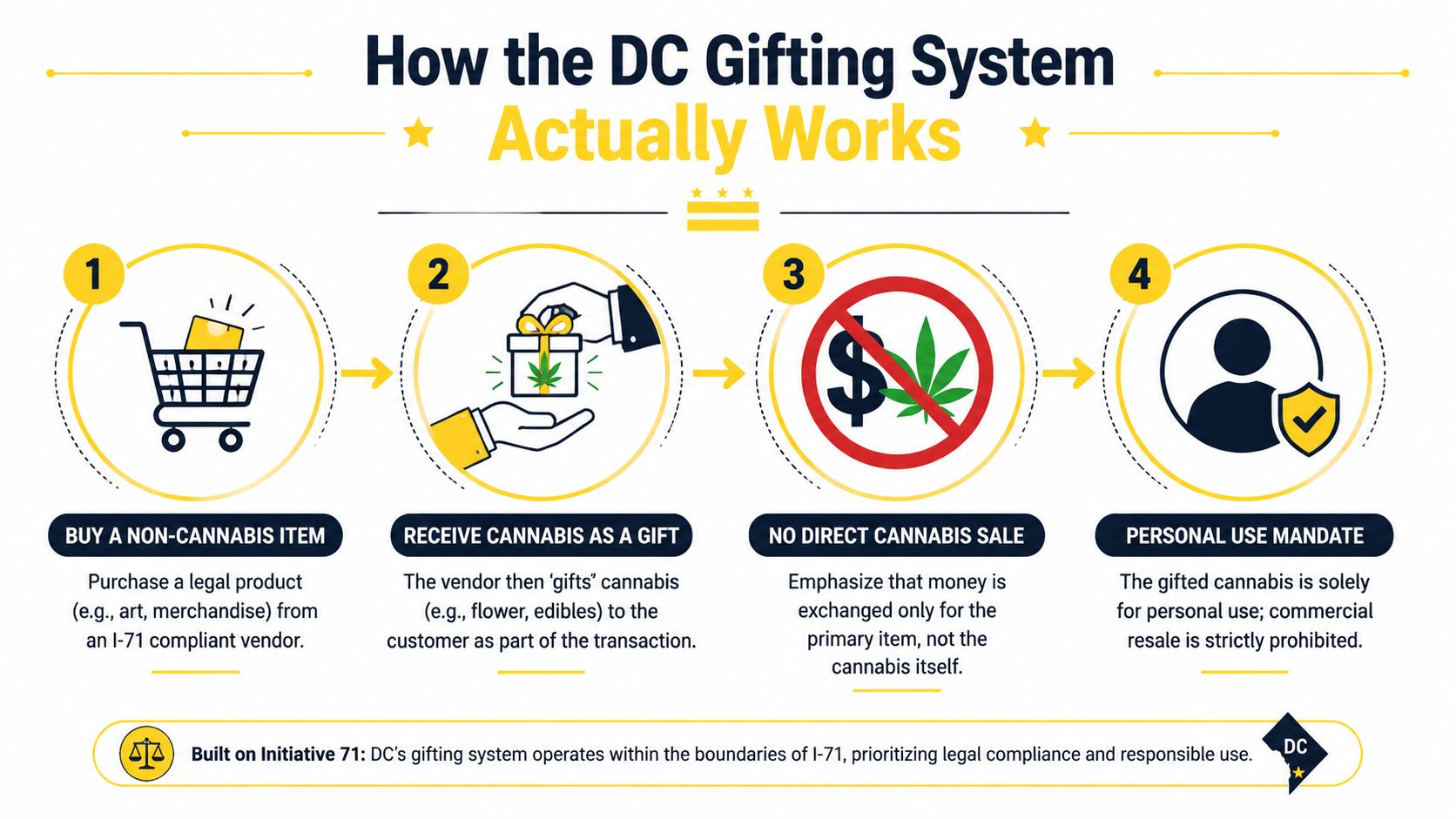
The short answer is that the transfer rule opened a gray market culture around non-cannabis purchases paired with cannabis gifts. The law allows an adult to transfer up to 1 ounce to another adult without payment. It does not create a normal retail sale.
The easy analogy
To illustrate, a business may present the transaction as buying a legal item, such as art or merchandise, and then receiving cannabis as a gift tied to that purchase. That's the concept people mean when they talk about the DC gifting system.
The important point is not whether the marketing sounds clever. The important point is that this exists because direct cannabis sales are not part of a standard adult-use retail system in DC.
For a local explanation of how people talk about this setup, see EZ Gifting DC.
A typical example people recognize
Here's a plain-language example:
- You place an order for a non-cannabis item.
- You pay for that item, not for cannabis as a line-item retail sale.
- Cannabis is presented as a gift connected to the transaction.
- You leave thinking it felt like a store, even though DC law doesn't treat it like a standard recreational dispensary model.
That last part is what matters. It may feel like ordinary retail, but the legal structure isn't the same.
A short visual walk-through can help if this still sounds abstract.
Why visitors should be careful
Visitors often assume gifting is the same thing as lawful recreational commerce. That's too simplistic. The gifting economy developed around a legal gap, not a conventional licensing framework.
Treat gifting as a gray-area access model, not the same thing as buying from a licensed adult-use dispensary in a state with a full recreational market.
A practical takeaway: if you want the highest level of legal clarity, the medical channel is the cleaner one in DC. If you're dealing with gifting, understand that you're operating in a space shaped by the ban on direct adult-use sales.
Staying Compliant Common Cannabis Mistakes to Avoid
The fastest way to get into trouble in DC is to focus only on what seems legal and ignore where it stops being legal. Local legalization did not erase federal law. It didn't make every sidewalk, park, train station, or public building cannabis-friendly.
According to the Metropolitan Police Department's marijuana guidance, marijuana remains illegal under federal law, and federal officers can still make arrests for any amount on federal land, including places like the National Mall and Rock Creek Park. The same guidance says marijuana is also prohibited on the Metro system and in public housing.

Mistake one, treating DC like one legal zone
DC is full of federal property. That's not a small technicality. It's one of the biggest practical boundaries in the city.
A common example: you're in a private residence and within local rules, then you head to the National Mall with cannabis on you. That move changes the legal picture. A lot of tourists don't realize that the federal land issue can matter just as much as the possession limit itself.
Mistake two, using cannabis in public
Public consumption is another frequent mistake. People assume that if possession is legal, stepping outside to smoke is no big deal. Under DC rules, that's the wrong instinct.
That includes the kinds of places people casually treat as harmless:
- Sidewalks and streets: Public space is not private-use space.
- Parks and open public areas: Even if it feels relaxed, that doesn't make it legal.
- Cars: A parked car in public isn't the same as private property for safe cannabis use decisions.
For more local detail on that issue, this guide to smoking in Washington DC helps clarify common misunderstandings.
Mistake three, thinking "everyone does it" equals legal
People also get comfortable when they see others acting casually. That's not a legal defense. The law still prohibits sales, public consumption, and possession in certain places even when the general vibe around cannabis seems loose.
A good DC rule of thumb is this: if the place is public, federally controlled, transit-related, or housing with federal restrictions, assume you need to pause and double-check.
That one habit will save a lot of people from preventable problems.
The Medical Cannabis Option Accessing Dispensaries
You get to DC, hear that cannabis is legal, and assume walking into a dispensary works the same way it does in other cities. In DC, that assumption causes confusion fast. The clearest retail path here runs through the medical program, which gives you a regulated way to buy from licensed dispensaries instead of relying on the looser gifting system.
That matters because the medical route gives you defined rules on verification, product testing, purchase records, and delivery. It feels less like guessing your way through gray areas and more like using an established process.

Why the medical route feels different
A good way to understand it is to compare two lanes. The gifting side can leave people wondering whether a storefront is operating in a gray area. The medical side uses a clearer checklist. Your age and identity are verified, the business is licensed, and the products come through the District's regulated system.
For a visitor or new resident, that structure removes a lot of guesswork. You still need to follow DC's possession and use rules, but you have fewer question marks about how the product was sold to you in the first place.
What access can look like
Say you want the most straightforward option available under DC rules. A licensed dispensary is usually the easier route to understand because the transaction is happening inside a system the District formally regulates.
If you need help sorting out eligibility, registration, or self-certification steps, this guide to medical card requirements in DC is a practical place to start. Mr. Nice Guys DC is one example of a local operator serving medical cannabis patients in Washington, DC.
Delivery and practical limits
Delivery can make the medical option more convenient, but convenience does not erase boundaries. Orders still involve identity checks and location rules. That last part is where people slip up.
A legal delivery address is not the same thing as every place in DC. If your hotel bans cannabis, if your building has its own restrictions, or if you're standing on federal property, the fact that the product came from a licensed dispensary does not give you a free pass. The medical system helps you buy more clearly. It does not override property rules, federal restrictions, or public-use bans.
That is the big practical lesson here. Buying through a dispensary can be the cleaner lane, especially if you want tested products and a defined process. Once the purchase is complete, the same local caution still applies. Where you carry it, where you use it, and whether you're crossing into federal space can still turn a legal purchase into a bad decision.
Your Practical Guide as a Visitor or New Resident
If you're just arriving in DC, keep your plan simple. The city's cannabis laws make the most sense when you think in terms of boundaries, not vibes.
Tips for visitors
If you're visiting for a weekend, a conference, or a quick trip, these are the habits that matter most:
- Stay grounded in private-space thinking: If you wouldn't confidently call the place private property, don't assume cannabis use is allowed there.
- Watch where you're walking: In DC, a normal sightseeing route can put you near federal property fast. Tourist-heavy areas create a lot of accidental risk.
- Don't treat Metro like a safe workaround: Transit is one of the places where people often relax too much and make a preventable mistake.
- Check where you're sleeping: Hotels, rentals, and other lodging may have their own rules. Even if local possession law is permissive, property rules can still get you removed or penalized.
- Use a local buying guide carefully: If you need a starting point for understanding access options, this overview of how to buy weed in DC gives a local snapshot, but you should still separate gifting culture from the regulated medical system.
If you're visiting, the safest mindset is not "weed is legal here." It's "some personal-use conduct is legal here, in specific places, under specific rules."
Tips for new residents
If you've just moved to DC, your decisions are a bit different.
A resident can spend time learning what private use means, what home cultivation requires in practice, and whether the medical route makes more sense than relying on informal access. A lot of confusion clears up once you stop comparing DC to fully recreational states and start treating it as its own legal ecosystem.
A few grounded habits help:
- Learn your building rules: Lease terms, condo policies, and housing restrictions can matter as much as local cannabis law.
- If you're interested in growing, keep it personal: Home cultivation is not a shortcut to commercial activity.
- Choose consistency over convenience theater: If an access method feels legally fuzzy, it probably is.
- Map your routine: Know whether your daily commute, workout spots, or hangouts bring you through places where local protections don't help.
Residents who do well with DC cannabis law aren't usually the ones who memorize every detail. They're the ones who understand where the traps are.
Frequently Asked Questions About DC Cannabis Laws
Can I take weed on the DC Metro?
No. The ACLU of DC says marijuana remains prohibited on the Metro system, on federal land, and in public housing, even though adults 21+ may possess up to 2 ounces under D.C. law, as explained in the ACLU of DC's marijuana rights guide.
Can I use cannabis on the National Mall or near federal buildings?
No. Those are exactly the kinds of places where people get confused because they are in DC but not protected the same way under local cannabis rules. If you're sightseeing, don't assume famous outdoor public areas are safe just because you're inside the District.
Is DC a normal recreational dispensary market?
No. That's the central misunderstanding behind many searches for weed legalized in DC. DC allows certain personal-use activity, but it does not operate like a standard adult-use retail market with normal recreational storefront sales.
What's the practical difference between gifting and the medical system?
The gifting model exists in a gray area shaped by the rule against direct sales. The medical system is the regulated channel. If you're trying to reduce guesswork, the medical side is generally the clearer path because it runs through formal compliance rules rather than workaround-style transactions.
If you want a more straightforward way to follow DC cannabis rules, Mr. Nice Guys DC offers educational resources and medical cannabis access for adults using the District's medical framework. For many residents and visitors, that's the simplest way to avoid the confusion that comes with DC's unusual mix of legal possession, no standard recreational retail market, and strict location-based restrictions.
Mr Nice Guys DC
At Mr. Nice Guys DC, we’re more than just a cannabis delivery service — we’re passionate advocates for quality, convenience, and community. With years of experience in the cannabis industry, our team is dedicated to educating and empowering customers across Washington, D.C. Whether you're a seasoned user or just starting your cannabis journey, our blog delivers trusted tips, product insights, and the latest updates from the world of weed. Stay informed, stay elevated.
