
Must Be 21 To Enter
By entering this site you are agreeing that you are at least 21 Years of Age or older.
I AM 21 OR OLDERTHC Tincture for Drinks: Dosing, Mixing, and Recipes
.svg)

.png)
You're probably standing at the counter with a tincture bottle in one hand and a drink in the other, wondering whether adding a few drops to juice, tea, or sparkling water will feel like the sublingual dose you tried before. That's the exact moment where a lot of people get tripped up.
THC tincture for drinks isn't just a flavor decision. It's a delivery decision. The same bottle can act very differently depending on whether you hold it under your tongue or stir it into a beverage and swallow it.
Why Putting THC Tincture in a Drink Changes Everything
You pour half a dropper into seltzer, drink it with dinner, feel nothing at 30 minutes, and start wondering whether the bottle is weak. That setup catches a lot of first-time drink makers because the route changed, even though the product did not.
A tincture held under the tongue can absorb through oral tissue before you swallow. The same tincture mixed into a drink usually skips that step and goes through the gut and liver first. That shifts the experience toward edible-style effects, with slower onset, more variability, and a higher chance of the classic mistake of taking more too soon. One overview of tincture use notes that sublingual doses can come on within about 15 to 45 minutes, while swallowed doses may take much longer and show lower oral bioavailability (MMJ tincture guidance).
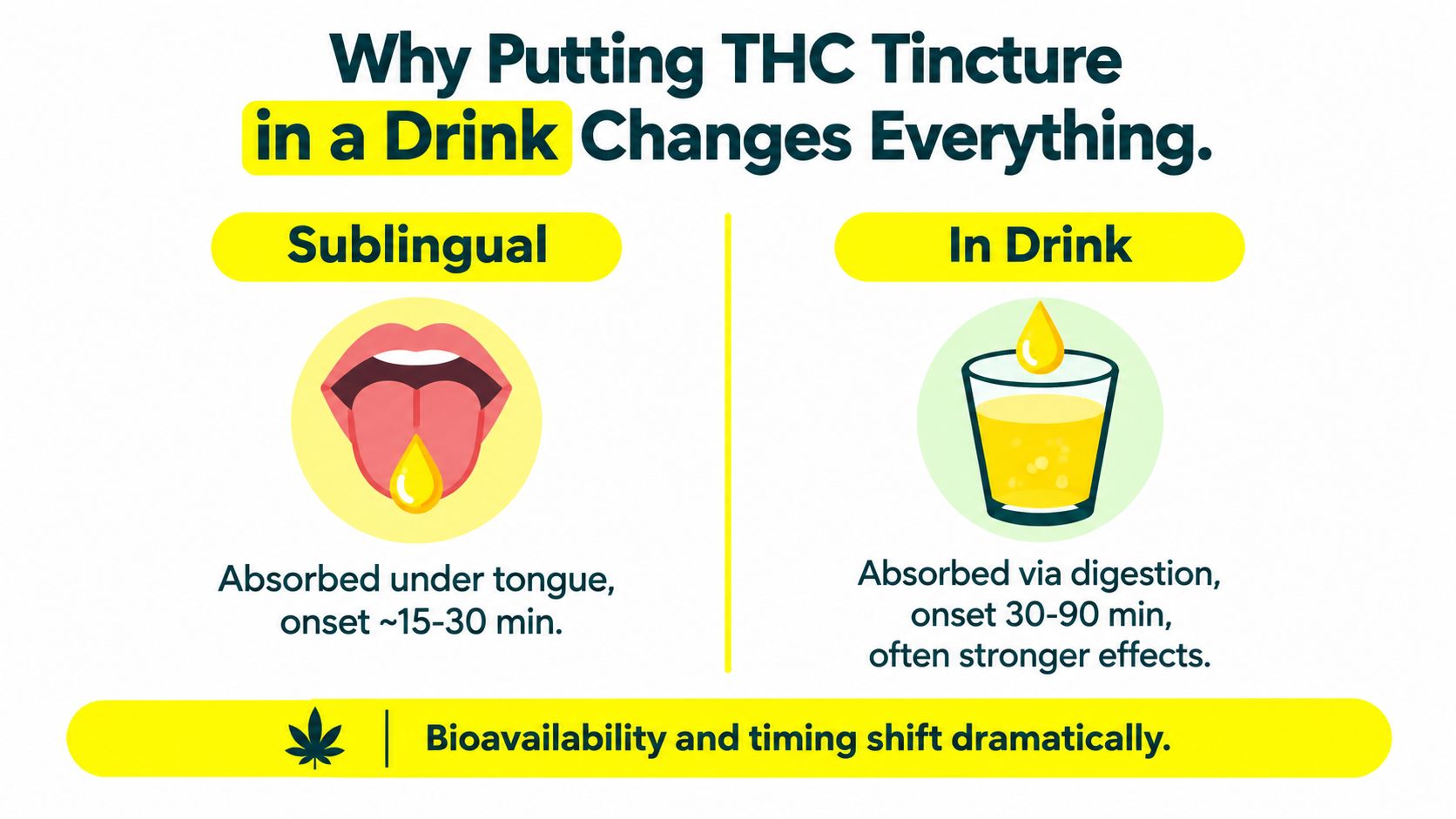
The other big variable is formulation. Oil-based tinctures in water do not mix. They break into droplets, float, cling to the glass, and get swallowed like a small edible dose spread through a beverage. Nano-emulsified THC products behave differently because the cannabinoid is dispersed into much smaller particles designed for liquid delivery. In practical terms, an oil tincture in lemonade often acts like a delayed edible. A well-made emulsified drink additive can act more like a fast beverage.
That distinction matters at the counter and at home. A patient might tell me, "I used 5 mg in tea and it hit harder than 5 mg under my tongue." That is believable. Swallowed THC is processed differently, and the liver converts part of it into 11-hydroxy-THC, which many people experience as heavier and longer-lasting than a comparable inhaled or partially sublingual dose. A pharmacy review on cannabis pharmacokinetics describes the first-pass metabolism and variable absorption that drive this difference (pharmacy pharmacokinetics review).
Three practical consequences follow:
- Oil tincture plus water is usually uneven. The first few sips can be light, and the last few can carry more of the dose if the liquid separates.
- Emulsified products are easier to dose consistently in drinks. They disperse better and usually produce a more beverage-like onset profile.
- Volume matters more than drop counts once you start mixing. If you are building a 12 ounce drink, measuring 0.25 mL or 0.5 mL is more reliable than guessing with random drops.
That is why THC tincture for drinks is not just a mix-in question. It is a delivery-method question with real trade-offs. If you want a clearer primer on how tincture formulations behave before you start experimenting, read the science behind marijuana tinctures and their effects.
Reading the Label and Calculating Your Dose
A first drink goes sideways fast when the math is loose. Someone fills a glass, squeezes in “half a dropper,” takes a few light sips, then finishes the rest and wonders why the last third feels twice as strong. That problem usually starts at the bottle.
Read the label for three things before you mix anything:
- Total THC in the bottle
- Bottle volume in mL
- Serving size on the label, if one is listed
Carrier type matters too, but for dose calculation the working number is milligrams per milliliter. That is the number you can measure.
| Bottle Strength | mL Volume | mg per mL | Approx. mg per 0.25 mL |
|---|---|---|---|
| 300 mg | 30 mL | 10 mg/mL | 2.5 mg |
| 600 mg | 30 mL | 20 mg/mL | 5 mg |
| 900 mg | 30 mL | 30 mg/mL | 7.5 mg |
A clinical example in The Permanente Journal uses this same logic. If a tincture contains 10 mg THC per 1 mL, then a 0.25 mL portion delivers 2.5 mg when the full measured amount is consumed (clinical dosing example).
Use the bottle math, not the drop count
Here's the clean formula:
total THC in bottle ÷ total mL in bottle = mg per mL
If a bottle contains 600 mg in 30 mL, the tincture is 20 mg/mL.
From there:
- 0.125 mL = 2.5 mg
- 0.25 mL = 5 mg
- 0.5 mL = 10 mg
- 1 mL = 20 mg
That is more useful than counting drops. Drop size changes with oil thickness, alcohol content, temperature, and the shape of the dropper tip. In a store, I never tell someone to build a drink around “about five drops” unless we have already tested that exact bottle and that exact dropper.
Match the dose to the full drink volume
This part gets missed. A 5 mg pour into 4 ounces of juice and a 5 mg pour into 16 ounces of iced tea contain the same THC, but they do not drink the same. With a larger drink, people often sip longer, the tincture can settle or cling to the glass, and dose timing gets murkier.
For drinks, measure the tincture first, then decide how much liquid you want around it.
A few practical starting points:
- 2.5 mg works for cautious testing
- 5 mg is a common entry point for people with some edible experience
- 10 mg in one beverage is where many newer consumers get surprised, especially if they drink it quickly
A simple glass-by-glass example
Say the tincture is 10 mg/mL and you want a low-strength 12 ounce drink.
Measure 0.25 mL. That gives you 2.5 mg total in the whole glass.
If you split that same pour between two 6 ounce glasses, each glass is 1.25 mg. If you accidentally pour 0.5 mL instead, you just made the full drink 5 mg. The difference is small in volume and very noticeable in effect.
That is why oral syringe markings beat guesswork. A marked dropper is fine if the lines are readable. An oral syringe is better when you want repeatability.
If you want more examples with common bottle strengths and serving sizes, this cannabis tincture dosing guide breaks the math down in a practical format.
As noted earlier, newer consumers usually do better starting low and waiting before adding more. That matters even more in drinks, where the same THC number can feel different depending on whether the product behaves like a swallowed tincture or a fast-acting emulsified beverage.
Emulsification and Carrier Liquids That Actually Work
You pour a measured dose into cold seltzer, give it one quick stir, and a slick ring forms on the surface. Patients bring me that complaint all the time at Mr. Nice Guys DC. The drink is not ruined, but the way it behaves matters because mixing affects both consistency in the glass and how the body handles that THC.
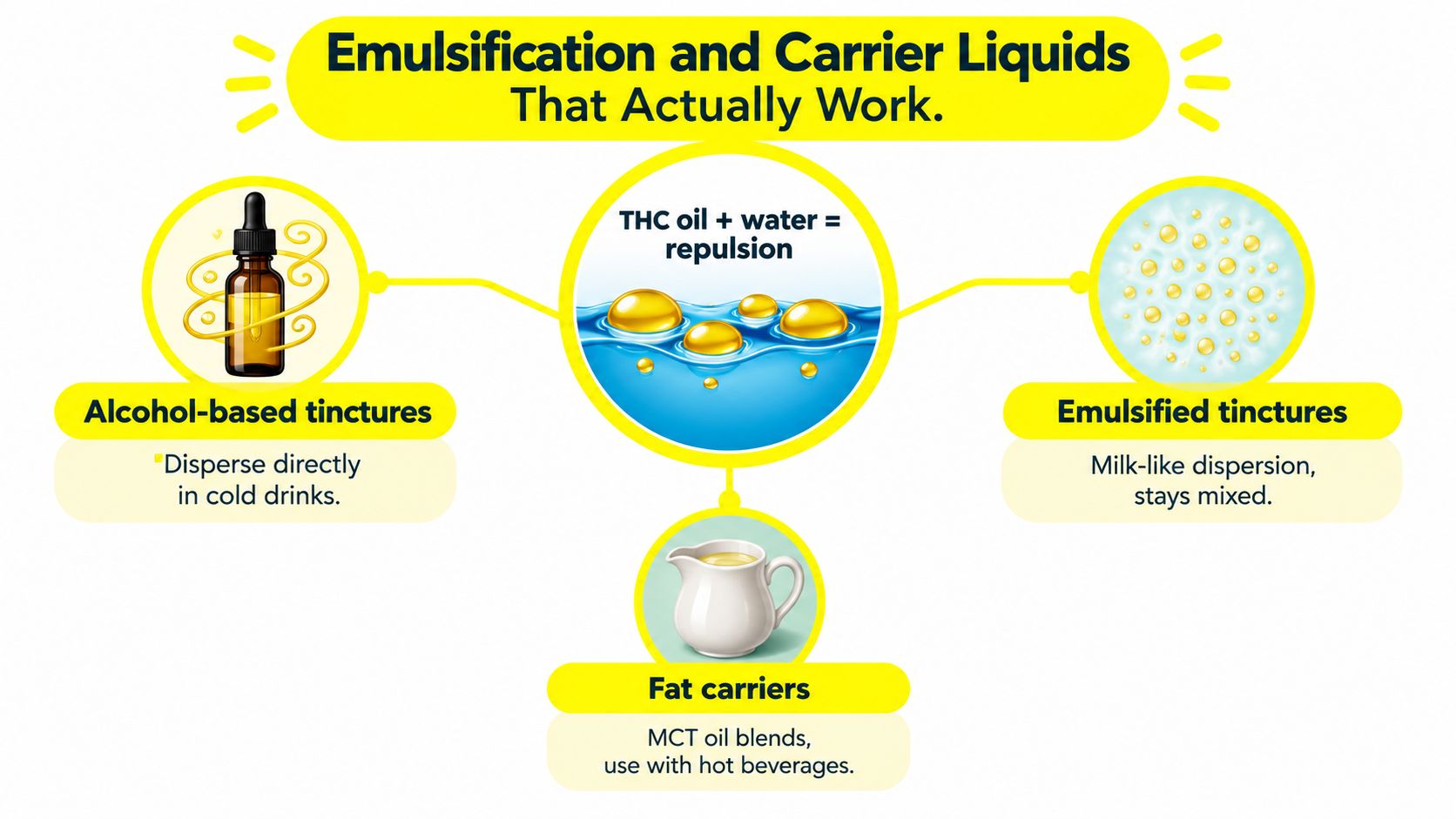
THC does not naturally stay mixed in water. If the tincture uses MCT or another oil carrier, the cannabinoids usually float, bead up, or stick to the ice and glass. In practical terms, that means one sip can be light and the last few swallows can hit harder if the liquid was not mixed well.
What each carrier actually does
Oil-based tinctures
These are the most common for direct oral use. In a drink, they usually act more like an edible than a true cannabis beverage. They can work in smoothies, milk drinks, or anything with some fat, but they are a poor fit for sparkling water, black coffee, or clear juice if you want an even pour from first sip to last.
Alcohol-based tinctures
These disperse better than oil in many cold drinks, especially if you stir aggressively or shake the drink in a sealed jar first. They still are not the same as a purpose-built water-compatible formula, but they usually leave less surface oil and less residue on the glass. If you are comparing carriers, this guide to cannabis tincture with 40 alcohol gives helpful context.
Emulsified or nano-emulsified products
These are formulated for beverages. The droplets are made small enough to stay suspended more evenly, which is why the drink looks and performs differently. That faster beverage-style effect people talk about is tied to formulation, not just the fact that THC was added to liquid. A beverage industry overview of nano-emulsified THC drinks hitting faster than standard formulations explains the mechanism in plain language.
What actually works in the glass
Match the tincture to the drink, not the other way around.
- Sparkling water, tonic, soda: best with emulsified products, acceptable with alcohol-based tinctures, frustrating with oil
- Smoothies, shakes, creamers: forgiving for oil-based tinctures because fat helps the mixture stay more uniform
- Black coffee or tea: often shows an oil film unless the product is emulsified or the drink includes creamer
- Juice and mocktails: cleaner results with emulsified formulas, decent results with alcohol-based tinctures if shaken well
A simple prep habit helps more than people expect. Add the measured tincture to a small amount of mixer first, stir or shake hard, then dilute with the rest of the drink. That does not turn oil into a water-soluble product, but it reduces pooling and gives you a more even serving.
This visual explainer is useful if you want to see those mixing pathways in action.
What emulsification does not do
It does not change the milligrams on the label. A 5 mg pour is still 5 mg. What changes is dispersion in the drink, how repeatable each sip feels, and often how quickly effects show up.
Stability matters too. Researchers publishing in Molecules examined cannabinoid beverage emulsion stability under different storage conditions and showed that formulation and temperature both affect how well these products hold up over time (study on cannabinoid beverage emulsion stability). That is one reason a fresh, well-formulated fast-acting beverage behaves differently from homemade oil drops stirred into club soda.
If the goal is predictability, use oil tinctures in fatty drinks, use alcohol tinctures in simple mixers, and use emulsified products when you want the drink to act like a drink instead of a swallowed edible in a glass.
Three THC Drink Recipes to Try at Home
The easiest way to keep drink dosing predictable is to build recipes around a known milligram target. Don't design the drink first and figure out the dose later.
A quick side-by-side
| Recipe | THC Dose | Tincture Type | Prep Time | Best For |
|---|---|---|---|---|
| Lemon tonic | 5 mg | Oil-based or MCT tincture | Short | First solo test |
| Social pitcher | 5 mg per serving | Measured tincture added per cup | Moderate | Group setting |
| Tropical mocktail | 5 mg | Nano-emulsified tincture | Short | Faster, cleaner blend |
Recipe 1: Lemon tonic
This is the simplest place to start if you want to learn how your tincture behaves in a glass.
Ingredients
- 1 mL of a 5 mg/mL tincture for a 5 mg serving
- 8 oz tonic water
- Ice
- Fresh lemon slice or squeeze of lemon
How to make it
- Add ice and tonic to the glass.
- Measure 1 mL of tincture.
- Stir it in hard, or shake it in a sealed jar first if it's oil-based.
- Finish with lemon.
What to expect
If this is an MCT tincture, you'll often see beading on top. That's normal. Shake or stir again before each sip.
With food
A small snack can make the experience feel steadier.
Recipe 2: Social pitcher
People usually make the big mistake here. They dose the whole pitcher, then lose track of who drank how much.
Build this by serving, not by guesswork.
Ingredients for four servings
- 20 mg total from a 10 mg/mL tincture
- Sparkling water
- Cranberry juice
- Lime juice
- Ice
Per serving
- 0.5 mL tincture for 5 mg
- 4 oz sparkling water
- 2 oz cranberry juice
- 1 oz lime juice
Mix each glass separately, or pour the liquids into a pitcher and add the tincture per cup as you serve. That keeps every person at 5 mg instead of relying on uneven mixing.
For a group drink, measured individual dosing beats a “shared infused pitcher” every time.
Recipe 3: Tropical mocktail
Use this one if you have a nano-emulsified tincture or beverage additive and want a cleaner texture.
Ingredients
- 5 mg nano-emulsified tincture
- 6 oz pineapple juice
- 1 oz coconut cream
- A splash of grenadine
- Ice
How to make it
- Add everything to a shaker with ice.
- Shake until the coconut cream is fully broken up.
- Pour into a chilled glass.
The reason this recipe works is texture. Pineapple and coconut hide minor cannabis notes well, and a nano formula usually blends much more evenly than an oil dropper.
Choosing the right one
Pick based on your goal:
- Want the simplest first test: Lemon tonic
- Need a low-dose social format: Per-cup cranberry sparkler
- Want a polished mocktail feel: Tropical nano blend
If you make infused drinks and food together, how to cook with cannabis has useful crossover tips on measured dosing.
Onset, Duration, and Strength Compared
A patient will often tell me, “I took 10 milligrams in a drink and it hit nothing like 10 milligrams under my tongue.” That is a real pattern, not user error. Putting THC tincture into a beverage changes the route of absorption, and route is what sets the clock.
Same cannabinoid, different clock
| Method | Typical onset | Peak | Duration | How it usually reads |
|---|---|---|---|---|
| Sublingual tincture | About 15 to 45 minutes | Earlier than swallowed formats | Moderate | Easier to track dose-to-effect |
| Oil-based tincture swallowed in a drink | Slower, often edible-like | Later | Longer-lasting | Can feel delayed, then heavier |
| Nano-emulsified beverage product | Faster in many formulations | Earlier than standard oral oil | More beverage-like | Often feels quicker and more even |
The practical split is simple. If the tincture is held under the tongue, part of the dose absorbs there before you swallow. If that same tincture is stirred into seltzer or juice and swallowed right away, you have changed it into an oral dose. With an oil-based product, that usually means a slower rise and a later peak. With a nano-emulsified additive, the experience is often faster and easier to read, which is why some infused drinks feel closer to a beverage than a brownie.
A 10 mg example that explains the confusion
Take the same 10 mg three ways:
- 1 mL of a 10 mg/mL tincture held under the tongue
- 1 mL of that same oil-based tincture mixed into a drink and swallowed
- 10 mg from a nano-emulsified beverage additive
The label matches. The timing usually does not.
That difference matters because people judge strength by speed. A slower oil-based drink can feel mild at first, then keep building after the person has already decided to pour more. A fast nano drink can feel stronger up front, even at the same milligram dose, because the onset gives clearer feedback sooner.
Why swallowed drinks surprise people
A peer-reviewed review found oral THC bioavailability around 6% ± 3% in a food product and 10% to 20% in a cannabis extract, compared with about 10% to 37% by inhalation (peer-reviewed THC bioavailability review).
That helps explain two common mistakes. First, inhaled tolerance does not transfer cleanly to drinks. Second, “nothing yet” at 20 or 30 minutes does not mean the dose failed, especially with an oil-based tincture in water.
At Mr. Nice Guys DC, this is the point where I tell first-time drink customers to compare products by format first, then by milligrams. Ten milligrams swallowed in an oily mocktail and ten milligrams from a nano beverage are the same on paper, but they do not always behave the same in the body.
For a fuller breakdown of how those format changes can feel in real use, weed tincture effects and timing by method is a useful companion read.
Hot Drinks, Alcohol Mixers, and Re-Dose Mistakes
A common first-time mistake goes like this: someone puts a measured amount of THC tincture into morning coffee, feels nothing after half an hour, adds more, then realizes at work or mid-errand that both servings are arriving together.
That usually starts with a bad assumption. A tincture in a drink is not automatically a fast drink.
Hot drinks can change consistency
Coffee and tea sound easy because they already have a strong flavor. The dosing problem is less about taste and more about control. If the mug is still very hot or the tincture is sitting in a pan on the stove, hold off. Add it once the drink is warm enough to sip.
That matters most with alcohol-based tinctures, which can throw off flavor and consistency faster in heat. Oil-based tinctures bring a different problem. They can separate, cling to the cup, or leave part of the dose behind if the drink sits too long. Stir, drink promptly, and do not assume the last sip matches the first unless the mixture stayed uniform.
Alcohol changes the feel, not just the recipe
Mixing THC with alcohol makes dosing harder to read. The alcohol can lower your guard right when you need patience, and people stop measuring carefully once a drink feels social instead of medicinal.
Public health guidance from the CDC on cannabis and alcohol use together keeps the warning simple: combining them can increase impairment. In practice, that means a serving that felt manageable as a mocktail may feel much heavier as a cocktail.
For a first trial, keep the drink alcohol-free. Learn how that tincture behaves by itself first, especially if you do not yet know whether it acts like a swallowed edible or a faster beverage formula.
Re-dosing goes wrong for predictable reasons
The classic example is 5 mg in a coffee mug that holds 10 ounces. If the tincture is oil-based and swallowed with the drink, the person may not get useful feedback early. Adding another 5 mg before the first serving declares itself can turn a light morning dose into a rough two or three hours.
The math is clearer if you work by volume. If your bottle contains 100 mg in 30 mL, each 1 mL dropper holds about 3.3 mg. A 5 mg serving is about 1.5 mL. If you pour that into a 10 ounce drink and then decide to drink only half, you did not necessarily take half the THC. Separation can make the top and bottom of the cup behave differently.
A review of cannabis-infused beverages notes that onset and absorption can vary with formulation, which fits what budtenders see every day in real use (review of variability in cannabis-infused beverages).
A simple rule works better than guesswork:
- Oil-based tincture in coffee, tea, or water-heavy drinks: wait longer before adding more
- Nano or emulsified beverage additive: you may feel it sooner, but give it a full read before topping up
- THC mixed with alcohol: expect less reliable self-assessment and a stronger overall effect than the label alone suggests
At Mr. Nice Guys DC, I usually tell patients to test new drink formats on a low-stakes evening at home, not at brunch, not before driving, and not during a shift. The dose on the label matters. The format, mixer, and timing often matter just as much.
Troubleshooting and Getting Personalized Help
Most drink problems come down to formulation, measurement, or timing. You can usually spot the issue fast if you know what to look for.
Quick fixes that solve most problems
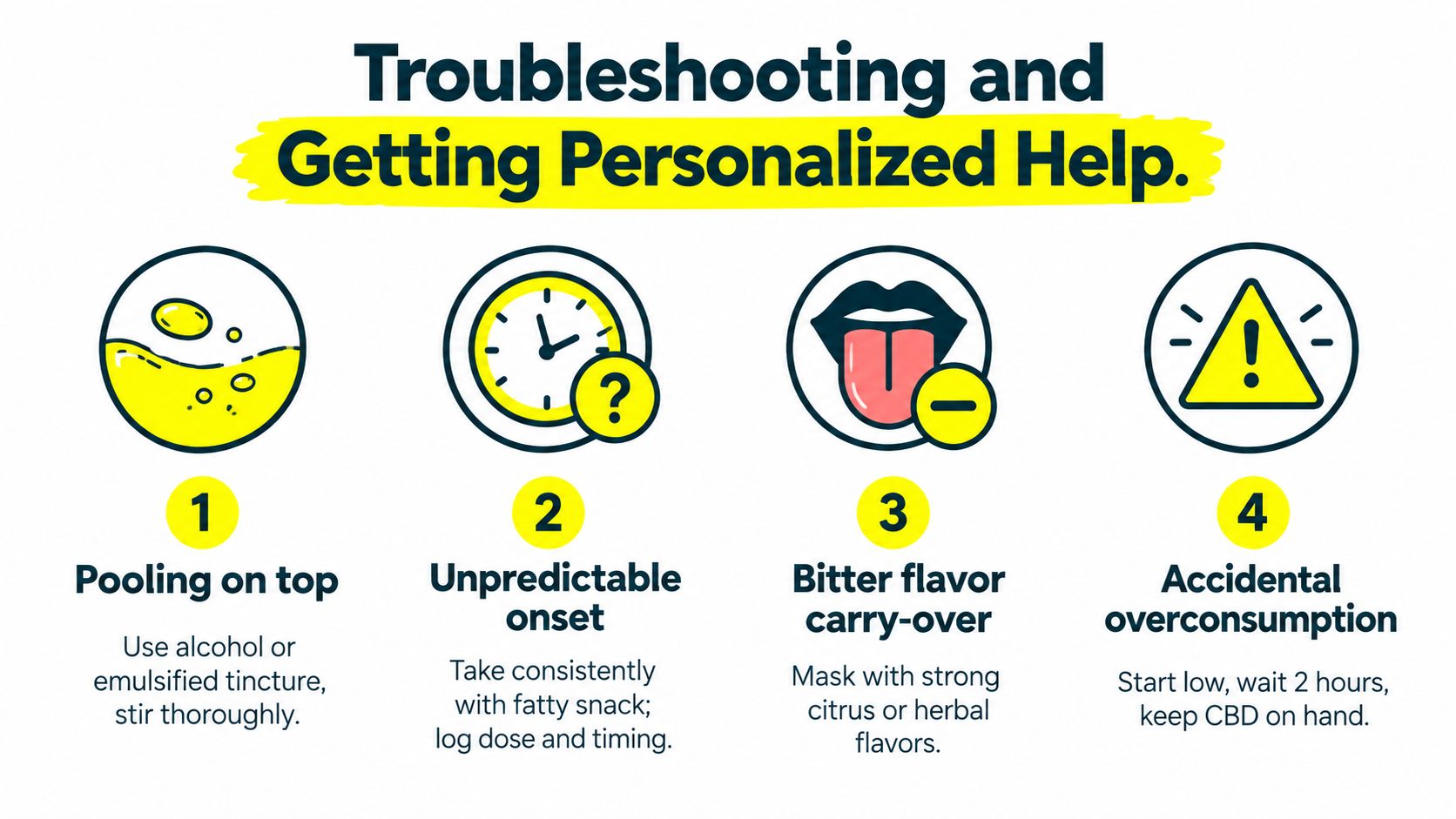
- Pooling on top: The tincture is likely oil-based and the drink is water-heavy. Use a richer mixer, shake harder, or switch to an alcohol-based or emulsified format.
- Unpredictable onset: You probably changed too many variables at once. Keep the same dose, same drink style, and similar meal timing for your next test.
- Bitter carry-over: Some tinctures bring plant or alcohol notes. Citrus, tonic bitterness, cranberry, and simple syrup usually mask that better than plain water does.
- Accidental double-dosing: The first serving may still be building. Log the time you drank it, then wait before deciding it missed.
What to bring when you ask for help
Don't walk into a dispensary saying you want “something for drinks” and leave it there. Bring specifics.
A better approach is:
- Take a photo of the label
- Know your usual serving goal, like a microdose or a stronger evening pour
- Name the drinks you make, such as coffee, tonic, smoothies, or mocktails
That lets a budtender compare carrier type, bottle strength, and realistic serving size instead of giving vague drop-count advice. If you're local, Mr. Nice Guys DC can match a tincture format to your tolerance, preferred drink style, and timing goal using the actual label math rather than guesswork.
If you want help choosing a tincture that fits the way you drink, the team at Mr. Nice Guys DC can walk through bottle strength, carrier type, and measured serving size with you. Bring a photo of your current tincture label and the kind of drink you want to make, and you'll leave with numbers you can use instead of trial-and-error.
Mr Nice Guys DC
At Mr. Nice Guys DC, we’re more than just a cannabis delivery service — we’re passionate advocates for quality, convenience, and community. With years of experience in the cannabis industry, our team is dedicated to educating and empowering customers across Washington, D.C. Whether you're a seasoned user or just starting your cannabis journey, our blog delivers trusted tips, product insights, and the latest updates from the world of weed. Stay informed, stay elevated.
