
Must Be 21 To Enter
By entering this site you are agreeing that you are at least 21 Years of Age or older.
I AM 21 OR OLDERTHC Edibles Near Me: A Friendly DC Buying Guide
.svg)

.png)
You're standing on a DC corner with your phone in hand, searching for “THC edibles near me.” The results show dispensaries, gifting services, delivery pages, old menus, and reviews that don't always explain what you'll receive. You still need answers: Is the product legal? How much THC is in one piece? Does the shop deliver to your neighborhood, or does “nearby” only mean nearby on a map?
Buying well in Washington, DC takes more than choosing the closest listing. You'll want to identify the access channel, inspect the menu and labeling, compare pickup with delivery, and ask how the product was tested and packaged. This guide walks through those decisions in plain language, from the District's Initiative 71 framework to your first dose at home.
Finding THC Edibles Near Me Without the Guesswork
A smart local search starts by separating location from reliability. A storefront may appear close to you but offer an unclear menu, limited product information, or delivery coverage that ends several blocks away. Another option may have a better menu but only accept orders during certain windows.
Start with the information you can verify
Open the menu before you make a decision. Look for the format, milligrams per serving, total milligrams per package, ingredient information, and any available testing or compliance details. A listing that says “strong gummies” tells you very little. A listing that identifies the dose per piece lets you compare products without guessing.
Recent customer feedback can help, but read it for practical details rather than star ratings alone. Comments about order communication, packaging, pickup delays, and whether the menu matched the available stock are more useful than vague praise.
Practical rule: Treat “near me” as a request for a dependable buying experience, not simply the shortest route.
Compare fulfillment before you check out
DC shoppers commonly choose among walking into a storefront, reserving an order for pickup, using curbside service, or arranging delivery. Pickup may make sense if you're already downtown or want to speak with a budtender. Delivery may be more convenient when you're at home, but you'll need to confirm the service area, ordering window, identification requirements, and payment method.
A useful starting point is this DC dispensary search guide, then verify the current menu directly rather than relying on an old directory listing. Your shortlist should contain options with clear product details, a visible ordering process, and a way to contact the business if something changes.
By the time you're ready to order, you should be able to answer four questions: What channel am I using? What dose am I buying? How will I receive it? What will I do with it once I get home?
How THC Edibles Are Legal in Washington, DC
Washington, DC has a two-track cannabis system, and that's why online searches can feel inconsistent. Initiative 71 created a framework in which adults 21 and older can possess and grow limited amounts of cannabis, while the District's licensed medical cannabis system provides a regulated route for registered patients. The practical details matter because products, labeling, and testing can differ between channels.
Initiative 71 and the gifting model
The phrase I-71 gifting refers to a business model in which cannabis is presented as a gift connected to another purchase. The cannabis isn't supposed to be sold as a standalone item under that model. That distinction can make menus, pricing, and product descriptions look different from a licensed dispensary's retail menu.
A licensed dispensary operates through the District's regulated cannabis system and sells cannabis products directly within the rules that apply to its license. A registered medical patient may also have access to the medical program, where the dispensary, product labeling, and purchasing process follow that system's requirements.
“Legal” doesn't mean every product advertised online is equally transparent. Ask whether the seller is licensed, how the product is labeled, whether testing information is available, and what identification or patient documentation is required.
The channel comparison
| Channel | How It Works | Buyer Considerations |
|---|---|---|
| Initiative 71 gifting | Cannabis is offered as a gift connected to another purchase | Review the transaction carefully, ask about labeling, and understand what information is available |
| Licensed dispensary | Cannabis products are sold directly through a regulated retail channel | Menus, packaging, dosing details, and compliance information are generally easier to verify |
| Medical cannabis program | Registered patients purchase through the District's medical system | Confirm patient eligibility, identification requirements, and current purchase rules |
Possession and consumption rules still apply whichever route you consider. Don't consume in public, and don't assume that carrying cannabis across District or state lines is permitted. Before choosing a seller, read a current Initiative 71 guide for Washington, DC and confirm the seller's present status.
What THC Edibles Actually Are and Why They Feel Different
You pick up a gummy near your DC neighborhood, take it with a snack, and expect a quick change. Instead, the first hour may feel uneventful. That delay is the main reason edibles require a different approach from smoking or vaping.
A THC edible is food or drink infused with tetrahydrocannabinol, the cannabis compound responsible for the high. Gummies, chocolates, brownies, beverages, and tinctures fall under the broad edible category, yet their effects can vary with the formula, serving size, and what is in your stomach.
Smoking or vaping moves THC from the lungs into the bloodstream quickly. Eating it works more like a slow ferry than a bridge. The edible passes through digestion, reaches the liver, and undergoes first-pass metabolism before active compounds circulate through the body.
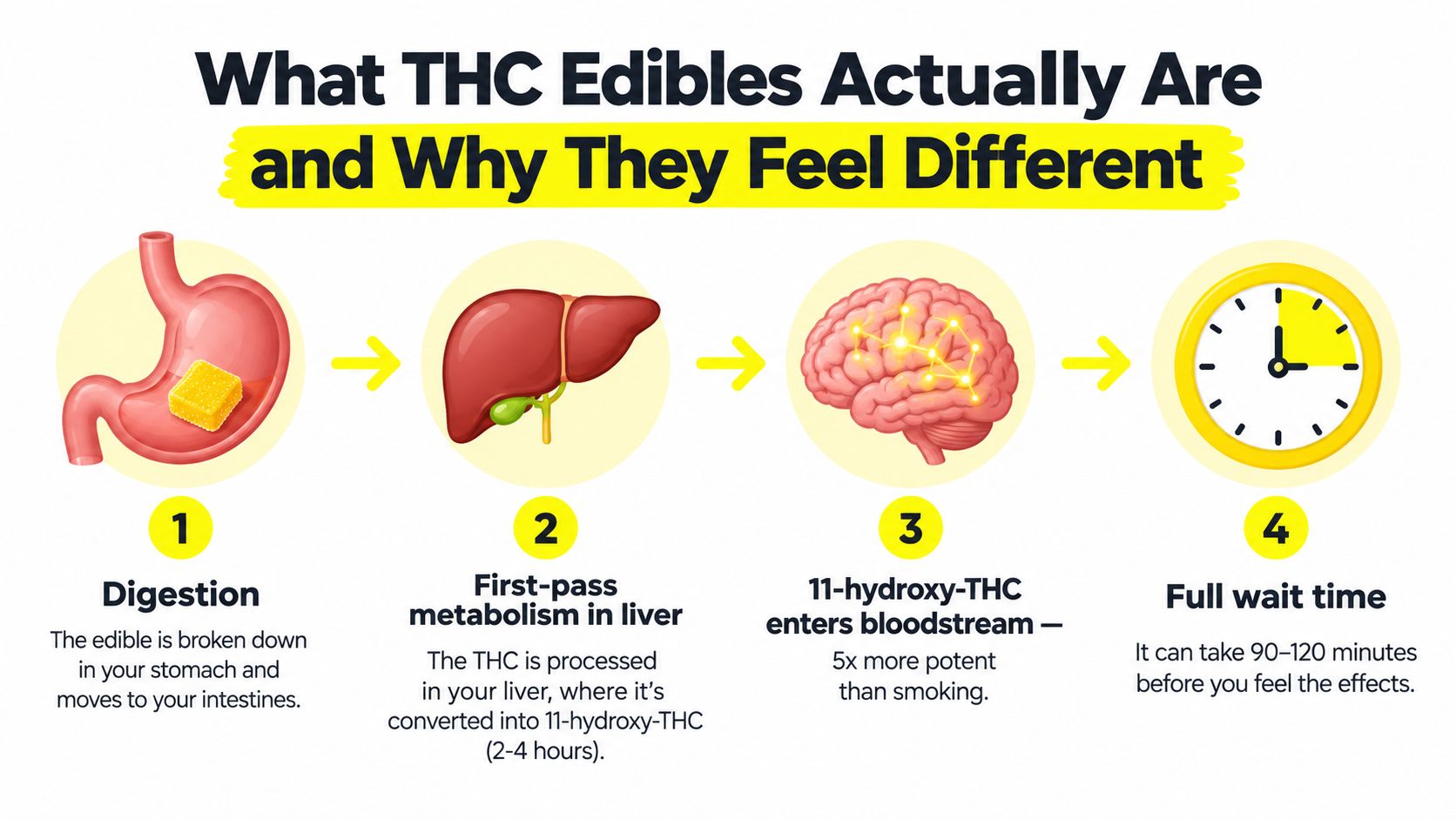
Published clinical data place oral THC bioavailability at roughly 4% to 12%, so the body absorbs a smaller and more variable share than many buyers expect from an inhaled dose. The liver also produces 11-hydroxy-THC, an active metabolite associated with a longer-lasting and sometimes more intense edible experience. Effects commonly begin in about 30 to 120 minutes and often peak around 2 to 4 hours after ingestion. Food, metabolism, formulation, and tolerance can shift that schedule. (Clinical review of oral cannabis pharmacokinetics)
The timing is the central difference
An edible may last longer than an inhaled session and can feel more body-led. That can suit someone who prefers not to inhale, but the delay creates a practical risk: taking another piece before the first one arrives can make both doses take effect together.
The same principle applies whether you order delivery, choose pickup, or use curbside service from a DC seller. Product format affects convenience, while digestion controls much of the timing.
For a clearer comparison, read this guide to edibles versus smoking. Judge the edible after its full onset window, not after the first few minutes.
Dosing THC Edibles the Way Experienced Buyers Do
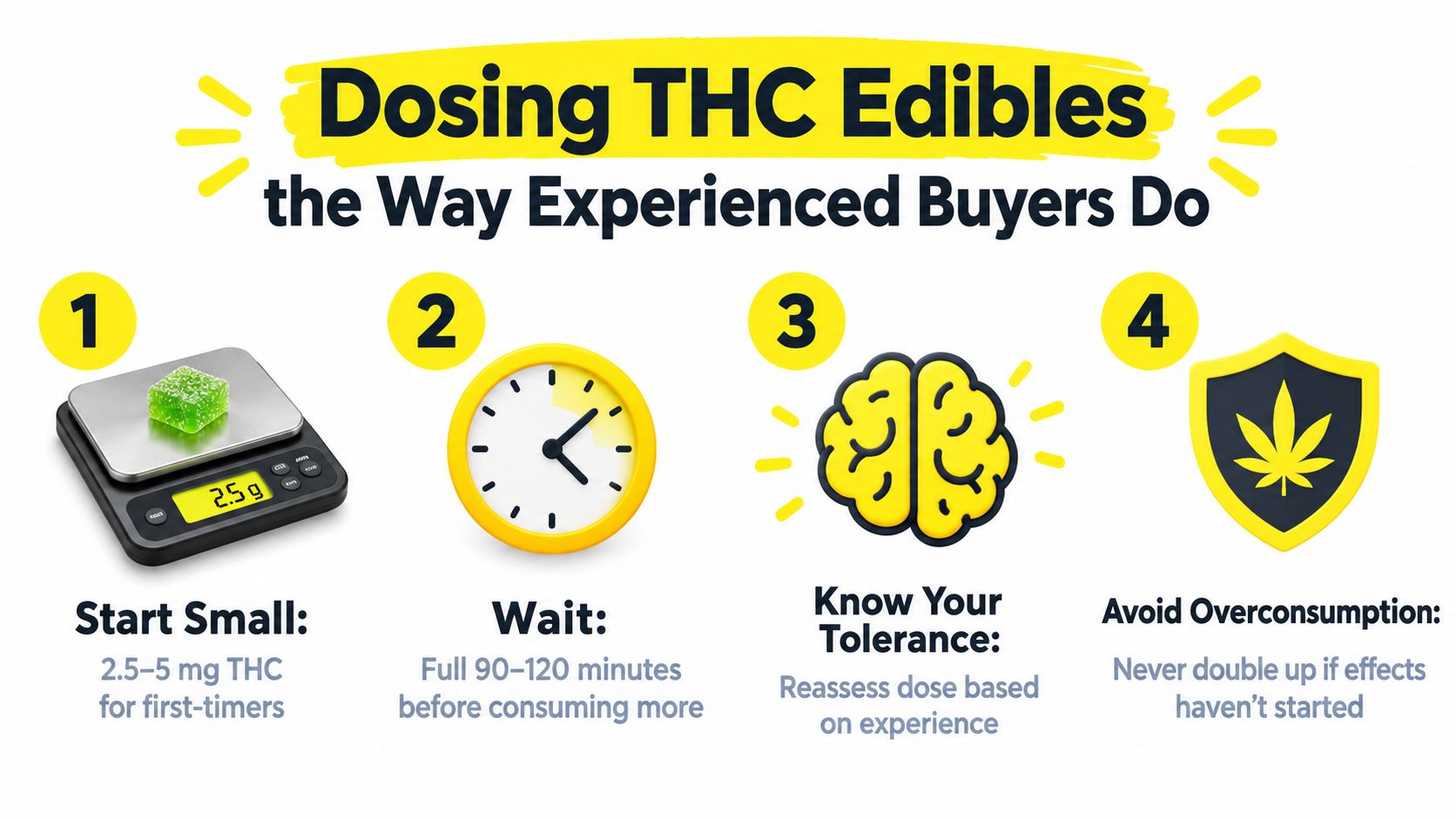
Experienced buyers don't treat dosing like a dare. They use a repeatable routine: start with a small amount, record the time, wait, and evaluate the full experience before changing the dose next time.
For a first experience, a starting range of 2.5 to 5 mg THC is commonly advised, followed by at least 2 hours before taking more. (Medical guidance on starting edible doses and redosing) The longer wait protects you from mistaking delayed onset for a weak product.
Read the label in two places
A package may show both the total THC in the package and the amount in one serving. Those figures answer different questions.
- Per serving: How much THC is in one gummy, square, can, or measured portion?
- Per package: How much THC is in the entire container?
- Serving count: How many individually dosed pieces or servings are included?
- Portion control: Can the piece be divided cleanly, or is each unit already individually measured?
A 50 mg package could contain five 10 mg pieces or ten 5 mg pieces. Those are very different shopping choices for someone new to edibles. If a gummy is scored, dividing it into quarters can help you make a smaller portion, although the THC may not be perfectly distributed unless the product is designed and labeled for that use.
Use a first-session example
Suppose you take one 5 mg gummy on a Saturday afternoon with food. Write down the time, keep your plans calm, and don't redose before the 2-hour mark. If the effect remains mild, consider adjusting by 2.5 mg at a later session, rather than adding more during the same uncertain window. This cannabis edible dosage chart can help you compare portions before ordering.
Never double up early, and don't mix your first edible with alcohol. A simple note on your phone containing the product, dose, time, food, and effect gives you useful information for the next session.
Choosing the Right Edible Format for the Moment
A Saturday concert, a quiet movie night, and a Friday evening at home call for different edible formats. Start with how you plan to use it, then compare serving clarity, portability, taste, and how much control you want over each amount. In DC's I-71 gifting market, menus may include familiar candy alongside beverages or tinctures, so a colorful package is only the starting point.
| Format | Typical Onset | Best For |
|---|---|---|
| Gummies | Delayed, with effects commonly appearing within 30 to 120 minutes | Portable, pre-dosed use and straightforward portioning |
| Chocolates | Delayed, with timing affected by digestion and the food matrix | A slower evening when taste matters |
| Baked goods | Delayed and potentially variable by portion and ingredients | Sharing only when every serving is clearly labeled |
| Beverages | Often chosen when a drinkable format feels more natural | A low-dose seltzer or other drink during a quiet wind-down |
| Tinctures | Timing depends on whether they're swallowed or held in the mouth | Measured, dropper-level adjustments |
A clearly labeled low-dose gummy can be easier to manage at a concert than a large baked item. A chocolate square may suit a planned movie-night treat, while a low-dose seltzer can provide a drinkable ritual without opening a bottle of alcohol. The right choice depends on the setting, your tolerance, and whether you need discreet transport.
Tinctures offer the clearest adjustment process. Measure a small amount, record when you take it, and evaluate the result on another day before changing the amount. This gives you a more consistent routine, although measured dosing cannot make every response predictable.
Candy remains a major part of the market. Cova's cannabis industry data and format analysis reports that candy represented 79% of edible dollar sales, while beverages and chocolates each represented 6%, and pills represented 5%. The same analysis reports that 42% of edible consumers prefer 10 mg or less, with 2.5 to 5 mg identified as the most popular range. These figures describe purchasing patterns, not a recommendation, and they show why “edible” does not automatically mean gummy.
For a first purchase, choose a format with clear serving information and a portion you can identify easily. Licensed dispensaries and I-71 gifting businesses may present similar products, but check the menu and labeling carefully before choosing pickup, curbside service, or delivery. Format helps, yet understandable dosing information matters more than flavor or packaging.
How to Actually Buy THC Edibles Near You in DC
A DC order usually goes more smoothly when you treat the menu like a checklist rather than a scroll through colorful product photos. Start by opening the dispensary's current online menu, then filter by edible type, serving dose, and availability.
A realistic ordering run
You're home in Northwest DC and want a small pack for the weekend. You select gummies, compare the milligrams per piece, check the package total, and remove anything that doesn't explain its serving size. Then you choose pickup because you'll be near the storefront later, or delivery if staying home matters more.
The online process commonly follows this pattern:
- Browse the menu: Confirm that the menu is current and that the product is available.
- Filter the selection: Sort by gummies, chocolates, beverages, tinctures, or another format, then compare dose information.
- Choose fulfillment: Select in-store pickup, curbside service, or delivery where offered.
- Complete the order: Add your items, provide identification details if required, and choose an available time window.
- Watch for confirmation: A text or message may tell you when the order is ready or when delivery is approaching.
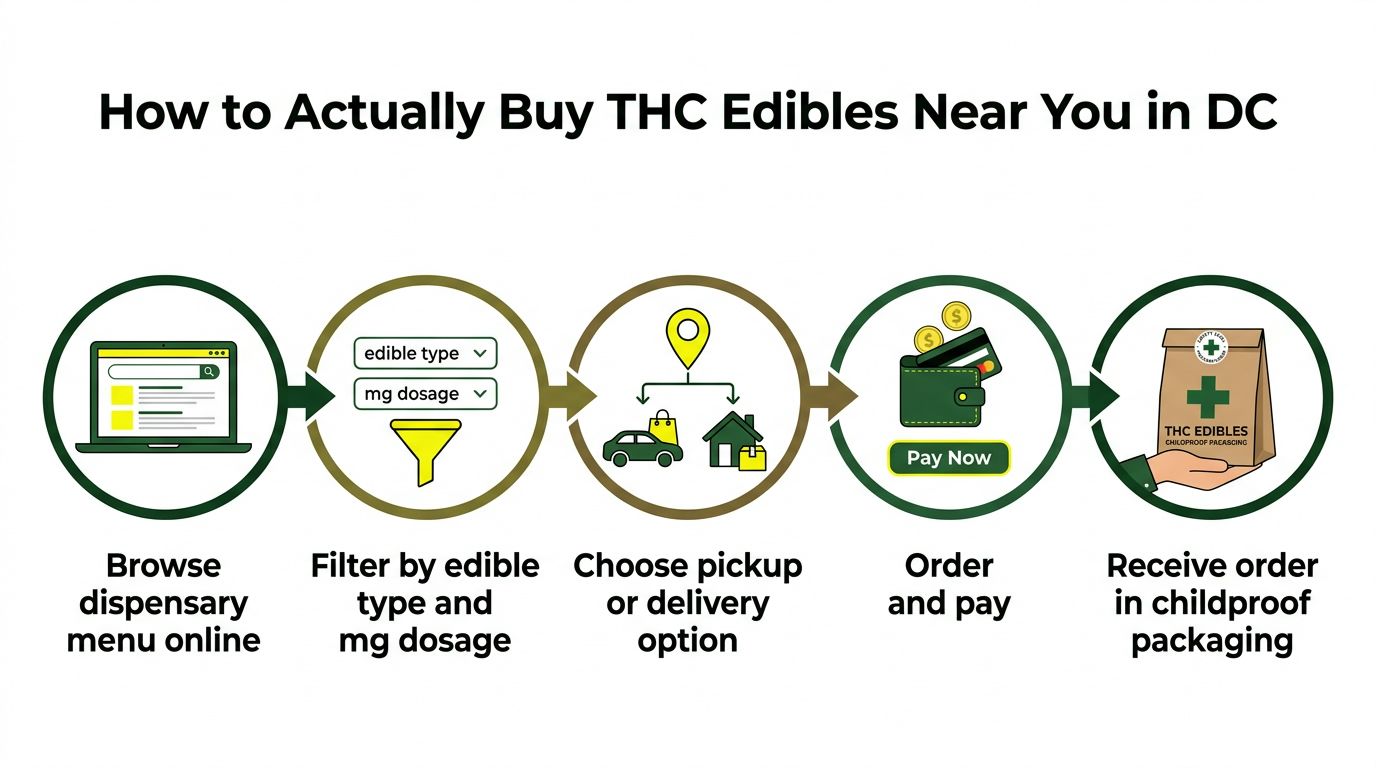
At pickup, expect an ID check and a chance to speak with a budtender. Ask whether the displayed dose is per piece or per package, and request help comparing a gummy with a beverage if timing is important. Discreet, child-resistant packaging is useful, but you should still check the label before leaving.
Delivery details vary by operator. Confirm whether your address is inside the service area, whether same-day orders have a cutoff, and whether payment is handled through cash, debit, or an app. Coverage may include DC and nearby Maryland or Virginia communities, but you shouldn't assume your suburb qualifies until the checkout page confirms it.
For a broader local overview, review this guide to where to buy edibles in DC. If the menu allows account orders, save a favorite product or reorder list. Your next purchase should take a couple of taps, not another long search.
Staying Safe With Edibles at Home and On the Go
Edible safety is mostly about preventing ordinary mistakes. The package may look like candy, and visitors or children may not recognize that it contains THC, so storage deserves the same attention as dosing.
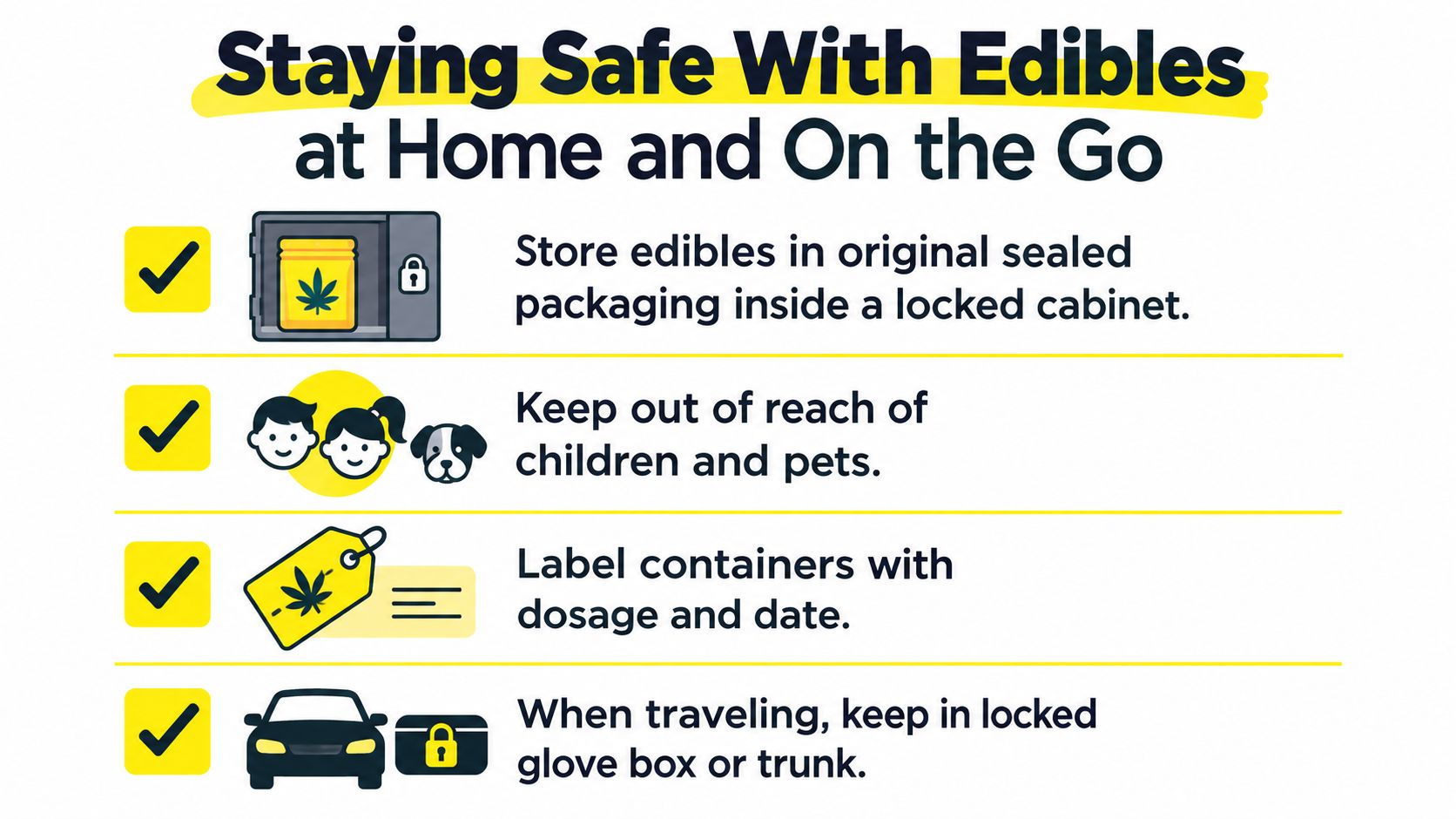
Use a simple home checklist
- Keep the original package: Store edibles sealed in their original packaging so the dose and product information stay attached.
- Lock them away: Use a locked cabinet or another secured, high location away from children, pets, and guests.
- Separate them from snacks: Don't place gummies or chocolates beside ordinary food where someone could grab them accidentally.
- Label personal containers: If you use a secondary container, identify the product, dose, and date clearly.
- Plan transportation: When traveling where permitted, keep cannabis secured rather than loose in a bag or visible in a vehicle.
Don't mix THC with alcohol, opioids, benzodiazepines, or sleep aids. Combined sedation can be unpredictable, especially when you don't yet know how the edible affects you. Choose a familiar, comfortable setting for a first session rather than a crowded bar, work night, or busy concert. Keep water and snacks nearby, and don't drive or operate machinery for at least 6 to 8 hours after dosing.
Children face particular risks from accidental ingestion. In one cited national poison-exposure dataset, the median THC dose among children who required respiratory support was 7.1 mg per kilogram. (Public-health reporting on pediatric cannabis ingestion) A few unattended gummies can therefore create a serious emergency.
If someone takes too much, move them to a calm, safe place, offer water, and remind them that the feeling is temporary. Don't let them drive or stay alone if they're frightened or confused. Call a trusted friend or Poison Control at 1-800-222-1222 if symptoms feel unmanageable, and seek urgent medical help for severe symptoms.
Putting It All Together With a Trusted Neighborhood Dispensary
A good DC edible purchase can follow a short decision flow:
- Confirm the channel: Choose a licensed dispensary or understand the terms of an Initiative 71 gifting transaction.
- Choose the format: Match a gummy, chocolate, baked item, beverage, or tincture to the occasion.
- Set the dose: For a first session, consider 2.5 to 5 mg THC, then wait before deciding whether to take more.
- Select fulfillment: Use walk-in service, pickup, curbside, or delivery based on your schedule and address.
- Store it properly: Keep the product sealed, labeled, and secured when you're not using it.
That approach turns a vague “THC edibles near me” search into a manageable purchase. You're comparing serving information, timing, legal channel, and convenience together instead of choosing based on distance alone.
Mr. Nice Guys DC is one local example of a medical cannabis dispensary offering clearly labeled edible products, online menus, budtender guidance, and in-store pickup, curbside, and delivery options. Its stated delivery coverage includes DC, Alexandria, Bethesda, Rockville, and Silver Spring, with products such as gummies, brownies, chocolates, and other edible formats available through its menu. The important questions remain the same wherever you shop: can you understand the dose, confirm the fulfillment details, and get help before you buy?
A neighborhood dispensary earns trust through practical details. A transparent menu reduces guesswork. A knowledgeable budtender can explain serving size without judgment. Flexible fulfillment helps you choose a safe, planned setting instead of rushing through an unfamiliar purchase.
If you're looking for THC edibles near you in DC, browse the current menu at Mr. Nice Guys DC, compare serving sizes and formats, and choose pickup, curbside, or delivery where available. Ask the team about a low-dose starting option and make sure your order is stored securely when you get home.
Mr Nice Guys DC
At Mr. Nice Guys DC, we’re more than just a cannabis delivery service — we’re passionate advocates for quality, convenience, and community. With years of experience in the cannabis industry, our team is dedicated to educating and empowering customers across Washington, D.C. Whether you're a seasoned user or just starting your cannabis journey, our blog delivers trusted tips, product insights, and the latest updates from the world of weed. Stay informed, stay elevated.
