
Must Be 21 To Enter
By entering this site you are agreeing that you are at least 21 Years of Age or older.
I AM 21 OR OLDERHow Much Is an Eighth? Weight, Price and Legal Limits


An eighth is one-eighth of an ounce, which cannabis retail rounds to about 3.5 grams of flower. That single jar sits in the middle of most dispensary menus, bridging a quick one-gram sample and a larger quarter-ounce purchase.
Still, if two jars on the same shelf both read 3.5 grams, why can one cost three times as much as the other, weigh noticeably less when you open it at home, and feel half as strong as the printed THC number promised? Most guides answer how much is an eighth with one quick unit conversion and stop there.
Weight alone won't tell you whether the buds inside match the package label, how much usable flower remains after stems and moisture loss, or whether you're getting fair value per verified gram. Breaking down retail rounding, current pricing benchmarks, label accuracy, and Washington, DC possession limits gives you a practical framework for judging every jar before you pay.
An Eighth Weighs About 3.5 Grams
An eighth represents 12.5% of a U.S. avoirdupois ounce, which cannabis retailers round to 3.5 grams of usable flower. State cannabis education materials from the New Jersey Cannabis Regulatory Commission define an eighth at approximately 3.5 grams within the standard ounce hierarchy, where one full ounce equals 28.35 grams.
Dispensary menus pair familiar imperial fractions with rounded gram labels so shoppers can compare jars without mental division. The table below matches the retail weight printed on most jars against the exact avoirdupois conversion reported in a Bloom Marijuana cannabis weight chart and shows how many eighths fit inside each tier.
| Unit | Retail grams | Exact grams | Eighths in it |
|---|---|---|---|
| One eighth (1/8 oz) | 3.5 | 3.54 | 1 |
| Quarter ounce (1/4 oz) | 7 | 7.09 | 2 |
| Half ounce (1/2 oz) | 14 | 14.17 | 4 |
| One ounce (1 oz) | 28 | 28.35 | 8 |
| One gram | 1 | 1.00 | 0.28 |
Reading the Ounce Hierarchy at the Counter
Eight standard eighths make one full ounce. Keep in mind that the word "eighth" describes mass and nothing else. It tells you nothing about strain genetics, cannabinoid percentage, bud count, or how many sessions you'll get out of the container. Two fluffy, stem-heavy buds and six dense, tightly trimmed nugs can both tip the scale at 3.5 grams while looking completely different inside the jar.
Say a customer picks up two eighths of different strains to last through the week. Those two jars total about 7 grams of flower, matching the weight of a single quarter-ounce bag while letting the shopper test two flavor profiles instead of committing to one. If you're deciding whether loose flower makes more sense than ready-to-smoke options for that same weekly budget, compare the tradeoffs in pre-rolls vs flower before placing your order.
Counter math: Multiply the number of eighths in your basket by 3.5 to get your total retail grams on the spot. Four eighths equal 14 grams, and eight eighths bring you to the 28-gram retail ounce.
What an Eighth Costs and Why Prices Vary
A 3.5-gram jar doesn't carry a single national price. Published 2026 benchmarks show a wide gap depending on whether you track city medians, multi-state packaged averages, or a mature single-state market.
| Source | Period | Figure | Scope |
|---|---|---|---|
| Ganja.com Cannabis Price Index | 2026 | Median $32 | 23 U.S. cities |
| Headset | September 2026 | Average $20.23 | Packaged 3.5 g eighth, 12 U.S. markets |
| California Department of Cannabis Control data | January to October 2026 | Average $21.34 | Packaged 3.5 g eighth, California |
In 2026, the median price of an eighth was $32 across 23 U.S. cities in the Ganja.com Cannabis Price Index. Looking specifically at packaged 3.5-gram jars across 12 U.S. markets in September 2026, retail analytics from Headset put the average price at $20.23. Over a longer window from January through October 2026, California's packaged 3.5-gram eighth averaged $21.34, according to state-attributed figures published by Vibe Cannabis.
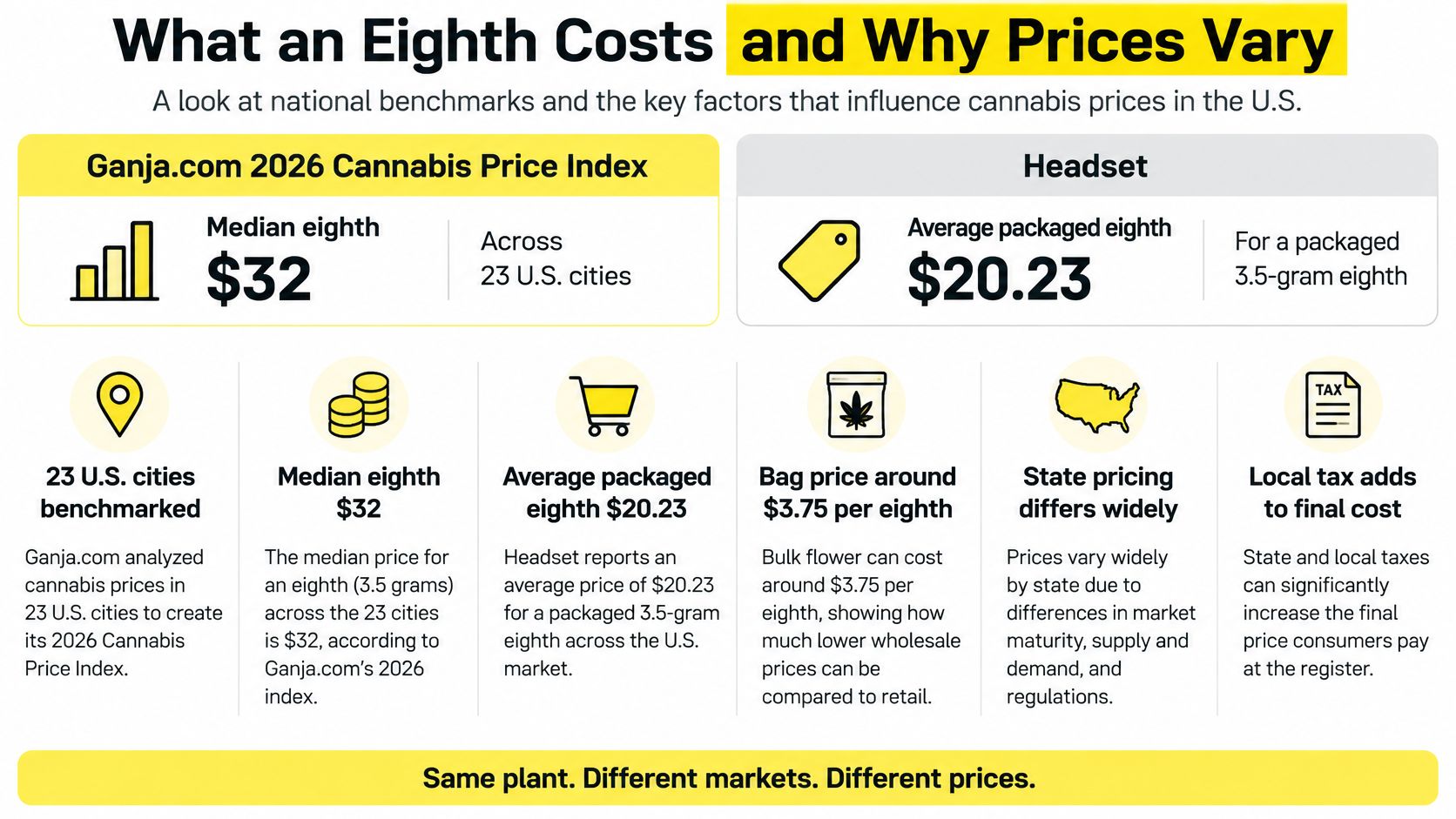
Those three numbers sit more than $11 apart for clear methodological reasons. A median reflects the middle price across 23 cities with very different licensing structures, whereas an average across 12 established markets reflects heavy discount volume in oversupplied states. Packaged jars also price differently from deli-style loose flower weighed to order, and some menus list pre-tax shelf prices while others bake local excise taxes into the sticker.
Five Factors That Move the Price of an Eighth
Eighths dominate retail shelves, accounting for 79% of flower sales in a 2021 industry survey published in the New Frontier Data Flower Report, with another 1% sold as a "farmer's eighth" carrying an extra 0.5 gram. In that same April 2021 snapshot, median gross sales spanned from $20 in the lowest price quartile to $60 in the highest. That spread comes down to five levers at the counter:
- Local tax rates: State excise taxes, city surcharges, and standard sales tax can push an identical shelf price noticeably higher at checkout depending on the jurisdiction.
- Flower quality tier: Indoor small-batch buds with intact trichomes and hand trimming cost more to grow than greenhouse or outdoor harvests.
- THC strength and strain demand: High-testing batches and newly released genetics command a markup even when lower-THC batches deliver smoother flavor.
- Brand and packaging: Glass jars with humidity packs and recognized cultivator labels add overhead that mylar house bags avoid.
- Pre-tax versus out-the-door quotes: Two dispensaries on the same street can post different shelf prices for the same brand, yet charge the exact same final total once taxes apply.
Looking at that $20 to $60 retail range shows why sticker prices mislead shoppers. Both jars contain 3.5 grams, yet dividing each total by 3.5 puts the cost per gram at roughly $5.71 on the budget shelf and $17 on the top shelf. Always divide your out-the-door total by 3.5 so you compare price per gram across jars, or weigh loose flower against typical pre-roll costs on the same menu.
Why Retail Rounds 3.54 Grams Down to 3.5
Type an ounce-to-gram conversion into a phone calculator and a small mismatch appears. One avoirdupois ounce equals 28.349523125 grams, which puts a strict mathematical eighth at 3.543690390625 grams. No dispensary menu shows that number.
The reason is practical. Printing four or five decimal places on every barcode sticker and state compliance label would slow down transactions and clutter tiny jar labels. Retailers round the figure down to 3.5 grams for clean math and easy scanning. That rounding is a labeling convention rather than a separate measurement system, which is exactly where shoppers get confused: the "⅛ oz" fraction and the "3.5 g" weight describe the same package, but only one of them is exact.
The exact arithmetic side by side:
- Retail rounding: 3.5 grams x 8 eighths = 28.00 grams
- Exact conversion: 3.5437 grams x 8 eighths = 28.35 grams
- Per-eighth gap: 3.5437 grams minus 3.50 grams = 0.044 grams (44 milligrams)
Precision standards for laboratory and commercial weighing work in fractions of a gram far smaller than anything flower retail requires. In everyday terms, 44 milligrams is roughly the weight of a tiny flake of trimmed leaf. Even if you buy four separate eighths to make a half ounce, the cumulative rounding difference comes to roughly 0.18 grams, too small to alter a normal week of sessions. The rounding gap only matters when it hides a real shortage, which is why the grams printed on your jar matter more than the fraction in the name.
How the Rounding Gap Adds Up on a Home Scale
Equipment limits matter far more than the 0.044-gram rounding gap when you weigh a jar at home. A standard stainless steel kitchen scale designed for baking flour and chicken breasts typically measures in 1-gram increments or loses accuracy below a single gram. A true 3.54-gram batch placed on that scale can flicker between 3 grams and 4 grams depending on where the buds sit on the tray. The scale's resolution, not the dispensary's rounding, creates that uncertainty.
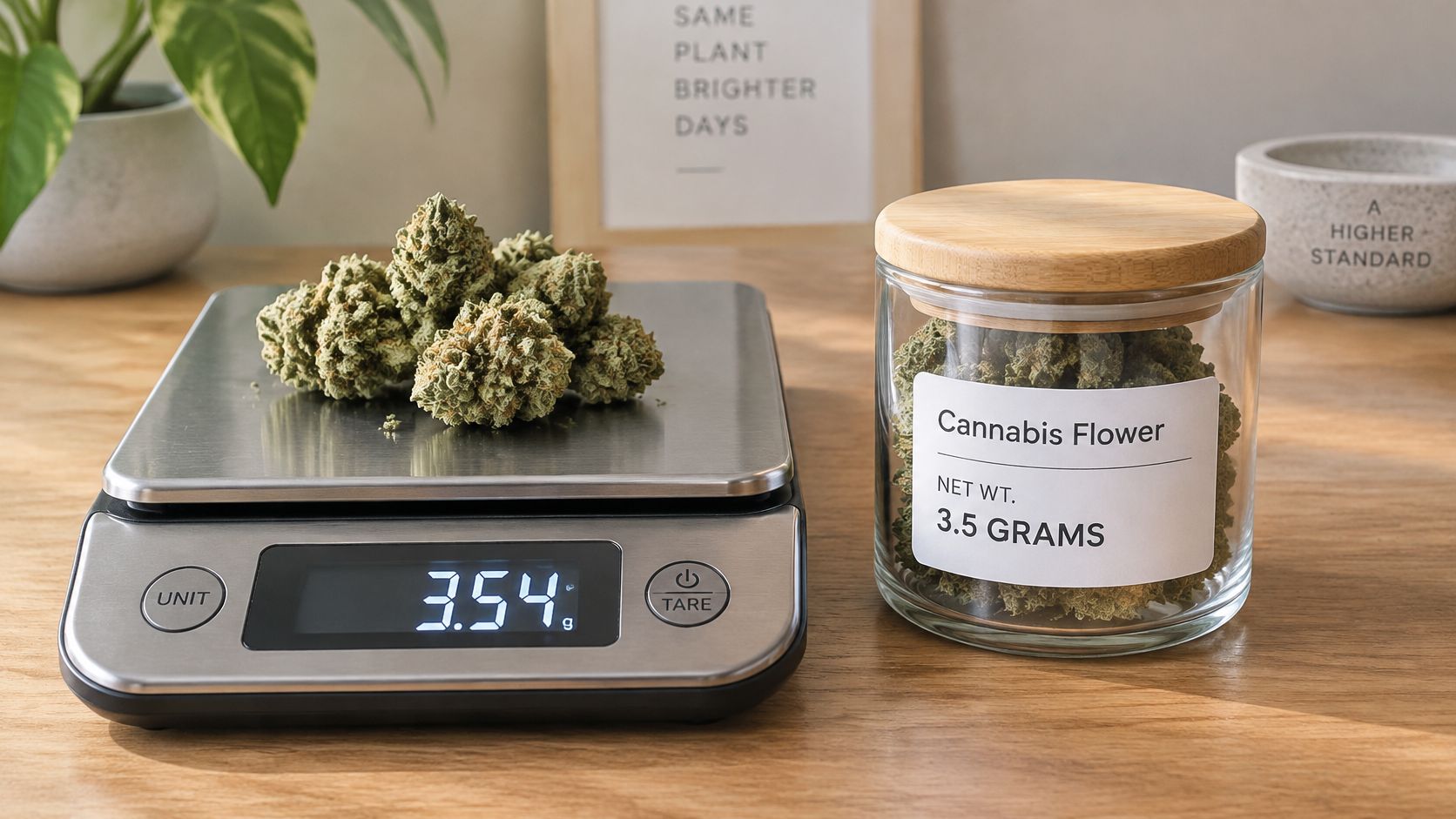
Treat the printed net weight in grams as the binding figure you paid for, and view the "⅛ oz" fraction on the label as the historical name behind that package size rather than a second weight guarantee.
To verify a jar accurately, skip the baking scale and use a pocket gram scale calibrated to 0.01 gram. That precision removes all guesswork around the 0.044-gram rounding gap and lets you spot genuine shortages that go well beyond ordinary rounding. Once you can trust the number on your scale, every price comparison in this article becomes a true cost per verified gram rather than a cost per sticker claim.
Checking the Weight and THC Label of Your Eighth
Knowing that a retail eighth targets 3.5 grams solves only half the puzzle. The harder question for patients and adult shoppers is whether the jar in your bag weighs 3.5 grams and delivers the potency printed on the front.
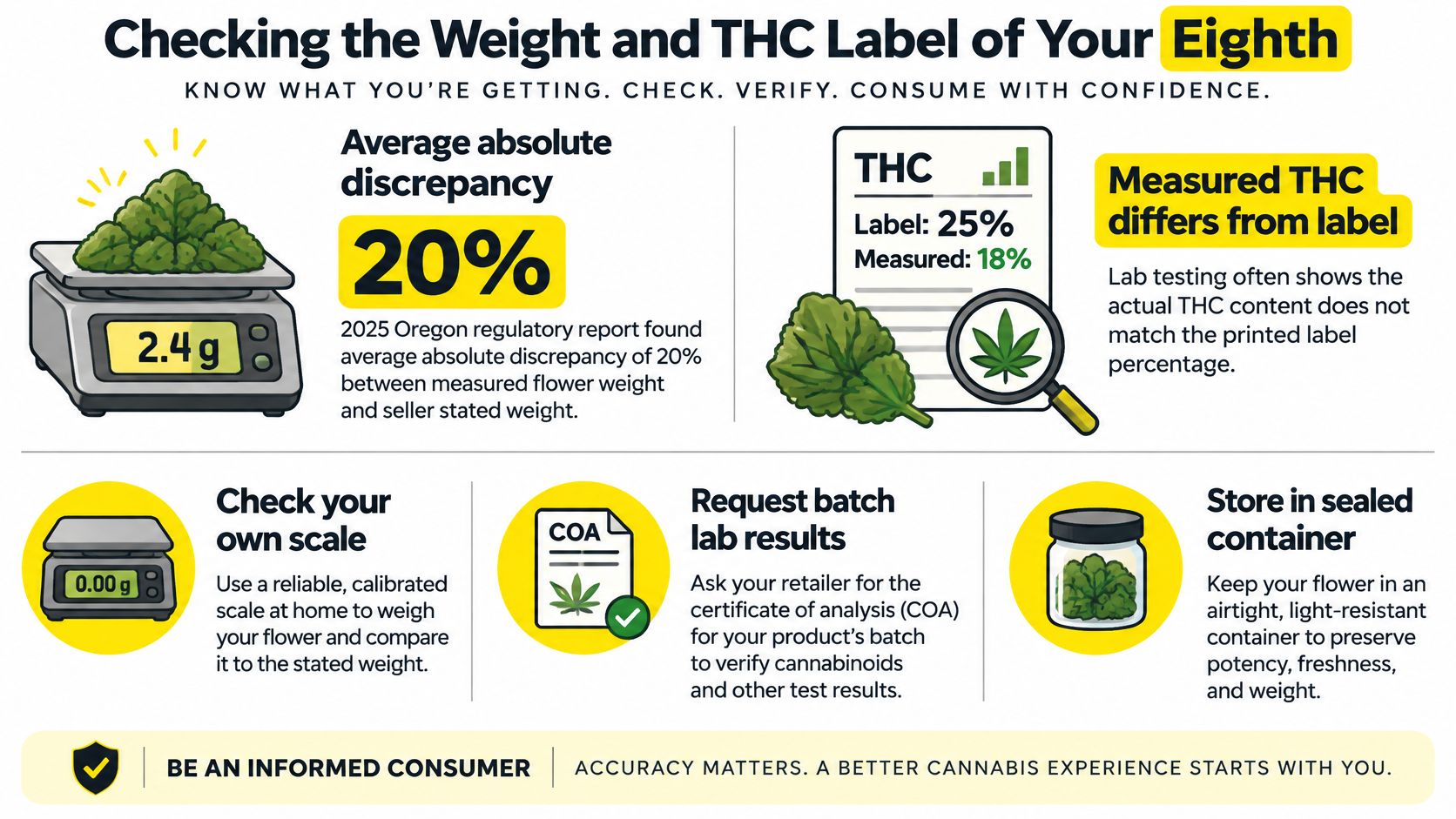
Two independent evaluations show why verifying both numbers pays off. First, an independent 2025 Oregon regulatory report published via PubMed Central documented an average absolute discrepancy of 20% between measured flower weight and the seller's stated weight, with a standard deviation of 28%. That means 3.5 grams functions as a commercial target rather than a guarantee inside every sealed container.
Second, a Colorado study of 178 flower products published in Scientific Reports found that only 56.7% landed within 15% of their advertised THC potency. Nearly 44% failed the state's accuracy threshold, and inaccurate labels overstated THC strength far more often than they understated it.
Why Stated Weights and Potency Labels Drift
Package weight rarely misses the mark for a single reason. Cannabis flower is an agricultural product that holds water. A jar packed at 3.5 grams right after curing can shed moisture during weeks on a dry shelf, dropping measurable mass without anyone skimming the container. Thick central stems and stray sugar leaves can also pad gross weight at packaging while leaving you with less smokeable bud.
Potency labels face a different set of pressures. Cannabinoid concentration varies even across buds harvested from the top and bottom branches of the same plant. Lab sampling practices, drying methods before testing, and degradation from heat or light in transit all shift active THC levels by the time you break the seal. Beyond that, THC percentage by itself doesn't reliably predict how strongly an eighth will hit you. Terpene ratios, minor cannabinoids, your current tolerance, and whether you vaporize or combust the flower all change the final effect. Reviewing how licensed shops vet batch paperwork under strict product testing standards helps separate reliable producers from inflated labels.
Five Steps to Verify Your Jar at Home
You don't need a lab bench to protect your budget. Run through this five-step check whenever you try a new brand or dispensary:
- Read the printed net weight first. Before leaving the counter, confirm the compliant packaging explicitly lists 3.5 g (or your intended weight) and includes a batch number and test date. That printed figure is the exact quantity the seller is accountable for.
- Weigh the contents on a 0.01-gram scale. Tare a small paper cup or weighing tray, empty the jar into it, and check the reading. Standard kitchen scales lose precision at small gram weights and can make an accurate jar look short.
- Separate heavy stems and loose shake. Pull out thick woody stems and stray debris before taking a second reading. Doing so shows how much usable flower you received rather than total plant matter.
- Check bud moisture by feel. Crisp, crumbly buds that turn to dust between your fingers have likely lost water weight in storage, while overly spongy buds may carry excess moisture that inflates scale weight and burns unevenly.
- Log weight alongside personal effect. Jot down the brand, measured weight, harvest date, labeled THC, and how a small single inhalation felt in a quick phone note before stepping up to higher-priced tiers.
Two Real-World Jar Checks
Numbers make this verification habit easier to picture. Say you buy three separate eighths during one trip, expecting 10.5 grams across the three jars. You tare your 0.01-gram scale at home, empty all three containers, and get a combined reading of 9.4 grams. That 1.1-gram gap goes far beyond retail rounding or minor drying, giving you a concrete figure and batch label to bring back to the shop's manager.
Now compare potency across three hypothetical 3.5-gram jars sitting side by side, labeled at 12%, 20%, and 28% THC. On paper, the 28% jar looks more than twice as strong as the 12% jar. In practice, if the 28% label was overstated and the flower sat dry for months, while the 12% or 20% jar stayed fresh and rich in aromatic terpenes, the moderate jar can easily produce a cleaner, more predictable session.
The safest test is simple: buy a single moderate-THC eighth first, start with one small inhalation, log the effect over a couple of sessions, and finish verifying that cultivator's consistency before paying extra for top-line THC claims.
Pick the Right Eighth for Your Budget
Once you know how to check weight and potency, picking a jar comes down to matching your consumption pace with real per-gram value. Work through these five decisions before you step up to the counter.
- Estimate how long 3.5 grams will last you. Occasional consumers who take a small bowl or two on weekends often stretch one eighth across several weeks. Frequent or daily medical patients may go through two or more eighths in a single month, making multi-jar or quarter-ounce pricing worth checking.
- Convert every sticker price to a per-gram rate. Divide the out-the-door cost by 3.5 instead of judging jars by their headline total. Comparing per-gram math against city and state averages keeps you from overpaying for flashy packaging.
- Inspect the compliance label before you pay. Confirm the printed net weight, batch lab results, and test date right at the register. Fresh harvest dates usually preserve better moisture and aroma than six-month-old jars sitting on clearance.
- Match the format to your routine. Loose flower delivers the most usable weight per dollar when you own a grinder and pipe or vaporizer. Pre-rolls and vape cartridges trade some of that raw weight value for zero prep time and quick portability.
- Ask about strain profile rather than chasing the highest THC number. At Mr. Nice Guys DC, our flower offerings range from classic strains to limited editions, so ask our staff to walk you through each batch's aroma, lineage, and typical effects to see whether a familiar staple or a small-batch drop fits your goals.
Comparing Two Dispensary Stickers Side by Side
Worked arithmetic makes the tradeoff clear. Suppose a menu lists a $30 eighth next to a $45 eighth. Dividing each price by 3.5 grams puts the first jar at $8.57 per gram and the second at $12.86 per gram.
At first glance, the $30 jar looks like a clear per-gram savings. Yet if that budget jar comes in light on usable flower because of stems, or requires twice as much material per session to reach the relief you want, the cheaper sticker quickly loses its advantage. Conversely, paying $12.86 per gram only makes sense when the jar delivers verified net weight, clean lab documentation, and consistent effects you've logged before.
A lower sticker price isn't automatically a bargain, and a higher sticker price isn't automatically stronger medicine. Value lives in verified grams and repeatable results.
Buy from a licensed, compliant shop, confirm the printed net weight on the package before leaving, and compare per-gram value across jars before choosing. If you're planning a trip in the District, our guide to buying pot in DC walks through what to expect at check-in and checkout.
How an Eighth Fits DC Possession Limits
Understanding an eighth as a fraction of an ounce also keeps you clear on local law, because Washington, DC writes its possession ceilings in ounces and grams rather than jars.
| Limit | Ounces | Approx. grams | Eighths (3.5 g each) |
|---|---|---|---|
| Adult possession limit, age 21 and older | 2 | 56 | 16 |
| Medical patient or caregiver, at any moment | 8 | 224 | 64 |
Adult Possession Versus Medical Patient Ceilings
Under guidance from the Metropolitan Police Department, adults age 21 and older in Washington, DC may possess or transport two ounces or less, with the department identifying one ounce as 28 grams. Possessing more than two ounces, or 56 grams, remains unlawful. Using the standard 3.5-gram retail eighth, two ounces equals 16 eighths. An adult carrying one eighth holds roughly one-sixteenth of that statutory ceiling, leaving wide legal headroom. Keep in mind that a legal ceiling is not a recommendation to carry the maximum, and separate District rules govern public consumption, vehicle transport, transfers, and federal land where cannabis remains illegal. For a broader look at how adult-use possession works alongside local storefront rules, review Initiative 71 in Washington, DC.
Medical cannabis follows a separate statutory track. Under the DC Code, the maximum amount of dried medical cannabis a qualifying patient or caregiver may possess at any moment is 8 ounces. At 3.5 grams per retail eighth, 8 ounces equals 224 grams, or 64 eighths.
Consider how small jars stack up under that patient limit. A registered medical patient picking up four eighths of different symptom-specific strains carries about 14 grams, or half an ounce. It takes 64 rounded eighths to reach the 8-ounce medical cap, though concentrates, edibles, and rolling purchase allotments carry their own equivalency rules. Because eligibility status, product type, and local regulations can shift, always confirm current possession and purchasing rules directly with DC regulators or a licensed medical dispensary before stocking up.
Looking for accurately weighed, lab-tested eighths with clear menus and knowledgeable guidance in Washington, DC? Mr. Nice Guys DC curates premium flower, pre-rolls, vapes, edibles, and concentrates for adults and medical patients 21+, with convenient in-store pickup, curbside service, and delivery across DC and nearby neighborhoods. Browse current strains or talk with our team at Mr. Nice Guys DC to pick an eighth that fits your goals and budget.
Mr Nice Guys DC
At Mr. Nice Guys DC, we’re more than just a cannabis delivery service — we’re passionate advocates for quality, convenience, and community. With years of experience in the cannabis industry, our team is dedicated to educating and empowering customers across Washington, D.C. Whether you're a seasoned user or just starting your cannabis journey, our blog delivers trusted tips, product insights, and the latest updates from the world of weed. Stay informed, stay elevated.
