
Must Be 21 To Enter
By entering this site you are agreeing that you are at least 21 Years of Age or older.
I AM 21 OR OLDERHow Long Do Vape Carts Stay Good: A Patient Guide
.svg)

.png)
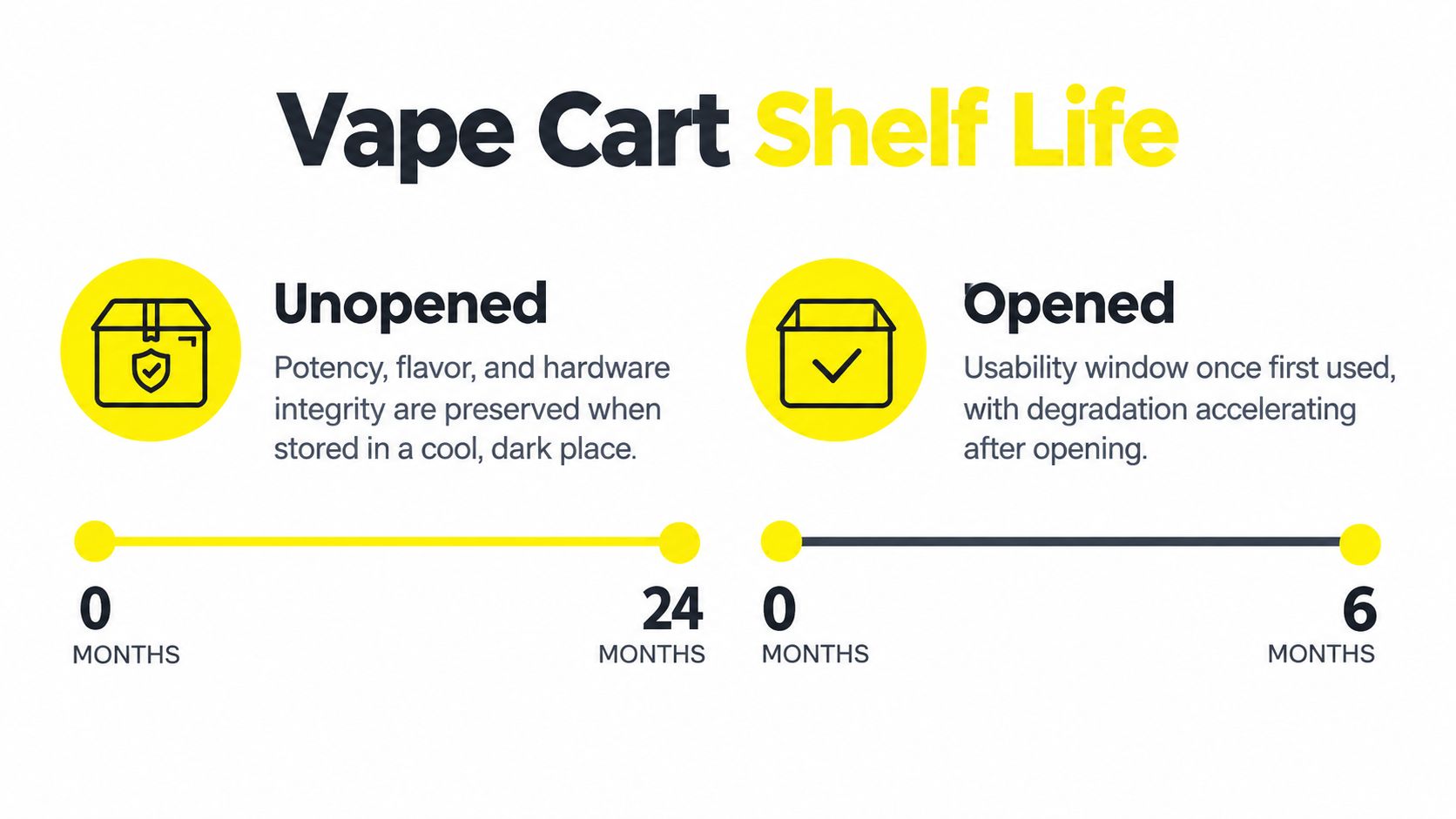
Unopened vape carts typically stay good for 12 to 24 months when stored cool, dark, and airtight, while opened carts are best used within 3 to 6 months. A cart left in heat, sunlight, or a warm car can lose quality much sooner.
Maybe you found an old cartridge in a bedside drawer, or you're standing at a DC dispensary deciding between a smaller cart you can finish soon and a larger one that costs less per gram. The label may show a date, but that date doesn't tell the whole story. A vape cart can still produce vapor after its best period has passed, yet the oil, flavor, effects, and hardware may no longer perform the way they did when you bought it.
For a patient asking how long do vape carts stay good, the useful answer isn't just “until the expiration date.” It depends on whether the cartridge is sealed, what kind of oil it contains, how it was stored, and what your eyes, nose, and first low-temperature test reveal.
What Shelf Life Really Means for a Vape Cart
A vape cart stays “good” while three things remain acceptable: the oil's potency, the vapor's flavor, and the cartridge hardware's ability to work properly. Those qualities don't always decline together. A cartridge may still connect to a battery and make vapor even after its aroma has faded or its cannabinoid profile has shifted.
For a practical starting point, treat an unopened cart as a 12-to-24-month product when it's sealed airtight and kept in a cool, dark place. Once you open it, aim to finish it within 3 to 6 months for the best flavor and experience. Broader guidance places properly stored carts somewhere between 6 and 24 months, while opened carts age faster because each use introduces air and repeated heat cycles. (Vaping360's shelf-life guidance)
Read the date as a guide
A harvest date, batch date, or printed expiration date gives you a useful reference point, but it isn't a magical switch that turns the oil bad at midnight. Storage conditions matter more than the calendar alone. An unopened cart kept in a closed drawer may hold up better than a newer cart carried through hot cars and sunny windows.
Use a simple patient check:
- Look at the oil. It should appear reasonably consistent, without troubling particles, severe separation, or dramatic darkening.
- Smell it carefully. A familiar cannabis or terpene aroma is more reassuring than a sharp chemical or mold-like odor.
- Judge the pull. A normal connection and smooth draw are better signs than leaking oil, repeated clogging, or a failing battery contact.
If the cart looks, smells, and pulls much like it did when you bought it, it's probably still within its useful window. For more guidance on choosing and using these products, review this overview of vape cartridges and pens.
Why Carts Age in the First Place
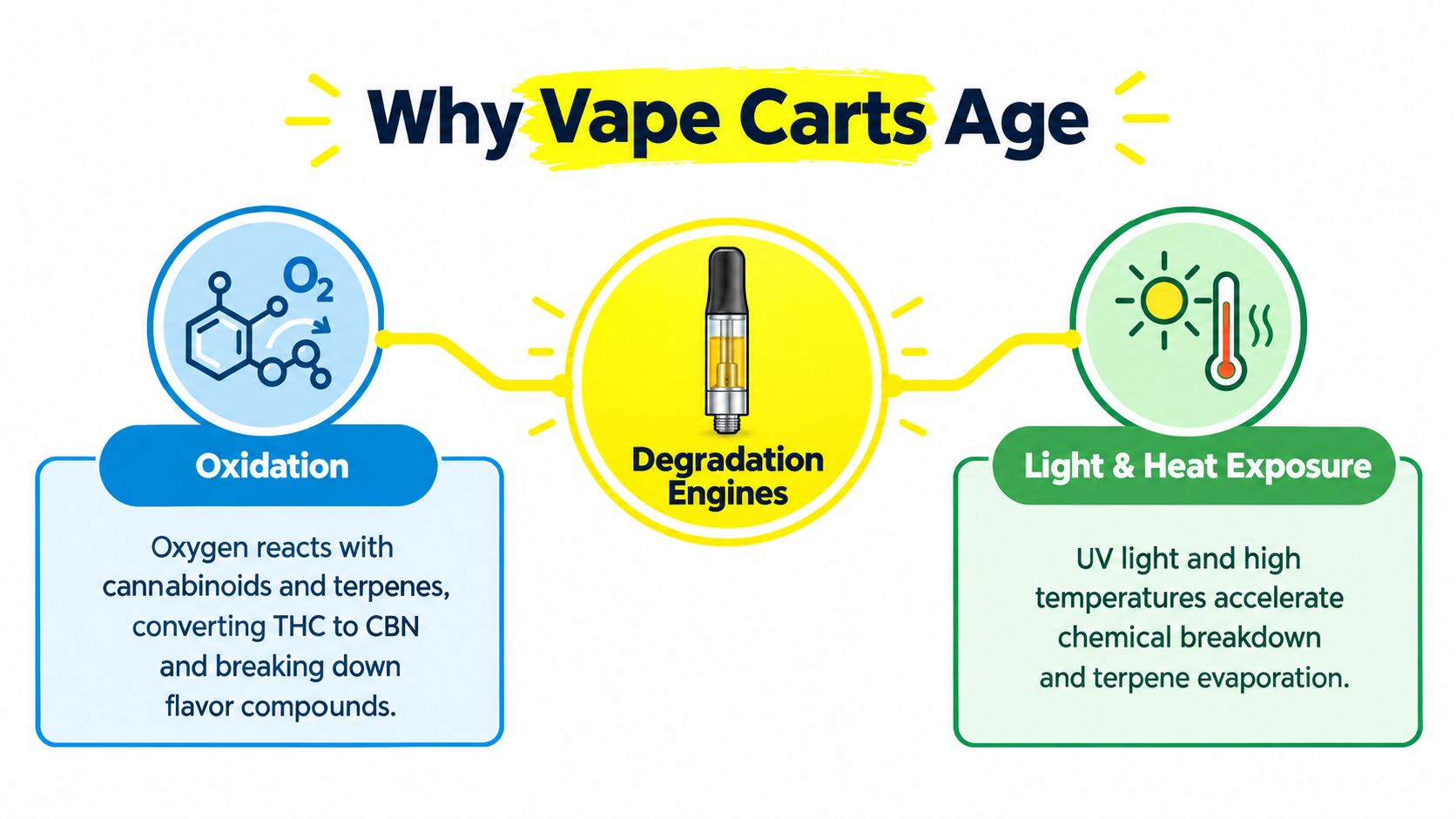
Two processes drive most of the quality loss: oxidation and terpene degradation. Heat and light speed both processes, while air becomes especially important after you open the cartridge.
Oxidation changes the cannabinoid profile
Think about a sliced apple left on a kitchen counter. It gradually turns brown because oxygen reacts with exposed compounds. Vape oil undergoes a comparable type of chemical change. Oxygen reaches the oil through the mouthpiece, small gaps in the seal, and air exchange caused by use.
A 2023 study summarized by Labroots found that cannabis powder stored in polyethylene vape cartridges at room temperature remained stable in function for at least 2 years, but its chemistry changed substantially during that period. CBGA fell by about 55%, THCA by about 44%, and total THC by about 21%, while CBN increased significantly. The aerosol dose stayed stable across the study window, which shows why a working cart isn't automatically a fresh cart. (Labroots study summary and consumer explanation)
That distinction matters at the dispensary and at home. The cartridge may still produce a visible cloud, but the oil's balance can shift enough to affect perceived potency, freshness, and flavor.
Terpenes leave before the cart looks empty
Terpenes provide much of a cart's aroma and flavor. They're volatile, so heat can make them evaporate, while oxygen and light can alter them. A useful analogy is a scented candle. The wax may remain, but repeated heat and exposure can leave the fragrance weaker and less recognizable.
That's why an older cart may taste flat, harsh, or generically herbal even when the oil still looks usable. Hardware adds smaller but important risks. A worn ceramic coil, corroded contact, damaged seal, or residue around the airway can make a cartridge perform poorly independently of the oil's chemistry.
Practical rule: A cart can remain functional without remaining fresh. Judge the experience and the condition of the hardware separately.
The Four Factors That Shorten a Cart's Life
Storage decisions determine whether a cartridge reaches its expected window or declines much sooner. Focus on heat, light, air, and ingredients.
| Factor | What It Does | Real-World Failure Example |
|---|---|---|
| Heat | Thins oil, speeds terpene loss, and accelerates chemical breakdown. | A cart left in a summer glovebox may darken, leak, clog, or taste harsh within weeks. |
| Light | UV exposure contributes to cannabinoid and terpene breakdown. | A clear cart left on a sunny windowsill can lose its fresh color and aroma faster than one in a drawer. |
| Air | Oxygen promotes oxidation, especially after the seal is opened. | A half-used cart left uncapped can develop flatter flavor and a darker oil profile. |
| Ingredients | Terpene-rich oils generally have more volatile compounds that can evaporate or change. | A live-resin cart may lose its bright aroma sooner than a more refined distillate cart. |
Heat turns a storage mistake into a quality problem
A pocket, car console, or windowsill can expose a cart to repeated warming and cooling. The oil becomes thinner, which can encourage leaking or flooding, while heat also pushes aromatic compounds out of the oil. Guidance for vape cart storage notes that temperatures above 21°C, or 70°F, can accelerate THC loss. (Consumer storage guidance from Green Society)
Keep the cartridge away from vents, radiators, direct sun, and parked vehicles. A stable indoor drawer is usually more dependable than a place that feels cool in the morning but becomes hot later.
Light and air work quietly
Light can fade the oil's appearance and contribute to chemical change even when the cartridge never feels warm. Air enters each time you remove a cap, draw through the mouthpiece, or leave the cart attached to a battery.
For temperature-specific vaping and storage considerations, this guide to the best temperature for vaping weed offers a useful companion reference. The simplest habit is to cap the cart, disconnect it from the battery, and return it upright to a dark container after use.
Ingredients create a separate difference. Distillate usually contains fewer delicate compounds than terpene-rich formats, so it often tolerates storage better. A summer glovebox cart illustrates the combined problem: heat thins the oil, sunlight changes the chemistry, and air exposure continues every time you use it.
Distillate Versus Live Resin Versus THCa Carts
The oil format changes the practical shelf-life expectation. Distillate, live resin, and THCa carts shouldn't be treated as identical products, even when they share the same hardware shape.
| Cart Type | Typical Unopened Shelf Life | Best-Used Window After Opening | Why |
|---|---|---|---|
| Distillate | 18 to 24 months | 12 to 18 months | Refinement removes many volatile compounds, though added terpenes can still fade. |
| Live resin | 6 to 12 months | 3 to 6 months | Its terpene-rich profile is more sensitive to heat, air, and repeated use. |
| THCa | 12 to 18 months | A moderate window that depends on formulation and storage | Crystalline cannabinoid content and terpene levels vary by product. |
These format ranges are practical estimates drawn from current cartridge guidance, not guarantees for every batch. One industry summary places live resin at roughly 3 to 6 months after opening and distillate at 12 to 18 months, while a peer-reviewed paper discussed in that summary found major differences in terpene stability at vaping temperatures. (Cartridge format and terpene stability discussion)
Why distillate often holds its profile longer
Distillate is highly refined oil, commonly paired with reintroduced cannabis or botanical terpenes. With much of the original plant material removed, there may be fewer volatile components to lose. That doesn't make distillate immune to oxidation, heat, separation, or hardware failure. It gives the format a comparatively stable starting point.
Live resin keeps more of the plant's aromatic character because producers preserve the material soon after harvest and don't distill it in the same way. That richer profile can be appealing, but it also gives heat and oxygen more delicate chemistry to affect.
THCa carts sit between those practical categories. Their behavior depends on how much terpene is present, whether the oil separates, and how well the cartridge hardware handles a thicker formulation. A clean seal and stable storage can matter as much as the label category.
Rule of thumb: The more terpene-rich and aromatic the cart, the sooner you should plan to use it. Don't choose a large format solely because its price per gram looks lower.
For a clearer explanation of the product distinction, compare live resin versus distillate before choosing your next cart.
What a Cart Looks and Tastes Like When It Goes Bad
A forgotten cart doesn't need a laboratory test. Start with a visual and sensory inspection before connecting it to a battery.
Consider a cart that has spent a year in a bedside drawer. The oil may have shifted from clear gold or amber toward a darker brown. It may look cloudy, show persistent crystallization, or appear separated into distinct layers where oil and added terpenes no longer blend evenly. A small change isn't automatically a reason for panic, but dramatic discoloration and unstable texture signal that the product has moved past its best experience.
Use your eyes before your battery
Check the cartridge under ordinary light, not direct sunlight. Look for:
- Severe darkening: Amber oil that has become very dark brown or nearly black is a strong replacement signal.
- Cloudiness: Haze or suspended material can indicate a change in the oil or contamination.
- Crystallization: Sugar-like crystals that don't dissolve with normal warming suggest an unstable or degraded formulation.
- Separation: Visible layers or droplets that remain distinct can mean the ingredients aren't staying uniform.
- Leaks and damaged contacts: Oil around the battery connection can interfere with the device and shouldn't be ignored.
Current cartridge guidance identifies discoloration, cloudiness, crystallization, separation, and flavor loss as early warning signs, while also emphasizing that a cart may remain usable after its quality has declined. (UBC shelf-life discussion)
Let flavor and performance make the final call
If the cart looks acceptable, use the lowest comfortable battery setting and take a cautious test draw. A flat, burnt, or chemical flavor, harshness at a low setting, very weak effects, or unusually poor vapor production means the cart is no longer delivering what you bought it for.
Some changes call for replacement rather than alarm. Mild darkening, faded effects, or weaker aroma usually means the product has lost quality. Stop using the cart entirely if you notice a metallic taste, leaking oil at the battery contact, mold-like signs, or visible particulates. A bad cart is often unpleasant and ineffective, but inhaling from a damaged or contaminated product isn't worth testing further.
A Simple Storage Routine for Longer-Lasting Carts
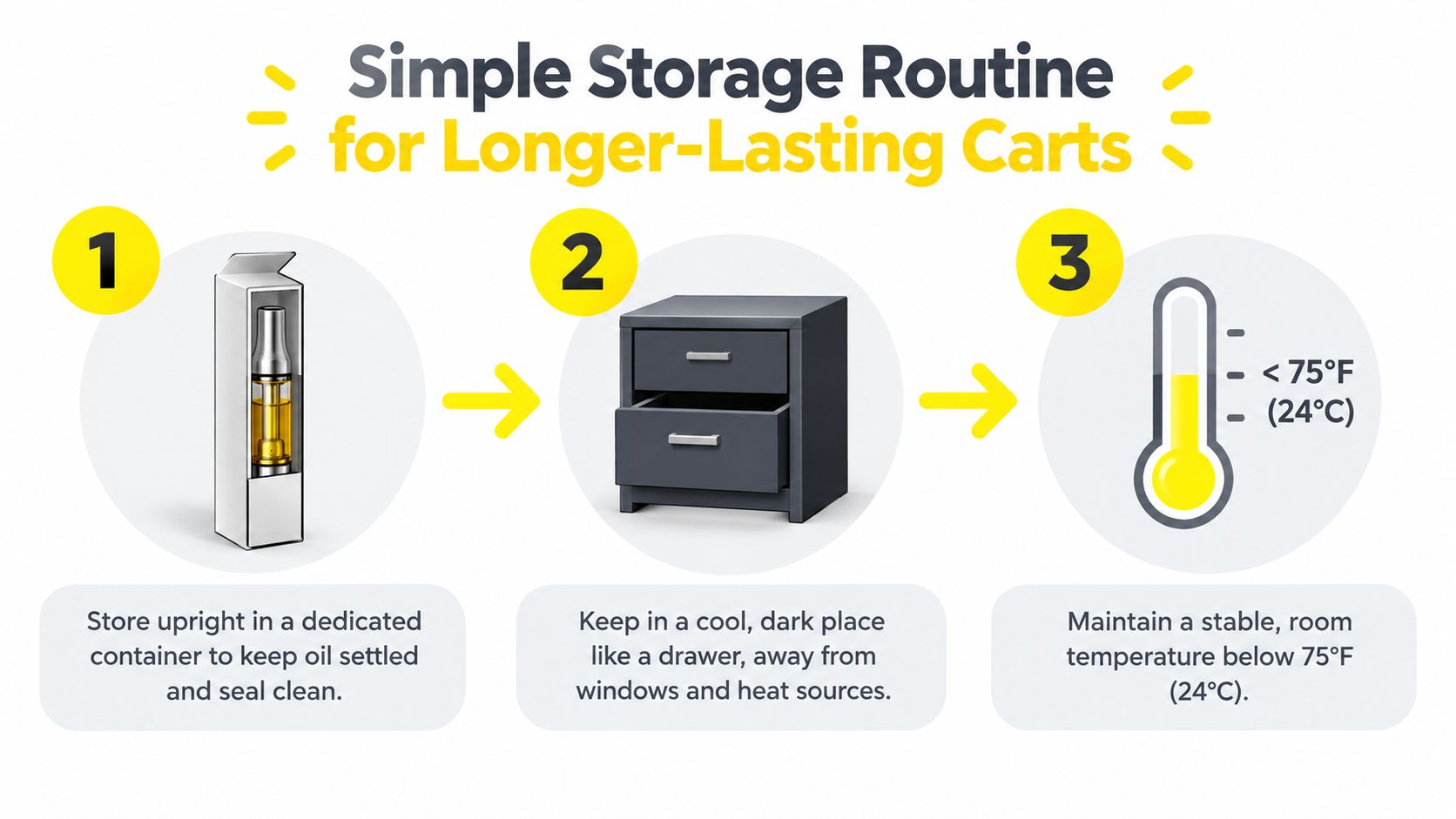
Set up storage the day you bring a cart home. The routine doesn't need specialized equipment. It needs a stable location and a few habits that limit heat, light, air, and leaks.
Build the routine around five actions
Store carts upright. Use a small container, original box, or dedicated case so the oil stays away from the airway and the seal remains cleaner. Upright storage also reduces the chance of oil reaching the battery connection.
Choose a stable indoor temperature. A practical target is 50 to 70°F, with the cartridge kept below 75°F, or 24°C, according to the storage infographic guidance. In a DC apartment, a closed drawer, closet shelf, or cabinet away from a heating vent usually works better than a windowsill.
Block light. Put the cart in an opaque pouch, dark case, or original packaging. A closed drawer is helpful because it shields the oil from direct sunlight and ordinary room lighting.
Limit air exposure. Cap the mouthpiece firmly, don't leave the cart attached to a battery, and use an airtight outer bag for longer storage. Vacuum sealing can reduce air around the package, but let a chilled cart return gradually to room temperature before opening it to limit condensation.
Rotate your supply. Write the purchase date on the box, keep older carts in front, and use them before newer ones. Rotation prevents a half-used cart from disappearing behind products you bought later.
Match the method to your day
For a short trip around DC, carry the cart upright in a padded opaque pouch rather than loose in a gym bag. If you're heading to the gym, don't leave it beside a hot locker-room vent or in a bag sitting in direct sun. For car travel, take it with you instead of leaving it in the glovebox.
A refrigerator can seem logical for long-term storage, but temperature swings and condensation can create hardware and consistency problems. A cool, stable room is usually easier to manage. For storage-container ideas that fit a home routine, see these storage containers.
Buying Fresh at the Dispensary Without Overstocking
The best storage plan can't fix an old product that has already spent too long in poor conditions. For many patients, buying smaller quantities more often preserves more value than stockpiling a larger cart because the product reaches your battery sooner.
A half-gram cart opened today and finished within a month has less time to experience repeated air exposure than a full-gram cart opened today and used slowly over several months. The cheaper price per gram isn't automatically the better value if flavor fades, the oil thickens, or you stop enjoying the last portion.
Make the label part of the purchase
Check the package for batch, production, harvest, or expiration information. Ask the budtender how quickly that product moves and whether the cart has been stored away from warm displays or direct light. If the answer is unclear, choose a product with a clearer date and a quantity that matches your actual use.
A weekend patient may prefer a smaller cart because it can reach the finish line while the flavor remains lively. A daily patient may reasonably choose a larger cart if they know they'll finish it within the opened-use window. The right comparison isn't only cost per gram. It's cost per fresh session, meaning how much usable, enjoyable product you get before quality drops.
Keep your rotation manageable. Having two to three active carts can offer variety, but opening more than you can use creates several partly exposed cartridges aging at once. Mark each box with the opening date and finish the oldest one first.
For help selecting a cart that fits your routine, review this guide on how to get a cart.
Quick Checklist to Keep Every Cart Fresh
Save this routine with your other medication and wellness notes. It turns the question of how long do vape carts stay good into a set of actions you can repeat.
- Buy sealed carts with clear batch or date information.
- Plan to use unopened carts within roughly 12 to 24 months when they're kept cool, dark, and airtight. (Green Society storage guidance)
- Finish opened carts within 3 to 6 months for the best flavor and performance. (Cannabuddha cartridge guidance)
- Store every cart upright in a stable indoor location.
- Protect the oil from heat, direct sunlight, and repeated temperature swings.
- Seal the mouthpiece and disconnect the cart from its battery after use.
- Match the format to your turnover. Distillate generally holds longer than terpene-rich live resin.
- Inspect the oil before each session for severe darkening, cloudiness, separation, persistent crystals, leaks, or particles.
- Stop if the cart tastes metallic or chemical, shows contamination, or leaks at the battery contact.
- Rotate older carts forward and write the opening date on each package.
- Check the cart before every session, not only after the flavor starts tasting wrong.
Mr. Nice Guys DC offers THC cartridges and pens with rotating dispensary menus, along with in-store pickup, curbside service, and delivery options for DC and nearby communities. Visit Mr. Nice Guys DC to compare current cart choices, ask product questions, and choose an amount you can store and finish while it remains fresh.
Mr Nice Guys DC
At Mr. Nice Guys DC, we’re more than just a cannabis delivery service — we’re passionate advocates for quality, convenience, and community. With years of experience in the cannabis industry, our team is dedicated to educating and empowering customers across Washington, D.C. Whether you're a seasoned user or just starting your cannabis journey, our blog delivers trusted tips, product insights, and the latest updates from the world of weed. Stay informed, stay elevated.
