
Must Be 21 To Enter
By entering this site you are agreeing that you are at least 21 Years of Age or older.
I AM 21 OR OLDERHow Long Do Pre Rolls Last and How to Tell When They Fade


A sealed pre-roll stored cool, dark, and dry stays at its best for weeks to a few months, and professionally packaged dried cannabis can remain acceptable for about 12 months. The printed date on the package overrides both estimates.
Yet when people ask how long do pre rolls last, why do so many guides hand them a single expiration count like a carton of milk? Dried cannabis doesn't spoil on a fixed calendar schedule. Two identical joints pulled from the same dispensary shelf can age on completely different timelines depending on whether one sits sealed in a dark drawer and the other rides around in a warm backpack.
A better approach separates freshness, potency, and safety into three distinct checks. Freshness covers aroma, flavor, and smooth airflow. Potency tracks how much active THC remains intact, while safety asks one blunt question: is there moisture damage or mold? Judging any pre-roll by its storage history, printed package date, and a short physical check beats chasing a universal number of days every time.
How Long Pre Rolls Last by Storage Condition
A sealed pre-roll kept cool, dark, and dry stays at its best for weeks to a few months, while professionally packaged dried cannabis may remain chemically acceptable for about 12 months, according to a four-year cannabis stability study indexed on PubMed. That same PubMed record also cites a United Nations review tracking cannabis kept at room temperature (20–22°C), where average THC dropped 16.6% after one year, 26.8% after two years, 34.5% after three years, and 41.4% after four years.
Short-term loss happens faster than most consumers expect once flower is packaged and handled. A 2024 cannabis-storage study summarized by Treehouse Cannabis reported that total potential THC fell 11.8% after 30 days and 34.6% after 360 days across tested containers and temperatures, leading the researchers to conclude cannabis is best sold, distributed, or consumed within 30 days of packaging.
| Storage condition | Usable window or measured loss | What changes |
|---|---|---|
| Sealed, cool, dark and dry | Up to about 12 months, possibly longer | Potency mostly holds; aroma fades first |
| Opened and ground, room temperature | Best within a few weeks | Terpenes and smoothness decline |
| Stored 1 year at 20-22°C | 16.6% average THC reduction | Cannabinoid breakdown begins |
| Stored 2 years at 20-22°C | 26.8% average THC reduction | Cannabinoid breakdown continues |
| Stored 3 years at 20-22°C | 34.5% average THC reduction | Substantial potency loss |
| Stored 4 years at 20-22°C | 41.4% average THC reduction | Heavy potency loss |
Matching Your Pre Roll to the Right Row
Start at the top row only if the original seal is still unbroken and the container stayed out of heat and sunlight. In that setup, potency holds reasonably well across months, though bright citrus or pine aromas begin softening first. Move down to the second row the moment you crack a tube or pouch open, because ground cannabis loses volatile flavor compounds and smooth smoke texture within a few weeks at room temperature.
The four room-temperature rows illustrate a key split between usable and fresh. Potency can remain measurable well past a printed package date, even while the flavor goes flat and the draw feels rougher on your throat. If you want a deeper look at protecting intact buds before rolling, our guide on how to keep cannabis flower fresh breaks down moisture and curing basics.
How to read the table: Match your actual storage history first, then check the printed date on the package, because the tested date overrides every general estimate.
Consider a practical example. Say you unseal a pre-roll tube on Monday, take two puffs, slip it back into a zip bag, and leave that bag in a warm car for a week. Even though you bought it days ago, it belongs in the opened room-temperature row (or worse), never in the sealed 12-month row.
Why Light, Heat, Air and Grinding Shorten Freshness
Think of a pre-roll like a cut apple on a kitchen counter. A whole apple keeps its crispness for weeks in a cool bowl, while sliced pieces brown within an hour because cutting multiplies the surface area touching oxygen. Grinding cannabis flower before rolling does the same thing, exposing delicate resin glands and volatile aromas directly to air.
The infographic below maps out the four environmental forces that speed up that breakdown.
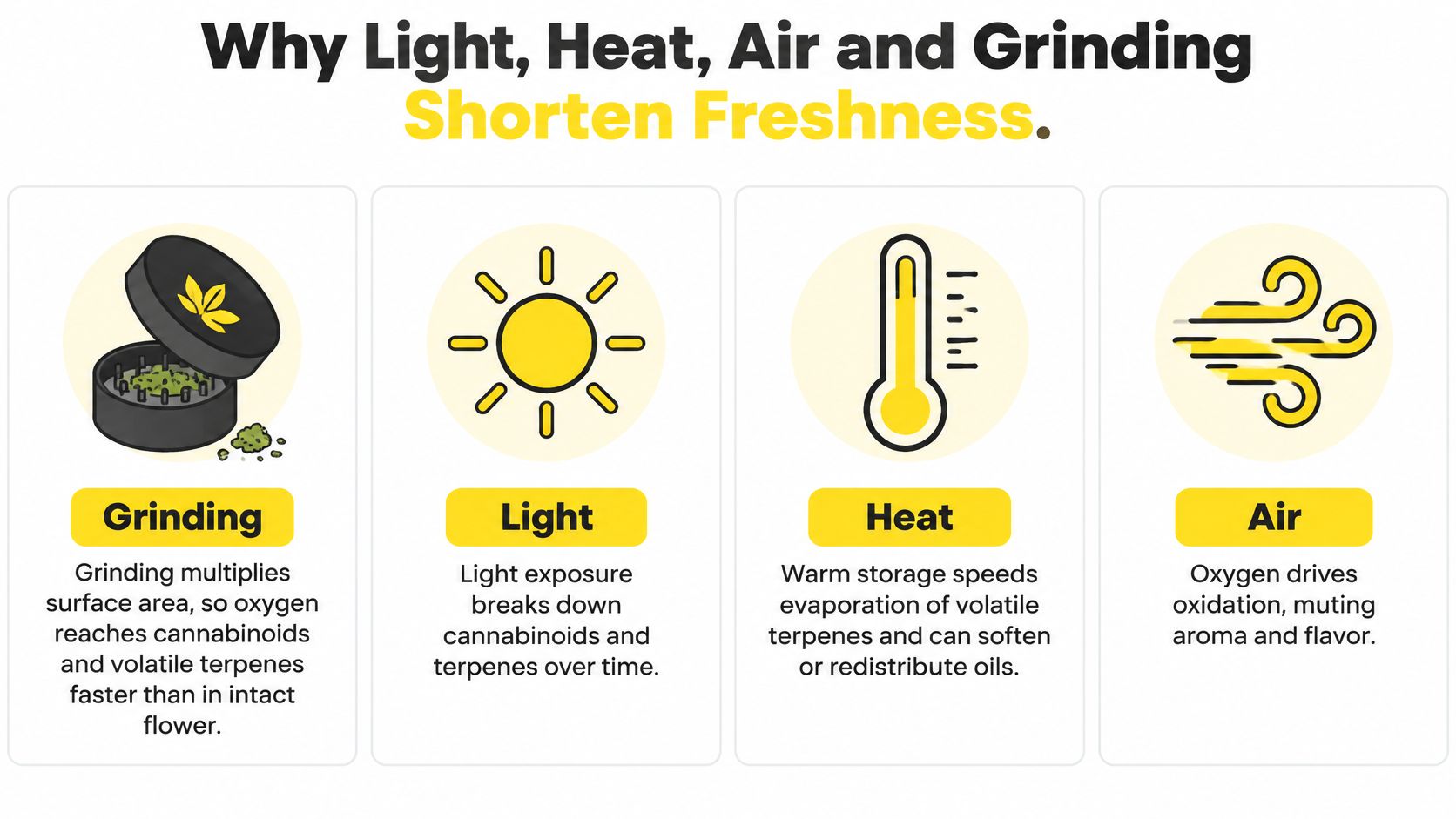
Grinding hits flavor and acidity fast. In storage work cited in a ScienceDirect food and bioproducts processing paper, THCA in whole and ground cannabis decreased by roughly 33% after one year at 25°C, driven primarily by decarboxylation. That same paper notes separate research measuring a 51.6% terpene reduction after only one month in comparable flower, which explains why a joint can lose its punchy scent long before its effects vanish.
Temperature, Light and Moisture Balance
Warmth and light compound oxygen exposure dramatically. In a four-year controlled study hosted on Europe PMC, researchers tracked high-potency cannabis products under four settings: continuous light at 22°C, darkness at 22°C, darkness at 4°C refrigeration, and darkness at -20°C freezing. Both room-temperature conditions triggered significant THC loss and CBN formation, with almost 100% of THC degraded after four years, whereas cold dark storage slowed deterioration sharply.
Humidity acts as the quiet fourth driver. A Springer cannabis research review identifies approximately 55–62% relative humidity as a typical optimal range for cannabis inflorescences, protecting both moisture balance and trichome structure. In plain terms, light, air, heat, and moisture swings fuel oxidation, including the chemical conversion of THC into CBN.
- Hot, dry rooms: Pre-rolls turn brittle, burn too fast, and deliver sharper, harsher smoke.
- Excessively humid spaces: Moisture softens the paper, hinders airflow, and raises microbial risks.
- Poor containers: Thin plastic tubes with loose caps let room air cycle in daily, so choosing better airtight cannabis storage containers slows oxidation right away.
Age on a calendar tells you almost nothing on its own; exposure to light, warmth, and air sets the real clock.
Picture two pre-rolls from the exact same batch sitting in the same 22°C apartment. One rests in a closed wooden desk drawer, while the other sits in a clear glass tube on a sunny windowsill. After six weeks, the drawer joint still smells herbal and burns smoothly, while the windowsill joint tastes papery and feels noticeably flatter because UV light and afternoon heat accelerated oxidation.
Infused, Flavored and Ground Pre Rolls Age Differently
Many consumers assume a shelf-life rule for plain dried flower transfers neatly to every joint on the menu. That assumption breaks down quickly once manufacturers add concentrates, botanical terpenes, or fine grind textures.
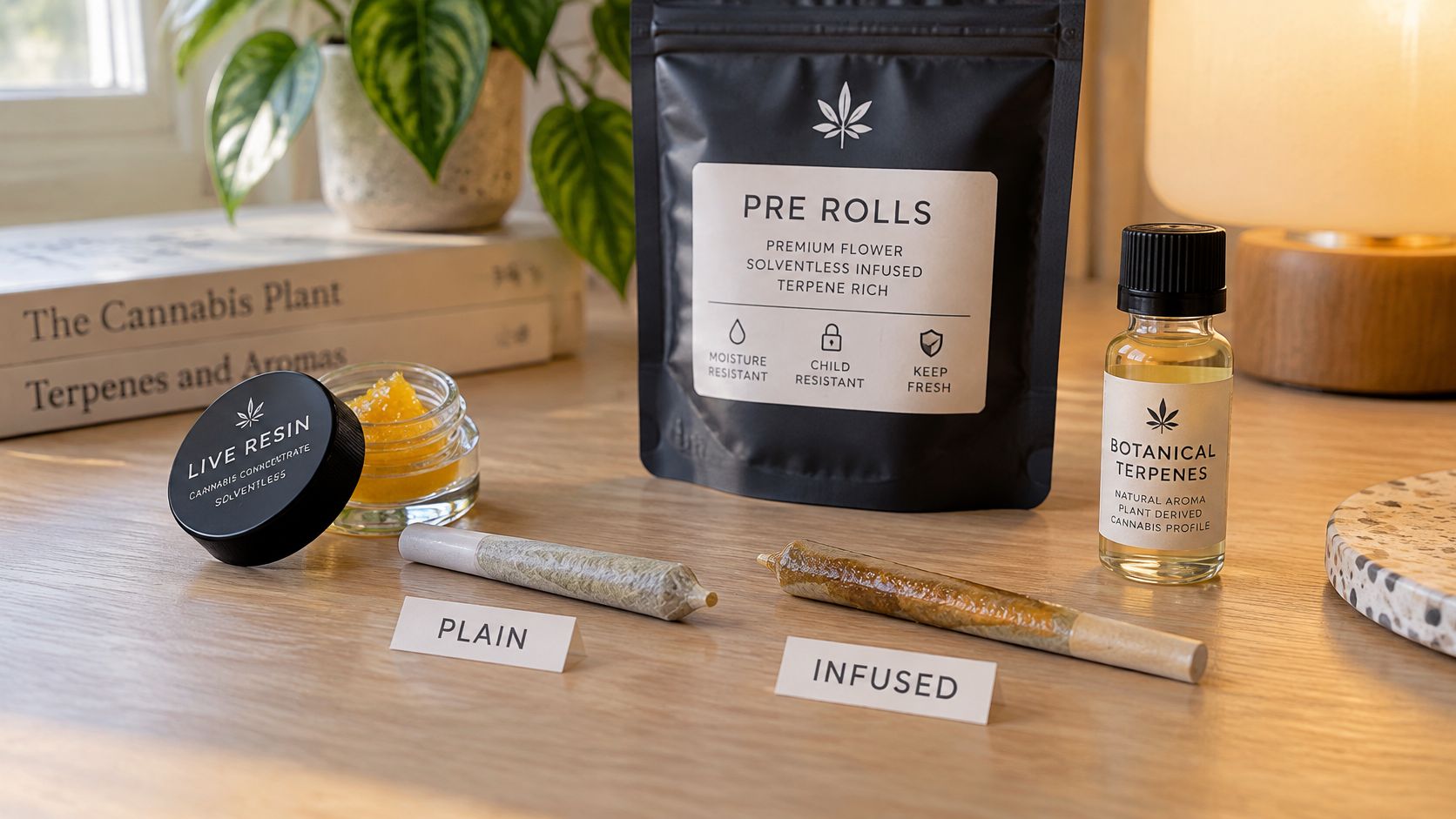
A cannabis stability study published in Knowledge International Journal points out that oils, concentrates, or added botanical terpenes can redistribute during heat exposure and storage, meaning ordinary plain-flower data can't reliably predict how finished infused pre-rolls hold up. If you're curious how manufacturers layer kief, hash, or live resin inside a cone, read our breakdown of what makes an infused pre-roll different.
How Format Changes the Way a Joint Fails
Each style runs into its own bottleneck long before cannabinoids finish breaking down:
- Infused pre-rolls: Concentrates and oils soften in warm storage and migrate toward one side of the paper. That uneven soak leads to thick resin rings, clogged airflow near the crutch, or slow relighting.
- Flavored pre-rolls: Added terpenes are highly volatile, so bright berry or citrus notes can evaporate quickly, leaving muted flavor behind even when potency barely moved.
- Plain ground pre-rolls: Grinding strips away the outer protective canopy of a whole bud, leaving thin rolling paper as the sole barrier between ground trichomes and ambient air.
Wrapper and flower also fail in opposite directions. When a joint dries out, the paper and flower race down in seconds and waste cannabinoids into sidestream smoke. When a joint absorbs too much humidity or starts out packed too tightly around sticky concentrate, it canoes down one side, clogs halfway through, or refuses to stay lit.
Say you pick up a five-pack mixing two live-resin infused cones and three plain flower joints for a weeklong mountain trip. Plan to smoke the infused pre-rolls during the first couple of nights, before cabin heat or daytime travel shifts the oil inside them. Keep the three plain pre-rolls sealed inside a tight jar, and open just one when you're ready to light it. Always judge an infused product by its own package date and burn behavior rather than borrowing a plain-flower timeline.
How to Store Pre Rolls to Keep Them Fresh Longer
Good storage isn't complicated, and it doesn't require lab gear. A repeatable routine blocks oxygen, stops light, and stabilizes humidity before freshness slips away.
This four-step visual highlights the core habits you can put in place the moment you get home.
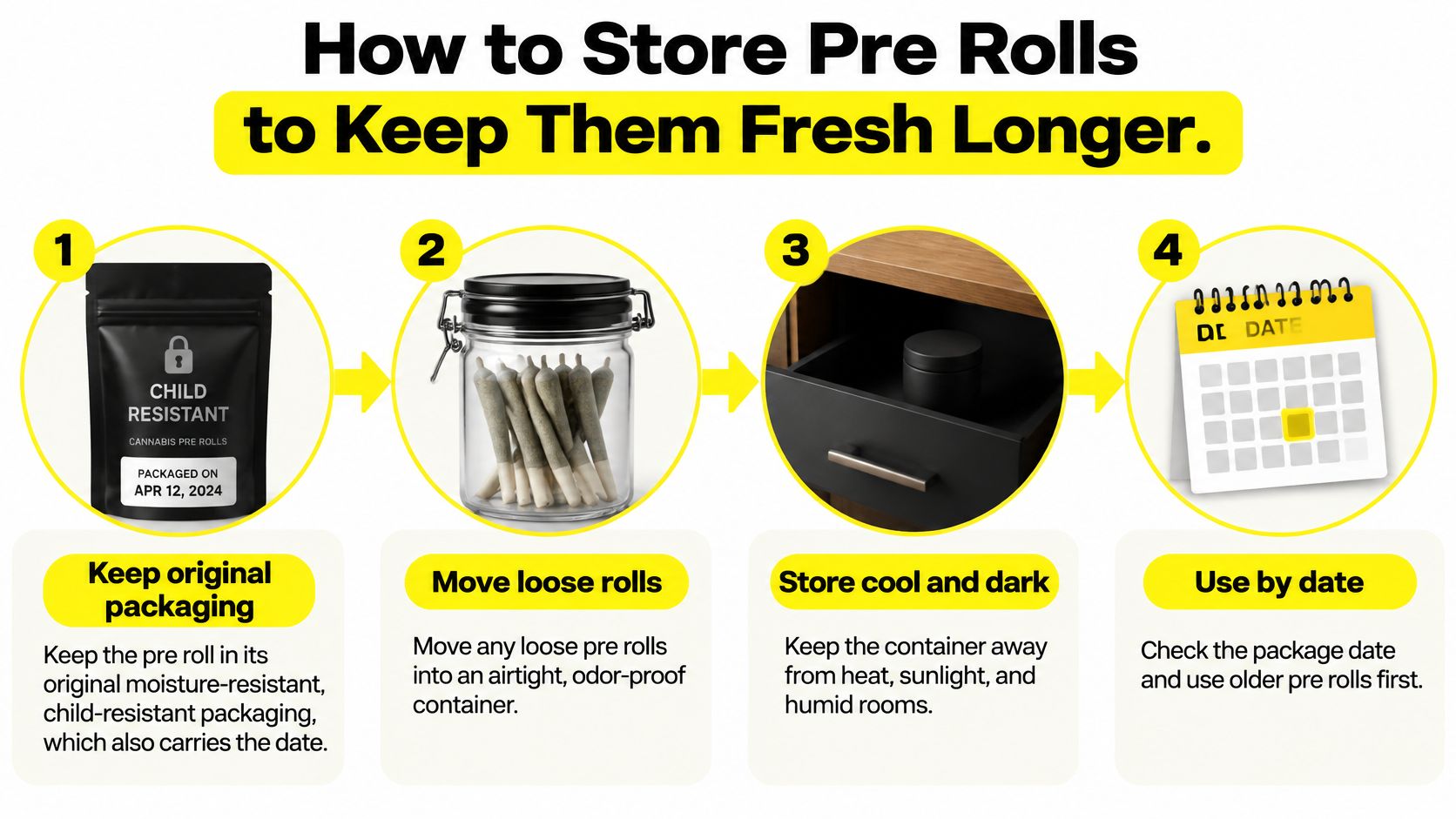
Packaging integrity makes a measurable difference over time. In a nine-month comparison reported in Knowledge International Journal at 25 ± 2°C and 60 ± 5% relative humidity, nitrogen-packaged laminate bags kept THC within specification throughout the entire study, whereas one ambient-packaged batch fell out of specification by month nine. That same paper notes that refrigeration isn't automatically better at home because repeated temperature swings trigger condensation that harms texture and raises microbial risk.
An Eight Step Storage Routine
- Keep the original package intact. Original moisture-resistant, child-resistant pouches and tubes shield against air while keeping the printed test date right in front of you.
- Transfer loose joints to a snug airtight container. Pick a small glass screw-top jar or fitted metal tube so little empty air sits around the paper.
- Choose a dark, cool cabinet or drawer. Stable room temperature away from windows, radiators, and kitchen stoves prevents daily heat spikes.
- Regulate moisture with a small pack. Drop in one of our recommended two-way humidity control packs sized for your jar, and check once a week that the pack still feels pliable rather than stiff and crusty.
- Ban three high-risk spots. Skip parked cars, warm bathroom vanities, and sunlit window ledges where heat and steam destroy texture fast.
- Keep pre-rolls out of the refrigerator. Cold glass sweats whenever you open it in a warm room, adding unwanted dampness directly onto the rolling paper.
- Save the freezer for long holds only. Deep cold slows chemical breakdown over long stretches, yet thawing and refreezing repeatedly introduces moisture and makes fragile trichomes snap off.
- Unseal one pre-roll at a time. Opening a multi-pack tin five times a week flushes fresh oxygen across every remaining cone inside.
Take a real-world example. Suppose you buy a five-pack to stretch across a full month. Leave four pre-rolls tucked inside a small airtight glass jar with a humidity pack in a bedroom dresser, and carry only the single joint you plan to smoke that evening in its protective tube.
Good storage keeps a pre-roll inside its best window, but no jar or humidity pack can restore lost terpenes once that window has passed.
For a quick walkthrough of container sealing and daily handling habits, watch the short video below.
Reading the Date on a Pre Roll Package
Hold a tube up to the light and the printed date does something no online rule of thumb can: it ties freshness to real testing. Regulated cannabis markets require producers to base those dates on evidence rather than guesswork. According to New York's Part 128 packaging and labeling guidance, licensees must establish an acceptable expiration date for adult-use cannabis products using available stability-study data.
The wording matters, because the two date types measure different things:
- Best-by date: Marks the end of the labeled quality window, the stretch where flavor, moisture, and burn are expected to match the producer's standard.
- Expiration date: Marks the end of the labeled product life supported by the licensee's stability data.
That distinction maps onto the freshness-versus-safety split this article keeps returning to. A best-by stamp describes how the pre-roll should taste and burn, while an expiration date reflects how long the product itself is expected to hold up. A sealed pre-roll stamped with a best-by date four months out gives you a far more dependable target than a casual claim that "pre-rolls last six months," but only if the tube stayed cool, dark, and sealed the whole time.
Three Quick Label Checks
- Locate the date before leaving the counter. Look along the back compliance sticker, tube cap, or bottom seam of the pouch.
- Verify the product form matches. Confirm the label covers the single pre-roll or multi-pack in your hand rather than an older bulk flower harvest date alone.
- Weigh the date against real storage history. A package still three months shy of its printed date loses that head start if it spent last weekend baking in a glove compartment.
No date printed at all? Ask the dispensary staff for the batch harvest date, packaging date, and any stability information on file, and treat rough age estimates cautiously. Breaking the factory seal also resets your timeline, since repeated exposure to air, heat, light, and humidity shortens the labeled quality window right away.
How to Tell a Stale Pre Roll From an Unsafe One
Opening an older tube shouldn't turn into a guessing game. Sorting sensory clues into freshness issues versus safety red flags tells you right away whether a pre-roll just tastes tired or belongs in the trash.
Research published on PubMed Central underscores why separating freshness, potency, and safety matters. In stability work cited there, packaged flower showed 7.27–9.40% total-THC degradation after three months under recommended storage while maintaining projected cannabinoid half-lives of roughly 21–28 months, and airtight dark storage better preserved secondary metabolites over six months. In other words, a well-stored pre-roll often remains chemically usable long after its aroma fades, so harsh smoke, muted scent, or dry crumbling points to staleness rather than sudden toxicity.
Use the visual checklist below to separate harmless aging from genuine mold or moisture hazards.
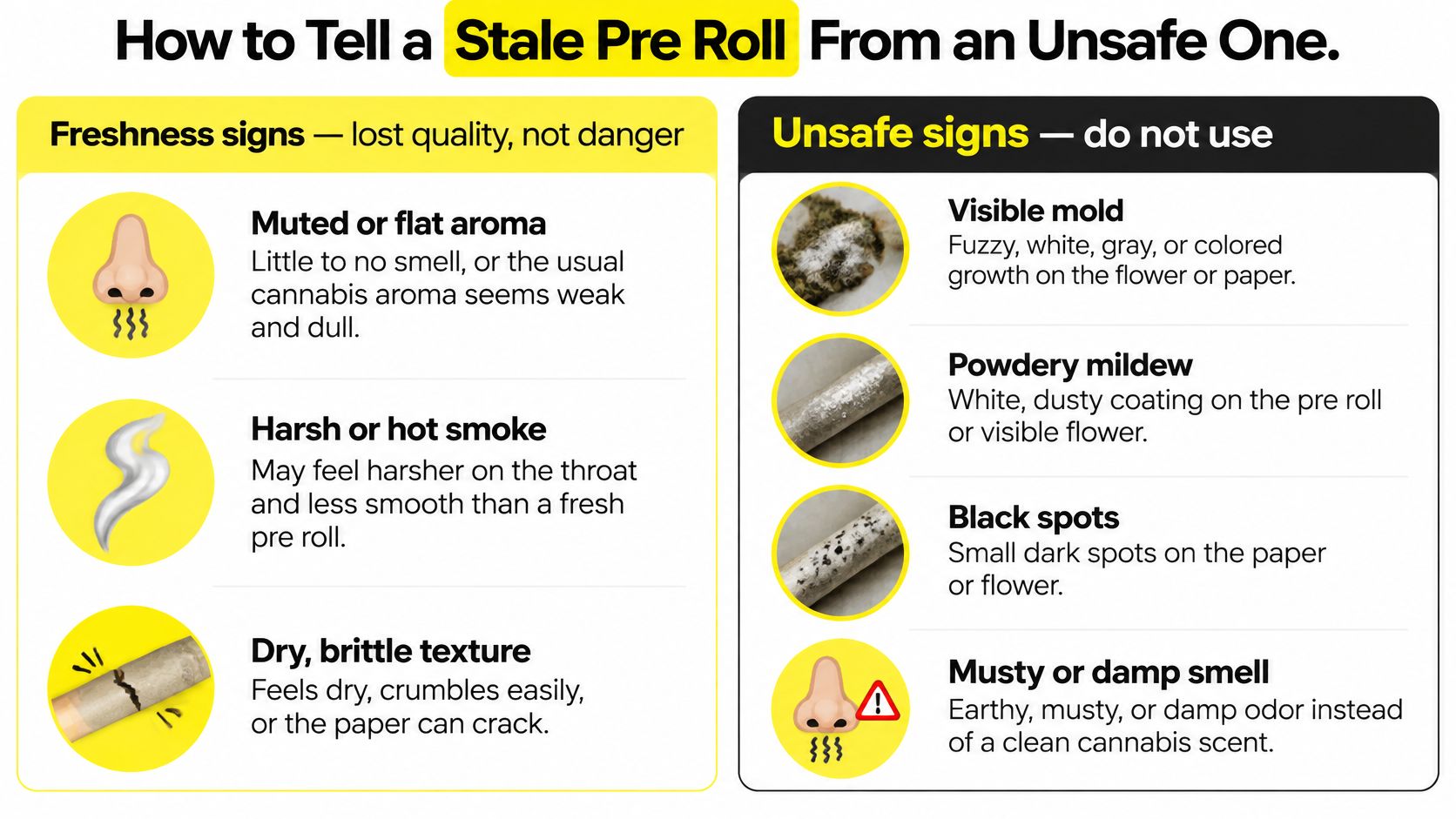
If you spot anything questionable, our detailed guide on how to tell if weed is moldy walks through visual signs up close.
| Sign | What it means | What to do |
|---|---|---|
| Flat or muted aroma | Terpenes have faded, potency may still be there | Use soon and judge by the burn |
| Harsh or hot smoke | Oxidation and over-drying | Use soon, or discard if it stays harsh |
| Dry brittle texture that crumbles | Moisture below the 55-62% range | Add a humidity pack for a day, then use |
| Burn runs fast or canoes | Uneven moisture or tight packing | Check the roll and use soon |
| Damp paper or flower | Excess humidity | Discard |
| Musty or damp odor | Moisture and microbial risk | Discard |
| Visible mold or fuzzy spots | Microbial growth | Discard, do not smoke |
| Poor burn after inspection | Quality failure | Discard |
A Four Step Inspection Before You Light Up
- Check the paper and filter tip. Hold the cone under bright light to look for damp rings, dark specks, or abnormal discoloration.
- Smell the pre-roll closed. Fresh flower smells earthy, piney, sweet, or skunky; a musty basement smell, wet hay note, or sharp ammonia odor means stop.
- Peek inside the twisted end. Gently untwist the tip and look at the exposed ground flower without crushing the cone.
- Break open anything suspect. If the roll feels spongy or smells off, tear the paper open on a white plate and scan for white fuzz or webbing before taking a single puff.
Apply one simple verdict once you finish inspecting. Use it now when the printed date hasn't passed and the aroma smells clean. Use it soon if only the scent has dulled while the paper feels intact and burns evenly. Discard immediately whenever you find dampness, a musty odor, abnormal discoloration, or visible mold.
Two everyday scenarios show the line clearly. A pre-roll kept four months in a sealed tin that tastes slightly flat is stale, so you can decide whether to smoke it or pass. A pre-roll that sat a week in a steamy bathroom and smells like damp hay gets thrown away without hesitation. For a partly smoked pre-roll, plan to finish it within a day or two, since the charred tip pulls air and room moisture straight into the remaining flower.
Buying rule: Freshness starts before a joint ever reaches your drawer, so choose a licensed shop that tests its inventory and rotates stock carefully.
At Mr. Nice Guys DC, every product is tested for pesticides, potency, and more, and our team can walk you through package dates and storage options before you head home. Asking for the date on the label and storing your purchase right away gives every pre-roll its longest, cleanest run.
Ready to pick up fresh, lab-tested pre-rolls and storage accessories without guessing how long they've been sitting on a shelf? We curate pre-rolls, premium flower, and sleek storage solutions for patients and adults 21+ across Washington, DC, Alexandria, Bethesda, Rockville, and Silver Spring, with convenient in-store pickup, curbside service, and same-day delivery options. Browse our current menu and ask our team for freshness guidance at Mr. Nice Guys DC.
Mr Nice Guys DC
At Mr. Nice Guys DC, we’re more than just a cannabis delivery service — we’re passionate advocates for quality, convenience, and community. With years of experience in the cannabis industry, our team is dedicated to educating and empowering customers across Washington, D.C. Whether you're a seasoned user or just starting your cannabis journey, our blog delivers trusted tips, product insights, and the latest updates from the world of weed. Stay informed, stay elevated.
