
Must Be 21 To Enter
By entering this site you are agreeing that you are at least 21 Years of Age or older.
I AM 21 OR OLDERCan THC Tincture Be Absorbed Through the Skin
.svg)

.png)
Yes, a THC tincture can touch the skin, but a standard tincture usually acts mostly as a topical with limited systemic effect. In a true transdermal system, human testing measured a peak THC plasma concentration of 346.57 pg/mL, or 0.346 ng/mL, while specialized patches have maintained THC delivery for at least 48 hours (human pharmacokinetic study; therapeutic cannabinoid review).
A patient rubs a few drops of an oil tincture onto a sore knee, waits, and feels nothing. The natural conclusion is that the product must be weak or fake. The more likely explanation is simpler: the product was made to travel under the tongue or through the digestive system, not through intact skin into the bloodstream.
The word “tincture” describes a product format, not its destination. A bottle may contain THC in alcohol or carrier oil, but that doesn't mean the same formula will work as a sublingual dose, a joint rub, and a transdermal patch. For patients comparing products at a DC dispensary, the important question isn't only whether THC can cross skin. It's whether this specific formulation was designed to do it.
Why This Question Trips So Many People Up
The bottle format doesn't tell you the route
A conventional tincture is usually intended for sublingual or oral use. A patient places it under the tongue, where mucous membranes can support absorption, or swallows it so the digestive system processes it. Rubbing the same liquid onto a knee changes the application site, but it doesn't automatically change the product's chemistry.
That distinction explains the familiar sore-knee scenario. A patient applies a few drops, massages the area, and expects the kind of whole-body effect associated with taking the tincture by mouth. Instead, the cannabinoids may remain near the surface, with little meaningful movement into circulation. The patient hasn't necessarily used a bad product. They may have used a good product for the wrong route.
For a clear explanation of how tinctures are formulated and used, see this guide to the science behind marijuana tinctures and their effects.
Topical and transdermal mean different things
Most cannabis creams, balms, and lotions are topicals. They're designed to stay near the application area and interact with skin and nearby tissues. Patients often choose them for localized comfort around muscles, joints, or a particular patch of skin, without expecting a noticeable whole-body THC effect.
Transdermal products are different. Patches and specialized gels use formulation strategies intended to move THC across the skin barrier and into the bloodstream. That may involve a carrier system, a penetration enhancer, and a controlled reservoir that releases cannabinoids over time.
Practical rule: If the label says “topical,” expect localized use. If it says “transdermal,” look for information about systemic delivery and the amount released over time.
The distinction matters for expectations, timing, and safety. Someone seeking local knee comfort may prefer a topical cream. Someone seeking a bloodstream effect without swallowing or inhaling may need a product specifically labeled and engineered for transdermal delivery.
How the Skin Actually Works as a Barrier
The stratum corneum blocks most molecules through a brick-and-mortar structure. Flattened, dead skin cells form the bricks, while a lipid matrix fills the gaps between them. Together, these layers limit how quickly substances move into living tissue.
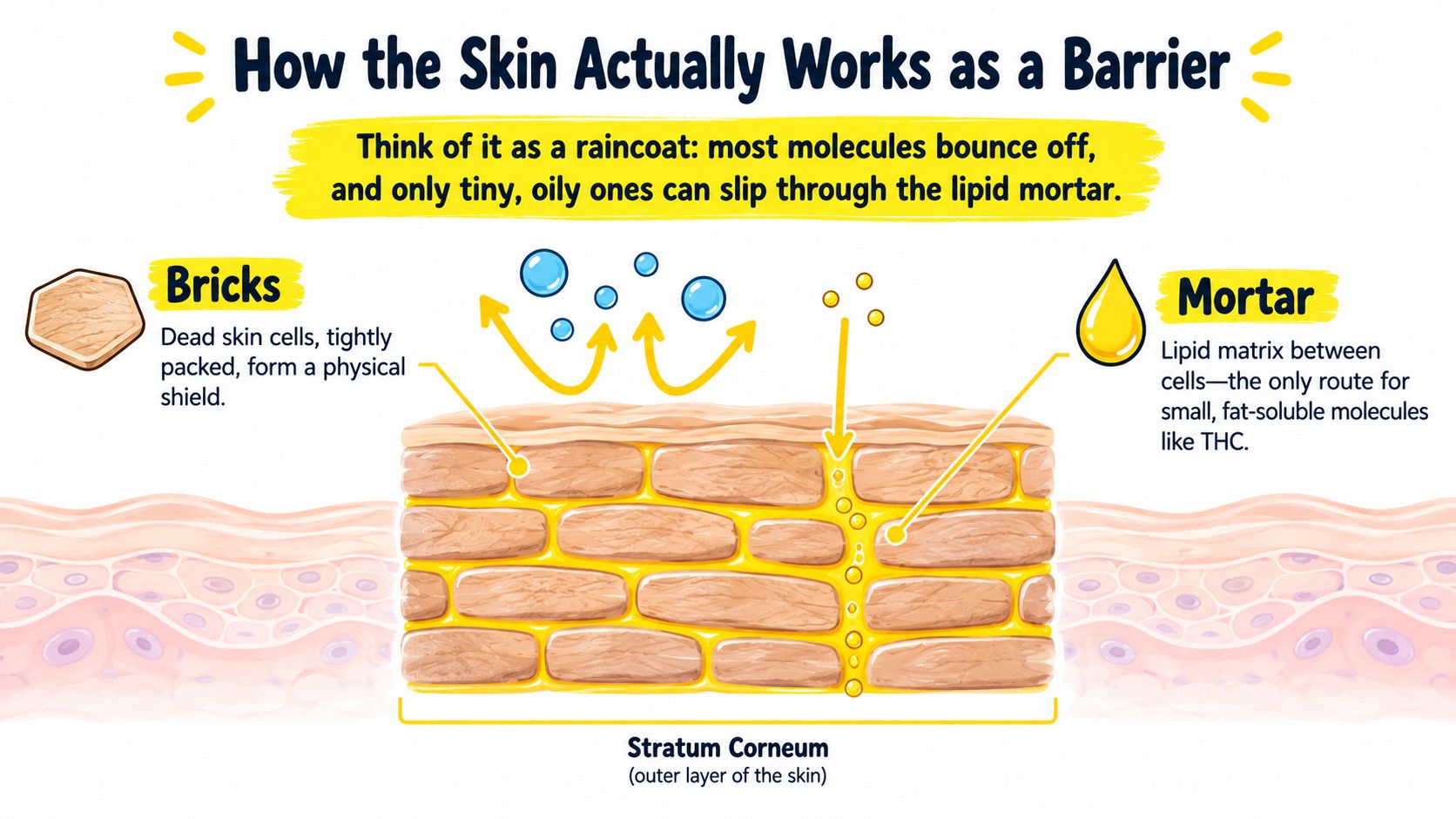
Most molecules stay on the surface or become held within the outer layer. To pass through, a molecule needs a suitable size, chemistry, and route through the lipid “mortar.” Skin therefore acts less like an open doorway and more like a selective filter.
THC and other cannabinoids are hydrophobic, so they prefer oily environments over water. That trait can help them interact with the skin's lipids, but it does not guarantee passage. THC may still remain trapped in the outer layers if its formulation does not help it move farther inward.
Why oily doesn't automatically mean absorbable
A compound must first enter the lipid spaces, then continue through them toward living tissue underneath. Without formulation support, cannabinoids can collect in the stratum corneum instead of reaching the bloodstream.
Rubbing a conventional oil tincture onto the skin may spread the liquid, especially with massage. Spread across the surface, however, is different from systemic absorption. The review of therapeutic cannabinoid delivery describes the stratum corneum as the rate-limiting barrier and explains why transdermal products commonly use penetration enhancers.
For a product intended to remain local, compare the ingredients and use instructions in this guide to a cannabis topical cream. A high THC amount does not overcome the barrier on its own. The formulation must help THC cross the wall, not merely place more THC on top of it. At the counter, that distinction helps patients choose a localized topical rather than expecting a tincture rubbed on the skin to act like a transdermal product.
Tinctures, Topicals, and Transdermal Patches Compared
A simple comparison prevents most mistakes. The key is to ask what the product is engineered to do, not what ingredient appears on the front label.
| Format | How Applied | Intended Effect | Systemic Absorption |
|---|---|---|---|
| Tincture | Under the tongue or swallowed. Rubbing it on skin is an off-label use for most products. | Sublingual or oral effects when used as directed. On skin, mostly localized exposure. | Usually limited when applied to intact skin. |
| Topical | Spread over the skin where localized comfort is desired. | Local action around the application area, such as a joint, muscle, or skin surface. | Not designed to produce meaningful blood levels. |
| Transdermal patch or gel | Applied to a designated skin site and left in place according to the label. | Controlled systemic delivery into the bloodstream. | Specifically engineered for measurable uptake, often over hours. |
Tinctures are route-specific products
Alcohol- or oil-based tinctures are usually made for sublingual or oral dosing. A few drops under the tongue and a few drops rubbed onto the wrist aren't equivalent experiments. The first uses mucous membranes or digestion. The second asks intact skin to do the work.
For patients comparing oral formats, this overview of cannabis tincture benefits can help clarify why the intended route matters. A tincture may be convenient and easy to measure, but convenience doesn't make it transdermal.
Topicals aim to stay local
A cream, balm, or lotion may contain THC and still be a local product. Its formula can improve spreadability, skin feel, and local contact without being designed to maintain THC in the bloodstream. That makes topicals useful for a patient who wants to apply a product to one area without seeking systemic intoxication.
Transdermal systems use delivery technology
A transdermal patch or gel typically combines THC with a carrier system and permeation enhancers. Some products also use a reservoir that controls release, so the skin receives a continuing supply rather than one surface application.
A topical answers, “Where do I want to apply this?” A transdermal product answers, “How do I want THC to enter circulation?”
The practical choice follows the desired result. Localized comfort points toward a topical. A bloodstream effect through the skin points toward a labeled transdermal product, not an ordinary tincture poured from a bottle.
What Changes How Much THC the Skin Takes In
Formulation sets the baseline
How much THC crosses skin depends on the formula, the skin site, and the time the product stays in contact. The label may reveal the intended route and carrier, but it cannot tell you everything about how the product will behave on a particular area.
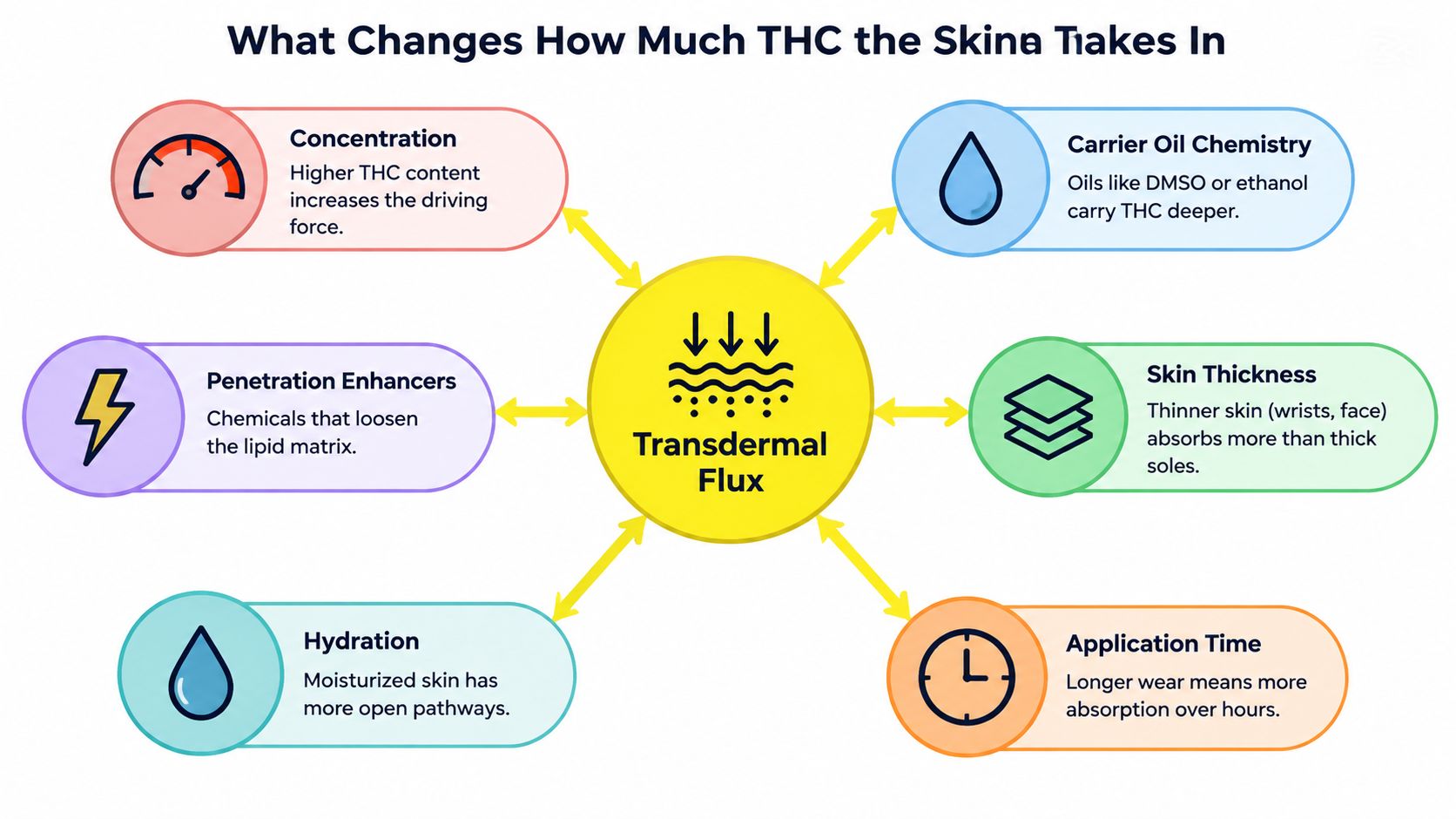
Concentration matters because more THC can create a stronger pressure for molecules to move across the barrier. It does not, by itself, make an oral tincture transdermal. Without a carrier and skin interface that support movement, additional THC may stay in the outer skin layer.
Carrier chemistry matters too. Alcohol-based and oil-based systems interact with skin differently. A purpose-built transdermal formula may include solvents or permeation enhancers to help THC pass through the stratum corneum, the skin's tightly packed outer layer. The cannabinoid delivery review identifies these enhancers as part of the strategy for improving movement through that barrier (delivery mechanisms review). At the counter, the useful question is whether the product was made for transdermal delivery, not whether its familiar carrier oil feels absorbent.
Skin site and contact time also matter
Skin behaves differently from one body area to another. Thinner areas may allow different movement than thick, heavily keratinized skin, while hydration can change the behavior of the outer layer. A product wiped off soon after application has less contact time than a patch designed to remain in place.
The human pharmacokinetic findings discussed in the study below show measurable systemic exposure from a formulation designed for transdermal delivery, rather than proving that every rubbed-on tincture acts like a patch (human PK study). The result depends on the delivery system as much as the THC itself.
Patients choosing between products can ask:
- What type is it? Does the label say topical or transdermal?
- What carries the THC? Does the ingredient list show a specialized delivery system?
- Where is it applied? Does the label identify a recommended site?
- How long does it stay on? Is there a wear schedule or reservoir design?
- What effect is expected? Does the manufacturer describe local action or systemic delivery?
The practical question is not only “How much THC did I rub on?” It is “What route did the product make possible?”
What the Research Shows About Real Absorption
Animal results do not predict human results
Can THC cross skin? Yes, under the right conditions, but the research does not support treating every rubbed-on tincture as a body-wide dose.
Early transdermal THC research found that rat skin was about 13-fold more permeable to Δ8-THC than human skin. After 24 hours, in vitro testing showed THC concentrated mainly in the stratum corneum, upper epidermis, and hair follicles (early transdermal THC research). The same formulation, which contained oleic acid, maintained serum cross-reacting cannabinoids at about 50 ng/mL for roughly 24 hours in rats.
That result shows sustained delivery in an animal model. It does not predict the blood levels a person will experience. A rat-skin finding is more like testing a road with different pavement. The route may exist, while the speed and amount of travel change substantially in human skin.
Topical and transdermal products answer different questions
A human study of topical THC products found no detectable THC or metabolites in blood or urine after exclusive topical use, even when the products contained measurable THC (topical THC study). For a patient considering a cream or tincture at a DC dispensary, that distinction matters. A product can support local skin exposure without producing a measurable whole-body effect.
Human systemic exposure has been reported with a combined CBD and THC formulation made for transdermal delivery. A therapeutic review also describes Δ8-THC patches reaching steady-state plasma concentrations within 1.4 hours and maintaining them for at least 48 hours (therapeutic cannabinoid review). Those findings apply to specific delivery systems, not automatically to products labeled topical.
Patients seeking localized comfort can also see this overview of topical cannabis for arthritis, while patients seeking systemic effects should ask whether the product was designed to move THC through the skin and into circulation.
| Product type | What the research indicates |
|---|---|
| Optimized transdermal formulation | Rat study, sustained blood exposure under a specialized formulation |
| Topical THC products | Human study, no detectable blood or urine THC or metabolites |
| Combined CBD and THC transdermal formulation | Human study, measurable systemic THC exposure (human PK study) |
| Δ8-THC transdermal patch | Reported systemic exposure with maintained concentrations in a review |
The practical conclusion is simple: skin exposure is not the same as bloodstream exposure. At the counter, ask whether the product is topical or transdermal, what delivery system it uses, and whether the label promises local action or systemic delivery.
A Day With a Transdermal THC Patch
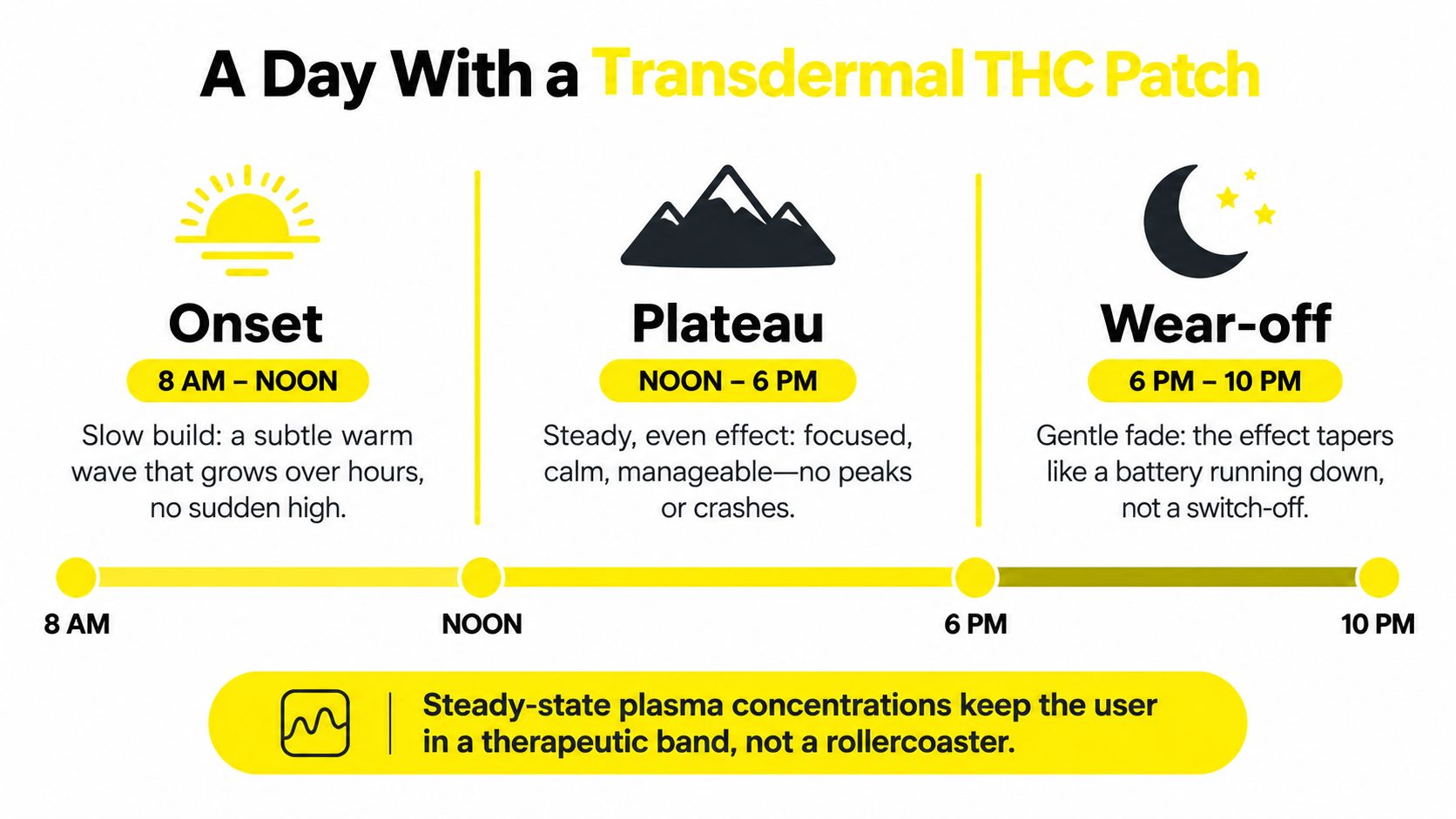
What does a transdermal THC patch feel like across an ordinary day? A patient applies a labeled patch in the morning to seek a steady systemic effect without swallowing a tincture or inhaling cannabis. At 8 AM, the patch should not be treated like a sublingual dose. It is designed to move THC through the skin over time, more like a slow-release tap than a single pour.
Morning brings a gradual build
Early on, the patch may feel subtle. That does not necessarily mean it is ineffective or that the patient should apply another product. As noted in the research section, absorption timing varies by delivery system, so the label's wear instructions matter more than an immediate sensation.
By late morning or afternoon, the experience may feel more even than the noticeable rise associated with a tincture. The patient may not feel a clear “dose moment” at all. Effects still depend on the individual, the formulation, THC concentration, and previous exposure.
Here's a short visual explanation of how delivery systems differ:
The day feels unlike a tincture dose
A tincture placed under the tongue is a distinct administration event. Rubbing a few drops of an oral tincture onto the skin is different again, because ordinary skin contact does not establish systemic delivery. A transdermal patch uses a delivery system intended to keep supplying THC through the skin, so the patient should follow its application, wear, and replacement directions.
The patient removes or replaces the patch according to the label. The practical lesson is simple: controlled delivery creates a different pattern from rubbing a few drops of an oral tincture onto skin. At the counter, patients should ask whether the expected experience is local or systemic, then allow the product's stated timing to guide their expectations.
Practical Guidance for Patients Choosing a Product
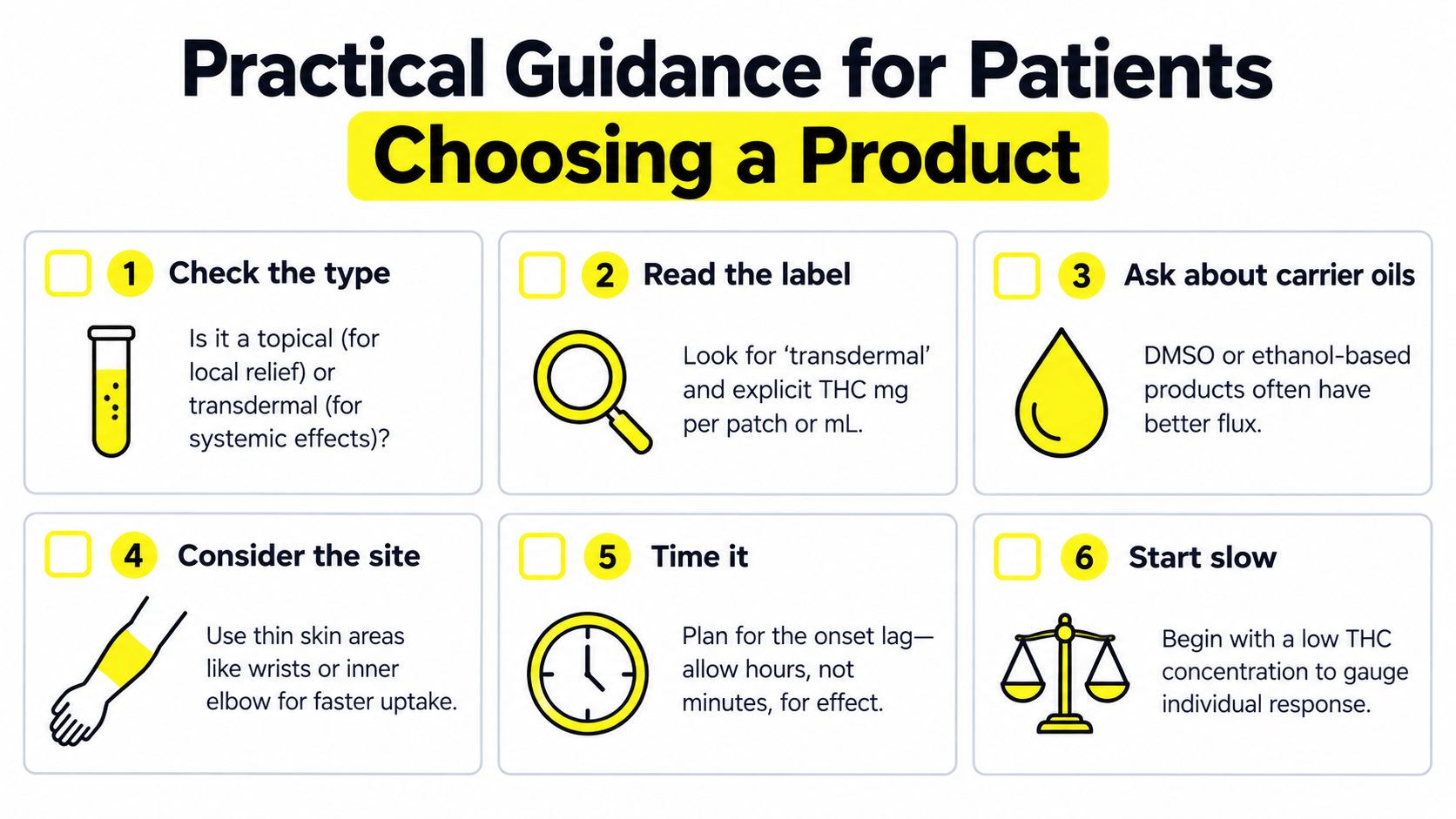
Start at the counter with the outcome, not the ingredient. Tell the educator whether you want localized comfort at a particular joint or muscle, or a systemic THC effect without inhalation or swallowing. That answer narrows the product category immediately.
Use the label as a route map
A patient can work through these checks:
- Check the type. A topical is intended for local use. A transdermal product is designed for systemic delivery.
- Read the application instructions. Look for a named skin site, wear time, and whether the product should remain covered.
- Look for explicit THC information. A transdermal label should explain the THC amount per patch or measured volume and describe its intended route.
- Ask about timing. Transdermal delivery can develop slowly. Don't judge the product immediately after applying it.
- Start cautiously. Use the lowest labeled THC concentration that fits your needs, especially if you don't know how the product will affect you.
- Monitor the skin. Stop and seek professional advice if you develop irritation, swelling, or another concerning reaction.
Match the format to the goal
A conventional tincture makes sense when you want a measured sublingual or oral product. A topical cream or balm fits a localized application. A transdermal patch or gel deserves consideration only when the label clearly identifies it as transdermal and explains systemic delivery.
For broader questions about measuring and adjusting tincture amounts, review this guide to cannabis tincture dosing. Mr. Nice Guys DC offers tinctures, topicals, creams, and patches, so DC patients can compare route-specific formats with staff rather than treating every THC product as interchangeable.
If you're still unsure, bring the product label or a photo of its ingredients to a qualified dispensary educator. The right choice may be a local topical, a sublingual tincture, or a purpose-built transdermal product, depending on whether you want THC to stay near the skin or reach the bloodstream.
Mr. Nice Guys DC offers tinctures, topicals, creams, and patches for patients comparing localized and systemic cannabis options. Visit Mr. Nice Guys DC to review current products and speak with the team about choosing a format that matches your intended route.
Mr Nice Guys DC
At Mr. Nice Guys DC, we’re more than just a cannabis delivery service — we’re passionate advocates for quality, convenience, and community. With years of experience in the cannabis industry, our team is dedicated to educating and empowering customers across Washington, D.C. Whether you're a seasoned user or just starting your cannabis journey, our blog delivers trusted tips, product insights, and the latest updates from the world of weed. Stay informed, stay elevated.
