
Must Be 21 To Enter
By entering this site you are agreeing that you are at least 21 Years of Age or older.
I AM 21 OR OLDERWholesale Pricing for DC Cannabis Dispensaries Explained
.svg)

.png)
You've found a product line you trust, the retailer is ready to buy, and then the wholesale account application asks for licenses, tax records, compliance documents, delivery details, and payment terms. At the same time, the supplier wants volume commitments while you're still trying to learn what will sell in your DC store. That friction is normal. Wholesale pricing is only one part of the deal. Documentation, inventory risk, product quality, timing, and communication can matter just as much.
What Wholesale Pricing Means in the Cannabis Market
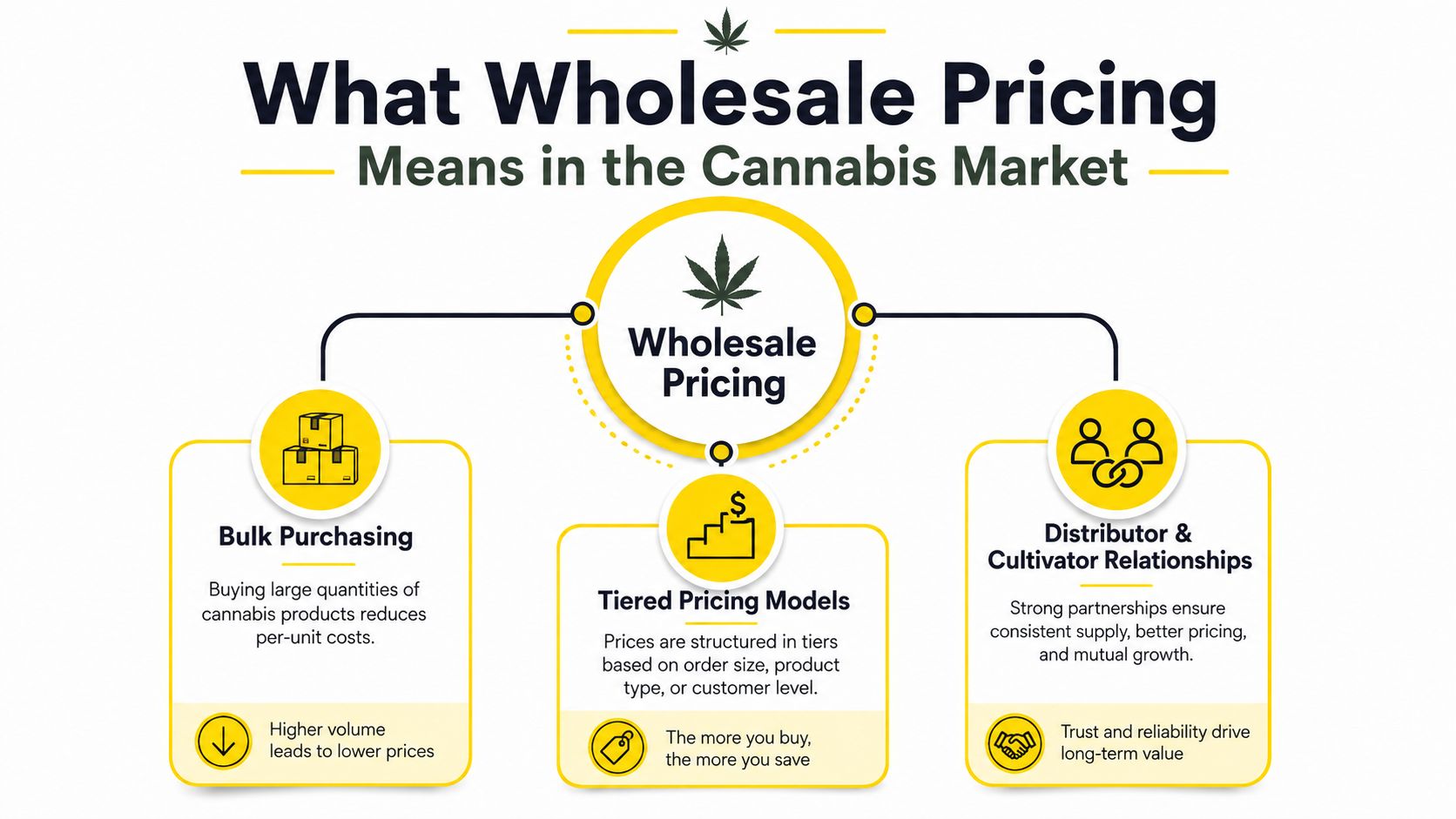
A new DC retailer often starts with a simple question: “What's your wholesale price?” The useful answer isn't a single number. Wholesale pricing is the amount a dispensary or approved buyer pays to acquire cannabis products before setting a consumer-facing price, but that amount reflects the product's cost structure, compliance obligations, supply conditions, and the relationship between buyer and supplier.
Think about a restaurant buying ingredients. A chef doesn't evaluate a case of tomatoes only by the per-unit price. The chef considers freshness, delivery reliability, waste, storage, order size, and whether the ingredient supports the menu's margins. Cannabis buyers face the same calculation with flower, pre-rolls, edibles, cartridges, concentrates, tinctures, and topicals.
Retail pricing adds the store's operating costs and target margin. It also has to account for slow-moving inventory, promotions, payment friction, staff education, secure storage, and the cost of carrying products that may lose appeal as the menu changes. A low wholesale quote can still be expensive if the product sits unsold or arrives with incomplete paperwork.
Why benchmarks matter
National wholesale price indices provide a broader view of how producer and wholesale costs move through an economy. India's All India Wholesale Price Index stood at 110.2 in June 2026, compared with 109.9 in May 2026, while year-on-year wholesale inflation reached 9.87%, up from 9.68% the month before. The same release recorded different movement across categories, including 7.0% for primary articles, 27.41% for fuel and power, and 7.48% for manufactured products, as reported by the Government of India wholesale price release.
Those figures don't set a DC cannabis quote. They demonstrate why wholesale pricing changes by category and time. Germany's official wholesale series, for example, recorded selling prices 1.2% higher year over year in February 2026, with a 0.6% increase from January to February, according to Germany's Federal Statistical Office wholesale-price information. A buyer should treat a quote as a current commercial offer, not a permanent market truth.
For DC-specific compliance context, review how Washington, DC regulates medical cannabis dispensaries before assuming that a favorable price outweighs the obligations attached to the transaction.
How DC Dispensaries Determine Wholesale Rates
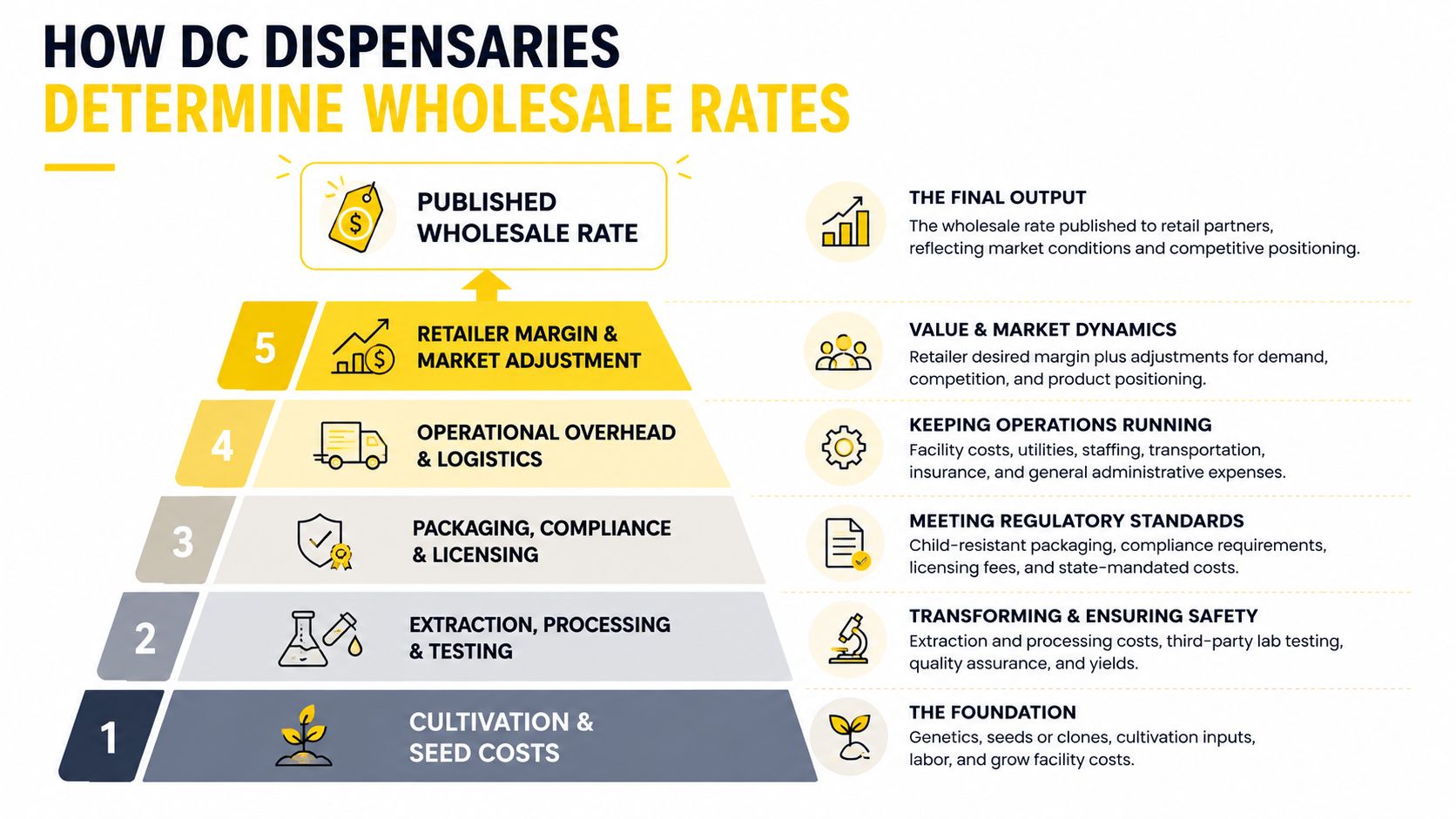
A wholesale rate starts with the product, but it doesn't end with cultivation cost. A DC dispensary or supplier has to recover the expense of producing or acquiring inventory, testing it, packaging it, documenting it, moving it securely, and maintaining the operation that supports the sale. The final quote also has to leave enough room for the buyer to operate without forcing the supplier into an unsustainable position.
The cost stack behind a quote
For premium flower such as Gelato or Blue Dream, the rate may reflect cultivation inputs, labor, curing, testing, packaging, storage, and the value of a product that customers actively request. A bulk edible order has a different structure. Its cost may depend more heavily on formulation, processing, dosage consistency, packaging, shelf life, and the number of units ordered. A cartridge or pen brings extraction, hardware, filling, labeling, and testing considerations that flower doesn't carry in the same way.
The following layers usually shape the conversation:
- Production and sourcing: Cultivation inputs, labor, genetics, harvesting, curing, or acquisition costs form the foundation.
- Processing and testing: Extraction, infusion, potency verification, contaminant testing, and batch documentation add product-specific expense.
- Packaging and compliance: Child-resistant packaging, labels, required information, licensing, and recordkeeping create costs that a buyer can't negotiate away casually.
- Operations and logistics: Staff, secure storage, transportation, insurance, delivery coordination, and inventory handling influence the delivered rate.
- Margin and market position: The supplier considers its required margin, while the buyer evaluates whether the product can support a sensible retail price.
What's negotiable and what isn't
A supplier may have room to adjust pricing for consistent volume, a prepaid order, a defined delivery schedule, or a limited assortment that simplifies fulfillment. Regulatory overhead, testing, required packaging, and traceability aren't good targets for aggressive bargaining. Asking a supplier to remove those costs usually produces a weaker deal, not a better one.
Availability also changes negotiating power. A limited harvest or sought-after strain may support a firmer quote, while abundant inventory can create room for a volume tier or a mixed-case arrangement. Buyers evaluating THC pre-rolls for wholesale should ask about batch dates, case configuration, testing records, replacement policy, and minimum order requirements, not just the unit price.
Eligibility and Documentation for Wholesale Accounts
Opening a wholesale account in DC starts with proving that your business is allowed to participate. A supplier that skips verification creates risk for both sides, so expect a review before anyone discusses recurring orders or delivery arrangements in detail.
Build the account file first
Prepare a clean digital folder with the following records:
- Valid DC medical cannabis business license: Confirm that the license is current and matches the entity seeking the account.
- Tax registration: Keep the current DC sales tax registration certificate available, along with the business's tax identification information.
- Compliance documentation: Provide records that demonstrate adherence to applicable DC cannabis rules and operating requirements.
- Wholesale application: Complete every ownership, contact, billing, and purchasing field consistently.
- Physical business location: Be ready to provide proof that the stated operating address is real and connected to the licensed business.
- Background and responsible-party records: If the supplier requests clearances or ownership documentation, submit complete copies rather than partial screenshots.
The most common delays are administrative. A license may show one legal entity while the tax certificate shows another. A business address may appear as a mailing location on one document and a physical location on another. An expired certificate, missing signature, or unreadable scan can pause an application even when the business itself is legitimate.
Treat approval as ongoing
Approval isn't the end of compliance. Buyers and suppliers should maintain accurate inventory records, reconcile received goods against invoices and manifests, and use the required seed-to-sale tracking process where applicable. Reporting obligations, license renewals, product documentation, and contact changes need attention throughout the relationship.
Practical rule: Never place an order against an account whose license, address, or responsible-party information hasn't been verified recently.
Payment procedures deserve the same care as product documents. Before exchanging funds, review the supplier's accepted methods, invoice controls, account permissions, and fraud-prevention process. Cannabis payment processing security guidance can help a new buyer identify weaknesses before they become an operational problem.
Fixed Versus Dynamic Pricing Models for Cannabis Wholesale
Fixed pricing gives a buyer a stable planning number for an agreed period or product arrangement. Dynamic pricing allows the quote to change as availability, input costs, inventory pressure, or market demand changes. Neither model wins in every situation.
A retailer with dependable movement on staple pre-rolls or tinctures may prefer a fixed rate because purchasing, pricing, and cash-flow planning become easier. A buyer taking seasonal flower or limited-run products may accept dynamic pricing if the supplier offers better access or adjusts rates when inventory conditions soften.
Recent wholesale surveys reveal why a rigid answer misses the practical issue. One survey found that 52% of surveyed brands prefer fixed pricing, while 17% considered dynamic pricing essential, as summarized by NuORDER's 2026 wholesale trends discussion. A separate 2026 industry survey found 58% of wholesale leaders viewed dynamic pricing as important or essential, while 34% still relied on static pricing, according to the same source. The difference suggests that buyers and suppliers aren't using one universal model.
| Factor | Fixed Pricing | Dynamic Pricing |
|---|---|---|
| Budget planning | Easier to forecast | Requires frequent updates |
| Inventory risk | Lower price uncertainty | Greater exposure to market movement |
| Access to deals | May exclude short-term reductions | Can capture discounts when supply is abundant |
| Best fit | Core SKUs with predictable movement | Seasonal, limited, or volatile products |
| Negotiation focus | Term length, volume, and renewal | Adjustment rules, notice, and benchmarks |
The hybrid usually works better
A practical agreement might lock the rate for core pre-rolls while allowing a review for seasonal flower. Another option fixes pricing for a defined order and permits changes only for future purchase orders. The contract should state what triggers an adjustment, how much notice the buyer receives, whether existing inventory is protected, and whether the parties can exit without penalty.
A buyer comparing pre-roll cost considerations should model both price and sell-through. A slightly higher fixed rate may outperform a lower dynamic quote if it prevents repeated menu changes, rushed repricing, or margin surprises. Conversely, dynamic pricing can make sense when the retailer has flexible shelf space and can move quickly on opportunistic buys.
Negotiation Strategies That Actually Work
The strongest wholesale negotiations reduce uncertainty for both parties. Asking, “Can you do better?” gives the supplier no reason to change the quote. A better conversation identifies what the buyer can offer, what risk the supplier is carrying, and which term can move without damaging the relationship.
Trade commitment for a better rate
Volume matters when it's real and repeatable. Don't promise a large order to access a lower unit price if the inventory won't move. Instead, show a purchasing pattern, define a recurring assortment, or offer a consistent order window. For example, a retailer might request a tier for a dependable monthly mix of pre-rolls and edibles, with the understanding that the supplier can plan production and delivery more efficiently.
A trial order can also create a stronger position later. Pay on time, report quality issues with batch details, and reorder the products that sell well. Reliability gives a buyer a stronger basis for requesting improved terms than a one-time claim that the account could become large.
Negotiate the whole commercial package
Unit price isn't the only lever. A supplier may resist lowering the rate but agree to better payment timing, delivery terms, replacement treatment for verified defects, mixed-SKU cases, or a smaller initial commitment. Each term has a financial effect, so calculate it before accepting.
- Payment terms: If cash flow is tight, extending payment timing may help more than a small unit reduction.
- Minimum order: Ask whether the opening order can be smaller while the account proves demand.
- Product rotation: Clarify whether slow-moving or damaged units can be replaced, credited, or returned.
- Delivery: Confirm fees, delivery windows, receiving requirements, and responsibility for discrepancies.
- Exclusivity: Treat exclusivity as a cost. If a supplier wants it, request a clear benefit and a defined review date.
Use benchmarks without pretending they set cannabis rates
Independent benchmarks can validate whether a quote deserves further questions. OPIS describes daily wholesale rack gasoline and diesel prices as a benchmark for regional procurement, RFP creation, and supplier-contract validation in its municipal wholesale pricing explanation. That example illustrates the negotiation principle: a third-party reference can reduce information asymmetry, even when it doesn't determine the final local price.
U.S. wholesale trade data shows the value of watching movement rather than relying on a list price. The Federal Reserve series for total wholesale trade recorded 214.856 in July 2026, down from 215.952 in June 2026 and up from 209.675 in May 2026, on a December 2006 = 100 basis, as shown in the Federal Reserve Economic Data wholesale-trade series. That movement doesn't tell you what a cannabis product should cost. It does support asking whether a quote reflects current conditions, committed service, or a stale price sheet.
For local comparisons, buyers can also review how Mr. Nice Guys DC compares with other DC weed shops and use the information to frame questions rather than make unsupported demands.
Step-by-Step Process for Opening a Wholesale Account
A clean opening process prevents the first order from becoming a compliance emergency. Move in sequence, keep written records, and don't treat a fast reply as proof that a supplier is ready to serve your business.
Research suitable DC programs. Review product categories, licensing information, fulfillment options, ordering requirements, and whether the supplier can support your expected assortment. A shop that only carries premium flower may not be the right fit if your customers primarily buy edibles and cartridges.
Contact the sales or wholesale team. Request the wholesale packet, current product list, minimum order information, delivery area, payment options, and account requirements. Ask who owns the relationship after approval. Slow or inconsistent communication at this stage often becomes worse once invoices and discrepancies appear.
Compile and submit documents. Send current licenses, tax registration, compliance records, completed applications, and physical-location proof in a consistent format. Check legal names and addresses line by line before submitting.
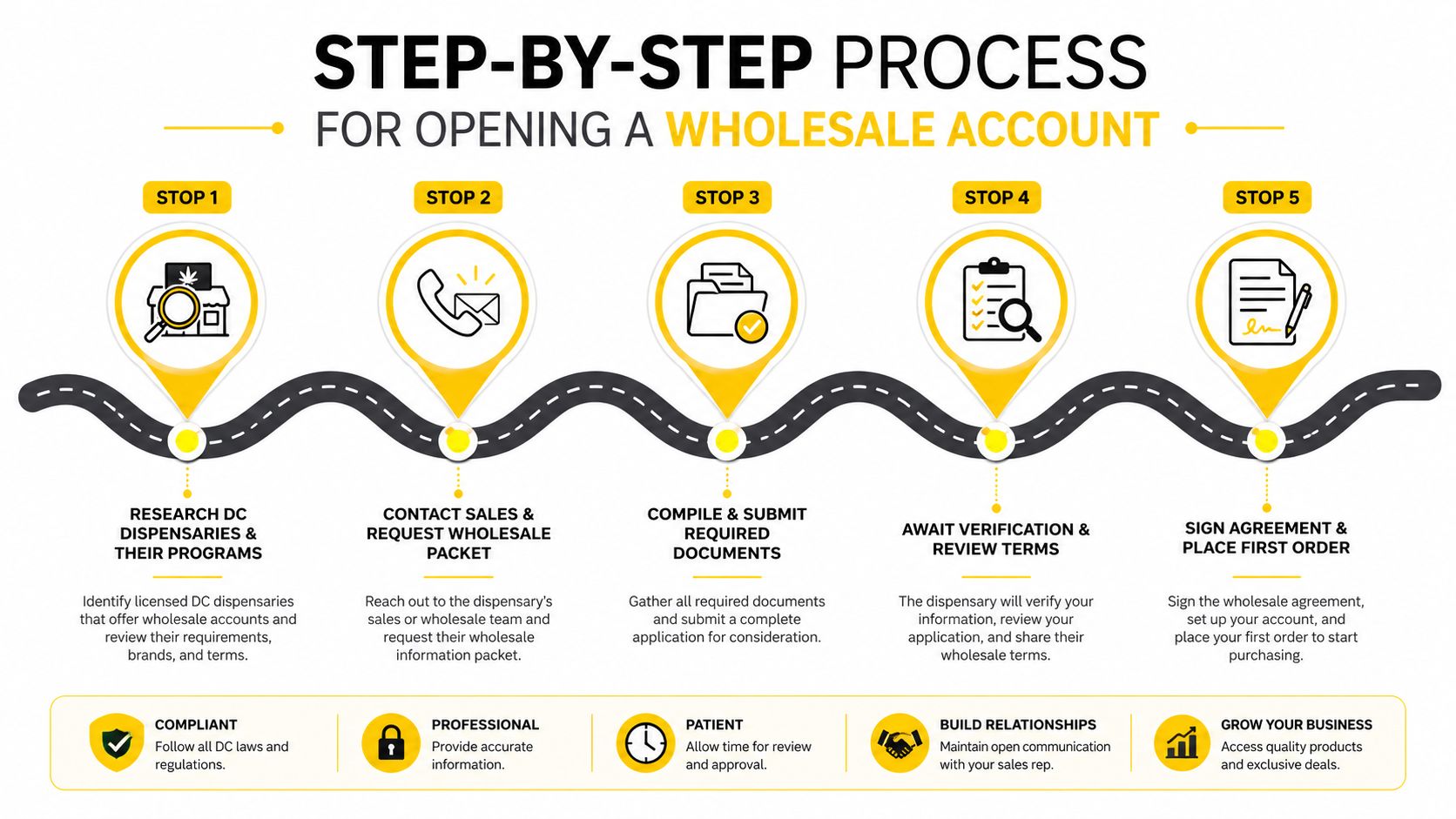
Complete verification and review terms. Expect the supplier to confirm eligibility, inventory controls, payment details, receiving procedures, and authorized contacts. Read the pricing section closely. Look for adjustment language, minimums, delivery charges, product replacement rules, and cancellation terms.
Place a controlled first order. Start with a trial assortment that tests quality, packaging, delivery accuracy, sell-through, and customer response. Record batch information at receiving, compare quantities with the invoice, and report discrepancies promptly.
- Verify eligibility: Match licenses, tax registration, compliance records, and business address.
- Record pricing terms: Save the quote, adjustment rules, notice periods, minimums, and delivery charges.
- Test the supplier: Use a controlled first order to check fulfillment, packaging, batch records, and sell-through.
- Set review dates: Track discrepancies, returns, payment history, and product movement.
A good partner explains the price structure without exposing information it doesn't need to share. Red flags include pressure to bypass documentation, unclear ownership of the account, unexplained payment changes, missing batch records, or quotes that change without written notice. After the first order, schedule a regular review of movement, returns, payment history, and upcoming product needs.
Key Takeaways and Next Steps for Wholesale Buyers
Before approving a supplier, confirm that the account can survive an audit, a receiving mistake, and a slow-selling product. Use this short closeout list:
Use this email when a quote is close but the terms need clarification:
Subject: First wholesale order and account terms
Thanks for sending the current quote. We are prepared to begin with a controlled first order. Please confirm available batches, minimums, delivery charges, payment terms, replacement procedures, and how much notice you provide before a price change. We will verify quantities and batch information at receiving and report discrepancies promptly. If those terms are confirmed in writing, please send the account application and required compliance documents.
Ask for written answers before submitting payment details. Pressure to skip documentation, unexplained payment changes, missing batch records, or ownership that does not match the account should stop the order.
Mr. Nice Guys DC offers flower, edibles, cartridges and pens, pre-rolls, concentrates, topicals, and tinctures, with in-store pickup, curbside service, and delivery through Sweede. Visit Mr. Nice Guys DC to review the current menu and discuss compliant purchasing options.
Mr Nice Guys DC
At Mr. Nice Guys DC, we’re more than just a cannabis delivery service — we’re passionate advocates for quality, convenience, and community. With years of experience in the cannabis industry, our team is dedicated to educating and empowering customers across Washington, D.C. Whether you're a seasoned user or just starting your cannabis journey, our blog delivers trusted tips, product insights, and the latest updates from the world of weed. Stay informed, stay elevated.
