
Must Be 21 To Enter
By entering this site you are agreeing that you are at least 21 Years of Age or older.
I AM 21 OR OLDERTHC Pre Rolls Wholesale: DC Dispensary Buying Guide 2026
.svg)

.png)
Friday afternoon is when weak pre-roll buying systems show up fast. Your menu says infused singles are available. The drawer says otherwise. A budtender has to explain the stockout again, a regular customer pivots to something they didn't want, and your supplier still hasn't confirmed the replacement order.
That's usually not a product problem. It's a procurement problem.
Buying THC pre rolls wholesale in Washington, DC takes more than finding a catalog and asking for a price sheet. You need a supplier who can deliver consistent burns, stable packaging, clean paperwork, and realistic order timing. You also need an internal process that fits DC's compliance reality, especially if a vendor starts pushing THCA items with big claims and thin explanations.
Why Your Pre-Roll Strategy Matters Now More Than Ever
Pre-rolls are no longer a side rack product you refill whenever someone remembers. They're a core category, and buyers who still treat them like an impulse add-on usually end up chasing stockouts, dead inventory, or both.

The market data makes that clear. Across 13 recreational markets, more than 310.7 million pre-roll products were sold in the first 10 months of 2025, generating nearly $2.8 billion in revenue and capturing a 15.8% market share. Inside that category, infused pre-rolls accounted for 48.5% of all pre-roll revenue according to Headset trend reporting summarized by Custom Cones USA.
That matters at store level because pre-roll shoppers are often buying for convenience, not for a long comparison process. If your top single, infused option, or trusted house-style format is unavailable, many customers don't wait for next week's delivery. They switch products or leave.
What changed for dispensary buyers
A few years ago, a lot of stores could get away with reactive ordering. A buyer would watch the shelf, text a rep, and refill after the weekend. That approach breaks down when velocity picks up and menu expectations rise.
Customers now expect pre-rolls to be:
- Easy to shop: clear strain type, weight, and format
- Easy to trust: no mystery burn issues, no stale tubes
- Easy to repeat-buy: same product should smoke the same way next time
That last point is where wholesale discipline starts to matter. A 1-gram single that burns evenly every time will often outperform a more exciting SKU that flakes, runs, or clogs.
Practical rule: If your team can't predict which pre-roll SKUs will sell through first, you're not buying a category. You're reacting to a shelf.
What strong strategy looks like in DC
In DC, you also have an added layer. Product sourcing decisions can't be separated from local compliance, receiving procedures, and menu risk. That's especially true if wholesalers pitch products with aggressive cannabinoid positioning but vague documentation.
A good pre-roll strategy does three things at once:
| Priority | What it means in practice |
|---|---|
| Protects availability | Your top formats stay in stock through peak periods |
| Protects margin | You know which products can survive price pressure |
| Protects the license | You don't buy into avoidable compliance gray zones |
For retail teams that want a customer-facing view of why pre-rolls keep winning, this breakdown of ready-made pre-roll appeal is useful context. It reflects what buyers see every day at the counter. People want convenience, consistency, and low-friction purchasing.
If you're buying THC pre rolls wholesale in DC, your job is to build that convenience on the back end before the customer ever sees the menu.
Finding Reputable Wholesale Pre-Roll Suppliers
Most buyers start the wrong way. They search online, collect a few menus, ask for pricing, and assume the lowest quote deserves the first test order. That usually leads to wasted samples, uneven product, and too much time spent managing vendors who were never a fit.
A better approach looks more like building a supplier bench than placing a one-off order.
The reason is simple. The U.S. legal cannabis market reached $33.8 billion in retail sales in 2025 and was projected to reach $60 billion by 2030, while pre-rolls held 15.8% share in tracked U.S. recreational markets and were described as the fastest-growing category according to cannabis market size reporting. In a category with that kind of mainstream demand, dependable suppliers get busy fast. If you wait until you're desperate, you'll buy from whoever replies first.
Build your list from three channels
A disciplined buyer usually pulls names from three places.
First, use licensed B2B ordering platforms and wholesale directories to identify active brands and manufacturers. Don't treat those platforms like the final vetting step. Treat them like a searchable lead list. The value is speed. You can compare product lines, packaging styles, and responsiveness without burning a week on introductions.
Second, attend regional trade events and face-to-face product showcases when possible. A short in-person conversation tells you more than a polished sell sheet. You can hear how a supplier talks about fill weight, burn consistency, replacement policies, and lead times. Reps who know their production process answer directly. Reps who don't usually pivot back to potency claims and packaging.
Third, talk to non-competing operators. A buyer in another neighborhood or a nearby market may not hand over their full supplier list, but they'll often tell you who misses deliveries, who stands behind replacements, and who sends samples that don't match shipped inventory.
A practical first-contact filter
When a promising supplier appears, don't ask “What's your best price?” first. Ask questions that expose whether the relationship is workable.
Use a short filter like this:
- Batch discipline: “Do you sell by current batch with matching COAs, or from a general product line sheet?”
- Production reality: “What formats are you producing consistently right now, not just seasonally?”
- Replacement policy: “If a batch arrives with burn issues or damaged packaging, how do you handle credits or swaps?”
- Lead times: “How much notice do you need for repeat orders on your top pre-roll SKUs?”
Those questions do two jobs. They surface operational maturity, and they save you from wasting time on vendors who only know how to market.
Buyers usually regret the supplier who had the fastest sales response and the weakest operations follow-through.
What a strong short list looks like
A usable supplier short list isn't just diverse in brand style. It's diverse in risk.
For example, a DC buyer may want:
- one dependable supplier for everyday flower-only singles
- one specialist for infused pre-rolls
- one backup partner who can fill short-notice gaps
- one private-label or custom-packaging option if that fits the business model
That mix gives you flexibility when a top seller spikes, a batch fails inspection, or a vendor's production timing slips. It also keeps one supplier from controlling your menu.
Reputable THC pre rolls wholesale sourcing starts before the sample box arrives. It starts with knowing who you'll trust when the category gets tight.
The Ultimate Vetting Checklist for Wholesale Partners
A polished sample kit doesn't prove much. Good branding, decent packaging, and a fast email response can make a weak partner look solid for a week or two. Actual vetting work starts when you move from “interesting vendor” to “possible long-term supplier.”
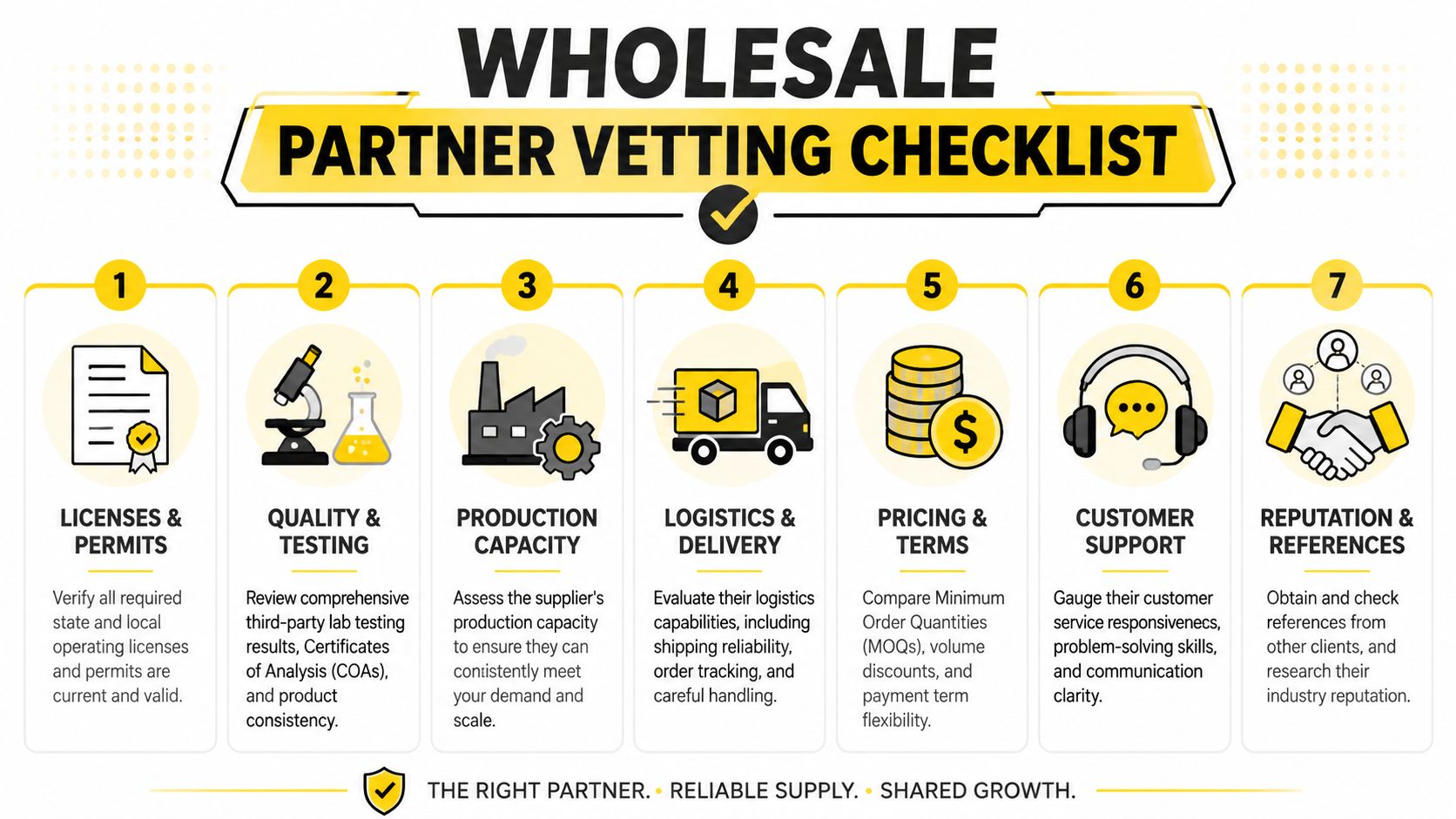
The most common mistake I see is overvaluing paperwork and undervaluing smoking performance. Both matter. But a pre-roll can pass a lab panel and still fail on the shelf if it can't hold structure, pull cleanly, or burn straight.
A useful quality reminder appears in this overview of cannabis potency testing. Potency data matters, but it doesn't answer whether a pre-roll performs well once a patient or customer lights it.
The non-negotiable paperwork checks
Start with compliance basics. If a supplier gets evasive here, stop.
| Check | What to verify |
|---|---|
| License status | Current state and local licensing that matches their role in the supply chain |
| COA availability | Batch-specific test results, not a generic old lab file |
| Insurance | Product liability coverage and proof that it's active |
| Packaging docs | Labels, warnings, and any required compliance details for your market workflow |
Ask for documents before you ask for final pricing. Serious partners expect that request.
Then read the paperwork, not just collect it. Look at dates, batch references, product names, and whether the COA matches the SKU being sold. A lot of buyers ask for a COA and never compare it to the delivered goods.
The quality checks most buyers skip
Public wholesale pages often emphasize testing, packaging, and potency. What they often don't answer is how bulk product performs across batches. That gap matters. As noted in Earthy Select's discussion of wholesale pre-roll quality questions, buyers need to assess fill weight variance, moisture control, and machine-vs-hand-roll consistency to avoid products that burn unevenly, clog, or crack.
That should shape your sample test process.
When sample units arrive, test them like a retailer, not like a fan:
- Light and draw test: Does the first pull feel blocked or open?
- Mid-burn check: Does the burn line stay even without constant correction?
- Ash and structure check: Does the cone canoe, loosen, or collapse?
- Flavor consistency: Does the infused version still taste intentional halfway through, or does it turn harsh and flat?
Field note: The right sample isn't the one that smokes best once. It's the one that smokes the same way across multiple units.
Ask about production, not just product
A supplier can make a good pre-roll in a sample run and still be a bad wholesale partner. Ask what happens at scale.
Here are the questions that usually reveal a lot:
- How is material milled and held before filling? Too fine and airflow suffers. Too dry and the product gets harsh.
- What's the fill method? Machine-made isn't bad. Hand-finished isn't automatically better. What matters is consistency.
- What is the hold time between production and delivery? Old inventory often shows up first in smoke quality.
- How are damaged tubes, loose caps, or cracked rolls handled? If they don't have a written answer, expect friction later.
Red flags that justify walking away
Some warning signs aren't dramatic. They're just repetitive.
- Mismatched samples and quotes: The sample feels premium, the quote references a different batch, and details get blurry when you ask follow-ups.
- No language for defects: Vendors who sell enough pre-rolls should already know how they handle runs, clogs, and packaging damage.
- Potency-first selling: If every answer goes back to THC or infusion strength, they may be covering weak process control.
- Slow document turnaround: Delays at the vetting stage often become worse during active ordering.
Vetting THC pre rolls wholesale partners means checking whether the product can hold up in real-world use and whether the company can hold up under normal retail pressure. You need both.
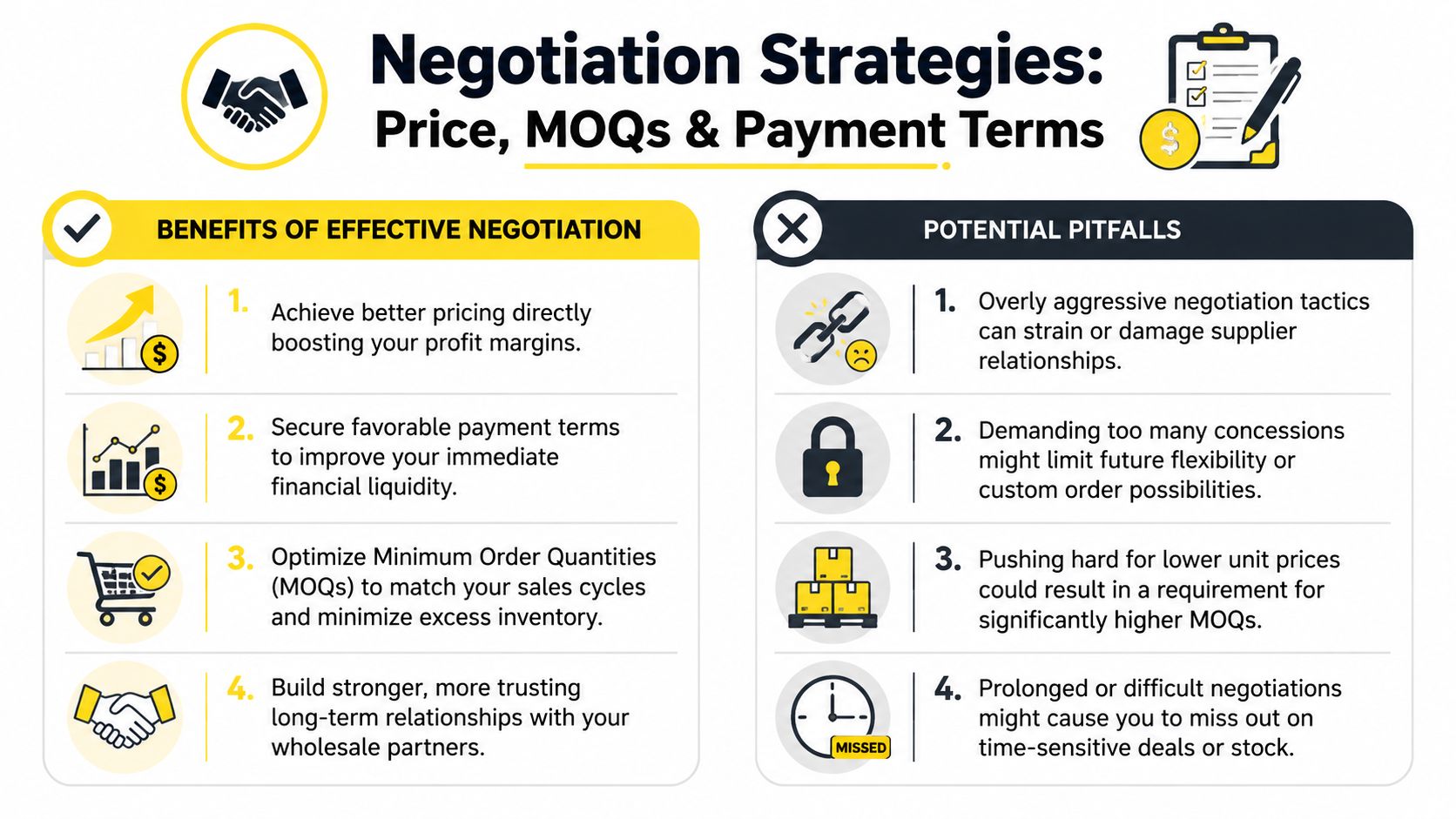
Negotiating Price MOQs and Payment Terms
A bad negotiation focuses only on the unit price. A smart one protects margin, cash flow, and reorder flexibility at the same time.
That distinction matters more now because price compression has already changed the category. In major U.S. markets, pre-rolls averaged a 46.6% margin overall, while vertically integrated house brands reached 55% margins because their average unit cost was $2.40 versus $5.19 for non-house brands. The same market reporting found average retail pricing fell to $9.31 per unit in 2025 according to Custom Cones USA's pre-roll market analysis.
If your store pays too much for a flashy pre-roll line, a lower retail market won't rescue you later. The cost structure has to work before the order is placed.
Negotiate from landed cost, not sticker price
When a supplier quotes a pre-roll, translate that quote into landed cost. Include packaging issues, likely defect rate, receiving friction, and any promotional discounting you know you'll need.
For example, a vendor might offer a lower unit price only if you take a larger MOQ. That can look attractive until half the batch slows down on the shelf and your working capital gets trapped in aging stock.
A more practical buyer response sounds like this:
“We'll test a smaller opening order at your quoted price if the batch matches sample quality. If sell-through is clean, we can discuss stepped volume on the next PO.”
That protects your downside without shutting the door on scale.
The MOQ conversation most buyers avoid
Many buyers hear the supplier's minimum order quantity and treat it as fixed. Sometimes it is. Often it isn't.
A better way to discuss MOQ is to anchor it to a mutual forecast:
- Trial order: Small enough to test real velocity
- Reorder trigger: A defined point where you commit to replenishment
- Volume review: Repricing once proven SKUs show repeat movement
That structure works especially well when you're adding a new infused line, a hybrid single-strain product, or a private-label run where shelf performance is still unknown.
A cost explainer like this pre-roll pricing breakdown is useful internal reading for teams that need to understand why price alone doesn't explain retail viability.
Payment terms are margin tools
Payment terms matter because cash tied up in slow product is still a cost, even if the invoice looked fair.
Use this lens when discussing terms:
| Term focus | Good reason to ask |
|---|---|
| Short initial terms | Helps verify reliability before expanding exposure |
| Partial upfront with balance on receipt | Useful when sample-to-batch consistency is still being proven |
| Improved terms after repeat orders | Gives the supplier an incentive to perform consistently |
Don't push for concessions you can't justify. Overly aggressive negotiation can backfire if the supplier starts deprioritizing your orders, holding weaker inventory for your account, or removing flexibility on replacements.
Lowest price can be the most expensive deal if the MOQ is too large, the terms are rigid, and the product turns slowly.
What works in practice
The strongest negotiations usually end with both sides clear on four points:
- exact SKU and batch expectations
- minimum acceptable shelf-life window
- what happens if the product arrives with defects
- when pricing gets reviewed
That's the true win. Not a tiny price cut attached to a bad ordering structure.
Mastering DC Compliance and Logistics
Washington, DC adds a layer that generic THC pre rolls wholesale guides usually skip. The buying decision isn't only about margin and menu fit. It's also about how your sourcing process holds up under local rules, receiving practices, and product classification risk.

If you operate in DC, your purchasing team should already know that “federally compliant” language from a seller doesn't resolve local retail risk. It may only shift that risk onto the dispensary.
For a local framework refresher, this guide to how DC regulates medical cannabis dispensaries is a useful reference point before you expand supplier relationships or add new cannabinoid categories.
The THCA issue needs operational answers
The biggest underanswered wholesale question is the regulatory gray zone around THCA. Many THCA pre-rolls are marketed as federally compliant when Delta-9 THC stays below the Farm Bill threshold, but buyers still carry the risk tied to THCA-to-THC conversion upon heating and inconsistent state-by-state enforcement according to TribeTokes' overview of wholesale THCA pre-roll concerns.
That's the legal headline. The store-level question is more practical.
If a product is marketed one way by the supplier but interpreted another way by regulators, enforcement staff, or payment and insurance partners, who absorbs the fallout? In practice, the retailer usually does.
That means a DC buyer should ask:
- How is the product labeled and described in sales materials?
- Does the supplier acknowledge post-heating conversion risk, or do they avoid the topic?
- What written indemnity or liability language exists, if any?
- Would you still be comfortable defending this SKU during a compliance review?
If those answers are fuzzy, pass.
Compliance lens: If you need a long verbal explanation to justify why a pre-roll is “probably okay,” it's usually too risky for routine inventory.
Receiving and transport discipline matters
Logistics in DC should be treated as a compliance function, not just a delivery function. Every receiving event needs structure.
Use a receiving checklist that covers:
- Manifest match: product name, batch, quantity, and packaging type
- Physical inspection: crushed tubes, broken seals, humidity damage, loose product
- Document capture: COAs, invoices, shipping records, replacement contact
- Quarantine process: hold questionable inventory until it's reviewed
Cross-border assumptions can create trouble. Buyers often get casual when products are coming from nearby markets or from partners they know well. Don't. Shorter geographic distance doesn't reduce your documentation burden.
A short video can help frame the operational mindset teams need around movement, delivery, and local handling:
DC-specific buying habits that reduce risk
A lot of problems can be prevented before the PO is sent.
For DC dispensaries, safer habits include:
- Favoring suppliers who communicate in writing when discussing compliance-sensitive SKUs
- Separating experimental products from core inventory so one questionable line doesn't disrupt the menu
- Training receiving staff to escalate exceptions immediately instead of shelving first and asking later
- Documenting every replacement or quality dispute in the supplier file
The point isn't to make procurement slow. It's to make it defensible. In DC, that difference matters.
Placing Your Order and Managing Inventory
Once a supplier is approved and terms are set, execution becomes the edge. It determines whether stores operate cleanly or start leaking money through preventable errors.
The biggest issue is inventory mismatch. In this category, unit sales grew 18.6%, and buyers are advised to use POS data to forecast SKU velocity and align order size with supplier minimums so they don't under-order fast movers or over-order products that age on the shelf, as outlined in Distru's wholesale THC pre-roll guidance.
Use a PO format that leaves no room for guesswork
Your purchase order doesn't need to be complicated. It does need to be complete.
A strong pre-roll PO should include:
- Supplier and buyer details: legal entity names, contacts, delivery location
- SKU detail: product name, format, weight, infused or non-infused status, packaging type
- Order terms: agreed quantity, unit cost, total cost, payment terms
- Batch expectations: current batch only, required documents, acceptable delivery window
- Exception instructions: what to do if quantity, packaging, or quality doesn't match
That last line prevents a common problem. Drivers arrive with a partially substituted order, staff are busy, and the store accepts product it didn't intend to buy.
Let your POS decide the reorder, not your memory
A lot of buyers still reorder based on feel. That's risky in a fast-moving category.
Review recent sell-through by format and ask specific questions:
- Are 1-gram singles turning faster than multi-packs?
- Are infused pre-rolls moving consistently, or only in weekend spikes?
- Which strain styles hold repeat demand, and which ones only sell once?
- Which SKUs need markdown support to move?
A practical example is simple. If your POS shows one infused single consistently selling through while a premium multi-pack lingers, don't split the next order evenly out of habit. Fund the winner first.
Reordering should answer one question. Which SKU earns another slot in the drawer right now?
Build a simple weekly inventory rhythm
Keep the cadence boring. Boring systems work.
| Day | Task |
|---|---|
| Early week | Review sales velocity and on-hand counts |
| Midweek | Confirm supplier availability and open issues |
| Before weekend | Check top sellers, incoming deliveries, and shelf gaps |
For stores that also serve online shoppers, Mr. Nice Guys DC's online ordering process is a good reminder of how quickly menu accuracy affects the customer experience. If inventory and menu timing drift apart, customers see it first.
Ordering THC pre rolls wholesale well isn't glamorous. It's just consistent. Clean PO language, disciplined receiving, and POS-based reordering will outperform guesswork every time.
If you're shopping pre-rolls in Washington, DC and want a compliant retail option with online ordering, pickup, and delivery, Mr. Nice Guys DC offers pre-roll products alongside flower, edibles, vapes, and other medical cannabis formats.
Mr Nice Guys DC
At Mr. Nice Guys DC, we’re more than just a cannabis delivery service — we’re passionate advocates for quality, convenience, and community. With years of experience in the cannabis industry, our team is dedicated to educating and empowering customers across Washington, D.C. Whether you're a seasoned user or just starting your cannabis journey, our blog delivers trusted tips, product insights, and the latest updates from the world of weed. Stay informed, stay elevated.
