
Must Be 21 To Enter
By entering this site you are agreeing that you are at least 21 Years of Age or older.
I AM 21 OR OLDER8 Ways to Concentrate: Practical Methods for Focus in 2026


Third hour of a shift. The inventory count is half finished, three tabs are open, and a message lands every few minutes. You restart the same row of numbers a fourth time and promise yourself you'll focus harder after lunch.
Attention rarely fails in one dramatic moment. It leaks. A switch here, a check there, and twenty minutes are gone before you notice. The fix isn't a personality transplant. It's matching a method to the way your day breaks.
The reasons people give for slipping focus are mostly structural. In a 2025 national survey of 1,000 U.S. adults, stress and anxiety were the most commonly named contributors to short attention spans at 43%, ahead of insufficient sleep at 39% and digital-device exposure at 35%, as Medical Xpress reported on the survey. A timer doesn't fix anxiety. Silent notifications don't fix a five-hour night.
So here are eight ways to concentrate, each tied to a workday you'd recognize: a retail floor, a back office, a remote desk. Every one names its main trade-off, because the honest answer to "which method works best" is "the one that matches your bottleneck this week."
If sleep and stress are the problem, start at number six. If starting is the problem, start at number seven. Otherwise, work through in order.
1. Pomodoro Technique
The Pomodoro Technique breaks work into fixed focus intervals, traditionally 25 minutes, separated by short breaks of about five minutes. After four intervals, you take a longer break of 15 to 30 minutes. Francesco Cirillo developed it in the late 1980s.
The visible timer does the work. It gives a task a clear start and a clear stop, which is exactly what a vague job like "update inventory" lacks.
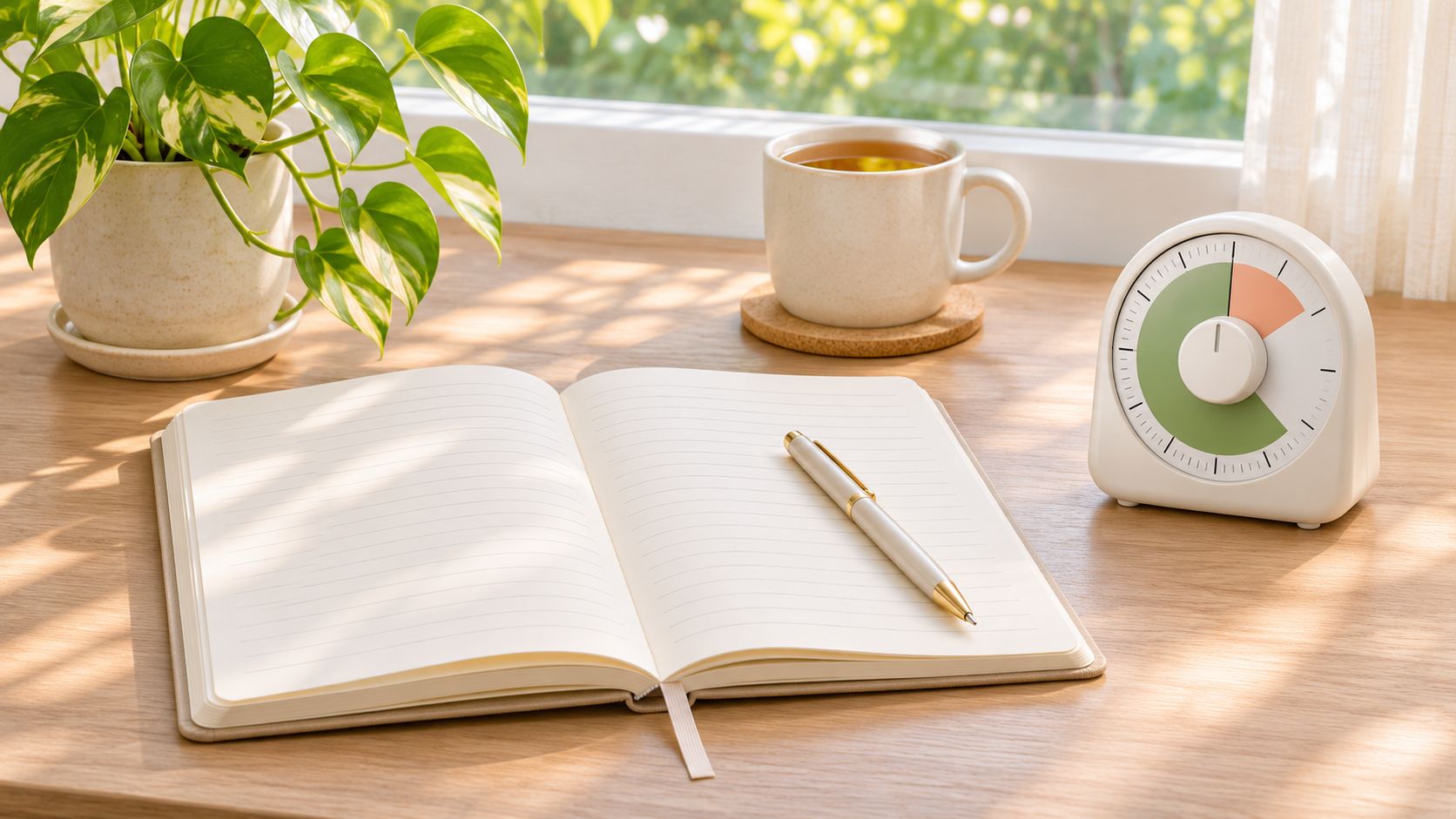
A budtender runs one 25-minute block to update the shelf inventory spreadsheet, breaks for five minutes, then runs a second block on new product rotation details. A delivery coordinator uses four pomodoros before noon to process online orders, then takes the long break before reviewing the afternoon delivery schedule.
What the evidence actually supports
Structured intervals change how work feels more reliably than they change how well you do it. Across three randomized trials with 87 students, fixed schedules of 24 minutes of work followed by 6 minutes of rest, or 12 minutes of work followed by 3 minutes of rest, produced approximately 20% lower fatigue, a 0.5-point improvement in distractibility, and a 0.4-point increase in motivation compared with self-paced breaks, according to this BMC Medical Education analysis. The same analysis reported positive correlations between Pomodoro use and focus (r = 0.72), performance (r = 0.65), engagement (r = 0.68), and lower fatigue and distraction (r = -0.55), though correlations can't establish causation.
That's the trade-off. Fixed intervals make work easier to start and easier to keep going. They don't guarantee better output. Track completed deliverables and error rates, not just the pleasant feeling of having focused.
Practical rule: If a task takes more than four intervals, it isn't a task, it's a project. Split it before you start the timer.
Use breaks to move rather than scroll. In one simulated classroom study, college students who took a 15-minute exercise break between two 50-minute periods of sitting showed significant improvements on a dual-task Stroop test, including faster responses and fewer errors, and the study puts 10 to 20 minutes as the useful range, per this study on movement breaks. If you want a daytime product that supports a work block rather than flattening it, the best sativa strains for energy are worth reading before you buy.
- Write the task before the timer starts: Each interval needs a goal someone else could verify.
- Silence notifications and keep a notepad: Write the distraction down instead of chasing it.
- Split anything over four intervals: Smaller pieces survive interruptions.
- Move during breaks: Stairs, water, a short walk. Not the feed.
2. Time Blocking
Time blocking is the difference between a to-do list and a schedule. You assign each category of work to a specific window instead of making a fresh decision every twenty minutes. A dispensary manager blocks 9:00 to 10:30 for compliance paperwork, 10:30 to 11:30 for supplier communication, and the afternoon for staff coaching. A marketing team member blocks two hours each Tuesday to write a strain spotlight, then leaves Thursday afternoon open for customer questions.
The gain is decision fatigue, not speed. You stop asking "what now" twelve times a day, and you stop burning the first ten minutes of every task working out what it was.
Build the breaks into the schedule
A block plan that ignores recovery collapses by mid-afternoon. NIH guidance on sustaining attention advises short breaks during tasks that require sustained attention and dividing large tasks into smaller steps. Research summarized by NIH also found that short, frequent rest periods improved performance on a newly learned skill, because the breaks helped strengthen memories of the skill just practiced.
Label each block with the outcome you expect, not the activity. "Draft the strain spotlight intro" survives a chaotic morning. "Write" does not.
The block many skip is the one that makes the rest work. NIH sleep guidance reports that losing even one hour of sleep can make focusing harder and slow response time the following day, and most adults should aim for roughly 7 to 8 hours nightly. A student who normally sleeps from 11:00 p.m. to 7:00 a.m. should protect that schedule before an exam rather than trade it for late-night review. Schedule the sleep window first, then the work blocks.
- Put peak hours on the hardest work: Rate your focus at morning, afternoon, and evening for one week, then move the demanding block.
- Leave 10 to 15 minute buffers: Overruns are normal. Back-to-back blocks are not.
- State a finish line for every block: If you can't describe the output, the block is a wish.
- Review on Friday: Move or delete any block that got skipped three weeks running.
The trade-off is honesty about your role. If you're on the floor or on call, you can't defend a four-hour block. Protect two hours and stop pretending the rest is schedulable.
3. Deep Work
Deep work means extended, undistracted focus on a cognitively demanding task. Cal Newport described the practice in his 2016 book Deep Work, and sessions typically run 60 to 90 minutes or longer. You schedule them in advance and protect them like a meeting with someone senior.
The case for deep work is really a case against switching. In experiments from the mid-1990s, participants alternated between two tasks every two or four trials and were consistently slower on task-switch trials than on task-repeat trials, even when they knew the next task in advance, according to the American Psychological Association's discussion of attention. The cost grew as the tasks became more complex. Researcher Edward H. Meyer estimated that brief mental blocks created by shifting between tasks could consume as much as 40% of productive time, and psychologist Gloria Mark found that average attention on a screen declined from about 2.5 minutes in 2004 to about 47 seconds in more recent measurements.
Read those two figures as a description of fragmented digital work, not a personal diagnosis.

A dispensary's operations lead schedules 90 minutes every Monday to analyze sales data and plan the next month's product rotation, with notifications off. A content writer sets aside a two-hour morning block to draft a buying guide, email closed and door shut. Both sessions need one thing beyond discipline: a manager who agrees not to interrupt.
Where deep work fails
Roles with real-time duty can't use it. A budtender during a rush, a support desk, a driver, a parent on school pickup: these jobs need interruption, and forcing a 90-minute block into them produces guilt rather than output. If your session is product research rather than drafting, keep it in a separate block. The best strains for creativity and focus is a reading task, and reading inside a writing block is a switch wearing a costume.
- Fix the location and the hour: Same desk, same time, so the room does the cueing.
- Name the deliverable: "Draft section two" beats "work on the guide."
- Batch shallow work outside the block: Email, messages, and quick approvals get their own window.
- Extend gradually: Add ten minutes per session rather than jumping to three hours.
Deep work produces your highest-value output and makes you unreachable while it happens. Choose which hours you can afford to be absent, and say so out loud to the people who'll test it.
4. Mindfulness Meditation
Five quiet minutes before a shift can change how a budtender handles the first rush: one customer asks about concentrate options, another is ready to pay, and a third needs rolling papers. A back-office payroll specialist can use the same reset before reviewing deductions, and a remote support agent can use it between difficult tickets. The practice costs time up front, and it asks you to notice distraction instead of waiting for the room to become quiet.
Mindfulness meditation trains attention by returning it to an anchor, usually the breath. The mind wanders, you notice, and you come back. That repetition builds the habit of catching distraction early. Mindfulness-Based Stress Reduction, developed by Jon Kabat-Zinn at the University of Massachusetts Medical School, is one structured way to learn it.

Modest effects and real limits
The results set the right expectations. In the trial published in PMC, the mindfulness-attention and mindfulness-oriented groups reported attentional-focus gains of 0.43 points (p<0.001, d=0.77) and 0.36 points (p<0.001, d=0.65) against 0.01 points for the no-treatment control (p=0.905, d=0.02), while distraction scores on a dichotic-listening task fell by 9.517 points (p=0.015) and 12.932 points (p=0.002) against a 5.394-point rise for controls (p=0.324), and trait attentional control improved with effect sizes of d=0.71 and d=0.49.
Reported control was stronger than the objective results, and some attention tasks lagged behind.
A meta-analysis of 27 randomized controlled trials with 1,632 healthy adults found a small overall benefit (Hedges' g = 0.20), with attention and executive control both at g = 0.18 and working-memory effects falling short of statistical significance. Larger reviews report small-to-moderate attention benefits across related cognitive measures.
For a patient, mindfulness is an adjunct for attentional control. Sleep, clinical evaluation, and treatment for ADHD, anxiety, or medication effects still do the heavier work.
The main trade-off is delayed payoff. A five-minute session is easy to fit between tasks, but the benefit builds through repetition and the measured effects stay modest. I would use it as maintenance before a demanding block and switch to a more structured method when the workload is already slipping.
If cannabis is part of your downtime, keep it separate from attention training. Ideas for low-key things to do while high fit after the workday is done.
5. Single-Tasking
A budtender finishes one customer's order before answering the phone. An inventory specialist reconciles one product batch fully before opening the next file. That is single-tasking: one task until it is finished or reaches a clean stopping point. No split screen, no second spreadsheet, no "quick check" that costs you ten minutes of re-reading when you come back.
A remote content editor finishes a complete product review before starting the next post, which skips the re-reading tax that multitasking charges.
Why medical cannabis patients should read this one twice
Switching is expensive for everyone. For some patients it is more expensive. A 2025 systematic review of medical-cannabis research in adults with psychiatric disorders reported possible improvements in attention, inhibition, and multitasking in some studies, but concluded the evidence remains insufficient for a high-confidence treatment recommendation, per the Archives of Clinical Neuropsychology review.
Read that as a scheduling instruction. Until the evidence firms up, cut the number of switches you ask your attention to make, and skip driving or safety-sensitive work after intoxicating use. If you dose during the day, I would put the switching-heavy work before the dose, not after.
Stopping note: Leave one plain sentence where you stopped. It costs ten seconds and saves the re-entry.
- One priority per session: Write it down, keep it visible, finish it before opening anything else.
- Close the tabs: Unrelated windows and apps are invitations you don't need.
- Set response expectations: Tell colleagues when you'll check messages instead of checking on impulse.
- Break between tasks, not inside them: An evening ritual belongs after the work window. How to pack a bowl isn't a mid-afternoon pause if it costs you twenty minutes of lost focus.
The trade-off is throughput. Single-tasking slows shallow admin work, and that cost is worth paying where accuracy matters and wasteful where it doesn't. Triaging ten low-stakes messages in one pass is good practice. Reconciling inventory is not.
6. Environment Design for Focus
Environment design means shaping the room and the screen so focus becomes the default. You remove clutter, cut noise, and put distance between yourself and whatever pulls you away. Willpower is a bad plan. Friction is a good one.
A dispensary back room keeps the desk clear of product samples and sets the workstation to a focus profile during inventory counts. A remote employee puts a sign on the door during deep work hours and runs a browser extension that blocks news sites until mid-afternoon.
The room you sleep in counts too
Half of concentration is the night before. NIH guidance on sleep and environment recommends keeping the same bedtime and wake time every day, weekends included, turning off screens at least an hour before bed, keeping the bedroom quiet and dark, and getting regular exercise, at least 30 minutes on most days, though not within a few hours of bedtime.
Someone who wakes at 7:00 a.m. can set a 10:30 p.m. screen cutoff, keep the bedroom dark and quiet, and walk for 30 minutes mid-afternoon rather than at 9 p.m.
- Name your top three distractions: Remove or relocate them. Don't negotiate with them daily.
- Use the focus mode you already own: Silence non-essential notifications at the operating-system level.
- Keep only current-task materials visible: A clear desk is a stated priority, not decoration.
- Mask noise deliberately: Headphones or one consistent background sound, not a playlist that changes every three minutes.
The same logic applies to storage. If you keep flower at home or in a back room, humidity control packs protect it from drying out. Control the variables you can see and the ones you can't stop competing for your attention.
The trade-off is invisible labour. Environment design needs maintenance, and a tidy desk won't fix a five-hour night or untreated anxiety. In a shared office you control maybe half of it, so defend that half properly.
7. Body Doubling
Body doubling means working alongside another person, in person or on a video call, on your own separate task. The other person isn't supervising. Their presence creates gentle accountability and a shared start, which is often enough to get past the hardest part of any task, which is beginning it.
Two dispensary staff who handle back-office paperwork agree to work during the same slow mid-morning window and check in at the end. A freelance writer joins an online co-working call each afternoon where everyone states a goal, then works with cameras on.
Set the terms before you sit down
The accountability is social, not supervisory. Nobody is checking your screen. The point is that starting is easier when someone else has already started.
- State the goal out loud: "Finish the compliance log for Tuesday" beats "do admin."
- Fix the clock: Same start time, same length, same break. Ambiguity kills the session.
- Keep talk for the end: A two-minute check-in at the close, not a running commentary.
- Go virtual if you must: Online co-working rooms work when no local partner exists.
The method has wide uptake in the ADHD community, where starting and sustaining a task is the specific difficulty, and virtual co-working has made it cheap to test. It's also the cheapest fix for the person who works fine in an office and badly alone at home.
The trade-off is dependency and fit. It needs a partner, it drifts into conversation with the wrong one, and it doesn't suit confidential work like patient records or payroll. If company drains you, try a silent video call before you try a shared desk.
8. Box Breathing
Box breathing uses equal counts: inhale, hold, exhale, hold, often four seconds each. It calms the nervous system and steadies attention before a demanding task. The technique is widely associated with U.S. Navy SEAL training and was popularized in civilian settings by Mark Divine.
Before a difficult conversation with a customer, a team member runs four rounds to steady their voice. A remote worker uses it between meetings to avoid carrying one call's stress straight into the next task.
What it does and doesn't do
A 2025 study in Scientific Reports found that 63% of participants said a mindfulness breathing practice helped them manage stress and pay more attention while studying, although objective attention measures did not significantly improve, according to the Scientific Reports study. Perceived benefit is real. Measurable attention gain is not established.
- Start at three or four counts: Increase gradually. The pattern matters more than the depth.
- Practise while calm: A pattern you've rehearsed is available under stress.
- Stop if you feel dizzy: Return to normal breathing. Breath holds aren't a competition.
- Pair it with a next action: Open the task list straight after, so the reset has a direction.
Here's the technique demonstrated before you try it on a hard morning.
The trade-off is scope. Box breathing is a reset, not a training program. It buys you a clear two minutes before a hard task. It won't build the attention for a three-hour analysis. Use it as the doorway to a session, then let one of the other methods fill the session.
How the Eight Focus Methods Compare at a Glance
Read the session length column first. It tells you the true cost of each method, because a technique that needs a protected 90 minutes fails on a retail floor, while a two-minute reset does nothing for a quarterly report.
| Item | Typical Session Length | Best For | Equipment Needed |
|---|---|---|---|
| Pomodoro Technique | 25-minute focus intervals with 5-minute breaks | Starting daunting tasks and maintaining focus with regular breaks | Timer, paper, or app |
| Time Blocking | Fixed windows you set, often 60 to 120 minutes | Organizing tasks and protecting dedicated work time | Calendar or planner |
| Deep Work | 60–90 minutes or longer | Complex, cognitively demanding work | Quiet space and a way to block distractions |
| Mindfulness Meditation | 5–20 minutes | Practicing attention control and reducing stress | None |
| Single-Tasking | Until the task reaches a clean stopping point, often 25 to 60 minutes | Completing one task while reducing context switching | None |
| Environment Design for Focus | No fixed session length; setup supports ongoing focus | Reducing physical and digital distractions | Workspace and optional focus tools |
| Body Doubling | A fixed block agreed in advance, often 60 to 90 minutes | Getting started and staying accountable | Another person, in person or online |
| Box Breathing | Under 2 minutes | A quick reset when stressed or distracted | None |
The trade-off runs through the whole table. Longer sessions produce more per attempt but demand calendar control that shift workers and back-office staff between meetings rarely have. Shorter methods fit any schedule but only buy an entry point, not a finished output. Match the method to the time you can protect, not the time you wish you had.
Choose One Method and Test It This Week
Focus improves through repetition, not reading. All eight methods work, none work on everything, and the ranking that matters is the one your own week produces.
Pick by bottleneck. Scattered workdays with constant re-entry respond to Pomodoro or single-tasking. Long projects that need one deep output respond to time blocking and deep work. When starting is the hard part, body doubling and box breathing get you into the chair. When the problem is the room or the night before, environment design and a protected sleep window do more than any timer.
Then run it for five working days. Not one heroic Tuesday, five ordinary days. Note when your attention drifted, what came just before, and what you finished. Adjust one variable at a time: session length, start time, phone placement, break content. Change three things at once and you learn nothing about any of them.
Keep score honestly
Felt focus is a poor scoreboard, because structured intervals can improve motivation and fatigue while leaving objective performance inconsistent. Count completed deliverables, error rates, and how often you had to re-read the same paragraph. That tells you whether a method is working or merely feels pleasant.
Expect a modest return. Even the best-studied attention practices produce small-to-moderate effects, and the trials showing the strongest self-reported gains don't always show matching objective improvement. That's not a reason to skip practice. It's a reason to set a realistic bar: slightly better concentration this month, not a new personality by Friday.
Watch for the causes a method can't fix. Persistent fatigue, anxiety, pain, medication effects, and disrupted sleep need clinical attention, not a better app. If you've run three methods for a month and nothing moves, your bottleneck isn't technique.
A simple first week
- Days one and two: Pick one method and one task type. Keep the start time identical.
- Days three and four: Note each drift and what triggered it. Change nothing yet.
- Day five: Change one variable and write down what improved.
Then keep what worked for two more weeks before adding anything new. One method used consistently beats five methods rotated for novelty.
Concentration guidance only becomes useful when it matches your actual week, and the same is true of cannabis. At Mr. Nice Guys DC, our team helps medical patients and adults 21+ match formats and effects to the goal in front of them, whether that's a focused afternoon or an unhurried evening, drawing on hand-selected flower, edibles, cartridges, concentrates, and tinctures. Visit Mr. Nice Guys DC to browse the current menu, arrange pickup or delivery, and ask questions before you choose.
Mr Nice Guys DC
At Mr. Nice Guys DC, we’re more than just a cannabis delivery service — we’re passionate advocates for quality, convenience, and community. With years of experience in the cannabis industry, our team is dedicated to educating and empowering customers across Washington, D.C. Whether you're a seasoned user or just starting your cannabis journey, our blog delivers trusted tips, product insights, and the latest updates from the world of weed. Stay informed, stay elevated.
