
Must Be 21 To Enter
By entering this site you are agreeing that you are at least 21 Years of Age or older.
I AM 21 OR OLDERTHC Tincture vs Oil Which Is Better for Fast Relief
.svg)

.png)
You're probably here because two small bottles on a menu look almost the same, both say THC, and neither label tells you what you want to know. You want to know which one will work faster, which one is easier to measure, and which one fits your day without surprises.
A common real-world example is the patient who wants relief before work but doesn't want a long, delayed ramp-up that hits at the wrong time. Another person wants something for the evening and doesn't mind waiting if the experience lasts longer. Both are shopping for “tincture” or “oil,” but they're really choosing between route of use, carrier, and timing.
That's why the question, THC tincture vs oil which is better, usually can't be answered by looking at the front label alone. Some products called tinctures are alcohol-based. Many modern “tinctures” are oil-based. Some are meant to be held under the tongue. Others are mostly used like an edible.
The practical difference is simple. One bottle may be better for faster, more predictable timing. The other may be better for slower, longer-use situations.
Introduction to THC Tincture vs Oil Decisions
A DC patient grabs a dropper bottle before a busy morning and asks a smart question: “If I need relief before a meeting, should I buy a tincture or an oil?” Later that same day, another patient asks almost the opposite question: “I want something for the evening that I can take and leave alone. Is oil better?”
Both questions sound similar, but the goal is different. That's where people get tripped up. They think they're choosing between two labels. In practice, they're choosing between how the product enters the body, how easy it is to titrate, and how well the timing fits the moment.
Early in the shopping process, a quick side-by-side view helps more than marketing terms.
| Product type | Common use pattern | Likely timing profile | Best fit |
|---|---|---|---|
| THC tincture used sublingually | Held under the tongue before swallowing | Often chosen when timing matters more | Before planned activities or when you want tighter dose control |
| THC oil swallowed | Taken directly or mixed into food | Usually slower and more digestion-dependent | Evening use or situations where longer-lasting effects may fit better |
| Oil-based product used sublingually | Held under the tongue if the formula supports it | Can vary more by carrier and formulation | Flexible option if you read the label carefully |
The most useful way to compare these products is by asking a few plain questions.
What matters most to you
- Need speed: If you want something you can use before a set event, timing matters more than branding.
- Need duration: If you're planning your dose around the evening, a slower route may be acceptable.
- Need control: If you like adjusting in small increments, droppers help.
- Need comfort: Taste, mouthfeel, and whether you want to mix it into food can matter as much as the THC amount.
Better doesn't mean stronger. Better means the format matches your schedule, your symptoms, and the way you actually use it.
That's the lens I'd use for any first-time or experienced shopper. Not “Which one wins?” but “Which one behaves the way you need it to behave?”
What THC Tincture and THC Oil Actually Mean Today
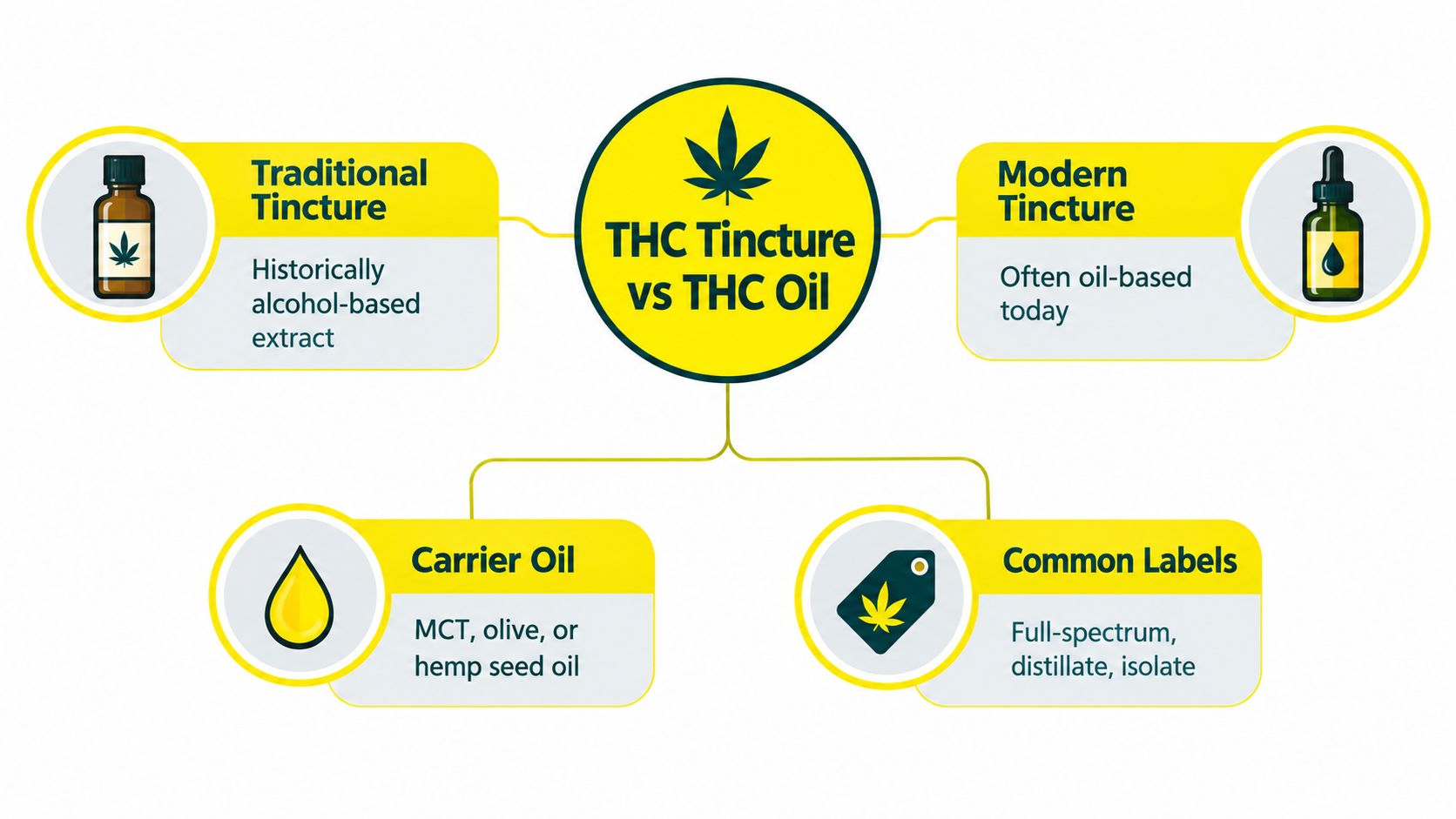
The first source of confusion is terminology. Historically, a tincture meant an alcohol-based cannabis extract. Today, plenty of products labeled “tincture” are made with an oil base. That means the name on the bottle often tells you less than the ingredients panel and directions.
The old definition and the modern shelf
Traditional tinctures were built around alcohol. Modern THC oils are usually built around a carrier oil such as MCT, olive oil, or hemp seed oil. The tricky part is that many brands still use the word tincture for both.
Independent educational guidance notes that the more useful distinction is often alcohol-based tincture versus oil-based oral product, because consumers are usually asking about onset speed, taste, dosing precision, and whether the product can be mixed into food, not just what the front label says (educational breakdown of THC oil vs tincture terminology).
A simple shopping example helps. If Bottle A says “THC tincture” but the ingredients list shows MCT oil, that product may behave more like an oil-based oral product than a classic alcohol tincture. If Bottle B uses alcohol as the solvent and directs you to hold it under the tongue, the taste and mouthfeel may be quite different.
What to look for on the label
When you pick up a bottle, scan these details first:
- Base ingredient: Alcohol and oil don't feel or perform the same.
- Directions for use: “Hold under tongue” suggests a sublingual use case. “Add to food” points more toward swallowed use.
- Carrier oil type: MCT, olive, and hemp seed oil can lead to different everyday experiences.
- Texture and taste clues: Alcohol-based products may have more bite. Oil-based products are often milder.
For a broader primer on these products, this guide on what cannabis oil is used for gives helpful context on how patients approach oils in daily routines.
Why the label alone isn't enough
Two products can both list the same THC amount and still feel different in daily use. One may be easier to mix into food. Another may be easier to use before a predictable event. One may taste neutral. Another may have more burn.
That's why experienced shoppers stop asking “Is this a tincture or an oil?” and start asking:
- Is it alcohol-based or oil-based?
- Am I supposed to hold it under the tongue or swallow it?
- What carrier is in it?
- Do I want speed, duration, or food flexibility?
Those questions usually lead to a better purchase than the product name alone.
How Tinctures and Oils Differ in Formulation and Daily Use
Once you get past the label, the everyday differences become easier to spot. This is less about lab language and more about what the bottle is like to live with.
Carrier changes the experience
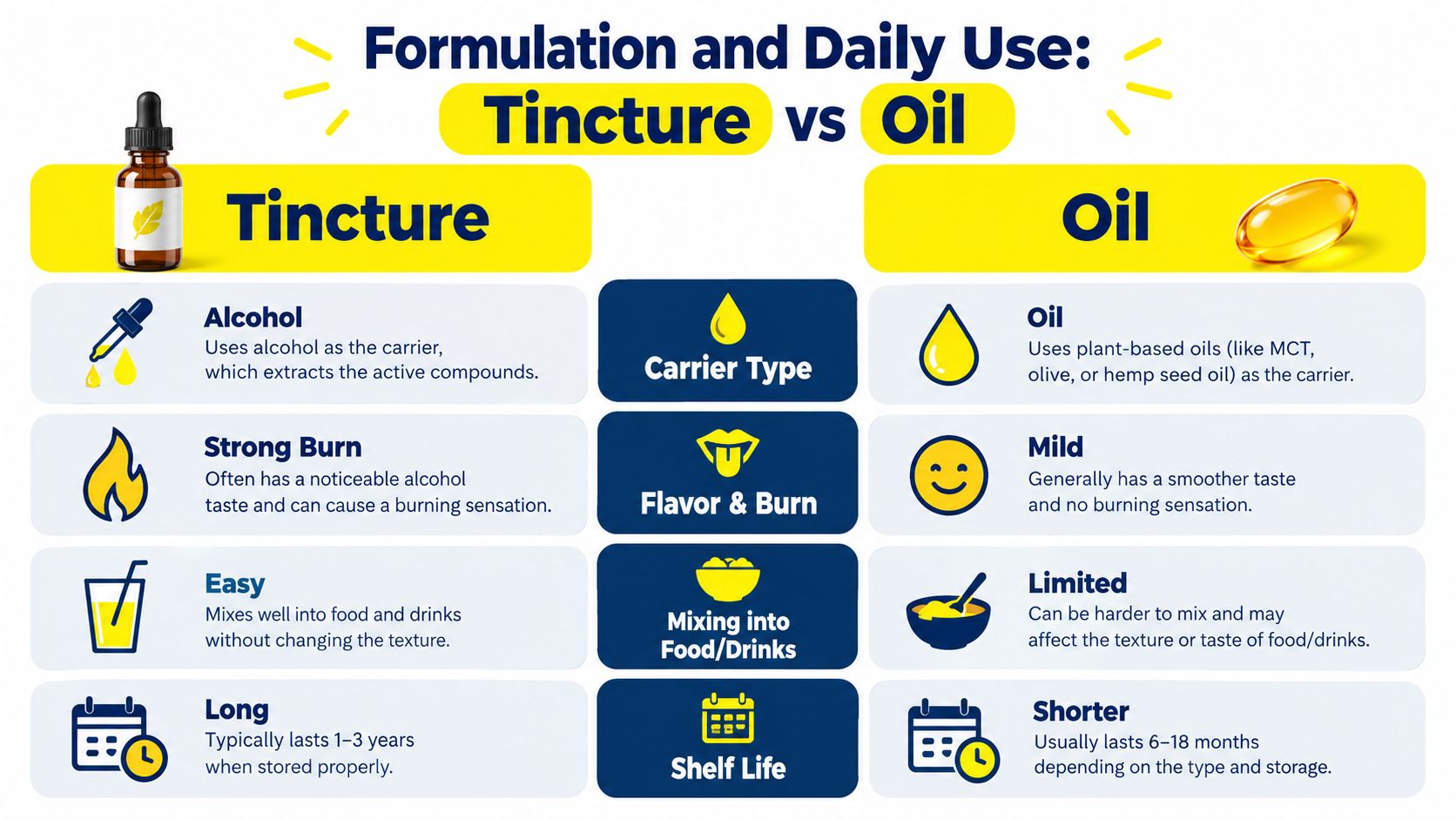
An alcohol-based tincture often has a sharper taste and a noticeable burn in the mouth. Some patients don't mind that at all, especially if they want a traditional sublingual format. Others try it once and immediately prefer an oil carrier.
Oil-based products usually feel softer in the mouth. MCT oil often feels lighter than thicker oils, while olive or hemp seed oil can taste more earthy. That doesn't make one automatically better. It changes comfort, mixing options, and how likely you are to stick with the product.
Practical rule: If you already know strong alcohol taste bothers you, skip the guessing and start with an oil-based bottle.
Mixing and meal use
Many people notice the difference right away.
- Alcohol-based tinctures: Some people use them directly and avoid adding them to meals because the flavor can stand out.
- Oil-based products: These are often more natural fits for mixing into food, a spoonful of yogurt, or a small snack.
- Routine use: If you want the product to disappear into an evening ritual, oil may feel easier to work with.
For readers comparing extraction styles and product categories, this overview of CO2 cannabis oil is useful background because extraction and carrier choices often get discussed together on menus.
Dosing tools and handling
Most tinctures and oils use a dropper, which is part of their appeal. They're easier to measure than many other formats, and that helps both new and experienced patients make smaller adjustments.
A practical example: someone who's cautious with THC may prefer a dropper bottle over an edible because they can work up slowly rather than committing to a single fixed serving. Another patient may choose oil specifically because they want to stir a measured amount into food at the same time every night.
Here's a quick side-by-side:
| Everyday factor | Tincture leaning | Oil leaning |
|---|---|---|
| Taste | Sharper, sometimes more bite | Milder, often richer |
| Under-tongue comfort | May feel stronger | Often more comfortable |
| Food mixing | Depends on formula, may be less pleasant | Often easier |
| Routine style | Direct dosing | Direct dosing or meal pairing |
| Patient preference | Those who prioritize a classic sublingual format | Those who want gentler flavor or food use |
Shelf handling, storage habits, and dose tracking also matter, but for most patients the deciding factors are still taste, comfort, and whether they want a direct sublingual product or something that fits a meal routine.
Onset Time Bioavailability and Why Effects Vary
The biggest misunderstanding happens. People see the same THC milligrams on two bottles and assume the experience will be the same. It often isn't.
Route matters more than the name
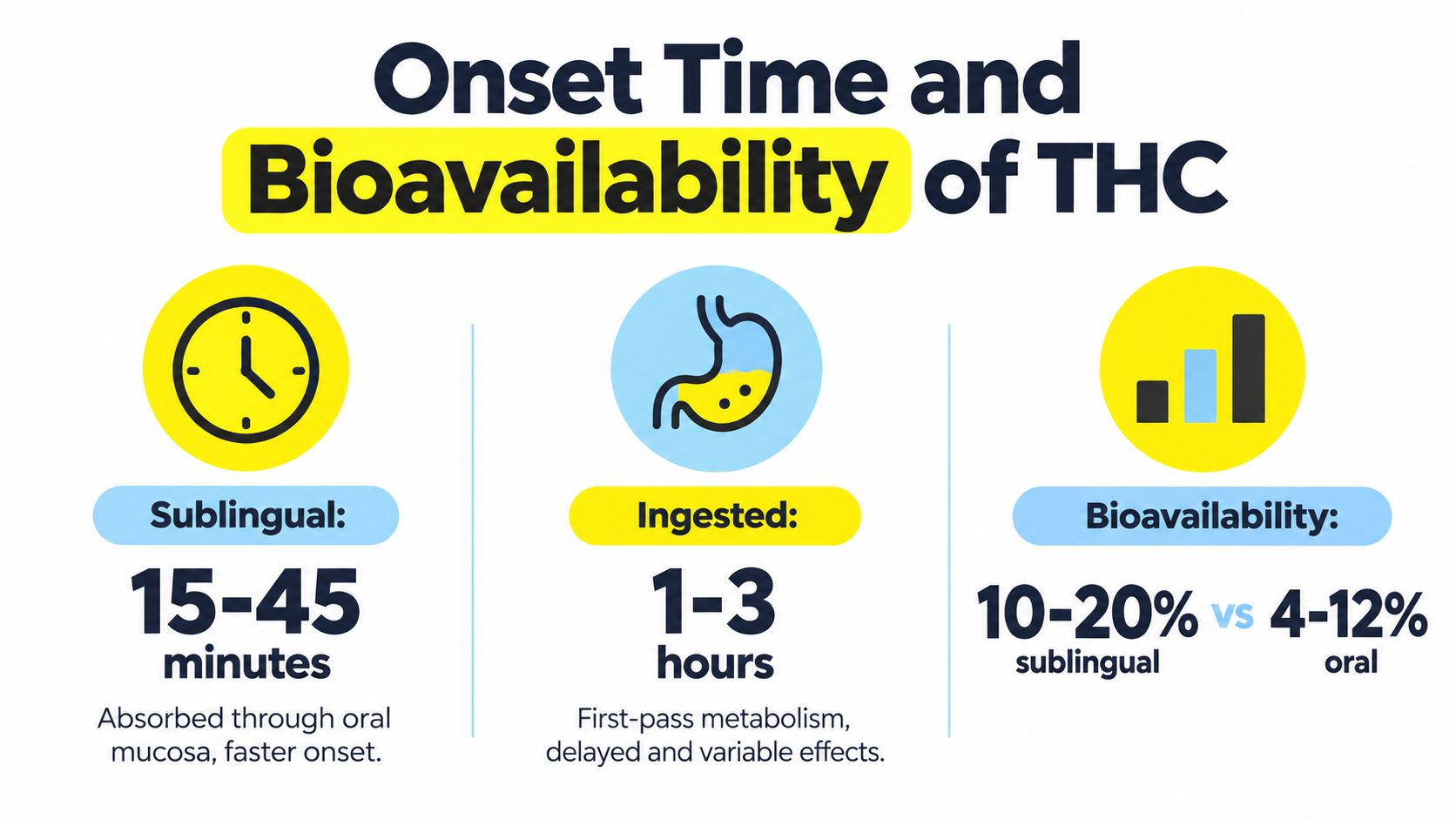
When THC is used sublingually, it's absorbed through the mouth's mucous membranes and can act faster than a swallowed oil because it partly bypasses first-pass metabolism. Educational sources place sublingual onset around 15 to 45 minutes when used this way, while swallowed oral oil products are slower and more digestion-dependent (sublingual absorption and onset overview).
When THC oil is swallowed, it behaves more like an edible. Educational guidance notes that swallowed oil typically starts in about 30 to 120 minutes, depending on the formulation and how it's used, while tinctures used sublingually are generally positioned for faster onset around 15 to 45 minutes (oral use timing and sublingual comparison).
A practical example is the patient who needs predictable relief before a meeting. That person may hold a tincture under the tongue for about 60 seconds instead of swallowing it immediately, aiming for a faster and more controlled onset, as described in the same sublingual education above.
Why the same milligrams can feel different
Swallowed cannabinoids go through the digestive tract and face first-pass metabolism, which can reduce how much reaches circulation. Expert guidance commonly places oral THC bioavailability in the low single digits to low tens of percent, while sublingual use can improve systemic delivery, though it still doesn't guarantee full absorption. That same guidance also notes that MCT-based oils may show sublingual onset around 15 to 30 minutes with oral bioavailability estimates roughly 20 to 35%, while olive- or hemp-seed-oil carriers can be slower and lower (route and carrier effects on cannabis experience).
The bottle tells you the THC content. The route and formulation do a lot of the work in deciding how much you feel, how quickly you feel it, and how repeatable the experience is.
Formulation is becoming more sophisticated
Consumer education has started paying more attention to carrier chemistry, food timing, and newer delivery systems. Pharmacy-focused educational material highlights that absorption varies sharply by route and that optimized fat carriers can improve performance versus non-optimized oral use. It also points to newer discussions around nanoemulsions and self-emulsifying formulations as emerging approaches for faster onset and better consistency (pharmacokinetics education for cannabis formulations).
That doesn't mean every modern formula will behave the same way. It means the old question, “tincture or oil,” is too simple. Patients usually need to ask a better question: How is this built, and how am I supposed to use it?
If you want more context on how patients talk about timing and feel in practice, this article on weed tincture effects adds useful perspective.
Choosing the Better Format for Your Needs and Schedule
You have a 7 p.m. dinner, you want the effects to start around the time you arrive, and you do not want surprises halfway through the meal. In that situation, the label matters less than the actual use pattern. Are you holding it under your tongue, or swallowing it? Is the THC carried in alcohol or oil? Is the oil MCT or another fat source? Those details usually do more to shape the experience than the word "tincture" on the bottle.
The simplest way to choose is to match the product to your schedule first, then your taste and routine. A bottle can fit one person well and feel inconvenient for another, even at the same THC strength.
Which format fits your goal
| Patient Goal | Better Fit | Why It Works |
|---|---|---|
| Relief before a meeting or appointment | Sublingual tincture | Often easier to time because the intended use is under the tongue, not mixed into digestion from the start |
| Evening use with less concern about exact timing | Swallowed oil | The slower build can fit a longer nighttime routine |
| Sensitive to strong taste or alcohol burn | Oil-based product | Many patients find it gentler in the mouth and easier to use every day |
| Wants to mix THC into food | Oil | Usually blends into a snack or meal more naturally |
| Wants dose precision in small increments | Either dropper format | Clear concentration and good dropper markings matter more than the category name |
| Wants fewer surprises from product to product | Product with clear carrier and route instructions | Carrier type and directions often predict real-world performance better than label language |
Real-world use cases
A morning patient with a fixed routine often does best with a product they can use the same way every day. Sublingual use usually fits that goal better because it is less tied to what breakfast looked like or whether a meal was early, late, light, or heavy.
Now consider someone who uses THC after dinner while reading or settling in for the night. A swallowed oil can make more sense there. It works more like adding THC to an evening ritual, similar to taking a supplement with food rather than timing a faster-acting format around the clock.
A third patient has tried two products with the same listed THC amount and felt that one came on more evenly. That difference often comes from the carrier and the route, not from imagination or tolerance changing overnight.
If your day runs on the clock, start by looking at products designed for sublingual use. If your routine is built around meals, taste, or a slower evening curve, swallowed oil may be the easier fit.
A practical shopping mindset
A helpful question is not "Which one is better in general?" It is "Which one behaves the way I need it to behave?"
Use this quick filter:
- Choose sublingual first if timing matters and you want a format that is easier to repeat the same way.
- Choose swallowed oil first if you prefer a slower routine tied to dinner, tea, or a bedtime snack.
- Choose by carrier if taste, mouthfeel, or consistency has been a problem before. MCT-based oils often feel lighter for some patients than heavier oil bases.
- Choose by habit if you already know which method you will use correctly and consistently.
Patients often get better results when a retailer explains carrier, route, and intended use instead of pointing only to the menu category. Mr. Nice Guys DC can help patients compare tinctures and oils in that practical way, with attention to how the product is meant to be used day to day.
Dosing Accurately and Using Each Format Correctly
A good product can still disappoint if the dose math is fuzzy or the method is off. The easiest way to avoid that is to calculate your concentration first and keep your routine consistent.
Start with mg per mL
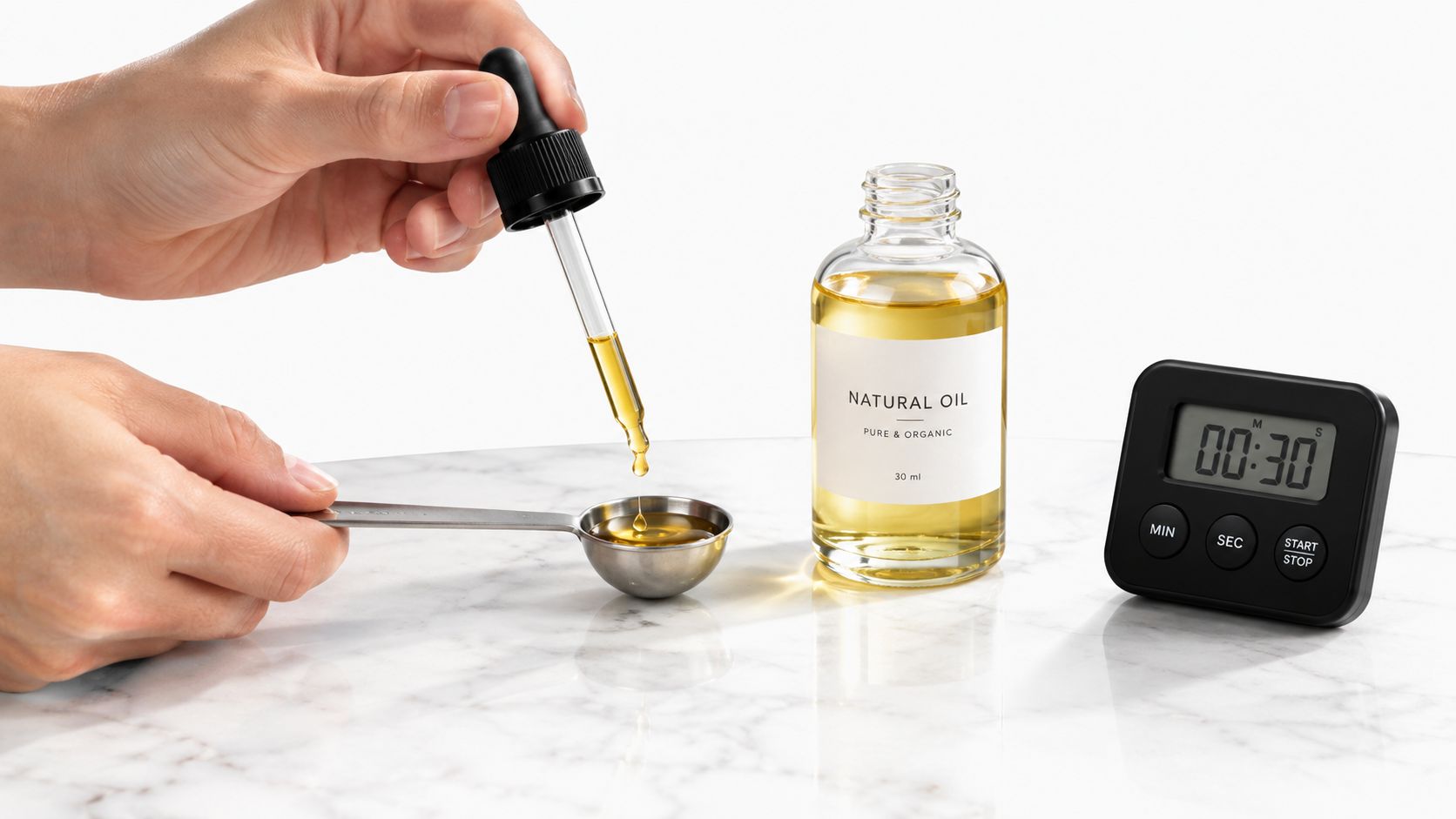
One straightforward dosing guide uses this formula: total mg ÷ bottle mL = mg/mL. That same guide states that a 1 mL dropper contains about 20 drops, which makes careful titration possible. It gives a clear example: if a bottle contains 1000 mg in 30 mL, the concentration is about 33.3 mg/mL, so a 5 mg dose is roughly 0.15 mL and a 10 mg dose is roughly 0.30 mL (tincture potency and dose calculation guide).
Here's how that looks in practice:
- Read the total THC on the bottle.
- Read the bottle size in mL.
- Divide to get mg per mL.
- Use the dropper markings, or drops if needed, to measure your target amount.
If your bottle is the 1000 mg in 30 mL example above, you don't need to guess. You can work from the math instead of the feeling.
Use the format the way it was intended
For sublingual use, place the measured amount under your tongue and hold it there before swallowing. As covered earlier, one practical example given in educational material is holding the tincture under the tongue for about 60 seconds when aiming for quicker onset.
For swallowed oil, expect a slower build. If you take it with food one day and on an empty stomach the next, the experience may not feel identical. That's why consistency matters as much as milligrams.
- For sublingual timing: Keep the hold time consistent.
- For swallowed use: Keep meal timing as consistent as you can.
- For both: Avoid stacking extra doses too soon just because the first one hasn't peaked yet.
Keep a simple dose log
You don't need a complicated spreadsheet. A notes app works fine.
Write down:
- Product name
- Amount in mL or drops
- How you took it
- Whether you had food
- How long it took to notice effects
That record becomes valuable fast. It helps you spot whether a product issue is really a dosing issue, a timing issue, or a route issue.
For people who want more help reading labels and serving sizes, this guide on cannabis tincture dosing is a practical companion.
Final Recommendation and Shopping at Mr Nice Guys DC
If your priority is fast relief with more predictable timing, a sublingual THC tincture is often the smarter choice. The route is usually the deciding factor. It gives many patients a more manageable way to plan around a meeting, commute, or scheduled activity.
If your priority is slower onset that fits a longer evening routine, a swallowed THC oil often makes more sense. It can work well for patients who prefer to pair their dose with food, who dislike stronger alcohol-style taste, or who don't need effects to begin on a tight schedule.
The clearest way to decide
Ask yourself these three questions:
- When do I need this to start?
- How important is repeatable timing?
- Do I want to swallow it, or hold it under my tongue?
Those answers usually matter more than whether the menu says tincture or oil.
A first-time patient might start with a low measured amount in a dropper format and keep careful notes for several sessions. An experienced patient might compare carriers more closely, especially if they've noticed that some products with the same THC amount don't feel equally consistent.
For shoppers browsing products locally, it helps to review a dispensary menu and ask for details on carrier, directions, and dose concentration rather than stopping at the category label. Mr. Nice Guys DC also publishes education on product formats, including this overview of what cannabis products are available at Mr. Nice Guys DC, which can help you compare liquids with edibles, vapes, and other options.
Patients in Washington, DC and nearby areas such as Alexandria, Bethesda, Rockville, and Silver Spring often benefit from choosing based on routine. Morning planners usually want predictability. Evening users usually want simplicity. The right bottle is the one you can dose accurately, use consistently, and trust to fit your schedule.
If you remember one takeaway, make it this: better isn't tincture versus oil. Better is the right route, the right carrier, and the right dose for the moment you need it.
Mr. Nice Guys DC offers curated tinctures, oils, and other cannabis formats for patients and adult consumers who want clearer guidance, not guesswork. If you want help comparing carriers, timing, and dose precision before you buy, visit Mr. Nice Guys DC and talk through which format fits your routine.
Mr Nice Guys DC
At Mr. Nice Guys DC, we’re more than just a cannabis delivery service — we’re passionate advocates for quality, convenience, and community. With years of experience in the cannabis industry, our team is dedicated to educating and empowering customers across Washington, D.C. Whether you're a seasoned user or just starting your cannabis journey, our blog delivers trusted tips, product insights, and the latest updates from the world of weed. Stay informed, stay elevated.
