
Must Be 21 To Enter
By entering this site you are agreeing that you are at least 21 Years of Age or older.
I AM 21 OR OLDERTHC Tincture Drops Guide to Dosing and Use
.svg)

.png)
You've measured a few THC tincture drops, held them under your tongue, and waited. Nothing happens, so you take more. Then the first dose arrives, followed by the second, and suddenly the experience feels much stronger than expected. That confusing pattern is common because tinctures aren't a purely fast cannabis format. They often behave as a hybrid between sublingual and edible use, depending on how long you hold the liquid, how much you swallow, and what carrier the product uses.
THC tincture drops can be discreet, portable, and easier to measure than many cannabis formats. They also have deep roots in medical history. Cannabis entered Europe and North America in the 19th century largely as ethanolic tinctures, and cannabis tincture remained in the U.S. Pharmacopeia until 1942, with historical accounts placing its formal entry there in 1850–1851. That makes tincture-based cannabis medicine a pharmaceutical format used for nearly a century before prohibition-era removal, as documented in the World Health Organization's historical review of cannabis extracts and tinctures.
This guide makes the process practical. You'll learn how to read a tincture label, calculate milligrams from milliliters, choose between holding and swallowing, wait safely before redosing, and track what your particular product does. For additional background, see this explanation of the science behind marijuana tinctures and their effects.
Introduction to THC Tincture Drops and Why Technique Matters
A new patient often approaches tincture dosing like using a liquid pain reliever. The bottle has a dropper, the label lists THC, and the natural assumption is that a certain number of drops should create the same result every time. In practice, the drop is only the delivery unit. The important information is the amount of THC in the measured volume, plus what happens after the liquid enters your mouth.
Suppose you place a dose under your tongue and hold it there briefly before swallowing. Some THC may absorb through the tissue in your mouth, while the remainder travels through your digestive system. If you swallow immediately, more of the dose follows an oral pathway. The same bottle can therefore produce a quicker, shorter-feeling experience for one person and a slower, longer-lasting experience for another.
The practical lesson: A tincture isn't just a bottle of THC. It's THC plus a carrier, a measuring tool, and a method of administration.
Tinctures appeal to people who want discreet use without smoke or vapor, flexible dose adjustment, and a format that can be taken directly or added to food and drinks. They can suit a patient who wants to make small changes rather than commit to a pre-portioned edible or an inhaled product that takes effect quickly.
The trade-off is that liquid dosing can look more precise than it feels. A dropper may help you measure volume, but absorption still changes with formulation, saliva, oral pH, salivary flow, mucosal permeability, and swallowing behavior. A patient who takes the same milligram amount under different conditions may notice a different onset or intensity.
Controlled human evidence describes sublingual THC as a mixed route rather than a perfectly separate pathway. One referenced study reported relative bioavailability around 13%, with onset typically 15–60 minutes, peak effects around 45 minutes, and duration about 4–6 hours. The same evidence indicates that some of the dose reaches the gastrointestinal tract and undergoes first-pass metabolism, which helps explain why serum 11-OH-THC patterns can resemble those of oral products. These findings appear in the clinical discussion of sublingual THC pharmacokinetics.
By the end of this guide, you should be able to treat THC tincture drops less like a mysterious shortcut and more like a controllable routine. Measure the dose, choose the method, give it time, and record the result.
What THC Tincture Drops Are and How They Work
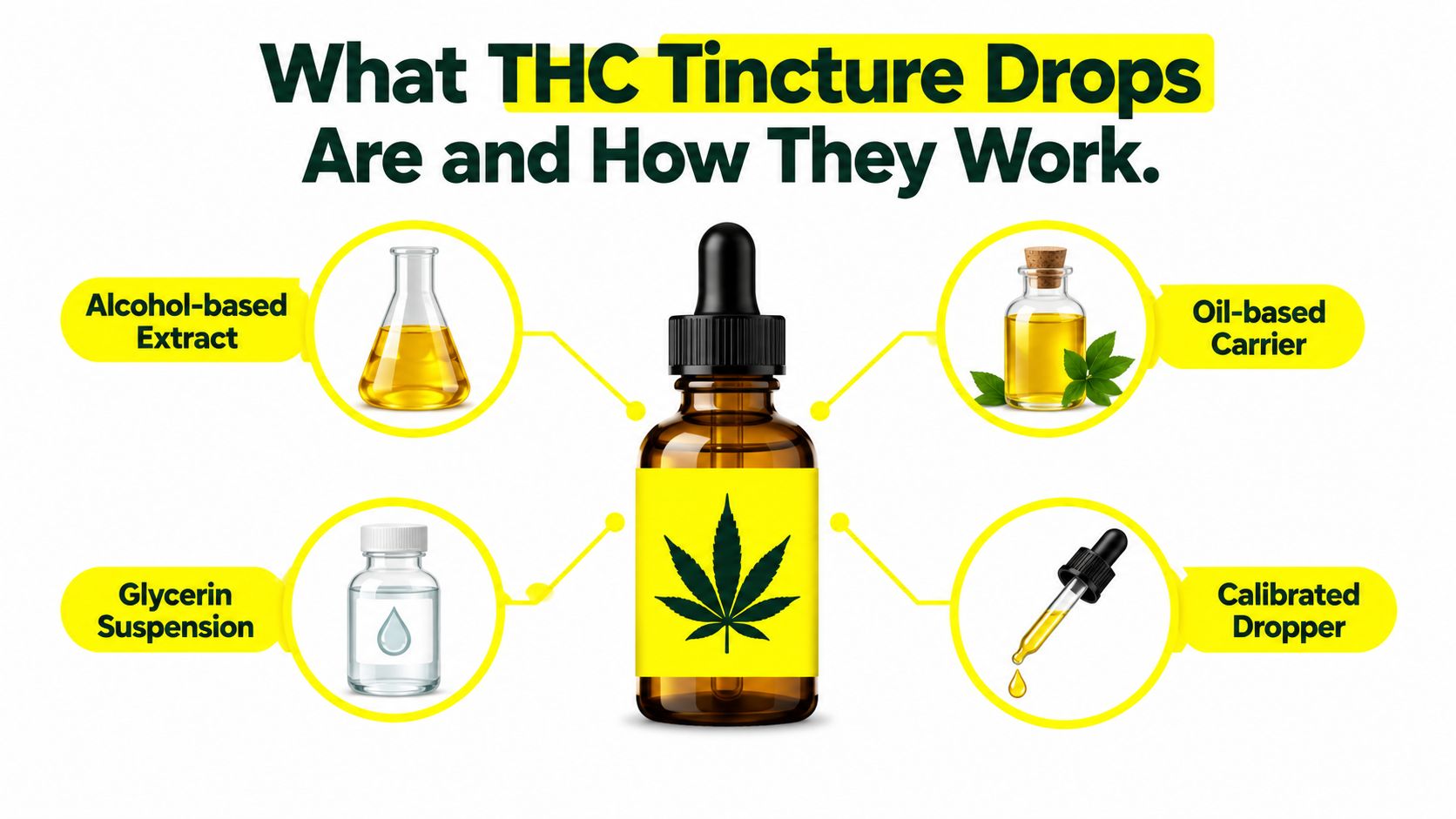
A THC tincture is a concentrated cannabis extract suspended or dissolved in a liquid base. That base may be alcohol, oil, or glycerin. The product is usually packaged in a bottle with a calibrated dropper so you can measure a volume rather than rely on an unmarked pour.
The simplest way to understand the routes is to think of your mouth and stomach as two different roads. The tissue beneath your tongue is a short local route into circulation. The digestive tract is a longer route that sends the swallowed portion through digestion and liver metabolism. Tincture drops can enter both roads during the same dose.
The liquid base changes the experience
Alcohol-based tinctures and oil-based extracts don't necessarily feel identical, even when their labels show similar THC amounts. The carrier affects taste, texture, how the liquid spreads in the mouth, and how the formulation interacts with saliva and oral tissue. Glycerin-based products can have a different mouthfeel again.
The label should tell you the total THC in the bottle and, ideally, the THC per milliliter. A concentration example from clinical literature describes a tincture labeled at 10 mg THC per mL, while a specific studied product context was estimated at 1.3 mg THC per 1 mL. Those figures illustrate why one product's milliliter cannot automatically be treated as equivalent to another product's milliliter, as discussed in this clinical review of oral and sublingual cannabis extracts.
That distinction matters more than the word “tincture” on the front label. Two bottles can both be called tinctures while delivering different concentrations, using different carriers, and producing different timing.
Sublingual does not mean instant
Holding liquid under your tongue may allow some mucosal absorption, but it doesn't guarantee that the entire dose bypasses digestion. Saliva builds up, and many people swallow part of the liquid naturally. A longer hold and less immediate swallowing may shift more absorption toward the mouth, while swallowing sooner shifts more toward edible-like metabolism.
This is why a tincture often sits between inhaled cannabis and a conventional edible. It can offer more control than a pre-portioned edible, but it won't usually provide the immediate onset associated with inhalation. It may also last longer than an inhaled dose, especially when a substantial portion is swallowed.
For a broader explanation of THC, CBD, and other cannabinoids, review this cannabinoid breakdown. The main point for tincture users is simple: the product label tells you how much THC is present, but your technique helps determine how that THC behaves.
How Dosing by Drop Actually Works in Practice
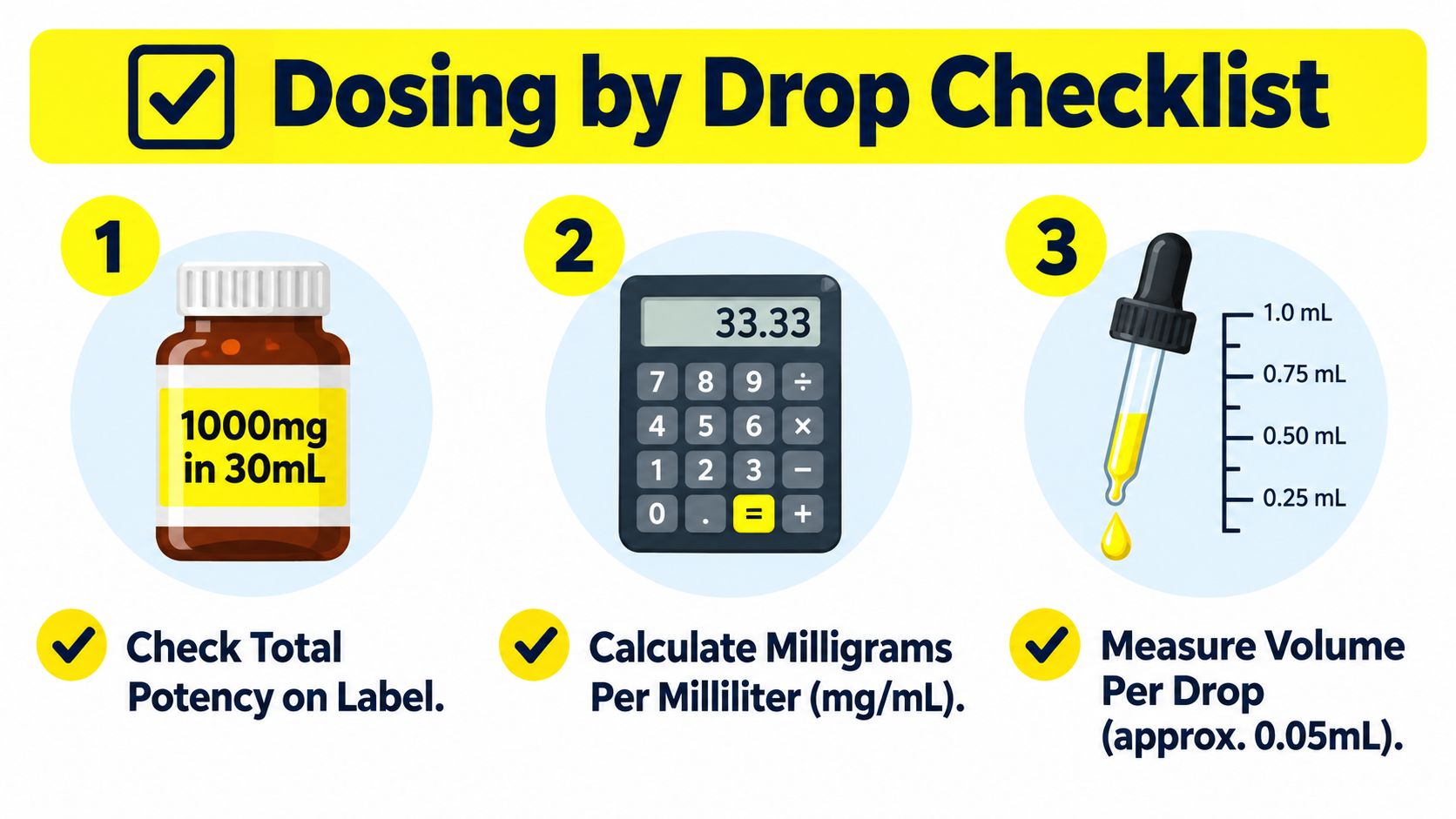
The safest way to make THC tincture drops repeatable is to work in milligrams and milliliters first, then think about drops only as a rough translation. Drop size can change with the dropper, liquid thickness, angle, and pressure. A marked dropper or measured volume is more dependable than counting individual drops.
Start with the bottle's total THC and total liquid volume. The basic calculation is:
Total THC in the bottle ÷ total milliliters = THC per milliliter
For example, if a label says 1,000 mg in 30 mL, the calculation is:
1,000 mg ÷ 30 mL = about 33.3 mg per mL
That is a mathematical example, not a recommendation for a starting dose. It shows why the label's total potency needs to be converted before you decide how much liquid to use.
Use volume as your anchor
If your product contains 10 mg THC per mL and you measure 0.25 mL, your intended dose is 2.5 mg THC. If you measure 0.5 mL, it's 5 mg THC. The calculation is:
mg per mL × mL used = milligrams delivered
A dropper may hold about 1 mL, but don't assume that every dropper or bottle delivers the same volume. The visual “full dropper” is useful only when the product label defines what that volume contains.
A clinical review reports THC doses in studies ranging from 0.01–0.5 mg/kg/day, while consensus guidance says daily THC should generally not exceed 40 mg without expert consultation. These figures are not a personal dosing plan. They show why medical cannabis dosing needs context, especially for a person who is new to THC, taking other medications, or treating a specific condition. The dosing evidence is summarized in this systematic review of medical cannabinoid dosing.
Build a personal timing record
Use one product consistently while learning how it affects you. Write down:
- Measured volume: Record the mL, not only the number of drops.
- Label concentration: Keep the product's mg per mL visible in your notes.
- Technique: Note whether you held it under your tongue or swallowed it immediately.
- Onset: Record when you first noticed effects.
- Peak and offset: Note when effects felt strongest and when they substantially faded.
Wait at least 1–2 hours before redosing, based on the clinical dosing guidance summarized in the oral and sublingual extract literature. A delayed experience can become much stronger after a second dose, particularly when swallowing shifts more THC into an edible-like pathway.
A useful example: If 0.25 mL feels mild after 30 minutes, don't automatically assume it failed. Record the time, continue waiting, and assess again before changing the amount.
Formulation chemistry can also alter time-to-peak. A controlled phase I crossover study reported no statistically significant differences in THC Cmax, half-life, or AUC between different cannabinoid ratios, but THC Tmax was significantly delayed in one formulation. In plain language, products can reach their peak at different times even when total exposure measures don't differ in the same way.
That's why a dose log should be product-specific. Your experience with one oil-based tincture doesn't establish the timing of another alcohol-based or glycerin formulation.
How to Take THC Tincture Drops for Different Effects
You have three practical choices: hold the liquid under your tongue, swallow it directly, or mix it into food or a drink. Each method changes the balance between mouth absorption and digestion.
Sublingual use
For a sublingual dose, measure the liquid, place it under your tongue, and hold it there before swallowing. The visual guide associated with tincture use often describes holding for 60–90 seconds, but the more important principle is consistency. Use the same hold time each time you test a product so your notes remain useful.
Try not to rinse the dose away immediately. If saliva builds up, swallow normally after the hold rather than repeatedly spitting or moving the liquid around. Some of the dose will still be swallowed, so expect a hybrid effect rather than a completely instant one.
Sublingual use is commonly reported at 15–45 minutes for onset, while controlled human data describe a broader 15–60-minute onset range. Duration is often described as about 2–6 hours for sublingual use, although individual response and swallowed material can extend the experience. These ranges are summarized in practical guidance on sublingual cannabis tincture use.
Swallowed use
Swallowing the measured dose right away sends more of it through digestion. The experience may take longer to appear and can feel more like an edible. Swallowed or oral use is often described as 30–120 minutes for onset, with effects lasting 4–8 hours or longer, according to practical tincture guidance from Union Chill's comparison of tincture duration.
That method may suit someone planning for a longer coverage window. For example, a patient seeking overnight relief might prefer swallowing a measured dose with food, while someone who wants a more adjustable daytime experience may choose a consistent sublingual hold.
Mixing into food or drink
You can add tincture drops to tea, juice, or a small snack, but treat the result as swallowed cannabis. A patient who takes a measured dose under the tongue may notice effects before finishing a 30-minute waiting period, while the same dose mixed into tea or juice may not be noticeable for 1–2 hours, as described in this practical guide to using cannabis tinctures.
Mixing also makes it easier to lose track of the amount if you don't consume the entire drink or portion. Measure the tincture first, add it to a small amount of food or liquid, and finish that portion so the intended dose doesn't become uncertain.
This video offers a visual overview of administration choices:
For patients thinking about sleep, pain, or anxiety, format choice should match the desired timing and duration. This guide to choosing cannabis products for sleep, pain, and anxiety can help frame that decision.
THC Tincture Drops Versus Edibles Vapes and Flower
Tinctures occupy a useful middle ground. They're generally more adjustable than a pre-portioned edible, less immediate than a vape or flower, and more discreet than smoking. The right format depends on whether you value control, speed, duration, or convenience most.
| Format | Onset pattern | Duration pattern | Dose adjustment | Practical fit |
|---|---|---|---|---|
| Tincture | Moderate, technique-dependent | Moderate to long | Flexible by mL or mg | Discreet, measured use |
| Edible | Slower and digestion-dependent | Often extended | Usually fixed per piece | Planned, longer coverage |
| Vape | Rapid | Shorter than oral formats | Adjustable puff by puff, but less milligram precision | Fast effects |
| Flower | Rapid | Shorter than oral formats | Adjustable by inhalation, with variable delivery | Familiar inhaled experience |
Tinctures can offer a clearer titration path than edibles because you can measure a smaller liquid volume rather than divide a piece. They still require patience. If you swallow most of the dose, the experience may resemble an edible more than a sublingual product.
Inhaled flower and vape products generally provide faster feedback, which can make it easier to recognize an effect before taking more. The trade-off is that inhalation doesn't offer the same type of labeled milligram measurement per liquid volume. Tinctures suit people who want a quieter routine and are willing to wait.
Choose the format around the clock, not just the cannabinoid. Fast relief, daytime control, and overnight duration can point to different products.
A practical decision might look like this:
- Choose tincture drops when you want discreet use and the ability to adjust a measured volume.
- Choose an edible when you prefer a pre-portioned product and a longer planned experience.
- Choose a vape or flower when rapid onset matters more than extended duration.
For a broader side-by-side discussion of these formats, read edibles versus vapes versus flower.
Safety Lab Testing and Smart Buying Tips for Tinctures
A careful purchase starts before the bottle reaches your mouth. Look for a clear label that identifies total THC, THC per milliliter, the liquid volume, the carrier, and any other cannabinoids. If the product's label makes you do too much guessing, choose a product with more transparent dose information.
A certificate of analysis, or COA, should connect to the specific batch you're considering. Check whether it reports cannabinoid potency and screening for contaminants. Depending on the product and jurisdiction, relevant testing categories may include pesticides, heavy metals, microbial contamination, and residual solvents. Accurate labeling matters because a tincture's apparent precision is only useful when the liquid has been tested and the stated concentration is reliable.
Questions to ask before buying
A dispensary menu may tell you the product name and total potency, but staff can often clarify details that aren't obvious from a thumbnail.
- Carrier: Ask whether the product uses alcohol, MCT or another oil, or glycerin.
- Measurement: Ask how the bottle defines one mL and whether the dropper is marked.
- Testing: Ask where to find the batch-specific COA.
- Cannabinoids: Confirm whether THC is dominant, CBD is present, or the product uses another blend.
- Use method: Ask whether the formulation is intended for direct oral use, sublingual use, or both.
Mr. Nice Guys DC offers tinctures alongside other cannabis formats and provides product information for registered medical patients. Its team can help shoppers compare a tincture's label, carrier, and intended effects with alternatives. You can also review its product testing standards before making a purchase.
Store and use it carefully
Keep the bottle secured away from children and pets, and follow the product's storage directions. Avoid sharing a THC tincture with someone who hasn't chosen to use cannabis, and don't drive or operate equipment while impaired.
Medication interactions deserve professional attention. THC can affect alertness, coordination, and judgment, and people who take prescription medicines or manage a medical condition should ask a qualified clinician or pharmacist about potential interactions. Start with a measured amount, use one product at a time while learning, and don't redose quickly just because the first part of the experience feels quiet.
Putting It All Together for Confident Use
THC tincture drops are an old format with a modern advantage: they can make cannabis dosing more measurable without requiring smoke or vapor. Their main limitation is that the dropper doesn't control absorption by itself. Hold time, swallowing, carrier formulation, and personal response all shape the experience alongside the milligrams on the label.
A simple routine keeps the process manageable:
- Read the label: Find total THC, liquid volume, and mg per mL.
- Measure the volume: Use the marked dropper rather than relying on drop counts.
- Choose the route: Hold consistently under the tongue for a more adjustable onset, or swallow for a slower, longer oral-style experience.
- Wait before changing course: Allow at least 1–2 hours before redosing, using the clinical guidance cited earlier.
- Track the result: Note product, volume, technique, onset, peak, and duration.
- Ask for help: A dispensary educator or healthcare professional can help you account for medication, tolerance, and wellness goals.
For a first attempt, consistency matters more than chasing a particular sensation. Use a lab-tested product, choose a calm setting, and let your own timing record guide future adjustments.
Mr. Nice Guys DC offers lab-tested cannabis products, including tinctures, with in-store pickup, curbside service, and delivery options for DC and nearby communities. Visit Mr. Nice Guys DC to review current tincture selections and speak with the team about matching a measured product and administration method to your needs.
Mr Nice Guys DC
At Mr. Nice Guys DC, we’re more than just a cannabis delivery service — we’re passionate advocates for quality, convenience, and community. With years of experience in the cannabis industry, our team is dedicated to educating and empowering customers across Washington, D.C. Whether you're a seasoned user or just starting your cannabis journey, our blog delivers trusted tips, product insights, and the latest updates from the world of weed. Stay informed, stay elevated.
