
Must Be 21 To Enter
By entering this site you are agreeing that you are at least 21 Years of Age or older.
I AM 21 OR OLDERThames Valley Alternative Relief: Effective Options
.svg)

.png)
You may be sitting with a bottle of something that didn’t help enough, a heating pad that only works for an hour, or a list of symptoms that keep interrupting work, sleep, and normal life. That’s usually when people start looking for “alternative relief.” Not because they want something trendy, but because they want something that fits their body, their schedule, and their goals.
A lot of first-time patients also feel stuck between two extremes. One side says to avoid anything outside conventional care. The other treats alternative wellness like a cure-all. Neither is very helpful. A calmer, more practical approach is generally needed.
That’s why thames valley alternative relief is a useful case study. It gives us a real-world example of what regulated, education-focused care can look like. If you live in Washington, DC, or nearby, that kind of model can help you judge your own options more clearly.
The Search for Better Relief A Look at Pioneering Models
A common story goes like this. Someone has ongoing pain, muscle tension, sleep trouble, nausea, or stress that won’t settle down. They try stretching, over-the-counter products, maybe a prescription, maybe a supplement. Some things help a little. Others bring side effects or just don’t match the problem.
That’s where the phrase alternative relief often enters the picture. In plain language, it means looking beyond a single default option. It can include cannabis therapy, topicals, acupuncture, movement-based care, or a combination that makes daily life easier.
Why a pioneering dispensary matters
Thames Valley Alternative Relief, operating as Thames Valley Apothecary LLC in Uncasville, Connecticut, matters because it wasn’t just another storefront. It was one of the first six dispensaries approved by the Connecticut Department of Consumer Protection to legally dispense medical cannabis, according to this listing on AllBud. That early approval placed it inside the first wave of Connecticut’s regulated medical system.
That matters for patients because a regulated setting changes the experience. Instead of guessing from a label or relying on a friend’s advice, patients can expect a more structured process. The focus shifts from “what gets me the strongest effect” to “what product format, dose, and timing best match my symptoms?”
A useful model for DC-area patients
The same AllBud listing notes that early licensing projections estimated 21,723 Connecticut residents would seek medical marijuana in the program’s early phase, which shows how large the need already was in a new market. A dispensary entering at that moment had to do more than stock products. It had to help people understand them.
Practical rule: When you evaluate any provider, ask whether they educate first and sell second.
That’s the lesson DC-area patients can borrow. A strong provider should feel less like a mystery shop and more like a guided wellness resource. If you’re exploring broader plant-based options, this overview of herbal alternatives in Washington DC can help frame the bigger picture.
For many patients, the biggest relief comes from finally seeing that they don’t have to pick blindly. They can compare options, ask better questions, and look for care models built on compliance, clarity, and patient support.
Understanding the Spectrum of Alternative Relief
Alternative relief works best when you think of it as a wellness toolkit, not a single magic answer. A toolkit has different tools for different jobs. You wouldn’t use the same thing for tight shoulders, an upset stomach, difficulty sleeping, and nerve irritation. Relief works the same way.
Some tools aim for fast support. Others are better for steady background help. Some work on the whole body. Others target one sore spot.

Cannabinoid-based therapies
This category includes medical cannabis and hemp-derived products. These options are often used when someone wants help with pain, sleep, stress, appetite, or nausea, especially when symptoms affect more than one part of daily life.
A practical example helps. If your knees ache after a long walk, a topical may make more sense than a whole-body product. If your main issue is lying awake for hours, a tincture or edible might be more relevant than a cream.
People also get confused about CBD and THC. They’re both cannabinoids, but they don’t feel the same and they aren’t used the same way. This simple guide to CBD vs THC is useful if those labels still feel fuzzy.
Physical and complementary therapies
This part of the toolkit includes physiotherapy, massage, stretching programs, acupuncture, and similar hands-on or movement-based support. These options are especially helpful when the problem has a mechanical component.
If someone has shoulder pain because their posture, desk setup, and muscle tension all feed into each other, a structured physical therapy plan may address the root issue better than a product alone. If another person carries stress in the jaw, neck, and upper back, acupuncture or bodywork may help release patterns that keep repeating.
Relief often improves when patients stop asking, “What is the best therapy?” and start asking, “What problem am I trying to solve?”
That shift matters. A structural problem usually needs a structural tool. A sleep problem may need a timing tool. A flare-up may need something that works quickly.
Advanced over-the-counter options
This category sits between home care and clinical care. It can include topicals, bath soaks, magnesium products, certain supplements, or other wellness items people use without a formal program.
These products can be useful, but they work best when chosen with a purpose. For example:
- Localized discomfort: A topical may fit sore hands, a stiff neck, or a tender lower back.
- Evening wind-down: A non-intoxicating routine such as a warm bath, a low-stimulation environment, and a calming supplement may support better rest.
- Exercise recovery: Someone who works out regularly may use stretching, hydration, and a muscle-focused topical together.
Why combinations often make more sense
Many people get the best results from layering options instead of forcing one product to do everything.
A simple toolkit might look like this:
- Morning support: Light movement or physical therapy exercises
- Daytime spot relief: A topical for one irritated area
- Whole-body management: A cannabinoid product chosen for timing and comfort
- Longer-term support: Acupuncture or rehab work for recurring issues
That’s a more realistic approach than chasing a miracle product. It also lowers disappointment, because each tool has a specific job.
A Deep Dive Into Medical Cannabis Therapy
Medical cannabis is often the most misunderstood item in the relief toolkit. Some patients think it’s all basically the same. Others assume the strongest product is the best one. In practice, what matters most is matching the product format and dose to the symptom, the timing, and your tolerance.
That’s where patient education becomes essential.
THC, CBD, and why labels matter
The two names often encountered first are THC and CBD. THC is usually associated with the classic cannabis “high,” but it’s also one reason many patients explore cannabis for relief. CBD is commonly chosen by people who want support without the same level of intoxication.
A label with both can signal a more balanced product. A label with mostly THC may feel stronger or more noticeable. A CBD-focused option may suit someone who wants a gentler daytime experience.
That still doesn’t tell the whole story, because format changes effect.
Here’s a helpful overview for first-time patients who want more background before shopping: medical cannabis basics before your first visit.
Why edibles and tinctures feel so different
This is one area where patients regularly get tripped up. They assume the same amount will feel the same across every format. It won’t.
According to Veriheal’s listing for Thames Valley Alternative Relief, edibles undergo hepatic first-pass metabolism, which changes how THC is processed in the body. That source notes an onset of 30 to 90 minutes and a duration of 4 to 8 hours for edibles. The same source says sublingual tinctures can offer a faster onset of 15 to 45 minutes with a shorter duration.
That difference explains a lot of bad first experiences. Someone takes an edible, feels nothing after a short wait, takes more, and then gets hit all at once later. A tincture, by contrast, may give feedback sooner, which can make it easier to judge.
Start with the format that gives you the clearest feedback. For many new patients, that matters as much as the ingredient itself.
The same Veriheal source also notes that optimized dosing protocols can reduce adverse events by 50% through careful titration starting at 2.5 mg THC equivalents. That’s a strong argument for patient guidance and for taking the first dose seriously.
A simple way to think about product formats
Different formats fit different situations:
- Edibles: Useful when someone wants longer-lasting support, such as evening discomfort or overnight needs.
- Tinctures: Often easier for people who want more control over timing and more predictable adjustments.
- Topicals: Better for targeted areas like wrists, knees, or shoulders.
- Inhaled options: Chosen by some patients who want a quicker effect, though the experience can feel stronger and may not suit everyone.
A practical example: a patient with all-day tension may prefer a tincture because they can measure carefully and adjust slowly. Another person dealing with localized soreness after a shift on their feet may not need a whole-body product at all. A topical could be the smarter first step.
Here’s a short video primer that can help make the basics easier to visualize:
Terpenes and the feel of a product
Patients also hear about terpenes, then wonder whether that’s just marketing. Terpenes are aromatic compounds that contribute to how a product smells and may shape the overall experience. Two examples often discussed are myrcene, which many people associate with a heavier, more settling feel, and limonene, which many associate with a brighter, more uplifting feel.
You don’t need to memorize terpene science to benefit from it. You just need to notice patterns. If one product helps you relax into sleep and another feels better for daytime use, the terpene profile may be part of the reason.
The real skill is matching, not chasing strength
New patients often ask for the strongest gummy, strongest flower, or strongest vape. That’s understandable, but it misses the main goal. Relief comes from matching the right format, right amount, and right timing to your actual need.
A person who wants help falling asleep has a different target than someone who wants calmer evenings without feeling heavy the next morning. A patient with occasional nausea has a different target than someone trying to soothe a single inflamed joint.
That’s why education-focused dispensaries matter. They teach patients how to read labels, respect onset times, and adjust gradually instead of overshooting and having a miserable first experience.
Comparing Your Alternative Relief Options
When people feel overwhelmed, comparison helps. Not because a table can choose for you, but because it separates broad claims from practical tradeoffs. The right question isn’t “Which option is best?” It’s “Which option best fits the problem I have today?”
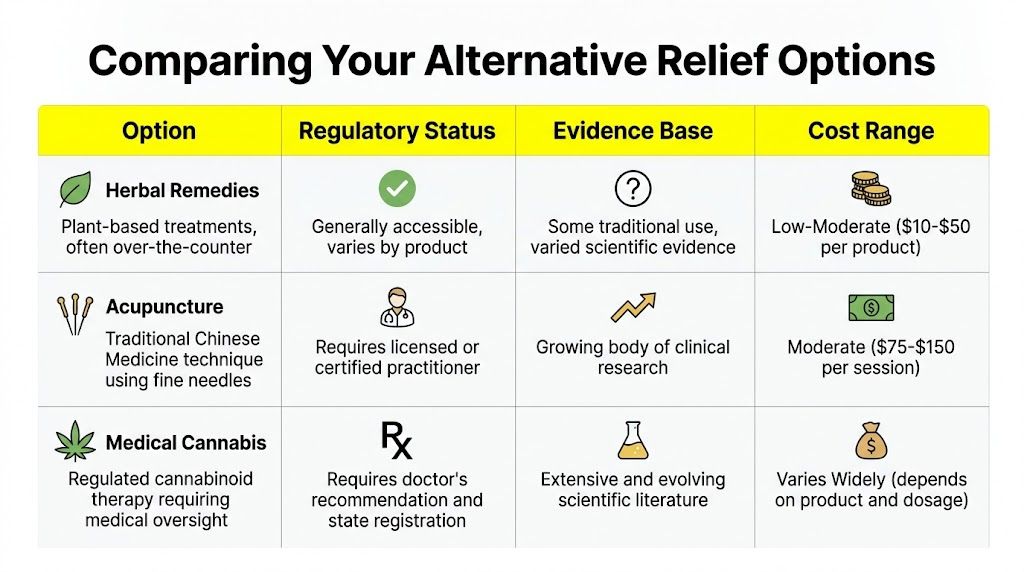
Alternative Relief Options at a Glance
| Therapy | Primary Use Case | Onset of Action | Typical Duration | Accessibility |
|---|---|---|---|---|
| Medical Cannabis | Whole-body symptom support or targeted relief depending on format | Varies by format | Varies by format | Regulated access varies by local law |
| Hemp-Derived CBD | Non-intoxicating wellness support | Often gradual | Varies by product | Broadly available, but product quality varies |
| Physiotherapy | Mobility, recovery, posture, and mechanical pain patterns | Usually gradual over repeated sessions | Builds over time with consistency | Requires practitioner access |
| Acupuncture | Stress regulation, tension patterns, pain support | Some people notice same-day effects, others need repeated visits | Often cumulative | Requires licensed practitioner |
How to use the table in real life
A comparison only helps if you apply it to a real scenario. Here are a few common ones.
When fast feedback matters
If someone needs to understand quickly whether a product is helping, formats with clearer, earlier feedback tend to be easier to manage than products that take longer to fully arrive. That’s one reason some patients prefer tinctures over edibles for early experimentation.
By contrast, a person going to physiotherapy for recurring hip pain usually isn’t looking for immediate dramatic change. They’re looking for better movement, less irritation, and fewer flare-ups over time.
When the problem is localized
If your discomfort lives in one obvious place, like a wrist, knee, or lower back, targeted approaches often make more sense than systemic ones.
Examples include:
- Topical support: Useful for one irritated area
- Physiotherapy: Useful when the joint, muscle, or movement pattern is part of the issue
- Acupuncture: Useful for tension patterns that keep returning
A person with hand soreness from keyboard work might use ergonomic adjustments, rehab exercises, and a topical. They may not need an edible at all.
When the issue affects the whole day
Some symptoms spread across the day and touch mood, appetite, rest, and focus. In those situations, more than one tool may belong in the plan.
A smart relief plan often mixes a fast tool, a steady tool, and a root-cause tool.
That could look like this:
- Fast tool: A format chosen for quicker feedback
- Steady tool: A longer-lasting option used later in the day
- Root-cause tool: Physiotherapy or acupuncture for the pattern underneath
Cost, convenience, and follow-through
People often choose based on what they’ll realistically keep doing. That’s sensible. The best plan on paper won’t help if it’s too complicated, too inconvenient, or too hard to repeat.
A few grounded questions can narrow your choice:
- Do you want local or whole-body support?
- Do you need relief today, or are you building a longer plan?
- Do you want to avoid intoxication?
- Can you track timing, dose, and results consistently?
- Will you actually stick with sessions, exercises, or product routines?
The answer for many patients isn’t one category. It’s a combination. Someone with chronic neck tension might use acupuncture for recurring patterns, stretching for maintenance, and a carefully selected cannabinoid product in the evening when symptoms peak.
That’s a stronger strategy than switching randomly from one trend to the next.
Navigating Safety and Legal Considerations in DC
Safety starts before the first purchase. It starts with asking whether a product is accurately labeled, whether you understand the format, and whether the place selling it operates under real standards.
That’s one reason patients need to understand the difference between a regulated medical framework and a loosely presented retail experience. The packaging may look similar. The level of oversight may not be.
Start low and respect timing
The most common beginner mistake is taking more before the first dose has had time to work. That’s especially risky with slower-onset products. If you don’t respect timing, you can accidentally turn a cautious trial into an uncomfortable experience.
Basic safety habits matter:
- Choose one variable at a time: Don’t try a new product, new setting, and new dose all at once.
- Keep notes: Write down the product type, when you took it, and how you felt later.
- Avoid stacking too quickly: If a product takes longer to kick in, give it that time.
- Use extra caution with other medications: A doctor or pharmacist should review possible interactions.
Why testing and labeling matter
In a regulated setting, patients can expect more clarity around what they’re buying. That includes product type, intended use, and a more reliable path for questions if something doesn’t feel right.
In a less regulated setting, the biggest problem isn’t just strength. It’s uncertainty. A gummy might be stronger than expected, weaker than expected, or inconsistent from piece to piece. That uncertainty makes safe dosing harder.
Buy from systems that can explain what’s in the product, how it’s meant to be used, and what to do if the first try feels too strong.
The DC legal landscape can confuse people
Washington, DC has a medical cannabis program, and it has also had public confusion around non-medical access models. Many people hear broad terms like “dispensary,” “shop,” or “gifting” and assume they all provide the same level of safety and legal clarity. They don’t.
A medical framework is generally the better fit for patients who care about consistency, documented processes, and products chosen for wellness use. A gifting-style environment can feel easier at first glance, but it may not offer the same confidence around testing, dosing, or staff guidance.
If you want a plain-English explanation of the medical side, this guide on how D.C. regulates medical cannabis dispensaries is worth reading.
A simple example
Take two identical-seeming scenarios. In one, a patient buys an edible from a regulated medical source with clear labeling and staff who can explain onset and dose. In the other, a consumer gets an edible through an unregulated or loosely presented channel where the guidance is vague.
The product may look similar in your hand. The experience around it is not similar at all.
That difference affects safety. It affects confidence. It also affects whether a first-time patient learns how to use cannabis well or gives up after one bad experience.
How to Access Treatment in the Washington DC Area
Starting treatment feels easier when you break it into small steps. Most patients don’t need to master the whole system at once. They just need to know what to do first, what to ask, and how to avoid wasting time on the wrong products.
Step one is getting clear on the problem
Before you talk to anyone, write down what you want help with. Be specific.
Instead of saying “I want something good,” try questions like:
- Sleep: Is the problem falling asleep, staying asleep, or waking too early?
- Pain: Is it joint pain, nerve irritation, muscle tightness, or flare-ups after activity?
- Stress: Do you want to feel calmer without feeling foggy?
- Appetite or nausea: Do symptoms come in waves or stay around all day?
Those details shape the product discussion. They also help a clinician or dispensary guide point you in a more useful direction.
Step two is talking with a medical professional
If you use prescription medications, have a complicated health history, or have had unpleasant reactions before, bring that up early. Alternative relief should fit your broader care plan, not collide with it.
For medical cannabis access, many patients also need to understand the local registration process. This overview of the DC medical card process gives a practical starting point.
Step three is choosing a trustworthy dispensary experience
Not every shopping experience is equally educational. A good provider should make it easier to ask basic questions without feeling rushed or embarrassed.
Look for signs like these:
- Staff who ask about your goals: They should care whether you want daytime clarity, evening calm, or localized support.
- Clear product categories: Menus should separate flower, tinctures, edibles, topicals, concentrates, and pre-rolls in a way that makes sense.
- Helpful access options: Pickup, curbside, and delivery can matter if mobility, schedule, or privacy is part of your decision.
- Willingness to guide first-timers: You shouldn’t feel pushed toward the highest-potency option by default.
A practical local example
A first-time patient in Cleveland Park might not want to walk into a store and make a decision under pressure. That person may prefer to review a menu at home, ask a few questions first, and arrange a delivery or pickup once they understand the options.
Someone in Bethesda or Alexandria may care just as much about convenience as product selection. If travel is stressful, access options like curbside or delivery can remove one more barrier from the process.
The best first purchase is usually the one you understand well enough to use correctly.
That may mean choosing a simple tincture over a flashy edible, or a topical over a stronger inhaled product. Early success usually comes from clarity, not bravado.
Your Action Plan for Finding the Right Relief
Relief gets easier to find when you turn a vague search into a short plan. You don’t need to know everything. You need to know your next move.
Five steps that keep patients grounded
Define your goal
Pick the problem you most want to improve first. Better sleep, calmer evenings, less joint pain, easier recovery, or less nausea all call for different choices.Do focused research
Learn the differences between formats, not just ingredients. A tincture, edible, and topical may all come from cannabis, but they behave very differently.Consult a professional
If you take other medications or have health concerns, get guidance before experimenting. A short conversation can prevent a frustrating or uncomfortable first try.Start low and go slow
This matters most with formats that can build slowly. Small starting doses and patient timing usually lead to better experiences.Track what happens
Keep a simple log. Write down the product, amount, timing, and result. Over a few tries, patterns become much clearer.
What confidence actually looks like
Confidence doesn’t mean buying the strongest product or trying everything at once. It means knowing why you chose a format, what result you expected, and what you’ll change next if it wasn’t the right fit.
That’s the key lesson from models like thames valley alternative relief. Good care is organized, educational, and patient-centered. When you use that standard to judge your own options, the market gets less confusing fast.
Frequently Asked Questions About Alternative Relief
Can alternative relief options interact with medications
Yes, they can. That includes cannabis products, CBD products, supplements, and even some over-the-counter wellness items. If you take prescriptions, have heart concerns, or manage a complex condition, speak with a doctor or pharmacist before adding something new.
Is medical cannabis always better than other options
Not always. It depends on the problem. A structural issue may respond better to physiotherapy. A localized ache may be best served by a topical. Medical cannabis can be useful, but it’s one tool in a bigger toolkit.
What’s the practical difference between a medical dispensary and a gifting-style shop in DC
The biggest difference is confidence in the system around the product. A medical setting is generally more aligned with regulated access, clearer patient guidance, and a wellness-focused experience. That can matter a lot if you’re new, dose-sensitive, or trying to avoid a bad first experience.
Will insurance cover alternative relief
Coverage varies a lot. Some complementary services may be covered in part, depending on your plan and provider. Cannabis products often involve out-of-pocket spending. Before you commit to a routine, it helps to estimate what you can sustain consistently.
What should a first-time patient buy first
Start with the format that feels easiest to understand and track. For some people, that’s a tincture. For others, it’s a topical for one clear area of discomfort. The best first choice is usually the one with the clearest purpose and the lowest chance of confusion.
If you want a compliant, supportive place to begin, Mr. Nice Guys DC offers educated guidance, premium medical cannabis products, and convenient pickup, curbside, and delivery options for patients and adults 21+ in Washington, DC and nearby areas.
Mr Nice Guys DC
At Mr. Nice Guys DC, we’re more than just a cannabis delivery service — we’re passionate advocates for quality, convenience, and community. With years of experience in the cannabis industry, our team is dedicated to educating and empowering customers across Washington, D.C. Whether you're a seasoned user or just starting your cannabis journey, our blog delivers trusted tips, product insights, and the latest updates from the world of weed. Stay informed, stay elevated.
