
Must Be 21 To Enter
By entering this site you are agreeing that you are at least 21 Years of Age or older.
I AM 21 OR OLDEROG Kush Strain Info: A Complete DC Guide for 2026
.svg)

.png)
You're probably here because you've seen OG Kush on a menu so many times that it started to feel like a test. Everyone seems to know it. Everyone talks about it like required reading. But when you try to figure out what it is, you get a pile of half-myths, conflicting descriptions, and a lot of recycled strain copy.
That confusion is normal.
A customer will come into a DC dispensary, spot OG Kush, and ask the same practical question I hear all the time: “Is this going to chill me out, make me spacey, or just hit hard?” That's a better question than “Is OG Kush good?” because OG Kush has been around long enough to earn its reputation. The primary concern is figuring out which kind of OG Kush experience you're buying today.
If you've been scrolling menus and trying to connect strain names to real-life effects, this guide should help. If you want a broader look at what shows up on menus and how to compare categories, this overview of strains carried by Mr. Nice Guys DC is a useful starting point.
Your Essential Guide to the Legendary OG Kush
OG Kush is one of those strains that carries its own legend. People ask for it by name, growers still treat it as a reference point, and newer hybrids often get described in relation to it instead of the other way around. That kind of reputation doesn't happen by accident.
What makes OG Kush tricky for newer shoppers is that the name sounds simple, but the experience often isn't. One batch may feel grounding and heavy through the body. Another may feel brighter in the head first, then settle down later. That's where a lot of strain guides fall short. They talk about OG Kush like it's one frozen thing, when in real life it behaves more like a classic song played by different bands. It's recognizably the same song, but the tone can change.
Why people keep coming back to it
OG Kush still matters because it gives people a familiar benchmark. If someone says a strain has “that OG backbone,” they're usually talking about a combination of strong potency, layered aroma, and a high that doesn't fit neatly into only “daytime” or only “sleepy.”
For shoppers in DC, the useful part of OG Kush strain info isn't the mythology. It's learning how to read the batch in front of you.
A strain name tells you the family. The actual flower in the jar tells you the personality.
That's the lens for the rest of this guide. We'll sort out where OG Kush came from, what people usually notice in the smell and effects, why it can feel inconsistent across purchases, and how to choose a batch with more confidence.
Uncovering the Mysterious Origins of OG Kush
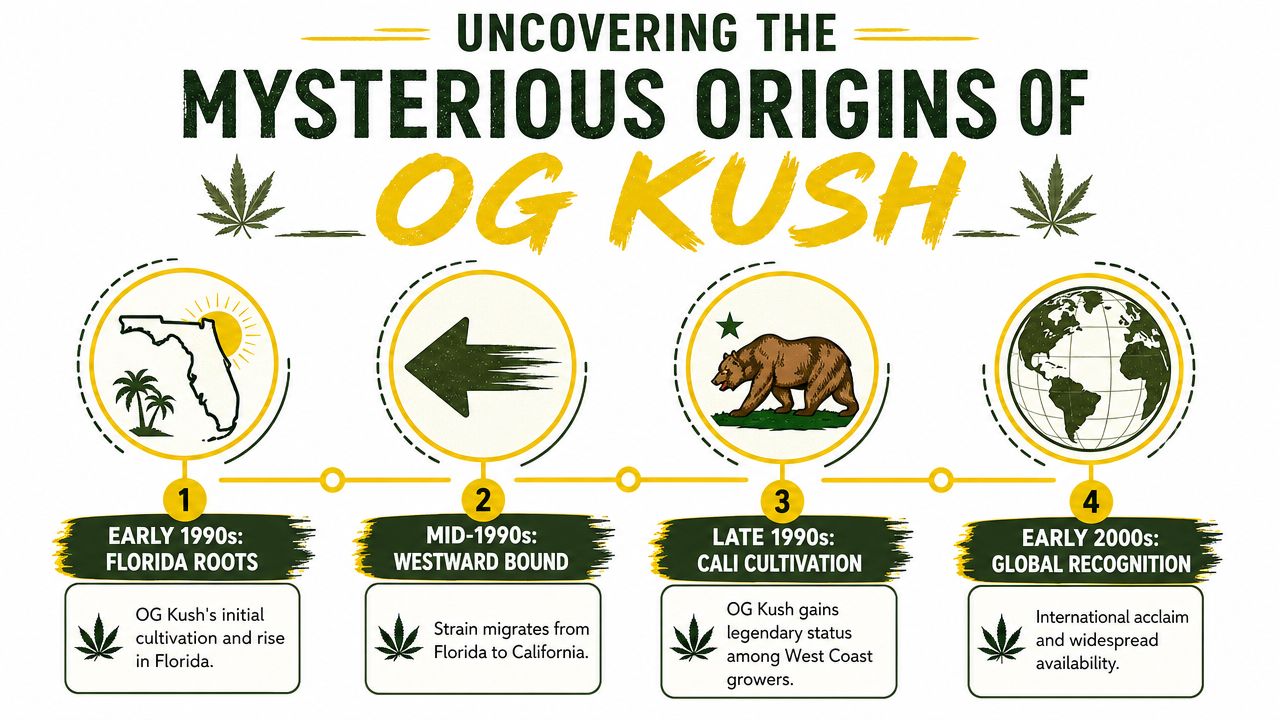
OG Kush has one of the most talked-about backstories in cannabis, and part of that is because the story isn't perfectly settled. The broad outline is clear enough. The fine print isn't.
According to Leafly's OG Kush strain profile, OG Kush is widely described as an indica-dominant hybrid that first emerged in Florida in the early 1990s, with most origin accounts linking it to Chemdawg and Hindu Kush. Some versions of the lineage story also include Lemon Thai. The same profile notes a commonly reported THC range of 18% to 26%, and Leafly reports that 38% of users say it helps with stress, 30% with anxiety, and 28% with pain.
Why the family tree feels murky
Older strains often come with fuzzy records. Cannabis wasn't documented with the kind of retail precision people expect now. So when you read “believed to be” or “most accounts link it to,” that isn't necessarily a red flag. It's often the reality of legacy genetics.
That mixed lineage matters because it helps explain why OG Kush doesn't feel one-dimensional. If you think of cannabis genetics like a stew, not a single ingredient, OG Kush makes more sense. Chemdawg is often associated with that sharp, loud, fuel-forward side. Hindu Kush points people toward the dense, grounding, Kush-family body feel. The possible Lemon Thai piece helps explain why some versions show a brighter citrus edge.
Why its origin still matters now
OG Kush isn't just famous because it's old. It matters because it became a building block. A lot of later Kush hybrids trace back to it in some way, which means understanding OG Kush helps you understand a whole chunk of modern menus.
That's also why shoppers get confused. A legendary strain starts as a genetic reference, then turns into a brand shorthand. Once that happens, people assume every product labeled OG Kush will behave the same way. It won't.
The legend is real. The consistency is not always guaranteed.
If you keep that in mind, the mystery around OG Kush becomes less frustrating and more useful. Its backstory tells you two things at once: it's foundational, and it has never been as simple as one fixed recipe.
OG Kush Effects and Terpene Profile
Strain history isn't sought for its own sake. Instead, the focus is on what opening the jar will be like and how the experience may land.
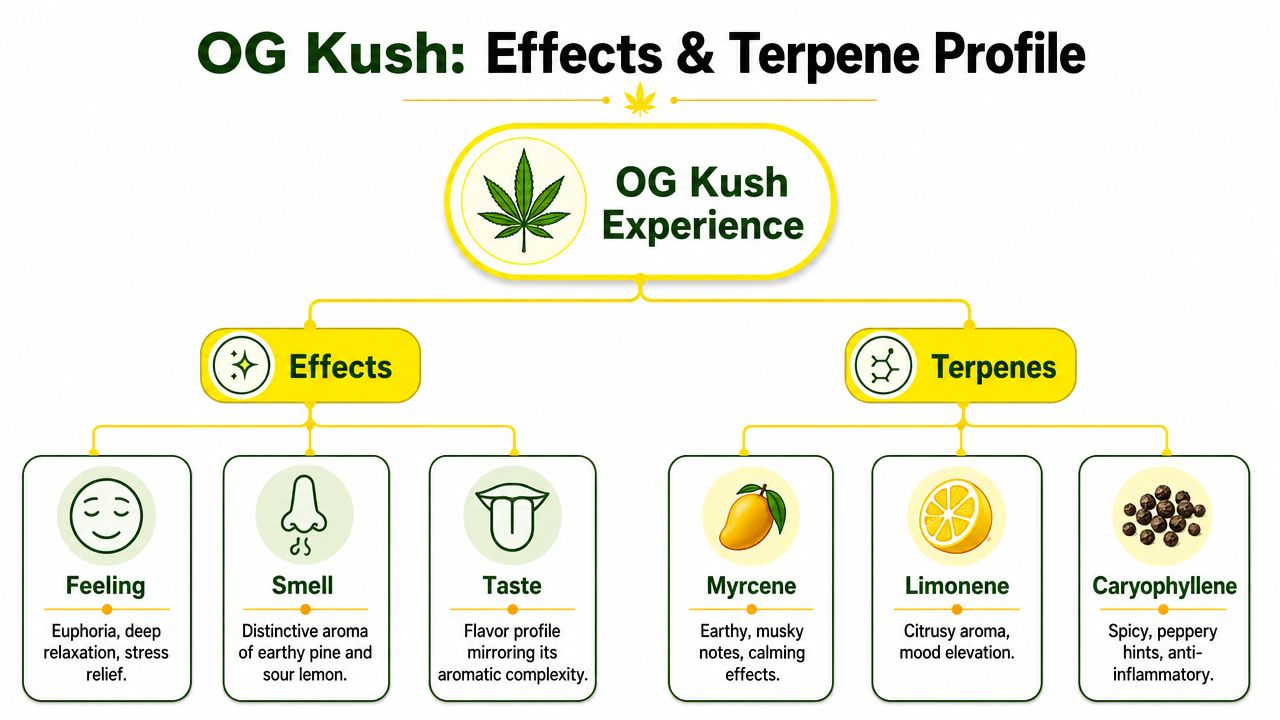
A modern summary from Smoakland's OG Kush review describes OG Kush as high-potency, commonly reported around 20% to 26% THC, while also being low in CBD. That's a useful clue. It suggests OG Kush is often best understood as a strong baseline hybrid rather than a gentle, CBD-balanced option.
What people usually notice first
The first giveaway is usually the aroma. OG Kush is commonly described with some mix of earthy pine, sour lemon, and fuel. That profile is one reason it's stayed so recognizable. Even when batches vary, good OG Kush usually announces itself fast.
The effects often follow that same layered pattern. Many people describe a head change first, then a body shift later. Not frantic. Not flat. More like the high starts in your forehead and shoulders, then spreads into the rest of you.
A simple way to think about terpenes
If cannabinoids are the engine, terpenes are the steering and suspension. They don't replace THC, but they help shape how the ride feels.
A kitchen analogy helps here. THC is like the heat level in a dish. Terpenes are the seasoning. Two meals can have similar heat, but one tastes bright and lively while the other feels deep and savory. Same with cannabis. Two OG Kush batches can have similar potency, but one may feel more upbeat while the other feels more settling because the aroma compounds and cultivation details differ.
If you want a simpler primer on how those aroma compounds affect the experience, this terpene explainer from the Mr. Nice Guys DC blog is worth reading.
How to read the experience in plain language
Here's a practical way to think about OG Kush when you're deciding whether it fits your needs:
- If you want mood lift with weight behind it, OG Kush often appeals to people who don't want a purely sleepy flower but also don't want something buzzy and thin.
- If you're sensitive to strong THC, the low-CBD profile means the experience may feel direct and pronounced.
- If you care about aroma as much as effects, OG Kush is one of the classic examples of a strain where smell tells you a lot about what kind of session you're likely to have.
A shopper might compare it with a newer dessert strain and think the newer one smells more polished. That can happen. But OG Kush still earns respect because it delivers a classic, sturdy profile that many people treat as the center line for hybrid flower.
Potential Medical Uses and Benefits
For medical patients, OG Kush usually enters the conversation because of how it may combine mental ease with physical relaxation. It's not a one-size-fits-all answer, and it isn't the only option for wellness-focused shopping, but it remains part of the conversation for a reason.
The Leafly data cited earlier gives a useful snapshot of why people keep reaching for it. Some users report using it for stress, anxiety, and pain. That doesn't mean it will work the same way for every person or every batch. It does help explain why OG Kush has stayed relevant long after many hype strains faded.
Why some patients gravitate toward it
A lot of patients aren't looking for fireworks. They're looking for a flower that may help them come down from a tense day, soften physical discomfort, or quiet mental noise enough to rest. OG Kush often gets discussed in that context because its profile tends to sit near the middle of two needs at once: relief and noticeable potency.
In practical terms, that might look like this:
- After-work stress support: Someone who feels wound up but doesn't want an intensely racy strain may prefer an OG Kush batch that smells more earthy than sweet.
- Body-heavy evenings: A patient dealing with lingering discomfort may look for dense flower with a stronger Kush aroma and ask whether the current batch leans heavier through the body.
- Transitional use: Some people want something that helps them move from “still in work mode” to “ready to slow down.” OG Kush often gets chosen for that middle ground.
A smart way to use it medically
The key is matching the batch to the moment. If you're shopping with stress, sleep, or discomfort in mind, broad strain names only get you part of the way there. You also want to ask how the current flower presents.
For a broader patient-focused overview, this guide to choosing cannabis for sleep, pain, and anxiety helps frame the decision around your actual goal instead of just the strain label.
If your goal is relief, don't stop at “OG Kush.” Ask what this batch feels like, smells like, and who it tends to suit.
That question alone can save you from buying a strong flower that's technically on-target but wrong for your timing or tolerance.
How to Choose High-Quality OG Kush Flower
When people say “good OG Kush,” they usually mean more than one thing at once. They mean the flower looks healthy, smells loud, feels properly cured, and delivers a consistent session. You can catch a lot of that before you ever grind it up.
From a quality-control angle, Aligned Wellness DC's OG Kush strain guide notes that OG Kush is valued for dense, trichome-rich flowers and a fairly standardized flowering window of 8 to 9 weeks, with indoor yields around 400 to 500 g/m² and outdoor yields up to 700 g/plant under favorable conditions. For shoppers, the important part isn't the farm math. It's that growers who manage light, resin development, and the environment well can preserve the look and consistency people expect from OG Kush.
What to look for at the counter
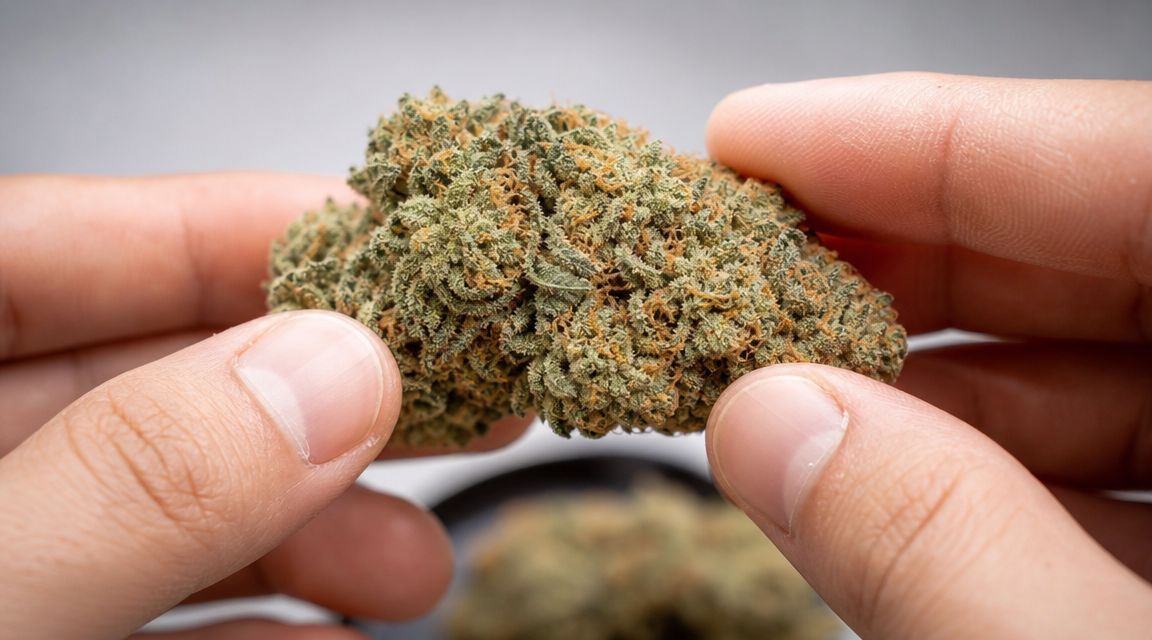
Start with your eyes. Good OG Kush often has a compact, chunky structure rather than loose, airy flower. It should also show a noticeable frost from trichomes. “Trichome-rich” sounds fancy, but in plain language it means the bud has that crystal-coated look people call frosty.
Then use your nose. OG Kush should smell distinct. You're looking for some mix of earthy, piney, sour, citrusy, or fuel-like notes. If the aroma feels flat, dusty, or dull, the flower may be old, poorly cured, or not a strong expression of the strain.
A quick checklist helps:
- Look for density: Buds should feel substantial, not wispy.
- Check the surface: A visible resin sparkle usually signals good trichome presence.
- Trust the nose: Strong aroma usually tells you the terpene profile has been preserved.
- Avoid brittle flower: Dry buds tend to burn harsher and often lose character.
- Ask for batch details: Potency and freshness matter, but so does how the flower presents.
Why testing still matters
Visual quality is useful, but it doesn't replace verified product information. If you want to understand how lab results fit into the buying process, this guide to cannabis potency testing is helpful.
A bud can look beautiful and still not fit your tolerance. Another can test strong but feel one-note if the cure wasn't handled well. The best buys usually combine both: solid testing and strong sensory quality.
Here's a quick visual primer before you shop:
A practical shopping example
Say two OG Kush jars are available. One smells sharply of lemon and fuel, with a lively top note. The other smells deeper, earthier, and more musky. Even before consumption, many experienced shoppers will expect those jars to feel a little different.
That doesn't mean one is real OG Kush and the other isn't. It means flower quality includes expression, not just name recognition.
Why Your OG Kush Experience Can Be Inconsistent
This is the question most articles skip, and it's the one shoppers care about most after they've bought OG Kush more than once.
If one purchase felt mellow and body-heavy, while another felt more heady and intense, you're not imagining it. Cheef Botanicals' OG Kush strain guide points out that references disagree on OG Kush's genetics and classification. Some describe it as a 55/45 sativa-leaning hybrid, while others call it indica-dominant. The same source also notes that the label can produce meaningfully different effects depending on phenotype, cultivation, and a THC range often reported around 18% to 27%.
The simple meaning of phenotype
Think of a phenotype as one family recipe made by different relatives. The base idea is the same. The final dish can still come out sweeter, heavier, sharper, or more balanced depending on how it's expressed.
That's what happens with cannabis. Two plants from the same broad genetic line can show different traits. One OG Kush phenotype may lean toward a brighter, more cerebral feel. Another may come off denser, calmer, and more sedating.
Grower choices change the result too
Even with similar genetics, cultivation can push the final flower in different directions. Harvest timing, cure quality, environmental control, and storage all affect the end result. A rushed cure can flatten the aroma. A better-handled crop can preserve more of the strain's signature character.
Here's where shoppers often get tripped up:
- Same name, different expression: “OG Kush” on the label doesn't promise the exact same sensory profile every time.
- Potency isn't the whole story: A stronger number doesn't automatically mean a better or heavier experience.
- Freshness changes perception: Older flower may feel duller even if the strain name is accurate.
- Retail context matters: How the flower was stored after harvest can shape your experience just as much as how it was grown.
Don't shop OG Kush like it's a fixed product. Shop it like it's a living batch with its own personality.
What to ask before you buy
A better question than “Is this OG Kush good?” is one of these:
| Question to ask | Why it helps |
|---|---|
| Does this batch lean more relaxing or more heady? | You get effect language, not just the strain name. |
| How would you describe the aroma on this batch? | Smell often hints at how the experience may land. |
| Is this flower fresh and well-cured? | Cure quality affects both taste and feel. |
| Is this OG Kush showing more earthy notes or more citrus and fuel? | That helps you compare one batch to another in practical terms. |
Those questions won't make cannabis perfectly predictable. They will make your odds better.
Finding the Best OG Kush in Washington DC
By the time you've read this far, the big takeaway is pretty simple. OG Kush is famous for a reason, but buying it well means looking past the name.
Cultivators keep growing OG Kush because it remains commercially practical. ILGM's OG Kush grow guide reports indoor yields of about 17 ounces per square meter, outdoor yields of 16 ounces or more per plant, and a flowering time of 8 to 9 weeks, with harvest typically in early October outdoors. The same guide also cites indoor yields around 400 to 500 grams per square meter and up to 700 grams per plant outdoors under strong conditions. For shoppers, that matters because OG Kush tends to stay in circulation. Availability is often less of the problem than curation.
How to shop for it locally
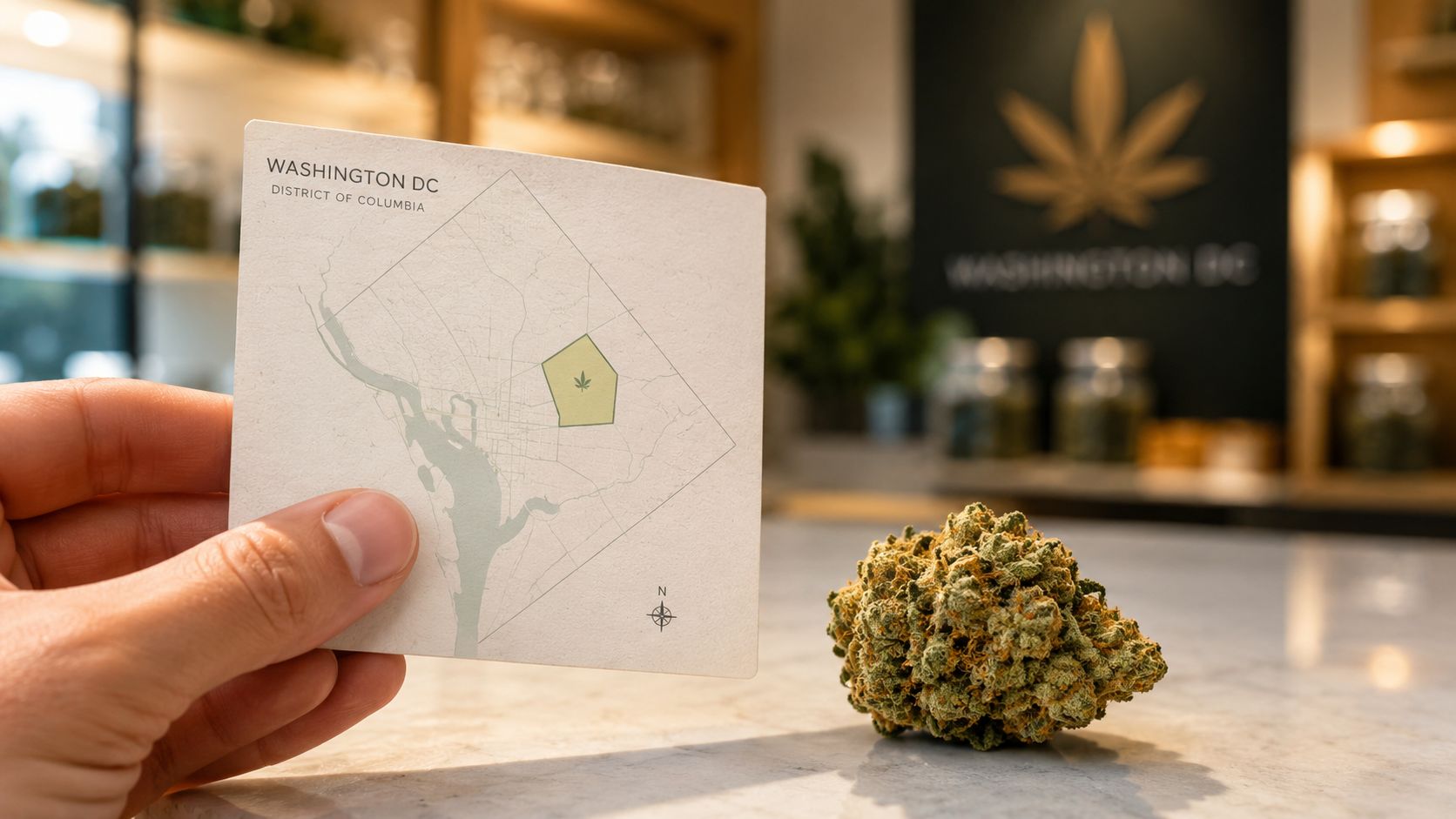
The smartest move is to treat OG Kush like you'd treat produce, wine, or coffee. The label gets you into the right aisle. The actual batch decides whether it fits your taste and needs.
That means asking about:
- Current batch character
- Freshness and cure
- Whether it leans heavier, brighter, or primarily stronger
- What similar options are available if this batch isn't the right fit
If you're comparing local shopping options, this Washington dispensary guide can help you think about what to look for in a store beyond just menu size.
When OG Kush isn't the right fit
Sometimes the answer is not “buy OG Kush anyway.” If you like the heritage but want a slightly different expression, it can make sense to ask about OG-related hybrids such as GSC or Headband. Those strains often appeal to shoppers who want some part of the OG backbone without the exact same feel.
For people shopping in DC, one practical option is Mr. Nice Guys DC, which provides menu access for flower and other categories and lets adults and patients compare currently available products before ordering. The key point isn't the logo on the storefront. It's whether the staff can describe the current batch in concrete language that matches your needs.
OG Kush remains a classic. Just don't buy it like a souvenir. Buy it like a specific batch of flower with a specific profile.
If you want help narrowing down an OG Kush batch by effect, aroma, or tolerance level, check the live menu at Mr. Nice Guys DC and use what you've learned here to ask sharper questions before you order.
Mr Nice Guys DC
At Mr. Nice Guys DC, we’re more than just a cannabis delivery service — we’re passionate advocates for quality, convenience, and community. With years of experience in the cannabis industry, our team is dedicated to educating and empowering customers across Washington, D.C. Whether you're a seasoned user or just starting your cannabis journey, our blog delivers trusted tips, product insights, and the latest updates from the world of weed. Stay informed, stay elevated.
