
Must Be 21 To Enter
By entering this site you are agreeing that you are at least 21 Years of Age or older.
I AM 21 OR OLDERMedical Cannabis Tincture: Dose, Effects, & DC Dispensaries
.svg)

.png)
You're probably here because you want something more controlled than smoking, more predictable than a random edible, and easier to fit into daily life. That's exactly why many patients ask about a medical cannabis tincture first.
A tincture gives you a middle ground. It's discreet, portable, and usually simple to dose with a measured dropper. If you're in DC and trying to make sense of menus, labels, and lab reports, the format can feel much less intimidating once you know what you're looking at.
What Is a Medical Cannabis Tincture
A medical cannabis tincture is a liquid cannabis extract you take in small measured amounts, usually with a dropper. The easiest comparison is vanilla extract. Both are liquids made by pulling plant compounds into a solvent, then bottling that concentrated liquid so you can use a small amount at a time.
With cannabis, that liquid contains cannabinoids like THC and CBD. Patients often place it under the tongue, but some products may also be swallowed depending on how they're intended to be used.
Two common types patients will see
Most patients run into two broad categories:
Alcohol-based tinctures
These are closer to the traditional idea of a tincture. Ethanol pulls cannabinoids from the plant material. These formulas can absorb quickly under the tongue, but some people notice a stronger herbal taste or a warm alcohol sensation.Oil-based tinctures
These use a carrier oil instead of alcohol. They often taste softer and may feel gentler for patients who don't like alcohol-based formulas. They're still easy to measure with a dropper, though the feel and timing can differ from one formula to another.
If you're reading a dispensary menu, both may be casually called “tinctures.” That can confuse first-time buyers. So if the ingredient list mentions ethanol, alcohol, or an alcohol-glycerin blend, you're likely looking at a more traditional tincture. If it lists MCT oil or another carrier oil, it's an infused oil product sold in tincture format.
Why the extraction method matters
The solvent used during production changes what ends up in the bottle. A review of tincture production found that 80 to 90% ethanol extracts contain ten-fold more cannabinoids from female flowering tops compared with leaf material, and reducing the alcohol concentration to 40% results in only 1/3 the cannabinoid content in comparison to an 80% benchmark, according to this analysis of cannabis tincture extraction and ethanol concentration.
That sounds technical, but the takeaway is simple. Think of the solvent like a sponge. A stronger, well-matched solvent pulls out more of what you want. A weaker one leaves more behind.
Practical rule: Two tinctures can look similar on a menu and still perform very differently because the extraction and formulation are different.
What that means for a patient
If you need help with day-to-day consistency, tinctures are appealing because they're built around measured dosing. You're not guessing how big a puff was or how evenly an edible was cut. You have a bottle, a label, and usually a marked dropper.
A practical example helps. If a bottle says it contains THC and the serving size is tied to a 1 mL dropper, you can repeat that same amount much more easily than you can repeat “two puffs and a tiny extra one.”
When you shop, look past the word tincture and ask a few basic questions:
- What is the base? Alcohol, oil, or something else.
- What is the cannabinoid profile? THC-heavy, CBD-heavy, or balanced.
- How is the serving measured? Full dropper, half dropper, or by individual drops.
- Is there a lab report? That helps confirm what's in the bottle.
That's the foundation. Once you understand the bottle, the next step is understanding what happens after you use it.
How Tinctures Work in Your Body
Tinctures are popular because they often use a shortcut. Instead of taking the full digestive route that many edibles do, a tincture placed under the tongue can absorb through the tissues there and enter the bloodstream more directly.
That shortcut is the key idea. Edibles usually take the scenic route. They go through your stomach, then your liver, and that can make the experience feel slower and less predictable. A tincture used sublingually aims to skip much of that detour.
Here's a quick visual of that process.
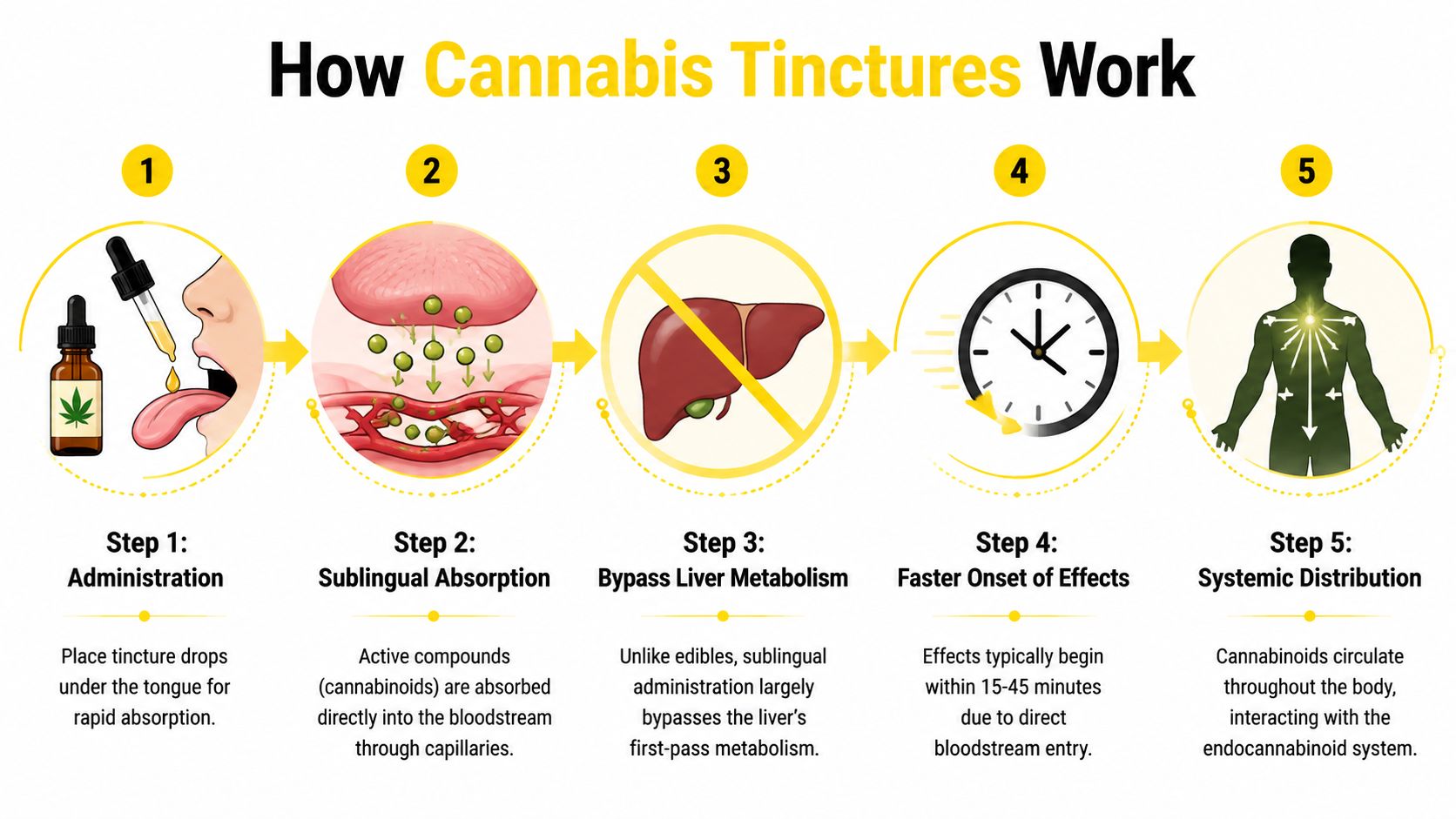
The under-the-tongue shortcut
The basic flow looks like this:
- You measure your dose with the dropper.
- You place it under your tongue instead of swallowing right away.
- The cannabinoids absorb through small blood vessels in that area.
- Less first-pass liver metabolism happens up front than with a standard edible.
- You feel effects sooner than you would from a product that has to move fully through digestion.
A review of tincture administration noted that sublingual use maximizes bioavailability with a 15 to 30 minute onset while avoiding hepatic first-pass metabolism, as described in this scientific review on marijuana tinctures and sublingual absorption.
What the experience can feel like
For many patients, tinctures sit between inhalation and edibles.
- Faster than many edibles because you're not relying entirely on digestion.
- Longer-lasting than a quick inhaled session for some people.
- Easier to repeat consistently because the dose is measured.
That doesn't mean every bottle feels exactly the same. The formula, your metabolism, whether you've eaten, and how long you hold it under your tongue can all shape the experience.
Hold the liquid under your tongue for a bit before swallowing if the product is meant for sublingual use. That small habit can matter.
A real-world example
Say a patient wants support in the evening but doesn't want the sudden lift that inhalation can bring. A tincture may fit because it tends to come on in a more measured way. Another patient might want something they can take discreetly before settling in for the night, without smell and without carrying a vape device.
The most common mistake is treating a tincture like an edible shot. If you swallow it immediately, you may shift more of the experience toward digestion. If the label and budtender guidance point to sublingual use, follow that route for the effect profile the product is designed to deliver.
Medical Uses and Choosing the Right Ratio
Patients rarely ask for “a tincture” and stop there. They usually mean something more specific. They want help with sleep, daytime calm, physical discomfort, appetite, or nausea, and they want to avoid effects that get in the way of work or routine.
That's where ratios matter. The ratio tells you how much THC and CBD are in relation to each other. It's one of the quickest ways to narrow down a product that fits your goal.
Why ratio matters more than hype
A bottle with a lot of THC may be useful for one patient and a bad fit for another. A high-CBD formula may feel gentler for someone who wants support without much intoxication. A balanced formula may land somewhere in the middle.
Patients often find these broad patterns helpful:
- High-CBD, low-THC options can make sense for daytime use when you want a clearer head.
- Balanced formulas such as 1:1 are often considered when someone wants both cannabinoids in play.
- THC-forward tinctures may be more appropriate for patients who already know they tolerate THC well and want stronger psychoactive effects.
If you're new, think of ratio like the balance knob on a speaker. You're not just turning the volume up. You're changing the mix.
Practical examples patients understand quickly
A few simple examples make this easier:
Daytime anxiety example
A patient who wants to stay functional may lean toward a high-CBD ratio such as 20:1 CBD:THC because that profile is commonly associated with less psychoactivity.Chronic pain example
Another patient may prefer a 1:1 THC:CBD formula because balanced products are often chosen when someone wants a wider cannabinoid mix.Evening wind-down example
A patient who already knows THC works well for them may choose a THC-dominant tincture for nighttime use.
This short video gives a useful overview before you compare labels and menus.
For a simple breakdown of how these two cannabinoids differ, this guide on CBD versus THC is a helpful next read.
What patients are asking for now
Customization matters to patients. Patient surveys show 68% prefer ratio-customized products for efficacy without intoxication, and post-2025 DC dispensary data shows a 25% year-over-year rise in sales of ratio-specific tinctures, according to this overview of ratio-specific tincture demand and patient preference.
That lines up with what patients often say at the counter. They don't just want “strong.” They want appropriate.
Patient-friendly mindset: Choose a tincture based on the day you need to have, not just the effect you're curious about.
A simple way to think about the entourage idea
You may hear the phrase entourage effect. In plain language, that means cannabis compounds may work differently together than they do alone. For a patient, the practical lesson is simple. Don't look only at the biggest THC number on the menu.
Look at the full picture:
- THC and CBD balance
- Whether the product is full-spectrum or more isolated
- How you want to feel during and after the dose
- Whether it's for daytime, evening, or symptom-specific use
If a label mentions a strain association like Blue Dream or OG Kush, treat that as a clue rather than a guarantee. The cannabinoid ratio and the lab report usually tell you more than the name alone.
Finding Your Dose A Guide to Titration
Dosing is where most new tincture users get nervous, and for good reason. A tincture is easy to measure, but that only helps if you know what the numbers mean.
The safest mindset is start low and go slow. Your goal isn't to prove you can feel it. Your goal is to find the smallest amount that does the job.
Start with the label, not the bottle size
Patients often confuse bottle size with strength. A larger bottle isn't automatically stronger. What matters is how many milligrams of cannabinoids are in the bottle and how much is in each serving.
A useful benchmark comes from patient purchase data. High-THC tinctures are commonly formulated to deliver 10 mg THC per dose such as a 1 mL dropper, and patients over 65 opted for tinctures at a rate of 44.9% in the study, reflecting how predictable dosing can support therapeutic use, according to this study of medical cannabis purchases and tincture dosing patterns.
That benchmark helps, but it isn't a starting dose for everyone. It's just a common formulation.
A step-by-step math example
Let's use a simple made-up label format without adding any unsupported market data.
If your bottle says:
- Total THC in bottle: 600 mg
- Bottle size: 30 mL
- Dropper size: 1 mL
Then the math is:
| Label detail | What it means |
|---|---|
| 600 mg in 30 mL | There are 20 mg THC in each 1 mL |
| 1 mL full dropper | 20 mg THC |
| 0.5 mL half dropper | 10 mg THC |
| 0.25 mL quarter dropper | 5 mg THC |
That's why labels matter so much. You're converting the total amount in the bottle into the amount you take.
A cautious titration example
A simple patient approach often looks like this:
- Begin with a very small measured amount based on the label math.
- Use the same time of day for your first few trials so the comparison is cleaner.
- Wait long enough before changing the dose because tinctures aren't instant.
- Increase gradually only if needed.
- Stop increasing once you've reached the desired effect.
Don't make the common mistake of redosing too early because “nothing happened yet.” That's how people overshoot.
Keep your first few trials boring. Quiet evening, no alcohol, no stacking with other cannabis products, and a notepad nearby.
Keep a dosing journal
A simple journal beats guessing. You don't need anything fancy. Your phone notes app works fine.
Track these basics:
- Date and time
- Product name
- Amount taken
- How you took it under the tongue or swallowed
- When effects started
- What you felt
- Anything you didn't like
A real example could look like this:
Tuesday, 8:30 PM
Took 0.25 mL under tongue. Mild relaxation. No racing thoughts. Slight dry mouth.Thursday, 8:30 PM
Took 0.5 mL under tongue. More body heaviness than needed. Next time, go back down.
That kind of note helps far more than trying to remember later.
Comparing Tinctures with Other Cannabis Products
A tincture makes sense for many patients, but not every patient wants the same timing, duration, or routine. Some want the speed of inhalation. Others want something they can keep in a nightstand and use without smell, smoke, or prep.
The easiest way to compare products is by decision criteria, not by marketing language. Ask five questions: How fast does it kick in, how long does it last, how easy is it to measure, how discreet is it, and does it fit your day?
Tinctures vs Other Methods At a Glance
| Method | Onset Time | Duration | Dosing Precision | Discretion |
|---|---|---|---|---|
| Tinctures | Moderate | Moderate to longer | High | High |
| Flower | Fast | Shorter | Lower | Lower |
| Vaporizers | Fast | Shorter to moderate | Moderate | Moderate |
| Edibles | Slower | Longer | Moderate to high, depending on product | High |
That snapshot helps, but the actual value is in how each method feels in daily life.
Where tinctures stand out
Tinctures are strong when you care about repeatability. The dropper gives you a more measured routine than smoking flower. They're also discreet. There's no lingering smoke smell, and you can carry a small bottle much more easily than some other formats.
They're often a good match for patients who want:
- Quiet dosing at home
- More control than smoking gives
- A simpler routine than cutting up edibles
- Less attention from the people around them
If you want a deeper side-by-side look, this comparison of tincture versus smoking walks through the tradeoffs in plain language.
Where other formats may fit better
Flower and vaporizers usually appeal to patients who want effects to arrive quickly. That can matter when someone doesn't want to wait. The tradeoff is that inhalation can be harder to measure precisely from one session to the next.
Edibles often appeal to patients who want something very discreet and long-lasting. The tradeoff is patience. If you're the kind of person who gets frustrated waiting and tends to redose early, a tincture may feel easier to manage.
Different methods solve different problems. Fast relief, measured dosing, long duration, and low smell usually don't all peak in the same product.
A simple patient decision test
Ask yourself which sentence sounds most like you:
- “I need something I can measure carefully.” Tincture.
- “I want the fastest possible change.” Inhalation may fit better.
- “I want something long-lasting and I don't mind waiting.” Edible.
- “I need discretion without much setup.” Tincture or edible.
That's usually more useful than chasing whichever product has the loudest menu description.
Safety Storage and Reading Product Labels
A medical cannabis tincture may be simple to use, but it still deserves the same care you'd give any product that affects your body. Safe use starts with a few basic habits: know what you're taking, store it properly, and don't treat the label like decoration.
Safety basics that matter
Common effects can include things like drowsiness, dry mouth, or feeling “too heavy” if the dose is too high for you. That's one reason careful titration matters so much. If you're using other medications, it's smart to ask a healthcare professional about possible interactions before adding cannabis to the mix.
A few practical guardrails help:
- Avoid mixing with alcohol when testing a new tincture because it can muddy the experience.
- Don't drive or do safety-sensitive tasks until you know how your product affects you.
- Keep it away from children and pets. A dropper bottle is small and easy to underestimate.
Storage is simple but important
Store tinctures in a cool, dark place. Heat, light, and careless handling can work against consistency over time.
Similar to storing olive oil or vitamins. You wouldn't leave them baking on a windowsill and expect them to stay the same. A bathroom cabinet that gets hot and humid isn't ideal either. A drawer, cupboard, or another stable indoor spot usually makes more sense.
How to read the label without guessing
A good label gives you enough information to use the product confidently. Focus on these parts first:
Total cannabinoids in mg
This tells you how much THC, CBD, or both are in the whole bottle.Serving size
This tells you what the brand considers one measured amount, often tied to a full or partial dropper.Ingredients list
This helps you tell whether the product is alcohol-based, oil-based, flavored, or full-spectrum.Batch number and expiration date
These help with quality tracking and freshness.
For patients comparing extract styles, this explanation of full-spectrum cannabis can help you understand why one tincture may feel broader than another.
A quick label-reading example
Suppose you pick up a bottle and see:
- THC listed for the whole bottle
- CBD listed for the whole bottle
- Serving size listed as 1 mL
- Ingredients including MCT oil and cannabis extract
- A batch number and expiration date
That tells you five useful things right away. You know the cannabinoid profile, how the bottle is meant to be measured, what the base is, and whether the product can be matched to its production record.
The best labels reduce guesswork. If a product doesn't make its dosing or ingredients clear, ask before buying.
A Patient's Guide to Buying Tinctures in DC
Buying a tincture gets easier once you know what to check before you click “add to cart” or ask for help at the counter. In DC, the practical part is usually less about finding a tincture and more about choosing the right one for your needs, tolerance, and budget.
Start with access and menu basics
If you're new to DC medical cannabis, get your certification and patient status squared away first, then browse menus with a plan. Don't sort by THC alone. Filter by the things that shape your experience:
- Ratio such as THC-dominant, CBD-dominant, or balanced
- Base such as alcohol or oil
- Intended use like daytime, evening, or general symptom management
- Available lab information
If you're looking for a local starting point, this page on medical marijuana dispensaries near you is useful for understanding DC access and shopping options.
One option in the city is Mr. Nice Guys DC, which lists tinctures on its menu alongside other medical cannabis formats and provides online ordering, pickup, curbside, and delivery information.
How to read a menu like a patient, not a browser
A menu can feel noisy. Strain names, potency numbers, flavors, and category tags all compete for attention. Cut through it by checking three things in order:
What are the cannabinoids?
Is it THC-heavy, CBD-heavy, or balanced?How is the serving described?
If the serving language is vague, ask for clarification before buying.Is there a lab report or COA?
That's where you verify what the label claims.
A certificate of analysis usually helps you confirm:
- Cannabinoid potency
- Whether the tested amounts match the product description
- Ingredient or extract style clues
- Sometimes terpene information, depending on the product and supplier
If a COA looks overwhelming, focus first on the cannabinoid panel. That panel answers the biggest patient question: “What am I getting per serving and per bottle?”
Price and value in the real world
Cost matters, especially if a tincture becomes part of a regular routine. As of March 2026, the average retail price for a 1000mg THC medical cannabis tincture ranges from $45 to $75, and savvy patients calculate Cost Per Milligram by dividing total price by total milligrams. Medical cardholders in DC also benefit by bypassing recreational excise taxes, leading to significant savings, according to this medical marijuana tincture pricing guide.
That “cost per milligram” idea is one of the most useful shopping tools you can learn. A bottle with a higher shelf price isn't automatically a worse deal if it contains more cannabinoids or a formulation that fits your needs better.
Here's a simple way to use it:
- Bottle A costs less up front but contains fewer total milligrams.
- Bottle B costs more up front but may provide a better value per milligram.
That doesn't mean the cheapest-per-milligram bottle is always the right choice. Some patients care more about ratio, extract style, or how the product feels. But the calculation keeps you from comparing bottles blindly.
What to ask before you buy
A short list of smart questions can save you money and frustration:
- Is this THC-dominant, CBD-dominant, or balanced?
- How many milligrams are in one serving?
- Is it alcohol-based or oil-based?
- Can I see the COA?
- Is this better suited for daytime or evening use based on its profile?
That's the kind of conversation that turns a confusing menu into a practical purchase.
If you want help choosing a medical cannabis tincture that fits your goals, browse the menu or talk with the team at Mr. Nice Guys DC. They can help you compare ratios, understand serving sizes, and read product details before you order for pickup, curbside, or delivery.
Mr Nice Guys DC
At Mr. Nice Guys DC, we’re more than just a cannabis delivery service — we’re passionate advocates for quality, convenience, and community. With years of experience in the cannabis industry, our team is dedicated to educating and empowering customers across Washington, D.C. Whether you're a seasoned user or just starting your cannabis journey, our blog delivers trusted tips, product insights, and the latest updates from the world of weed. Stay informed, stay elevated.
