
Must Be 21 To Enter
By entering this site you are agreeing that you are at least 21 Years of Age or older.
I AM 21 OR OLDERMarijuana Store Near Me: A Local Guide
.svg)

.png)
A marijuana store near me in Washington, DC should be a licensed dispensary that accepts a valid medical registration from most U.S. states or allows adults 21 and older to self-certify for medical registration. Your distance from the shop matters less than whether your documents, purchase method, and product choice comply with DC rules.
You may be checking your phone from a hotel, apartment, or office, comparing menus and wondering which result is safe to use. The practical questions start before you leave: Can you legally buy, can the store deliver to your address, what should you bring, and how can you tell whether a product has meaningful testing information?
DC's medical market already had a substantial patient base and regulated supply system by 2020. The District reported 8,836 registered patients in an official update covering September 25 through October 27, 2020, along with participating physicians, nurses, other practitioners, and caregivers (District medical-cannabis program update). That history matters because a dispensary visit isn't just a convenience-store stop. It involves eligibility, traceable products, informed selection, and limits that can affect what you buy and how you receive it.
Finding Your Way to a Local Dispensary
You type “marijuana store near me” into your phone while standing near Georgetown or Downtown DC. The map fills with storefronts, delivery pages, menus, and listings that look similar at first glance. One result is closer, another has a more polished menu, and a third explains almost nothing about registration.
The closest pin isn't automatically the most useful choice. A reliable dispensary should make its license status, purchasing pathway, product information, and pickup or delivery process understandable before you arrive. If a listing avoids explaining who can purchase or provides no clear information about packaging and testing, a short drive won't compensate for the uncertainty.
What to check before choosing
Start with the practical details rather than the strain names:
- Legal status: Confirm that the business operates through a licensed retail channel and explains the applicable medical registration process.
- Product transparency: Look for manufacturer details, product categories, serving information, and testing documentation where available.
- Staff knowledge: A useful team asks about experience, timing, desired effects, and tolerance instead of steering every customer toward the highest THC option.
- Real access: Check whether the address supports in-store pickup, curbside collection, or delivery under the rules that apply to your registration.
A first-time visitor might choose a shop near U Street because it offers a clear online menu and lets the customer arrange pickup before traveling across town. That can work better than walking into a closer location with unclear eligibility information, no visible product details, and staff who can't explain the difference between package potency and serving potency.
Practical rule: Treat a search result as an invitation to verify, not as proof that the storefront is lawful or suitable.
The national context explains why local search has become more crowded. Legal U.S. cannabis sales reached an estimated $30.1 billion in 2024, with California at approximately $4.66 billion and Washington State at about $1.26 billion for fiscal year 2024 (Los Angeles Department of Cannabis Regulation overview). A mature market creates more choice, but it also makes comparison more important. A dependable local guide should help you understand the purchase, not just point you toward a menu.
For a more detailed local-search approach, see this guide to finding a cannabis dispensary near you, then confirm the store's current requirements before setting out.
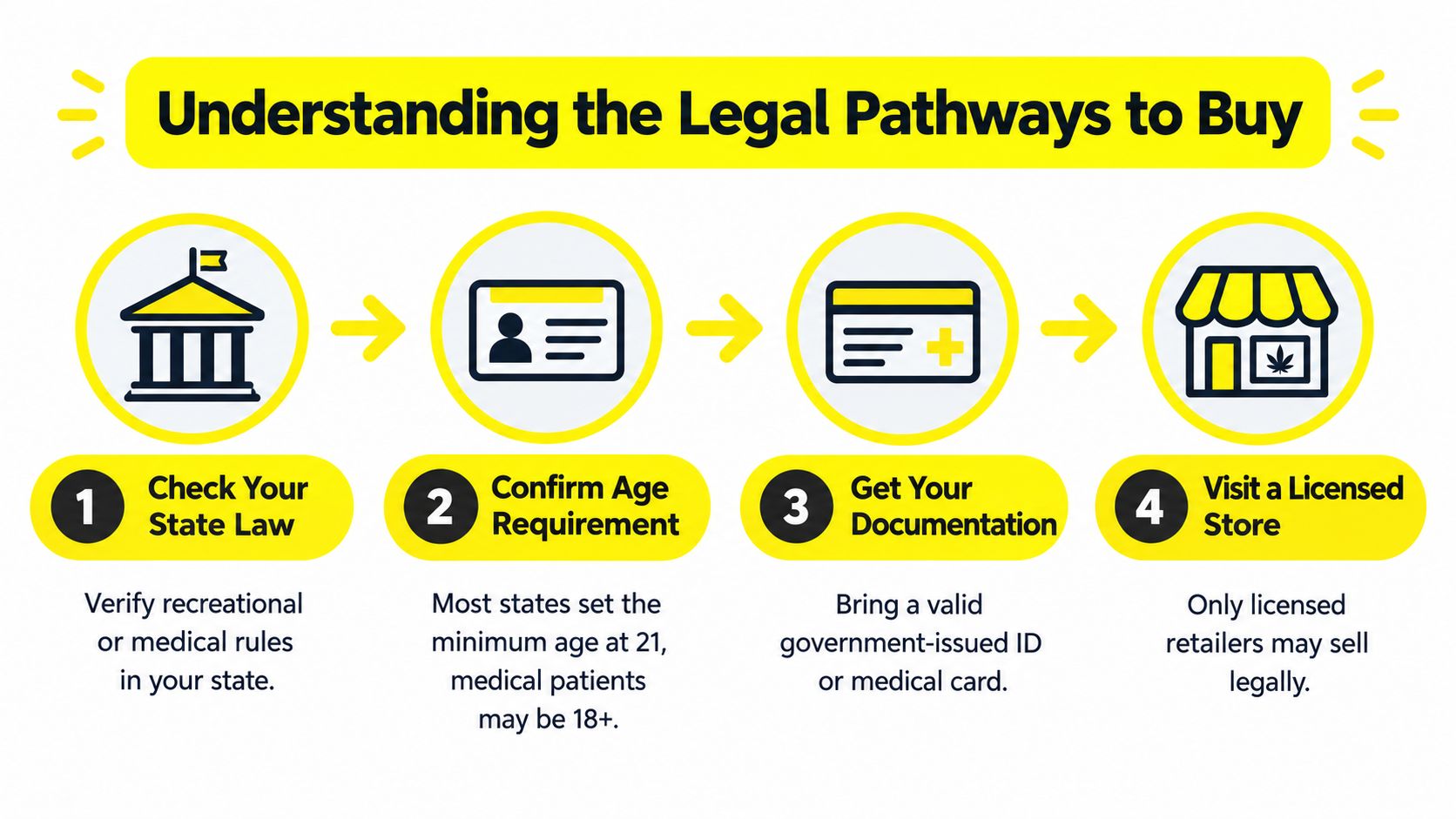
Understanding the Legal Pathways to Buy
The central question isn't “Which store is closest?” It's “Which registration path applies to me?” DC's access system recognizes residents and nonresidents, so a visitor shouldn't assume that crossing into the District automatically disqualifies them.
Path one for DC residents
If you're a DC resident, begin with the District's medical-cannabis registration process. Adults 21 and older may self-certify for medical use during registration. Younger patients need a practitioner recommendation, so age and documentation affect the process from the start.
Keep your government-issued identification available and follow the current registration instructions from the Alcoholic Beverage and Cannabis Administration, or ABCA. Don't rely on a map listing to tell you whether your registration is active. The retailer needs to verify your status before completing a compliant medical purchase.
Path two for visitors and out-of-state patients
ABCA accepts registrations from DC residents and nonresidents, and licensed retailers may accept medical registrations from most U.S. states, territories, and select tribal nations (ABCA medical-cannabis patient information). A patient traveling from Virginia or Pennsylvania may therefore have an access route, but should verify the current requirements before arrival rather than assume reciprocity is automatic.
A temporary registration detail deserves attention. In 2025, DC extended temporary registration validity from 30 to 90 days to reduce access gaps while applications are reviewed, according to the ABCA patient guidance linked above. The practical questions are whether you can apply before arrival, which identification is accepted, whether a temporary digital registration can be used immediately, and how long your approval remains valid.
Use this sequence:
- Confirm your category. Decide whether you're applying as a DC resident, nonresident, visitor, or minor patient.
- Check the current ABCA requirements. Rules and documentation can change, so don't rely on an old social post or an unverified storefront claim.
- Prepare identification and registration details. Have the documents needed for verification ready before you travel.
- Call or message the retailer if anything is unclear. Ask whether its licensed channel accepts your registration type.
The DC cannabis legalization and access guide can provide additional background, but your registration status remains the deciding factor at checkout. Proximity won't fix missing documentation.
Pickup, Delivery, and Where You Can Go
A dispensary can appear nearby on a map and still be inaccessible for delivery. DC delivery rules are tied to the patient's registration, address, quantity limits, and the retailer's license category, rather than just how close the driver happens to be.
The cited District delivery rules require the dispensary to confirm active enrollment in the DC Medical Marijuana Program, verify that the delivery address matches the registered home address, and keep the order within the patient's rolling 30-day limit of 4 ounces (District delivery and pickup announcement). Those rules also describe deliveries to residential addresses within DC during 11:00 a.m. to 7:00 p.m. The current ABCA internet-retailer guidance lists a broader 9:00 a.m. to 9:00 p.m. window for licensed internet retailers, which is why you should confirm the retailer's current license category and delivery terms.
Why neighboring addresses cause problems
Suppose you're staying in Arlington, Bethesda, or Silver Spring and a DC driver passes through your neighborhood. That doesn't mean a DC medical delivery can be completed there. A Maryland address may fail verification even if the store is only a short distance away, because the registered address and District delivery boundary control the order.
Pickup can be simpler for someone already traveling into the city. In-store or curbside pickup lets you place an order ahead of time, confirm availability, and reduce the time spent inside. It still requires the correct registration and identification, and the retailer may have its own arrival instructions.
Before ordering, check:
- Address match: Use the residential address connected to your registration when delivery rules require it.
- Patient verification: Keep your medical card or registration details available.
- Quantity: Review the rolling limit before combining a delivery with earlier purchases.
- Service type: Confirm whether the order is medical delivery, internet retail delivery, curbside pickup, or in-store pickup.
- Jurisdiction: Don't assume DC authorization extends to Arlington, Alexandria, Bethesda, Rockville, or another nearby community.
The dispensary delivery guide is useful for comparing local logistics, but the retailer should confirm current coverage before you submit payment. Delivery is regulated access, not an ordinary courier order.
Choosing Between Flower, Edibles, Vapes, and Topicals
A lot of first-time shoppers focus on strain names. Format usually matters more. If you are trying to avoid surprises on a DC dispensary visit, start by asking how fast the product will hit, how long it may last, and how precisely you can control the dose.
Inhaled cannabis usually becomes noticeable within minutes, peaks around 20 to 30 minutes, and tapers over roughly 2 to 3 hours. Oral THC usually begins after 30 to 90 minutes, peaks around 1.5 to 4 hours, and may last up to 8 hours (peer-reviewed pharmacokinetic review).
| Format | Onset Time | Duration | Dose Control | Key Safety Note |
|---|---|---|---|---|
| Flower | Within minutes | Roughly 2 to 3 hours | Adjustable inhalation, but not exact | Inhalation can feel strong quickly, so avoid driving or safety-sensitive tasks |
| Vapes | Within minutes | Roughly 2 to 3 hours | Convenient, but device and extract quality vary | Ask for batch testing covering contaminants, not only THC |
| Edibles | 30 to 90 minutes | Up to 8 hours | Measured serving when clearly labeled | Delayed onset makes taking more too soon a common risk |
| Topicals | Varies by product and use | Varies | Applied locally rather than measured as an inhaled dose | Don't assume a topical product has the same effects as an edible or vape |
Two common scenarios show why this matters. A patient looking for evening relief may choose an edible because the effect lasts longer, but the safer approach is still to start with the lowest labeled serving and wait several hours before taking more. Someone who wants a shorter window and more immediate feedback may prefer flower or a vape, while understanding that fast onset can also make overconsumption happen fast.
Edibles deserve extra caution. Oral bioavailability is estimated at about 6% to 10%, and absorbed THC is substantially converted into the active metabolite 11-hydroxy-THC, per the same pharmacokinetic review cited above. That helps explain why an edible can feel different and last longer than an inhaled product, even when the package seems to show a similar amount of THC.
Testing matters most for inhaled products
For inhaled products, potency alone is not enough. Heating extracts can generate ultrafine particles and degradation products including acrolein and methacrolein, which are respiratory irritants. Berkeley Lab researchers reported that these particles remained airborne in a chamber for at least three hours, and the same report describes contamination risks tied to solvents, formulation chemicals, and device hardware (Berkeley Lab emissions report).
That is why licensed-store testing matters so much more than menu hype.
For cartridges and concentrates, ask for a batch-specific certificate of analysis that covers residual solvents, pesticides, microbial contamination, and heavy metals. Check for a manufacturer, lot number, testing laboratory, ingredient list, and device compatibility details. An unlabeled or unsealed cartridge is a poor gamble, even if the THC percentage looks appealing.
If you want a practical product-by-product comparison before ordering, review this guide to edibles, vapes, and flower.
What to Expect Inside a Licensed Dispensary
You arrive with your ID ready, you know your registration status, and you have one practical goal: get a product you can use safely and legally. Inside a licensed DC dispensary, the process should feel orderly and documented, not rushed or vague. Menus matter, but for many first-time patients and visitors, the bigger questions are eligibility, product testing, and whether the package you leave with is clearly labeled and traceable.
The visit in four practical stages
- Check-in: Staff confirm your identification and medical registration before they discuss products or process a sale.
- Consultation: Tell them what outcome you want, whether that means evening use, lighter effects, avoiding impairment, or trying a format for the first time.
- Selection: Ask how much THC is in each serving, how much is in the full package, and whether the batch has testing documentation.
- Checkout: Review the order, package labeling, quantity, and receipt before you walk out.
A new patient at a U Street shop might say, “I want something manageable after work and I do not have much experience.” Good staff will slow the conversation down, ask when you plan to use it, and explain lower-dose options before pointing you toward stronger flower or concentrates. Product names like Blue Dream or Gelato can be a starting point, but they are not a substitute for clear guidance on dose, format, and expected effects.
Keep the package sealed, labeled, and easy to identify after purchase. That record matters if you ever need to show where the product came from or what quantity you bought. If staff cannot explain the difference between per-serving potency and total package potency, pause the purchase and ask again. Clear answers are part of a professional visit, and you can leave without buying.
For a practical walkthrough of how the first appointment usually feels, read this first-time dispensary visit guide.
Final Checklist Before You Visit
A successful search for a marijuana store near me ends with more than a street address. Before leaving home, confirm four things: eligibility, identification, quantity, and fulfillment method.
- Eligibility: Know whether you're using a DC registration, a nonresident registration, or another accepted medical pathway.
- Documents: Carry the identification and registration information the retailer needs to verify you.
- Limits: Check the applicable possession rule before combining flower, pre-rolls, and edibles. MPD describes a registered medical patient limit of 2 ounces, or 56 grams, while a separate DC statute establishes a maximum of 8 ounces of dried medical cannabis for a qualifying patient or caregiver. Because the provisions may apply differently, verify the current rule for your category before purchasing (MPD marijuana offenses document).
- Delivery or pickup: Confirm whether your address, registration, and selected service type qualify before placing the order.
For example, a patient who orders delivery to a Maryland address may receive a rejection despite being close to DC. Another patient may combine flower and edibles without checking how the applicable possession or equivalent-form rule treats the total. Keeping dispensary packaging and records makes the source and quantity easier to demonstrate.
Mr. Nice Guys DC serves customers across areas including Georgetown, Shaw, and surrounding DC and DMV neighborhoods, with options that can include in-store pickup, curbside pickup, and delivery. Check the current menu and service coverage before relying on any location or delivery claim.
Mr. Nice Guys DC offers medical cannabis products, online ordering, pickup, curbside service, and delivery options for patients comparing nearby access in Washington, DC. Visit Mr. Nice Guys DC to review current products, confirm service details, and get practical guidance before your dispensary visit.
Mr Nice Guys DC
At Mr. Nice Guys DC, we’re more than just a cannabis delivery service — we’re passionate advocates for quality, convenience, and community. With years of experience in the cannabis industry, our team is dedicated to educating and empowering customers across Washington, D.C. Whether you're a seasoned user or just starting your cannabis journey, our blog delivers trusted tips, product insights, and the latest updates from the world of weed. Stay informed, stay elevated.
