
Must Be 21 To Enter
By entering this site you are agreeing that you are at least 21 Years of Age or older.
I AM 21 OR OLDERGreater Goods DC: A Patient's Guide for 2026
.svg)

.png)
You're probably doing what a lot of DC shoppers do. You type in Greater Goods DC, open a few tabs, see Georgetown pop up, notice a menu mention here, a review there, and then hit the same wall. Is this a medical dispensary, a pickup-only shop, a delivery option, or something else entirely?
That confusion matters more than people think. If you're a patient trying to line up a legal, smooth purchase, vague listings waste time and can leave you guessing about basics like location, ordering, and what products are available. In DC cannabis, the details change the whole experience.
Your Search for Greater Goods DC Ends Here
A common scenario goes like this. A patient searches for Greater Goods DC because they've heard the name from a friend or seen it in a listing, then tries to confirm what they can do next. Can they order online? Can they get it delivered? Is the Georgetown location the right one?
What they usually find is partial information. One site confirms a storefront. Another hints at menu items. Another doesn't answer the practical question the shopper has right now, which is how to complete a compliant purchase without guessing.
That's where a local guide helps. If you're trying to sort through DC options, a broader overview of where to buy weed in Washington DC can save you from chasing stale or incomplete listings.
What most patients actually need
Most shoppers aren't looking for abstract cannabis education in that moment. They want a short list of answers:
- Exact location: Where is Greater Goods located?
- Order path: Can you walk in, reserve online, or schedule delivery?
- Product clarity: Are the menu categories clearly explained?
- Patient fit: Is this a medical setup, an adult-use setup, or a listing that leaves too much open to interpretation?
A practical example helps. If someone in Glover Park wants flower after work, pickup in Georgetown might be fine. If someone in Bethesda is managing a tight schedule or limited mobility, unclear delivery information becomes the deciding factor.
Practical rule: If a dispensary listing doesn't clearly explain how you get the product into your hands, keep digging before you build your order around it.
That's the main issue with Greater Goods DC searches. It's not that nothing is available. It's that the publicly visible information often doesn't answer the operational questions patients care about most.
Understanding the Greater Goods Profile
Publicly available listings point to Greater Goods Georgetown at 1251 Wisconsin Ave NW in Georgetown, which is confirmed on Yelp and AllBud. For someone searching “greater goods dc,” that's the key starting point because it ties the name to a specific neighborhood and storefront identity.
What's clearly known
The Georgetown location is the most concrete part of the profile. If you're trying to verify whether Greater Goods is a real DC retail presence and not just a floating directory entry, that address gives you a fixed point.
Listings also suggest a cannabis retail operation with menu-style browsing and ordering interest from patients and shoppers. That's enough to place Greater Goods inside the DC cannabis conversation, but not enough to resolve every operational detail.
A useful way to think about it is this. Public listings tell you where the store is and that cannabis products are part of the offering. They don't always tell you how transparent the shopping experience will be once you move from browsing to buying.
Why menu language matters
Experienced shoppers slow down and read carefully. A dispensary can look polished at first glance, but if the menu language is broad or the product categories feel loosely described, patients can end up with avoidable confusion.
That's especially true when comparing formats like flower, vapes, edibles, tinctures, and concentrates. If you're newer to shopping, even understanding how aroma and expected effects differ can help. A quick read on what terpenes in weed actually mean gives useful context for evaluating any menu, not just one store.
Good dispensary information does two things at once. It shows what's available, and it helps the shopper understand what those categories mean in practice.
A grounded read on Greater Goods
Greater Goods appears to have a recognizable Georgetown footprint and enough visibility online that patients keep searching for it by name. That usually signals genuine interest. It also tells you there's demand for clearer answers than the current listings provide.
A practical example. If you're near Georgetown and only need in-store pickup, the existing public profile may be enough to get you started. If you need certainty around service areas, medical rules, or unusual product claims, the public profile leaves more unanswered.
Product Offerings and Patient Requirements in DC
A common Georgetown shopping scenario goes like this. Someone finds a menu or directory listing, sees familiar cannabis categories mixed with references that sound outside standard DC dispensary retail, and assumes the store covers all of it. That is where confusion starts.
The Greater Goods question is not just about what they carry. It is about whether the public-facing product language gives patients enough clarity to order with confidence. Based on the listings patients usually find first, that answer still looks mixed.
The product confusion to watch for
Some public listings tied to Greater Goods mention standard cannabis products, while also referencing items like “magic mushrooms” and “chocolates” without much explanation or legal framing, including on the Greater Goods Georgetown AllBud listing. For patients, that creates a practical problem. A menu should help you decide what to buy, how to dose it, and whether it fits DC rules. If the wording raises extra legal questions, the listing is doing less of the work it should.
That matters because DC cannabis patients are often trying to solve a specific need fast. Better sleep. Less pain. Lower anxiety. They do not need vague product language standing between them and a clean purchase.
If a listing mixes ordinary cannabis categories with unclear claims, verify the product type and the store's rules before you spend time building an order.
What patients should actually expect to shop for
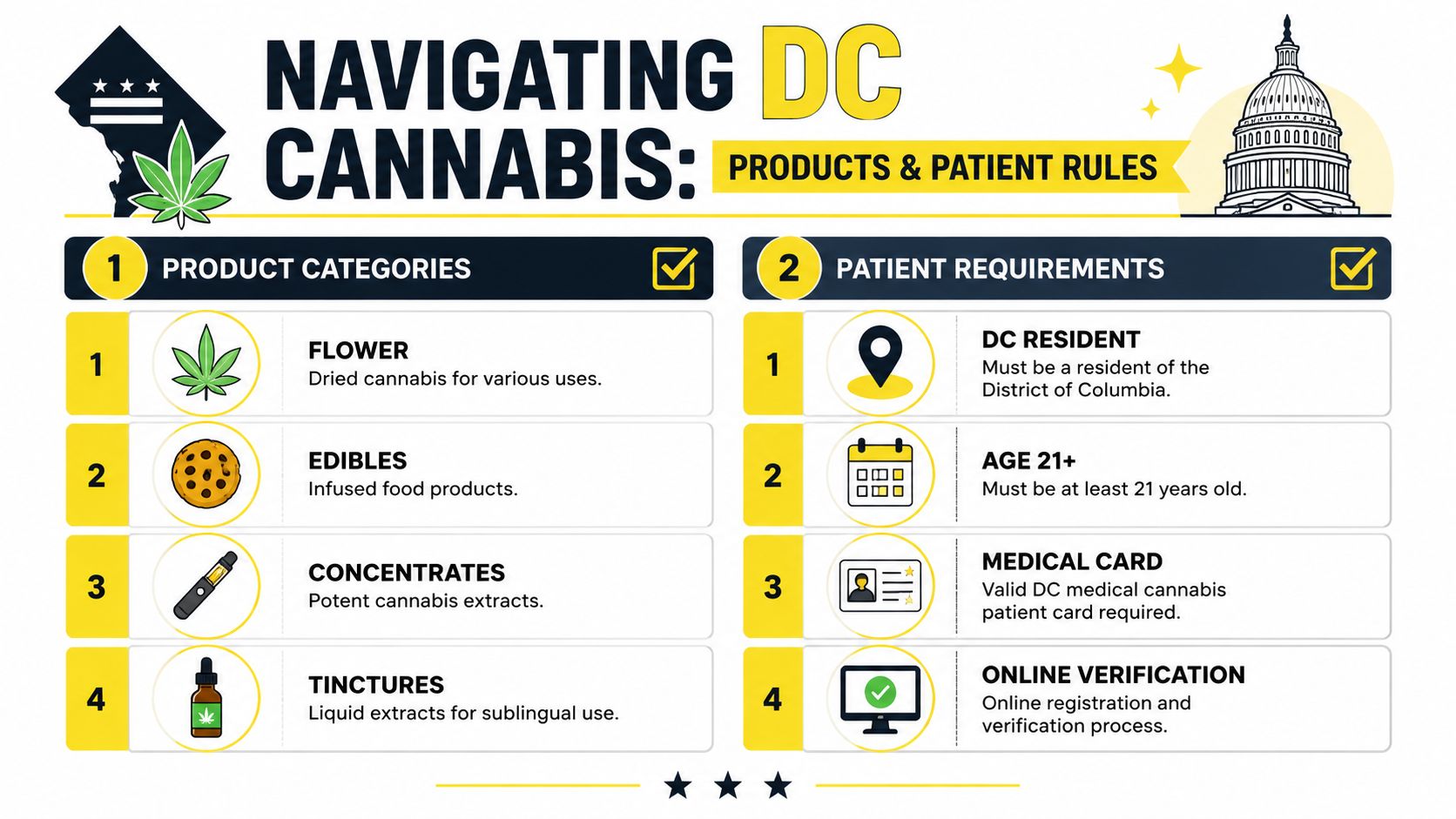
The usable product categories in DC are usually straightforward:
- Flower: Best for shoppers who want strain choice, terpene variety, and flexible dosing.
- Edibles: A good fit for patients who prefer longer-lasting effects and do not want to inhale.
- Concentrates: Higher potency products that make more sense for experienced consumers.
- Tinctures and topicals: Useful for patients who want options beyond smoking or vaping.
In practice, clear labeling matters more than a long menu. A patient comparing flower to vapes is usually deciding on onset time and convenience. A patient comparing gummies to tinctures is usually deciding on duration, dose control, and how predictable the experience will be. Good dispensaries explain those trade-offs plainly.
That is a key difference patients notice when comparing stores. A broad listing can attract attention, but transparent category descriptions help people buy correctly the first time. Mr. Nice Guys DC tends to be stronger on that point because the shopping path is easier to understand.
The patient requirement that still trips people up
Eligibility is where many DC shoppers lose time. Some stores are medical-only, and patients do not always realize that until checkout.
If you are ordering from a medical dispensary in DC, you need to meet the patient verification rules for that business. That usually means having your registration and ID ready before purchase. If you need a clean explanation of the paperwork, age rules, and what to have prepared before ordering, review the medical card requirements in DC.
This is another area where transparency matters. Patients should not have to piece together eligibility from scattered directory listings, vague menu notes, and third-party summaries. The better approach is simple. State who can shop, what documents are required, and what product types are available.
What works and what does not
What works is clear product scope, clear patient eligibility, and menu language that matches what the store can fulfill.
What does not work is a public profile that leaves patients guessing about whether a product is standard cannabis, whether it fits DC rules, or whether they are even eligible to complete the order. That uncertainty is a real disadvantage for Greater Goods, and it is one reason many patients end up choosing a more direct option like Mr. Nice Guys DC.
The Critical Difference in Ordering Delivery vs Pickup
You finish a long day, open a dispensary menu, fill your cart, and then hit the question that decides everything. Can this order get to you, or do you need to go get it yourself?
That distinction matters more than patients expect. Pickup is straightforward if you are already near the store and can make the trip on your own schedule. Delivery matters when getting across DC is the hard part.
Why pickup is often easier to confirm
Pickup usually creates fewer surprises. The store lists a location, you place the order, bring your ID and registration, and complete the transaction in person.
For a patient who works near Georgetown or is already running errands nearby, that can be the fastest option. A basic storefront profile may be enough if the goal is to reserve and collect an order.
Delivery requires more than a menu and an address. Patients need to know whether their neighborhood is covered, how orders are placed, and whether the dispensary clearly offers that service at all.
Where Greater Goods creates hesitation
This is the point where Greater Goods tends to lose clarity. Public-facing information appears to confirm in-store pickup, but delivery details are harder to verify from the same sources. The Yelp listing for Greater Goods Georgetown supports the pickup side of the process, yet it does not give patients a clear, complete delivery framework they can rely on before ordering.
For patients who depend on home delivery, that gap matters. It leads to extra calls, abandoned carts, and wasted time.
Practical rule: Confirm fulfillment first. Check whether the dispensary serves your address and whether the order is pickup only before comparing products or pricing.
Questions that save time
Patients usually get better answers when they ask direct operational questions:
- Delivery zone: Do you deliver to my exact neighborhood?
- Ordering method: Do I place a delivery order online, by phone, or both?
- Timing: Are delivery windows listed clearly, or confirmed after checkout?
- Eligibility workflow: Is the process the same for every patient, or are there separate steps depending on status?
- Menu accuracy: Does the online menu clearly separate pickup from delivery availability?
Patients should not have to infer any of that from vague "order online" language.
If you want a cleaner example of what a clear process looks like, this guide to how weed delivery works in Washington DC explains the ordering flow in plain language.
The real trade-off
Pickup gives you more control over timing. Delivery gives you access when distance, mobility, traffic, or schedule makes in-person shopping unrealistic.
In practice, the better dispensary is the one that states the rules plainly. If a shop clearly confirms delivery coverage, ordering steps, and expectations, patients can buy with confidence. If public information only supports pickup, treat delivery as unconfirmed until the dispensary verifies it directly. That is one reason Mr. Nice Guys tends to be the more reliable choice for patients who want fewer assumptions in the ordering process.
Greater Goods vs Mr Nice Guys A Clear Comparison
A patient in Georgetown and a patient in Rockville can both be shopping for flower, but they are solving different problems. One may just want a nearby counter and a fast pickup. The other may need clear delivery coverage, a menu that explains what is available, and fewer unanswered questions before checkout.
That practical difference matters more than branding.
What matters in a real comparison
Patients usually get the best read on a dispensary by checking a short list of things that affect the actual purchase:
- Confirmed storefront information
- Clear explanation of who can shop
- Straightforward ordering steps
- Public clarity on delivery availability
- Product categories that are easy to understand
- Useful support for patients who do not want to guess
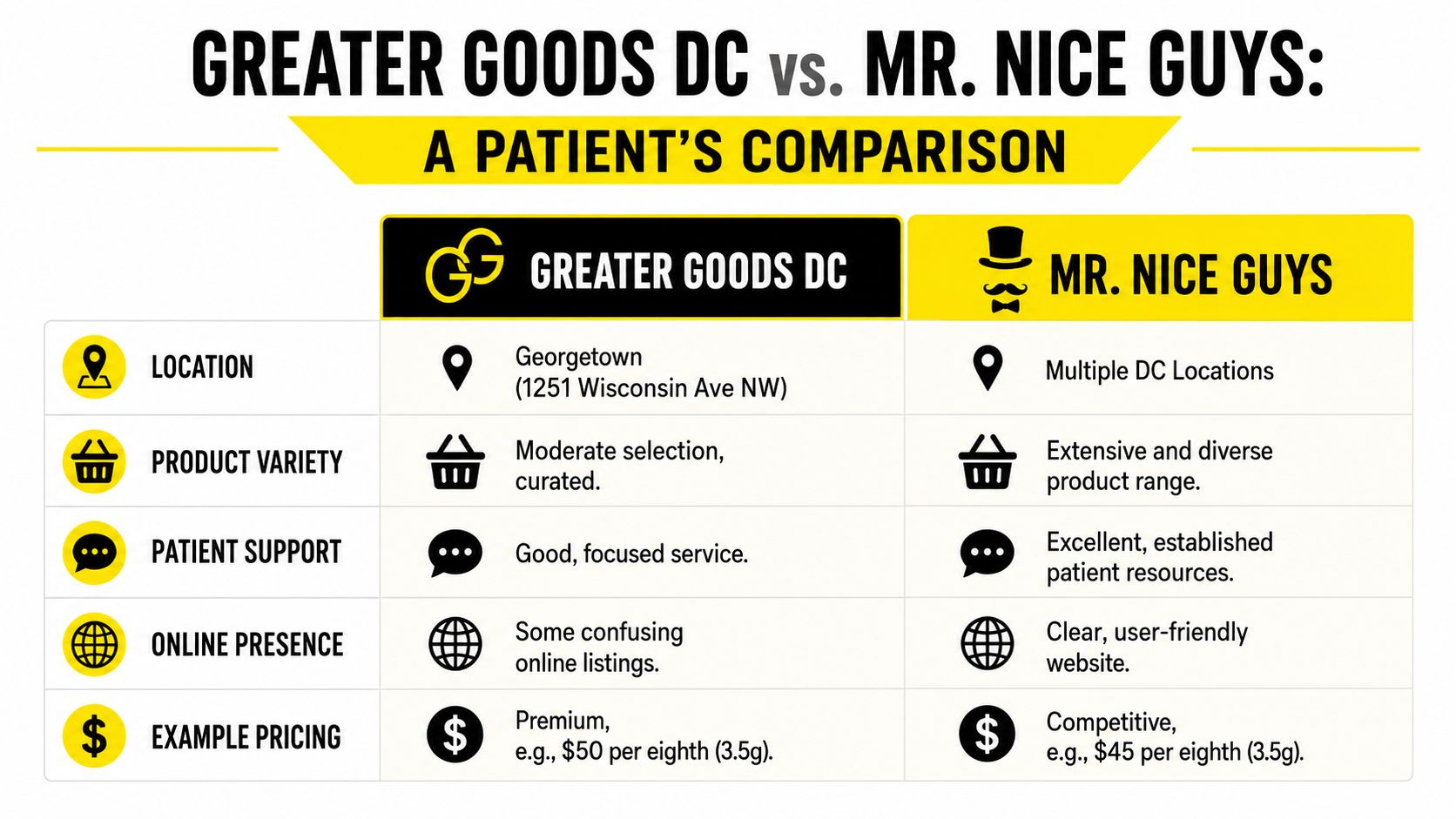
That standard puts Greater Goods and Mr. Nice Guys in different lanes. Greater Goods looks more workable for someone focused on a known storefront in Georgetown. Mr. Nice Guys fits better when the patient wants a clearer operating process and broader day-to-day usability.
Dispensary feature comparison
| Feature | Greater Goods DC (Based on Public Info) | Mr. Nice Guys DC |
|---|---|---|
| Confirmed location | Georgetown at 1251 Wisconsin Ave NW | Licensed medical dispensary in Logan Circle at 1470 Church St NW, with its license information publicly listed on the Leafly dispensary profile |
| Public ordering clarity | Storefront and pickup details are easier to confirm than delivery specifics | Ordering flow and service options are explained more directly through public-facing materials |
| Delivery confidence | Public information discussed above does not clearly confirm nearby delivery service | Public materials discussed earlier present delivery as part of the service model, which gives patients more to work with before they order |
| Product scope | Public listings suggest standard cannabis retail categories, but the presentation can create avoidable confusion | Menu coverage includes common categories such as flower, edibles, vapes, pre-rolls, concentrates, topicals, and tinctures, as shown in this overview of available cannabis products at Mr. Nice Guys DC |
| Support style | Better suited to shoppers who are comfortable verifying details on their own | Better suited to patients who want clearer guidance and fewer assumptions during the buying process |
What the difference looks like on the ground
For a simple neighborhood pickup, Greater Goods may be enough. If the address is convenient and the shopper already understands the rules, that can work.
The gap shows up when the order is less straightforward. Patients comparing shops often want to know more than where the storefront sits. They want to know whether the menu is easy to read, whether the shop clearly serves their type of patient status, and whether the ordering process answers basic questions before money changes hands. Mr. Nice Guys tends to perform better on that kind of practical clarity, which is why it is often the safer recommendation for patients who do not want to piece the process together themselves.
Here is the simple test I use. If a patient has to infer too much, the shop has not explained enough.
A better way to compare DC dispensaries
Use these questions:
- Can I tell who the shop serves without digging through multiple pages?
- Can I see the product types clearly enough to shop with confidence?
- Can I confirm whether my order is pickup-only or eligible for delivery?
- Can I understand the process before I start the order?
If one shop answers those questions faster and more clearly, that shop is usually the better choice. For a broader breakdown of that standard, read how Mr. Nice Guys DC compares to other weed shops in D.C..
Clear policies, readable menus, and direct patient guidance make a dispensary easier to trust.
Practical Tips for Every DC Cannabis Patient
You place an order on your lunch break, assume delivery works one way across the city, and then hit a delay because your ID, patient registration, or order type does not match the shop's process. That is a common DC problem. It is also avoidable.
The patients who have the easiest experience usually do four things well. They confirm their status before ordering, stick to products that fit their routine, check the shop's fulfillment rules, and ask direct questions early. That matters even more when comparing a shop like Greater Goods with Mr. Nice Guys, because the biggest difference is often not the product itself. It is how clearly the process is explained before you commit.
Bring the right documents
Patients lose time at the door for simple reasons. Missing ID. Expired registration. Wrong assumption about whether a shop is serving medical patients only.
Before you leave home or confirm delivery, make sure your identification and patient credentials match the dispensary's requirements. If a store is less explicit about who it serves or what it needs at handoff, slow down and verify first. Shops that explain this clearly save patients a lot of frustration, which is one reason Mr. Nice Guys tends to be the easier recommendation for people who want fewer surprises.
Read product labels like a regular patient, not a chemist
A good purchase starts with fit, not hype.
Use this order when you shop:
- Start with format: Flower, edible, vape, tincture, and concentrate all suit different situations.
- Check potency: Higher THC is not automatically a better experience.
- Track repeat winners: If a certain gummy, cartridge, or strain worked for you, write it down and buy smarter next time.
Patients who keep simple notes shop better over time. Brand, dose, and timing tell you more than package design ever will.
Know the purchase limit before you build a bigger order
Limits matter most when you mix categories. A patient may build an order that looks reasonable, then learn at checkout that the combination pushes past what the system can process under DC rules.
If you are unsure, use the primary source. The District's medical cannabis rules are published by DC Health in the medical cannabis program regulations. Ask the budtender to review your total before payment if you are combining flower, concentrates, or multiple high-dose items.
That one question can save a reorder.
Ask better questions in-store or on the phone
“The best strain” is not a useful question. A better question gives the budtender a job they can do well.
Try prompts like these:
- For daytime use: “What flower is less likely to slow me down?”
- For discretion: “Which vape option works well for short, controlled sessions?”
- For longer-lasting effects: “Which edible is easiest to dose carefully?”
- For smoke-free use: “What would you suggest for a beginner using tinctures or topicals?”
Specific questions usually get specific answers. That is also where transparent shops separate themselves. If the staff or menu makes it hard to tell what is available, ordering gets harder than it needs to be.
For a quick visual walkthrough on medical cannabis basics, this overview helps:
Make first-time delivery easier on yourself
Delivery in DC is where confusion shows up fast, especially for patients comparing Greater Goods with Mr. Nice Guys. The smart move is to keep the first order simple and confirm the handoff rules before the driver is on the way.
Use a short checklist:
- Start with a smaller order: Save the large mixed cart for later.
- Keep your phone on: Delivery issues usually come down to missed calls or missed texts.
- Set out your documents early: Do not start looking for them at arrival.
- Choose products you already understand: First delivery is a poor time to test every category at once.
I usually tell patients the same thing. Your first order should answer process questions, not create new ones. If a dispensary explains delivery coverage, menu categories, and verification steps clearly, the whole experience goes smoother. That is where Mr. Nice Guys has an advantage. Patients can tell what they are ordering and how they will receive it without piecing together the rules themselves.
Mr Nice Guys DC
At Mr. Nice Guys DC, we’re more than just a cannabis delivery service — we’re passionate advocates for quality, convenience, and community. With years of experience in the cannabis industry, our team is dedicated to educating and empowering customers across Washington, D.C. Whether you're a seasoned user or just starting your cannabis journey, our blog delivers trusted tips, product insights, and the latest updates from the world of weed. Stay informed, stay elevated.
