
Must Be 21 To Enter
By entering this site you are agreeing that you are at least 21 Years of Age or older.
I AM 21 OR OLDERDo You Tip Budtenders? How Much and When to Tip


Tipping a budtender is optional, and the normal range is a flat $2 to $9, with most customers landing in the middle of that band. The prompt on the card reader is an offer, not a bill, and declining it needs no explanation.
You know the moment. The terminal swivels toward you with 15, 20 and 25 percent buttons lit up, your card is already in the slot, and the line behind you can hear the machine thinking. Two seconds to answer a question that feels like a test you didn't study for. What settles it is a single idea: you're paying for minutes of attention and for expertise, never for the size of the receipt. A $45 eighth and a $180 gift bundle can justify the exact same five dollar bill when both took five minutes at the register.
The Short Answer on Tipping Budtenders
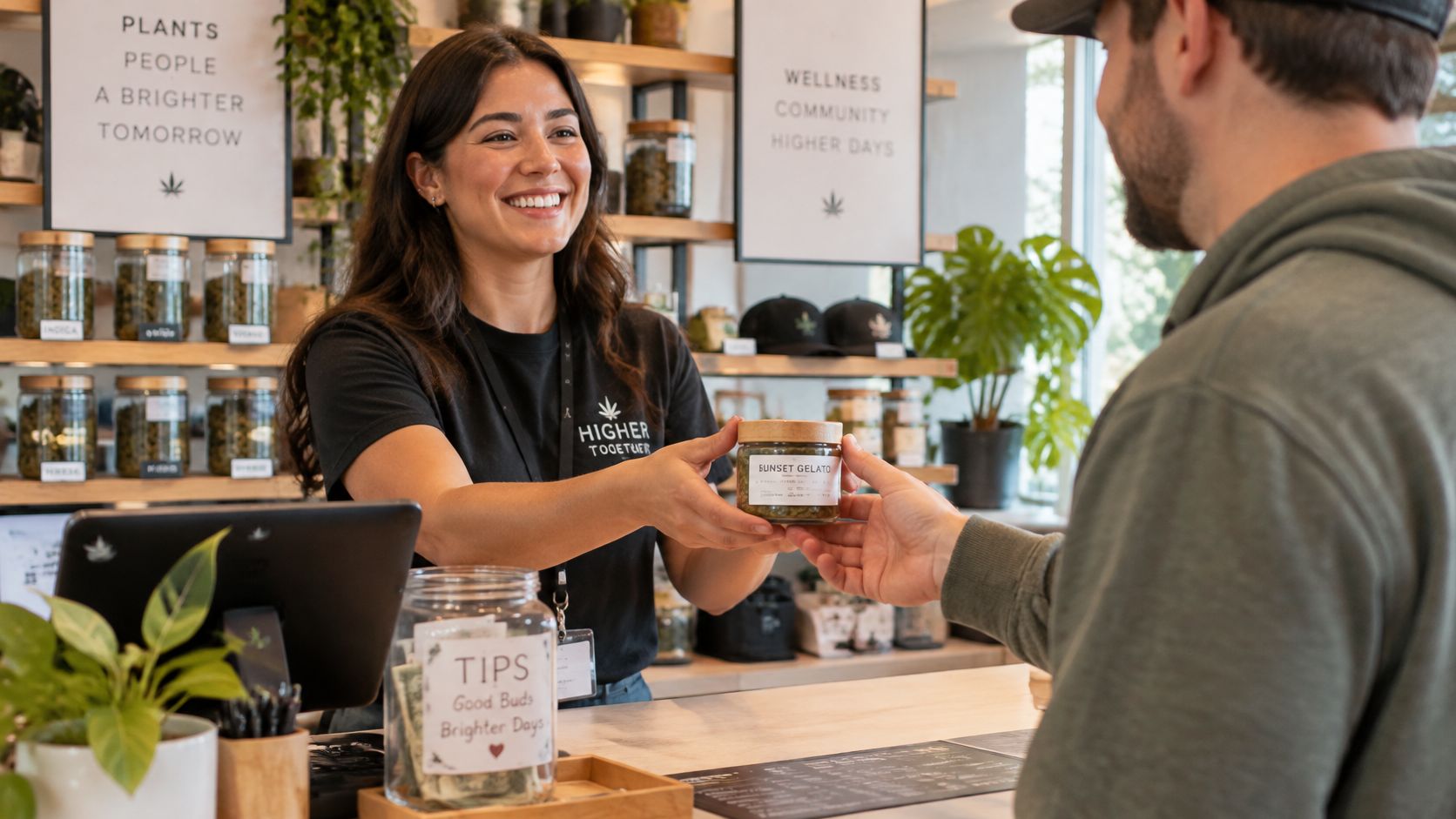
A friendly handoff at the counter is where most of this anxiety starts, and it's also where it ends.
Plenty of customers tip, but the shape of that tipping isn't what the checkout screen implies. In Flowhub's survey of more than 1,300 cannabis customers and professionals, 37.9% named $5 to $9 as their typical budtender tip, making it the largest single answer. Another 26.6% typically tipped $2 to $4, 18.7% used a percentage of the purchase, and 11.6% reported tipping $10 or more. Just 0.5% said they don't tip at all, while 1.7% said their dispensary doesn't accept tips. Add the two largest dollar brackets together and 49.5% selected at least $5, which puts flat amounts well ahead of restaurant-style percentages.
What that survey does and doesn't prove
It's directional evidence, not a rulebook. Participation came through one industry survey, and tipping policies shift by store and by jurisdiction, so treat the numbers as a picture of habit rather than a legal standard. The same source notes that the word "budtender" dates to 1997 and was modeled on "bartender," which explains the reflex to tip like you're at a bar even though the pay structure behind the counter is different.
For a Washington, DC customer, the practical guidance is simple. Roughly $2 to $5 for helpful routine assistance, and $5 or more for substantial education or personalized service. If you've never been through a dispensary before, the first-timer's guide to a dispensary visit covers the flow of the room before you ever reach the terminal.
The one decision to make: pick your number in the car, not at the counter. Whatever you choose, choose it before the screen flips around.
How Much to Tip a Budtender by Situation
The table below covers the situations a DC customer walks into, from a bag you pre-ordered to a full walkthrough on a first visit. Find your row, then read the three anchors underneath so you understand why the numbers sit where they do.
| In-store situation | Suggested tip | What the tip pays for |
|---|---|---|
| Pre-ordered pickup bagged in under five minutes | $0-$1 | Speed and accuracy, no consultation |
| One or two questions about a product you already chose | $1-$3 | A short assist at the register |
| Budtender matches products to an effect like sleep, pain or anxiety | $2-$4 | Ten to fifteen minutes of comparison |
| First visit with a walkthrough of flower, edibles, vapes and topicals | $5-$10 | Education across formats and doses |
| Extended medical consultation or caregiver questions | $5-$10 | Dose guidance and paperwork questions |
| Large edible or gift bundle pre-ordered online | $5 flat, not a percentage | Basket size is not extra labor |
| Regular with a standing order and a two-minute exchange | $0-$2, an occasional $5 | Relationship rather than every visit |
| Patient working to a fixed monthly budget | $0-$3 | Access and advice are never gated by a tip |
The three anchors behind every row
A tip is a bonus, rarely expected, and never a condition of sale. Independent etiquette guidance describes gratuity as discretionary, and Washington State's regulatory interpretation allowed tipping only where it could not be required, tied to product price, or used to work around cannabis excise taxes, as reported by Cannabis Etiquette's guide to tipping budtenders. Treat the transaction price and any disclosed service or delivery fee as the complete required cost.
Effort sets the number, not the subtotal. A rapid, self-directed purchase can get nothing. Product matching runs about $2 to $4. An extended first-time or medical-oriented consultation runs roughly $5 to $10.
Tip on the pre-tax subtotal and round to the next dollar. That keeps the arithmetic trivial when a line is waiting.
Two edges worth naming
A $180 gift bundle pre-ordered online still lands near $5, not $30, because nobody carried thirty dollars' worth of extra labor to the shelf. And a patient on a fixed wellness budget can tip nothing and still receive the same advice, the same recommendation quality and the same access. Tipping should never influence product access, queue position or compliance procedures.
Ask once per store whether tips are pooled and how electronic tips are distributed under the written policy. Then pick the number from the minutes spent, not the total rung up.
Why Flat Dollars Beat Percentages at the Counter
The percentage button is the wrong instrument for this room, and the earliest reporting on the practice already showed it. A 2017 report built on an unscientific survey of Spokane-area budtenders found that roughly 25% to 50% of customers left a tip depending on the retailer, that every retailer contacted kept some form of tip jar, and that typical tips ran about $3 to $5, according to the Spokesman-Review's reporting on budtender tipping. Workers described no consistent formula tied to purchase price, service level or minimum amount, and one budtender guessed about half of customers tipped, usually under $5.

That survey was local and explicitly unscientific, so treat the 25% to 50% range as an early market snapshot, not a national average. Its real value is the detail about how the money was chosen: by feel, in dollars, without a formula.
The arithmetic that settles the argument
Run the percentages on two orders that take the same five minutes at the register. 18% on a $45 eighth is about $8. 18% on a $180 edible haul is about $32. Same conversation, same bagging, same queue, and the suggested tip moves $24 for no added labor. The percentage isn't measuring the work. It's measuring the basket.
A restaurant server's income depends on the bill, which is why percentage tipping makes sense at a table. A budtender's doesn't work that way.
The replacement rule
Choose a band before the screen turns: $0 to $1 for a grab-and-go bag, $2 to $5 for genuine product help, $5 to $10 for a long consultation. Dollars are also easier to read at a glance, on both sides of the counter, and a predictable thank-you lands better on a shift than a percentage nobody can predict.
When a Tip Recognizes Time and Not a Wage
Here's the guilt, said out loud: if budtenders already earn an hourly wage, why does a screen ask for 20%? A neutral California workforce study answers part of it. Cannabis workers earned a median $19.50 per hour, retail workers earned slightly less than cultivation and delivery workers, and the report found tips were an important supplement for retail employees, per the UCLA Labor Center study published by California's cannabis agency. That explains why the prompt exists. It doesn't turn the prompt into a bill.
The useful distinction is between education and fulfillment. Education begins when the budtender asks what you're trying to solve, whether that's pain relief, sleep, or anxiety support, before anything comes off the shelf. That's how the team at Mr. Nice Guys DC works, and it's the moment the clock starts. Comparing a tincture's onset against an edible's, walking a first-timer through dose and format, untangling a caregiver's questions about paperwork, that's expertise spent on your specific situation.
Handing over a bag you ordered online is fulfillment. Fast, accurate, skilled in its own way, and not something you owe extra for.
The ten-second test at the counter
Ask one question before you tap: did someone spend minutes on my specific needs, or did they hand me a bag? Minutes get a few dollars. The bag gets a dollar or nothing.
Two rules that never bend. A tip never buys access, queue position, or a better recommendation. And no patient should tip with money they need for medicine.
If the answer to "do you tip budtenders" were ever going to be yes, it's for a real consultation. A few dollars, sized to the minutes, is the whole answer. The people on the other side of that counter have careers built on product knowledge, and recognition for it is a courtesy, not a fee.
Tipping on Delivery, Curbside and Card Prompts
Modern orders split the work across different people, and the tip should follow whoever did it. A delivery may involve an order taker, a fulfillment worker who bags it, and a driver who fights traffic. A curbside order moves through a bagger and whoever walks it to your window. Tipping the same flat amount in every case ignores what happened.
Delivery is about conditions, not subtotal
Set delivery amounts by distance, weather and accessibility. A short in-city drop is a few dollars. A long run in bad weather earns more. The widely repeated 15% to 20% delivery advice misfires badly on a $200 order where nothing extra happened, because the driver's work didn't grow with the subtotal, a gap Weedmaps' budtender tipping etiquette guide points out when it separates service labor from basket size.
Curbside is simpler. A staffer carried your order out, so $2 to $3 fits a normal handoff.
When the machine asks before the service happens
Cashless terminals often present the prompt before the service is finished, which is awkward for everyone. If the screen has no tip field, or you have no cash on you, skipping it isn't rude. Cash remains the simplest route when you can manage it. Mr. Nice Guys DC accepts cash and debit cards and keeps an ATM in the dispensary, so a card-only customer can still leave something in a jar.
| Transaction | Who did the work | Suggested tip | What to check |
|---|---|---|---|
| Online order collected in store | Fulfillment staff who bagged it | $1-$2 | Whether pickup tips reach the bagger or the shift pool |
| Curbside handoff | Staffer who walked it out | $2-$3 | Whether curbside staff share in the pool |
| Delivery, short city run | Driver | $3-$5 | Whether the driver keeps the whole tip |
| Delivery, long run or bad weather | Driver | $5-$10 | Whether delivery tips are shared with fulfillment staff |
| Card prompt at checkout | The store rather than the person | Skip it and tip cash if you prefer | The store's written tipping policy |
The question that decides where your money lands: is this pooled, and who shares it? Ask once. Pooling policy belongs to the store, and it's fair to expect a straight answer.
If you order curbside often, the curbside pickup and delivery guide covers timing and handoff expectations. A tip follows a person's effort, and knowing who touched the order is half the decision.
Three Real Transactions and What to Tip
Numbers get abstract fast, so here is what the same decision looks like on three different receipts.
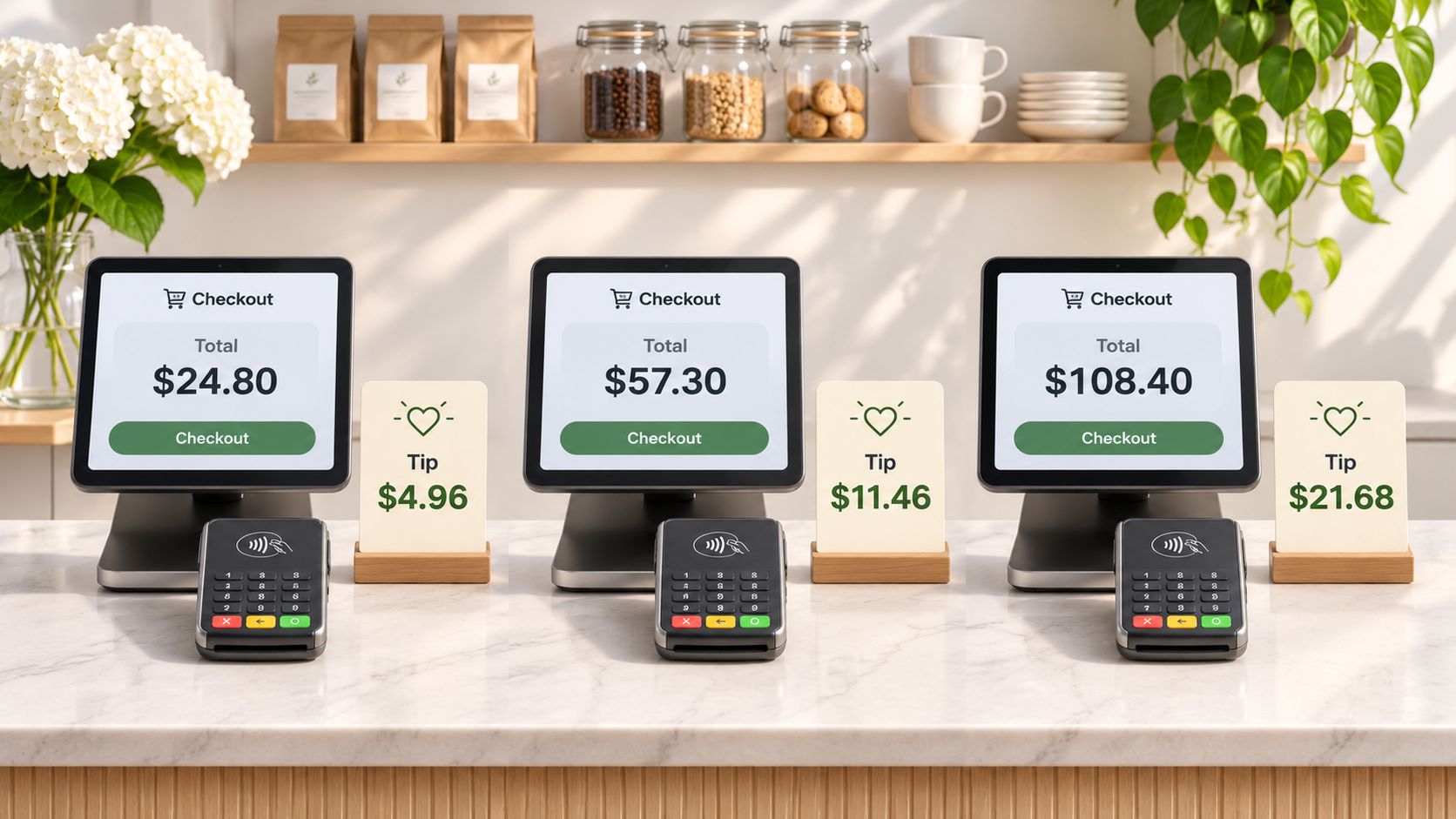
The first-timer. Twenty minutes comparing tinctures and edibles for sleep, questions about onset and dose, a couple of formats pulled down for a closer look. The order lands at $62 and the tip is $6 to $8. That is roughly 10% to 13%, but the framing matters more than the percentage: it is payment for twenty minutes, and the receipt is incidental.
The regular. An online order for one eighth, in and out in four minutes, $45 total. Tip $0 to $2, and nobody behind the counter blinks. If that same eighth turns into fifteen minutes of strain comparison and storage advice, it can justify the same $5 as a much larger order, because the labor changed even though the product did not.
The gift run. A $180 bundle of pre-rolls and specialty edibles ordered for pickup, bagged in five minutes with one question answered. Tip $5 flat, not the $27 a 15% prompt would suggest. The labor was five minutes of fulfillment, and the buyer's budget for the gift has nothing to do with it.
Look at what moved the number in every case: minutes of attention and the difficulty of the ask. Never the subtotal, never the strain, never the size of the bag. If you want to see how much of a difference informed staff make to the visit, the dispensary customer experience breakdown is worth ten minutes.
Decide Your Number Before the Screen Flips
Set the tip while you are still ordering, before the reader offers 15, 20 and 25 percent on a sale that may have taken ninety seconds. I treat it as a labor decision: how many staff minutes went into the visit, and whether anyone used judgment to narrow the menu. A grab-and-go pickup is a dollar or nothing. A real product match is two to four. A first-time or medical consultation is five to ten.
Ask once, early, whether tips are pooled. Pooling is the store's policy to explain, and the bagger, driver and budtender do not automatically keep the same dollar you hand over. In-store and curbside pickup are available at all locations, so choose the transaction type before you arrive, then choose the number before the prompt appears.
If the card prompt is the part that throws you, read how card payment works at this dispensary before you go.
If no service was given, there is nothing to tip, and that is a complete answer.
Most of the anxiety around do you tip budtenders evaporates once the number is chosen in advance. A heavy bag and a quick eighth can earn the same few dollars when the counter time was the same. The only wrong move is paying a figure you never intended because a screen asked at the worst moment.
Mr. Nice Guys DC pairs a curated menu of flower, edibles, vape cartridges, concentrates, pre-rolls, topicals and tinctures with staff who will spend the minutes that earn a tip. Order for in-store pickup, curbside, or delivery across DC and nearby Maryland and Virginia neighborhoods, and pay by cash or debit, with an ATM on site. Visit Mr. Nice Guys DC before your next pickup and let the team match the product to the effect you're after.
Mr Nice Guys DC
At Mr. Nice Guys DC, we’re more than just a cannabis delivery service — we’re passionate advocates for quality, convenience, and community. With years of experience in the cannabis industry, our team is dedicated to educating and empowering customers across Washington, D.C. Whether you're a seasoned user or just starting your cannabis journey, our blog delivers trusted tips, product insights, and the latest updates from the world of weed. Stay informed, stay elevated.
