
Must Be 21 To Enter
By entering this site you are agreeing that you are at least 21 Years of Age or older.
I AM 21 OR OLDERDiscreet Delivery in DC: What Stays Private


Discreet delivery limits who sees the package and the product name, while DC rules still require a licensed courier and an ID match before anything changes hands. You're standing in a shared lobby, a neighbor is checking mail two feet away, and your phone lights up with an arrival notice. You don't need secrecy from the law. You need a plain bag, a quiet message, and a handoff that doesn't turn into a hallway conversation.
What Discreet Delivery Actually Protects
A courier steps into your lobby holding a small bag. A neighbor glances over. Your worry isn't dramatic. It's specific. Will a logo show? Will the courier say a product name out loud? Will a text on your lock screen announce what's inside?
That's the job of discreet delivery. It keeps your identity, address, and contents from being shown to anyone who doesn't need them to complete the sale. Think of a plain pharmacy bag, not an unmarked dead drop. The outside looks ordinary. The seal stays closed. The courier still confirms who's receiving it.
The idea has older roots than cannabis shops. The U.S. Postal Service privacy policy FAQs describe personal information as something to collect only when specifically and knowingly provided, limited to what's necessary, and not disclosed to third parties without consent except to facilitate a transaction, act at your request, or comply with law. The same federal framework treats the mailpiece itself, including its cover, recipient information, and contents, as protected information.
Three moments decide how private it feels
- The outer package: It either looks generic or advertises what's inside.
- The arrival message: It either gives a time window or names the product.
- The handoff: It either happens with the adult who ordered or fails because someone else is home.
In Washington, DC, medical cannabis delivery runs through a licensed courier who checks identity and age and may not leave the order unattended at a door. If you want the check itself explained step by step, our guide to the age verification process walks through what the courier confirms.
Discretion shrinks the audience. It doesn't erase the check.
Privacy From Checkout to the Door
A delivery can look ordinary from the hallway while still being traceable to the person who ordered it. Discretion limits who sees the package and product details. It does not make a regulated cannabis order anonymous.
| Moment | Stays low-profile | Still required |
|---|---|---|
| Outer package | Plain opaque bag with no cannabis branding on the outside | Sealed package with dispensary labeling |
| Arrival message | Time window without product or strain names | Confirmation goes to the account holder |
| Vehicle | Product concealed from outside view | Courier and order remain accountable |
| Doorstep | Direct handoff, nothing left on a mat | Government ID matched to the name on the order |
| Payment and records | Customer details limited to fulfillment needs | Sale records kept as compliance requires |
| Shared building | Recipient chooses a private meet point | The verified recipient accepts the order |
The rule is straightforward: bystanders need to see less; the courier still needs enough information to verify the handoff.
Package, message, and vehicle
A plain outer bag can hide the product name from someone passing in the hallway. The package inside remains sealed and keeps its dispensary label for accountability during transport. Removing that label would not make the order anonymous. It would remove information needed to identify the order.
Messages can reveal details the bag conceals. A time window tells you when to expect the courier. A notification naming a strain or product could be visible to someone nearby if your phone is face up on a counter.
Vehicle storage raises a separate question: what can someone see through a window? The California cannabis regulations require cannabis products to leave the retailer in an opaque exit package. That example shows why a plain outer layer matters, while also leaving other privacy details, such as messages and payment records, to consider.
Door, records, and shared buildings
At the door, the courier checks that the recipient's ID matches the order. The bag goes directly to that person rather than being left on a mat, where someone else could pick it up.
Payment records are another part of privacy. A plain package does not make a sale anonymous, and a payment record may still show activity. Read about payment processing security before choosing how to pay.
In a shared building, a front desk can add another person to the exchange. Choosing a private meeting point helps keep the conversation between you and the courier. The goal is minimum necessary exposure, not a delivery with no identification.
Packaging Seals and What Riders Can See
A plain bag can hide the product from a neighbor, while the sealed package inside protects what you ordered. Each layer has a different job. Discreet delivery limits who sees the package and its contents, but regulated delivery still requires an identity check and a live handoff.
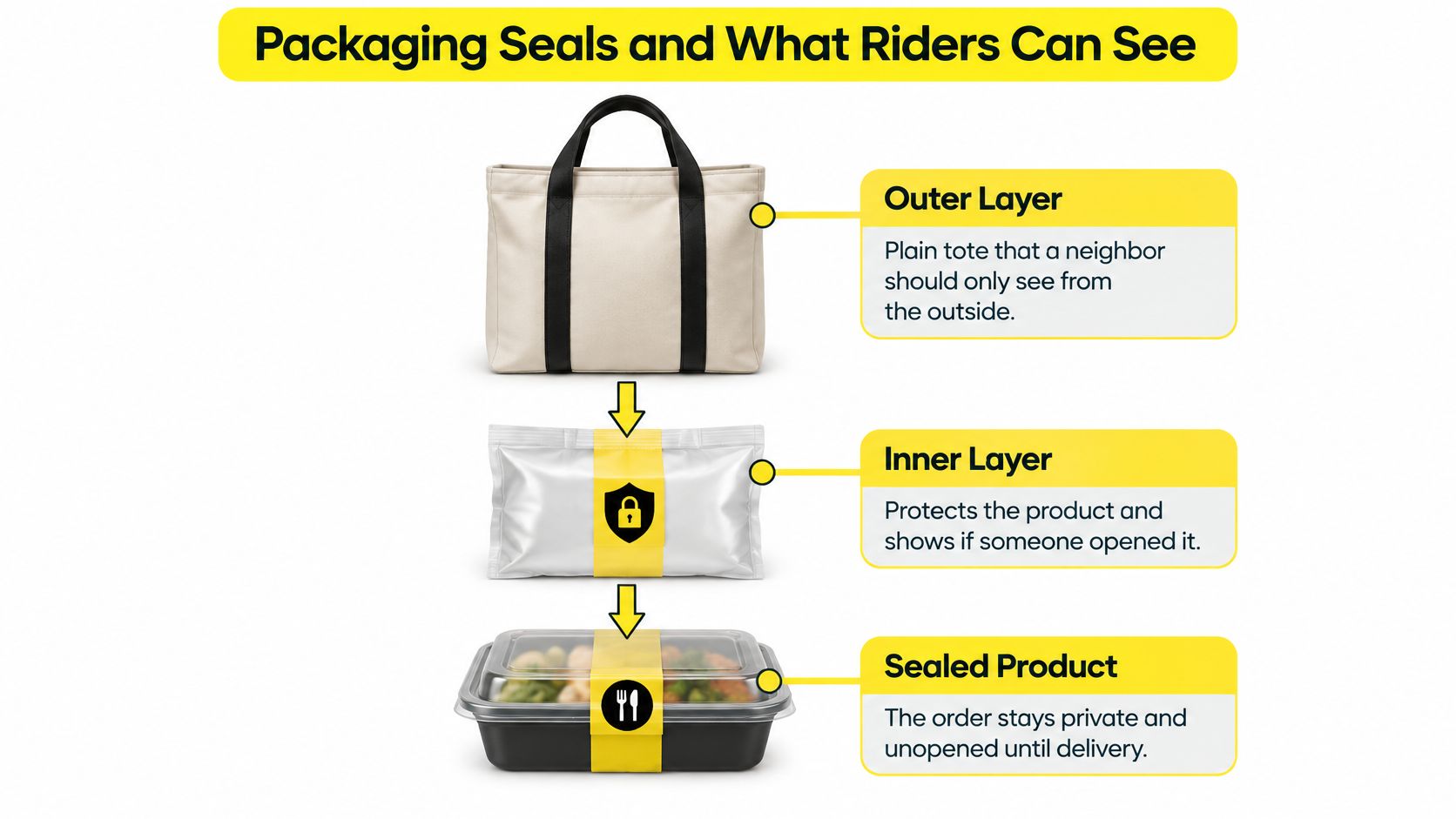
Inner seal first, outer bag second
A tamper-evident seal shows whether a package was opened before it reached you. Child-resistant packaging slows a child who finds the product at home. The dispensary label stays on the sealed package during transport, identifying its source.
All edibles are sealed and packaged to keep them fresh until delivery. The seal helps preserve freshness and shows whether the package has been opened.
The outer bag serves a separate purpose: it keeps the products out of view. Flower jars, edible packs, and vape boxes should not be visible through it. To someone passing in the hall, the bag should look ordinary. The product name and contents stay inside, while the package remains sealed for the handoff.
What the vehicle should and shouldn't show
Products stored in a vehicle should remain enclosed and concealed from outside view. A product left loose on a seat could be seen through a window. Concealed storage also makes it harder for a passerby to identify what is being transported.
California regulations require cannabis goods to leave a retailer in an opaque exit package. They also require tamper-evident, child-resistant packaging, with resealable packaging for multiple-serving products. These rules offer a useful pattern, not a statement of DC law.
The layers work together: an opaque bag limits what others can identify, a seal helps protect package integrity, and concealed storage reduces visibility during transport. At the door, the courier still needs to match the order to the recipient's ID and complete the handoff in person.
Driver habits matter as much as the bag
A plain bag draws less attention, but the courier's conduct matters too. Keep the package closed and the conversation brief. A discreet handoff can avoid product names and unnecessary discussion while still allowing the required ID check.
You can add a delivery note with practical preferences:
- Call on arrival: Request a call instead of a knock if a knock draws attention.
- Skip product names: Ask the courier to avoid naming items at the door.
- No extras left behind: Ask that no branded material be left at the door or desk.
Pickup Curbside or Home Delivery
You have an online order ready, but a busy lobby makes a doorstep meeting feel exposed. Pickup, curbside, or home delivery may suit you better, depending on where you can meet privately.
Pickup, curbside, and delivery compared
| Option | Where you meet | Hours in DC | Best when |
|---|---|---|---|
| In-store pickup | Shop counter after an online order | Shop hours | You want a short visit and staff guidance |
| Curbside | Your car at the shop | 9:00 a.m. to 9:00 p.m. | You would rather not cross the sales floor |
| Home or office delivery | DC residential or commercial address | 9:00 a.m. to 9:00 p.m.; no courier operation 11:00 p.m. to 7:00 a.m. | You can meet the courier at a private spot |
| Unattended or third-party drop | Not available as a standard handoff | Not offered | You can meet the courier yourself |
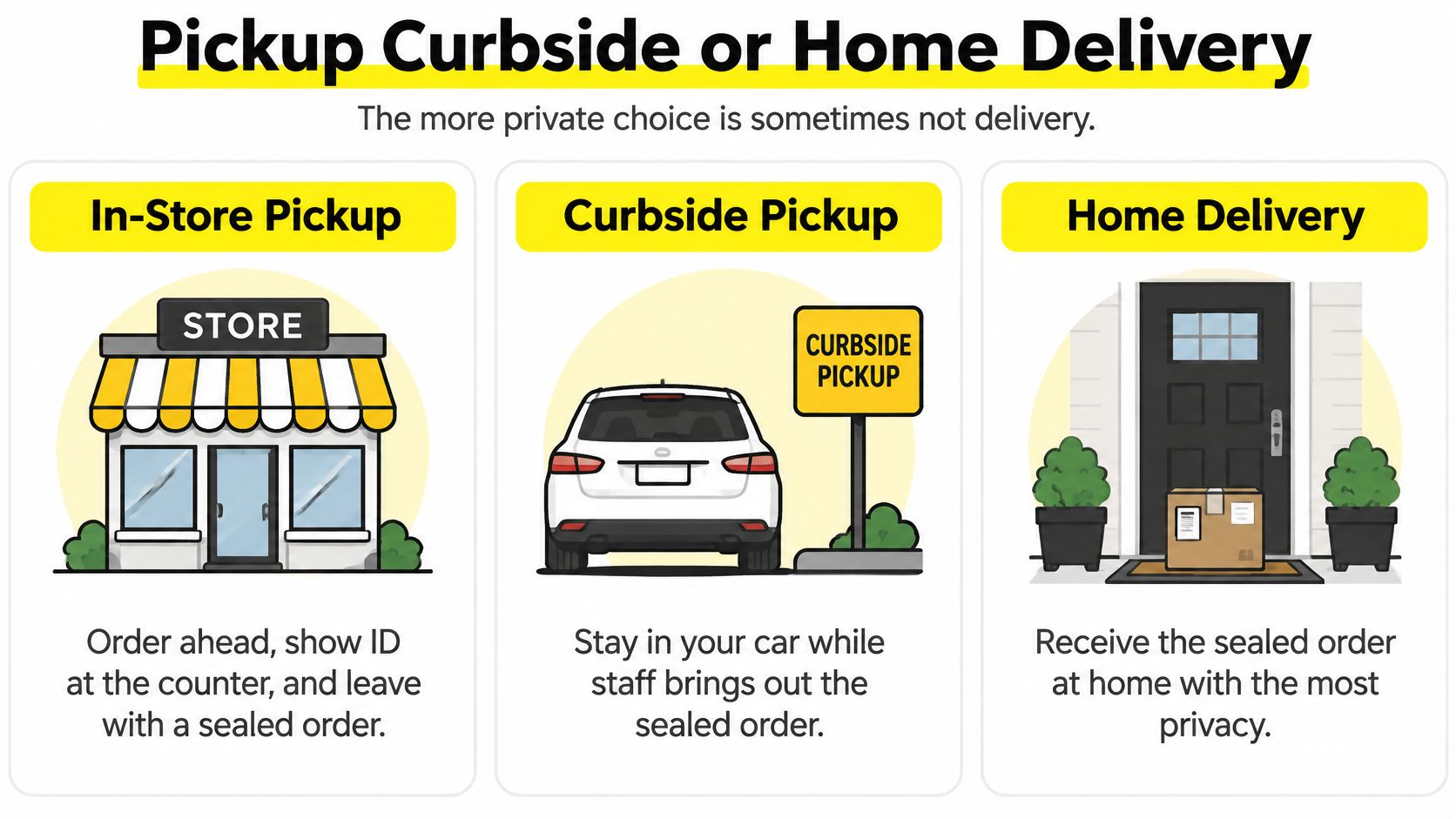
In-store pickup keeps the trip simple: order online, show ID at the counter, and leave with your sealed bag. You can order online for quick pickup upon arrival. Choose this option if you want staff guidance or would rather avoid a courier meeting at your building.
Curbside keeps you in your car while staff bring the order out. The DC medical cannabis courier license guidance states that delivery and curbside pickup are permitted daily from 9:00 a.m. to 9:00 p.m. Separate courier rules prohibit operation between 11:00 p.m. and 7:00 a.m. Curbside may suit you if you can drive to the shop but prefer not to enter the sales floor.
Home or workplace delivery brings the order to a District residential or commercial address during the permitted daytime window. For any online order, browse the menu, add items to your cart, confirm the address or pickup point, and wait for confirmation. Read more about curbside pickup and delivery to compare the shop-based options.
What delivery is not
A delivery cannot be left unattended at a stoop or handed to someone who is not the patient or caregiver on the order. Delivery also has location limits: it cannot go to a federal building or school grounds. The DC medical cannabis code sets out the rules for delivery locations and routes.
Decision line: Choose pickup or curbside if you can meet the shop on your schedule. Choose home delivery if you can meet the courier at a private DC address.
How the Doorstep Handoff Works
The doorstep is a controlled handoff, not a drop-off. The rule to plan around is simple. The ID at the door must match the order.
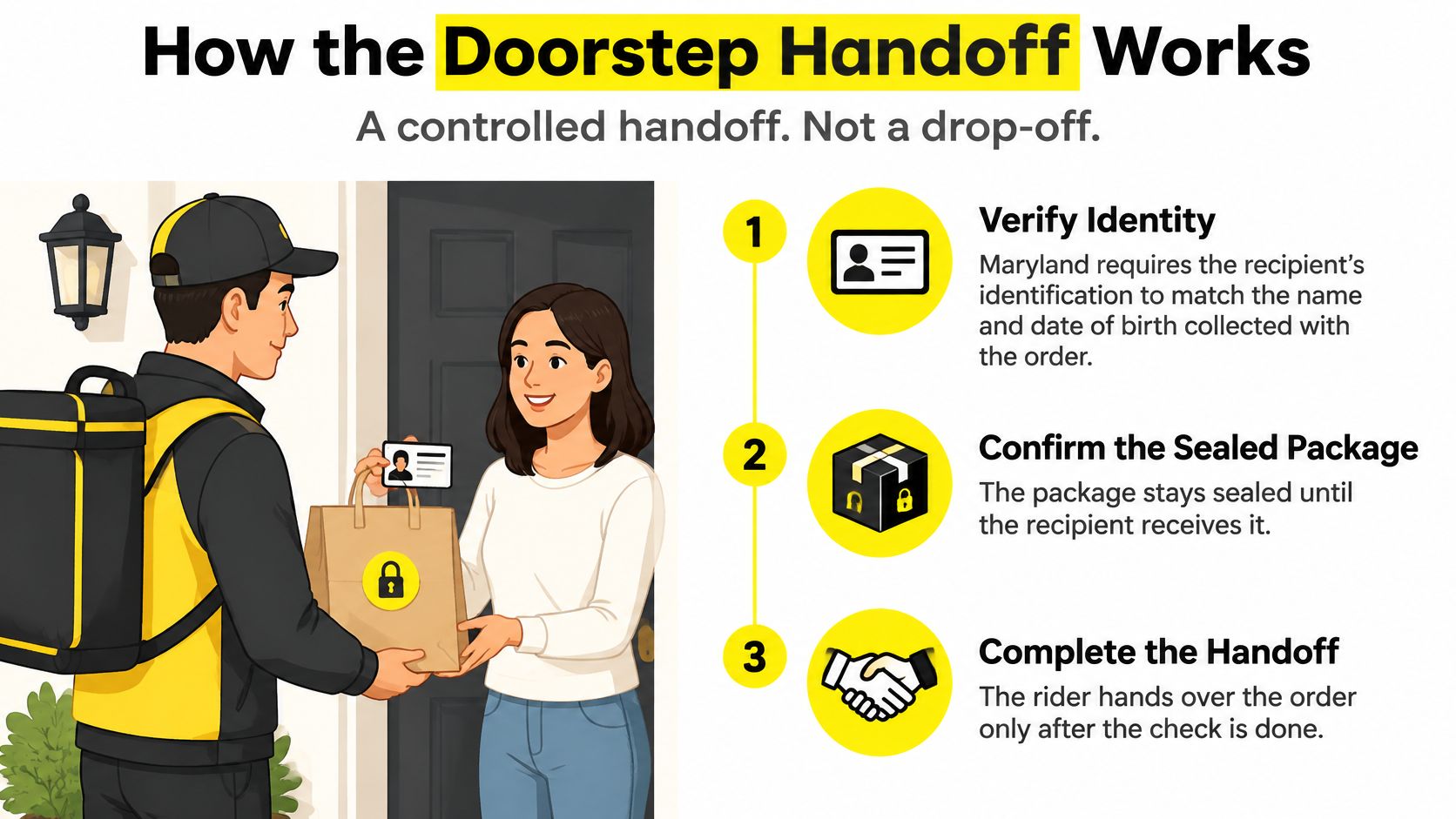
Regional rules show how strict that match can be. The Maryland cannabis delivery regulation requires the recipient's identification to match the name and date of birth collected with the order before cannabis can be dispensed. Virginia rules similarly require delivery staff to verify the identity of the person accepting the order and, for medical purchases, confirm the patient's registration information, and unresolved identity or registration questions can require the order to be returned.
DC fits the same idea. A licensed courier verifies identity and age and may not leave cannabis unattended at a door. If you want the full sequence from cart to door, our guide on how weed delivery works in Washington DC lays out each stage.
Prepare before the courier leaves the shop
- Order in the right legal name. Use the legal name of the adult who'll open the door, not a nickname and not the name of someone who'll be at work.
- Keep your ID within reach. A current government ID in your pocket works. An ID in a car parked down the block turns a quiet handoff into a wait in the hallway.
- Pick a private meet point. Your unit door usually beats a crowded lobby desk. Fewer people hear the exchange, and no third person handles the bag.
- Ask for a call or text. When order notes allow it, a call on arrival is quieter than repeated knocking that brings roommates to the door.
- Reschedule if you won't be there. Don't ask a roommate, hotel desk, or doorman to take it. A changed time is a minor delay. A refused handoff sends the order back.
- Have a backup spot. If your hallway is busy with movers or neighbors, a side entrance or a quieter corner you name in advance keeps you from improvising.
What a failed handoff looks like
Say you order during lunch and get held up at work. Your roommate is home and offers to accept the bag. The courier asks for ID, the name doesn't match yours on the order, and the courier can't complete the delivery. The plain bag did its job. Nobody saw a product. The order still returns because the recipient check failed.
A caregiver is different only in one way. A caregiver can receive when that person is already the authorized recipient on the order. A caregiver isn't a last-minute substitute you name by phone while the courier waits.
A plain bag doesn't help if the ID doesn't match and the order goes back.
Patients, apartment residents, and anyone sharing a home should run through the list before paying, not after the courier is en route. Discretion reduces what neighbors see. It also raises the cost of an unprepared handoff, because there's no unattended fallback.
DC Rules in Real Delivery Situations
Rules are easier to use when you test them against real addresses. Run three scenes before you check out.
Scene one, the ordinary successful delivery
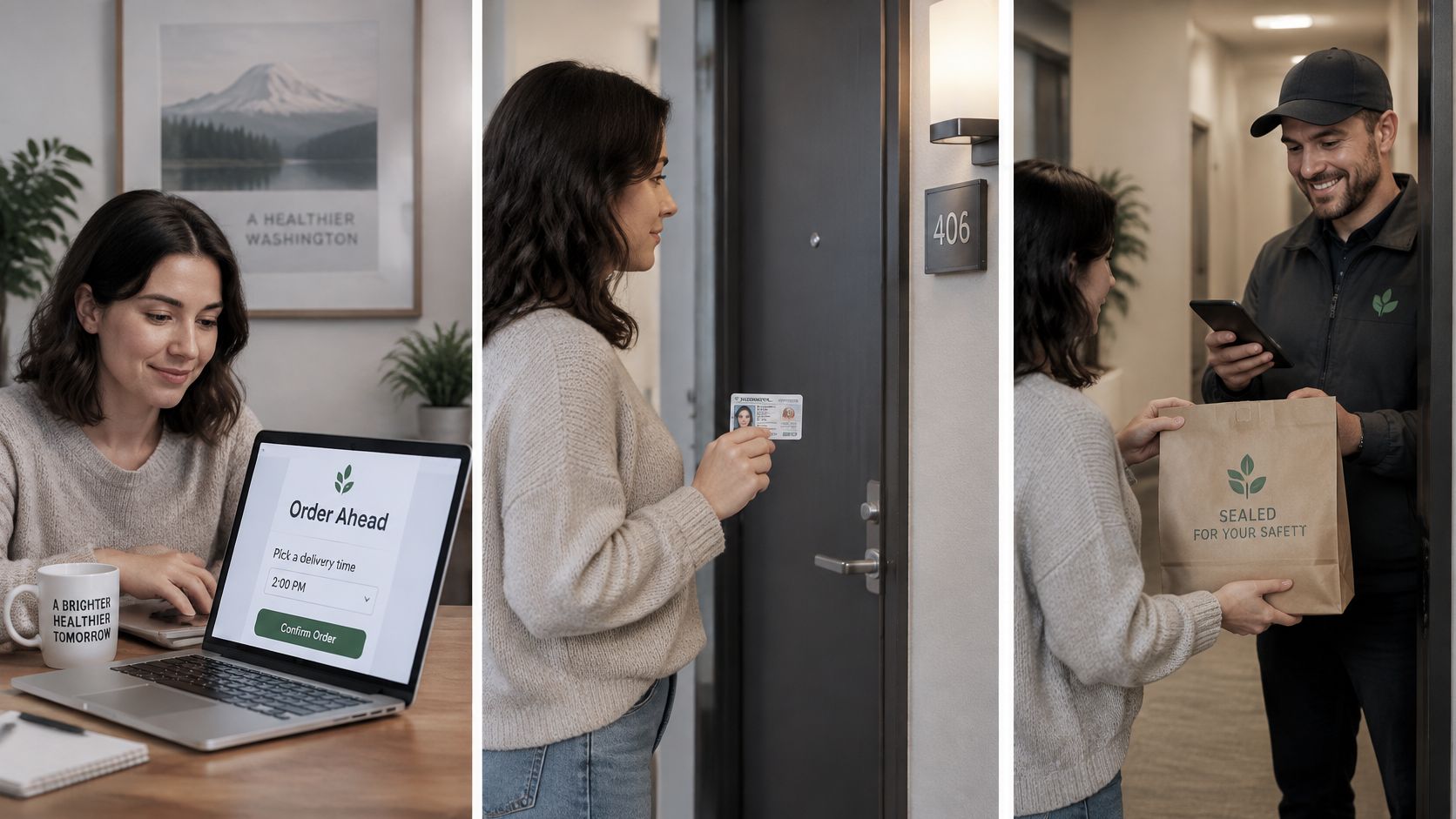
A patient in a Northwest apartment orders with time to spare. She waits at home with her government ID nearby. The courier arrives, matches her name to the order, and hands her a sealed bag. Nothing is opened in the hallway. Nothing is left outside.
That's the standard case, and it also works at a commercial address when the recipient is the qualifying patient or caregiver. The DC medical cannabis code requires a licensed courier for third-party medical cannabis delivery, and the courier may deliver only to a qualifying patient or caregiver at a District residential or commercial address. The courier must verify the recipient's identity and age before handing over the order and may not leave cannabis unattended at a door.
Scene two, addresses the courier must refuse
The same patient asks for delivery to her office on federal property. The courier must refuse. The same refusal applies outside a DC government building and on public or private school grounds. An unverified address is a refusal too, and so is a request to leave the bag at an unattended door.
There's one exception worth knowing. Delivery to people aged 21 or older at colleges and universities is allowed, even though other school grounds are barred.
The practical example is worth stating plainly. A courier can deliver a sealed order to a patient's apartment after checking identification, but cannot leave it outside an office, send it to a federal building, or drop it at an unverified address. If you're unsure whether your building counts as government property, check before you pay. Our explainer on whether Washington DC pot delivery is legal covers the address limits in more depth.
Scene three, the route and the clock
Your map app suggests a faster drive through Bethesda or Arlington. For a District medical courier trip, that shortcut isn't available. The route stays inside DC even if it adds time, because surrounding jurisdictions aren't part of the delivery route. An order going from a DC retailer to a patient in Northwest DC remains within DC for the whole trip.
The clock works the same way. Delivery and curbside run from 9:00 a.m. to 9:00 p.m., and courier operation is prohibited from 11:00 p.m. to 7:00 a.m. An 8:30 p.m. request can still fit the evening window. A late-night request at 11:30 p.m. waits until the next day, no matter how close you live to the shop.
Test your own address against all three scenes. Is it a DC residential or commercial address where the named patient or caregiver can meet the courier? Is it clear of federal property, District government property, and school grounds? Can the courier reach it inside DC during the delivery window? Three yes answers mean the address works. One no means you should change the plan before you pay, not argue at the door.
Place Your Next Order With Less Exposure
Turn the rules into actions for the next order, in the order you'll do them.
- Choose where you'll meet. Pick pickup, curbside, or delivery based on where you can be present with ID and some privacy. Don't default to delivery if your lobby is the most public place in your day.
- Build the order online. On our menu, browse, add items to the cart, confirm the address or pickup point, and submit. We've partnered with Sweede to handle our deliveries, and when you place your order early, we can arrange drop-off the same day.
- Think about storage after the handoff. If carrying the purchase home discreetly matters, formats that store easily help. Vape pens offer discreet delivery and easy travel and storage, and they still travel in the same plain outer bag as everything else.
- Use the receiver's legal name. Order under the legal name of the adult who'll receive it and keep a current ID nearby. This one step prevents most failed handoffs.
- Add a short delivery note. Ask for a call on arrival and name your private meet point. Short notes work best because the courier reads them quickly at the curb.
- Read the confirmation. Check the name, address, and time window as soon as the confirmation arrives. Fixing an address before the courier is on the way is easy. Fixing it at the door is not.
If your address is inside DC, expect District courier rules on routing, hours, and a live ID check. If you're in a nearby area we list, such as Alexandria, Bethesda, Rockville, or Silver Spring, confirm that location's delivery details on the site instead of assuming the DC route rule is identical there. Rules change at jurisdiction lines even when the drive is short.
The outcome you're aiming for is unglamorous, and that's the point. A confirmed order in the right name. A sealed, low-profile handoff. Nobody improvising at the door, and nobody in the hallway learning anything they didn't need to know.
When you're ready to order, we offer in-store pickup, curbside, and delivery handled through Sweede, so you can choose the handoff that keeps your purchase most private. Browse the menu, order under the name of the adult who'll receive it, and keep your ID ready for a sealed, low-profile exchange. Start your order at Mr. Nice Guys DC.
Mr Nice Guys DC
At Mr. Nice Guys DC, we’re more than just a cannabis delivery service — we’re passionate advocates for quality, convenience, and community. With years of experience in the cannabis industry, our team is dedicated to educating and empowering customers across Washington, D.C. Whether you're a seasoned user or just starting your cannabis journey, our blog delivers trusted tips, product insights, and the latest updates from the world of weed. Stay informed, stay elevated.
