
Must Be 21 To Enter
By entering this site you are agreeing that you are at least 21 Years of Age or older.
I AM 21 OR OLDERCompliance of Patient in DC Medical Cannabis: A Guide
.svg)

.png)
You've just left a DC dispensary with a legally purchased product, and the worry starts before you reach your car. Is the amount still within your limit? Is your card current? Can you stop for coffee with the product in your bag? What happens if a police officer asks where it came from?
That uncertainty is exactly where patient compliance breaks down. In DC, staying compliant isn't about memorizing cannabis jargon. It means keeping your registration active, buying from the right source, tracking what you possess, transporting it correctly, and using it only where the law allows.
A Day in the Life of a Compliant DC Patient
A middle-aged patient in a Capitol Hill apartment finishes work and checks his medical cannabis authorization card before heading out. He also opens the note on his phone that lists what he purchased during his last visit. He isn't trying to make the process complicated. He just wants to know what he already has before buying more.

At the dispensary, he presents his current patient card and photo identification. He buys from the dispensary connected to his registration, checks the receipt, and keeps the products in their original packaging. He doesn't open a package on the sidewalk, take a sample in the parking area, or hand a pre-roll to a friend.
The trip home matters. A compliant patient keeps the cannabis sealed, labeled, and out of public view during transport. Once inside the apartment, he stores it in a private area away from children and visitors. He doesn't consume in the lobby, on the street, in a public park, or anywhere else that isn't private property.
The small decisions matter
The difficult part is often not the purchase itself. Patients must understand how different product types count toward their permitted amount, keep a running record of purchases, and watch for gaps between a physician recommendation and a renewed registration.
A simple calendar reminder can prevent a major problem. Put the card expiration date in your phone, then schedule an earlier reminder for the recertification appointment. If you use delivery, review the eligibility and identification requirements before placing the order through a DC delivery service guide.
Practical rule: If you can't explain where the product came from, how much you possess, and whether your authorization is active, don't leave the store with it.
Compliance also means not sharing. Your medical cannabis belongs to you. It isn't a gift for a roommate, a way to help a friend, or something to leave in a communal kitchen. The compliant routine is quiet and repetitive: check the card, review the amount, buy from the registered source, transport it sealed, store it privately, and consume only in a lawful private setting.
What Patient Compliance Means for Medical Cannabis in DC
Patient compliance is the ongoing practice of meeting every rule that applies to your medical cannabis authorization. It isn't a one-time application, and it doesn't end when a dispensary approves your purchase.
A compliant patient has an active registration with the Alcoholic Beverage and Cannabis Administration, a current physician recommendation, and a valid patient identification card. The patient also stays within DC possession limits, buys through an authorized dispensary, transports cannabis lawfully, and uses it in an approved setting.
The most important point is the recurring nature of the responsibility. A patient can have a valid card one day and lose that protected status when the card or physician recommendation expires. The product in the home doesn't become a substitute for current authorization.
Turn the concept into a daily check
Use this working definition:
- Your identity is current. Your registration and patient card match your government-issued identification.
- Your medical authorization is current. The physician recommendation supporting the registration hasn't expired.
- Your source is authorized. You buy from the registered DC dispensary connected to your registration.
- Your amount is lawful. You track what you buy and possess rather than relying on memory.
- Your conduct is lawful. You transport cannabis in the required packaging and consume only in a private setting.
The DC medical cannabis dispensary regulation guide is useful for understanding the relationship between patients, dispensaries, registration records, and regulated sales.
Caregivers have responsibilities too. A caregiver shouldn't treat a patient's card as a general purchasing pass. The caregiver must act for the registered patient, follow the applicable identification and registration requirements, and keep the product within the patient's authorized chain of possession.
Why “I bought it legally” isn't enough
A legal purchase doesn't excuse improper transport, public consumption, possession beyond the permitted limit, or a lapsed authorization. Compliance covers the entire chain, from the active recommendation to the product's source and the place where it is used.
That broader view also helps explain why a receipt matters. A receipt shows what you purchased, when you purchased it, and which dispensary completed the transaction. It supports your own records when you need to reconcile your supply or address a question about a purchase.
Core Rules Every DC Medical Cannabis Patient Must Follow
DC compliance has several separate pillars. Satisfying one doesn't cancel out a failure in another. A current card won't protect a patient who carries cannabis across a restricted federal location, and a lawful purchase won't fix an expired recommendation.
Registration and authorization
Keep your ABCA registration active, maintain a current physician recommendation, and carry your current patient card with government-issued photo identification. Card renewal is an annual task, so put the expiration date somewhere you'll see it before the deadline.
Patients should also confirm that their dispensary relationship is correct. DC rules provide that qualifying patients and caregivers may possess, administer, or dispense medical marijuana obtained from the registered dispensary listed on the registration card. Products must be transported in a labeled container or sealed package carrying the dispensary label, as explained in the DC medical card requirements guide.
Possession, purchase, and home cultivation
The verified DC rule is up to 8 ounces within a rolling 30-day period, with possession also limited to 8 ounces at any moment. That means patients need to think in rolling windows rather than assuming that a calendar-month reset automatically clears their records. The official DC medical cannabis patient guidance explains both limits.
Keep a log that accounts for flower, edibles, concentrates, tinctures, and other formats according to the dispensary's applicable equivalency rules. Don't assume that a small package is automatically irrelevant to your total.
The supplied legal information doesn't establish a verified plant-cultivation allowance, so patients shouldn't rely on an unconfirmed plant number. Ask ABCA or a qualified DC cannabis professional about current home-cultivation rules before growing.
Transport and consumption
Transport cannabis in its original sealed or labeled packaging and keep it out of public view. Don't consume in a public space, and don't transport or use cannabis on federal land. A private apartment, private home, or another lawful private setting is a different situation from a sidewalk, public park, office common area, or federal property.
Visitors must check reciprocity before purchasing. DC reciprocity rules allow eligible domestic and international visitors who are 21 or older to register temporarily, while people enrolled in recognized state or territorial medical cannabis programs may use their existing registration with an unexpired government photo ID. The DC reciprocity information should be checked before travel because an out-of-state card isn't automatically accepted in every situation.
| Compliance Rule | DC Limit | Patient Action |
|---|---|---|
| Rolling possession and purchase window | 8 ounces within 30 days | Keep a rolling purchase and possession log |
| Immediate possession | 8 ounces at any moment | Check the amount before leaving the dispensary |
| Source | Registered dispensary connected to the registration | Confirm the dispensary and keep the labeled package |
| Card and recommendation | Must remain current | Set renewal reminders before expiration |
| Transport | Sealed or labeled package, out of public view | Keep cannabis secured during the trip home |
| Consumption | Private property only | Never use cannabis in public or on federal land |
Real Scenarios That Show Compliance in Action
Rules become easier to follow when you test them against ordinary situations. The same product can be lawful in one setting and create a problem in another, depending on the patient's authorization, source, amount, and conduct.
Scenario one, a documented purchase
A patient buys flower and edibles from the dispensary connected to the registration. Before leaving, the patient checks the receipt, confirms the patient card is current, and keeps the product sealed and out of public view during transport.
The important compliance facts are the source, the current authorization, the documented purchase, and the patient's total amount. If the patient's running record remains within the applicable DC limit, the purchase is properly documented. Outcome: compliant conduct, determined by authorized source, current status, lawful amount, and proper transport.
Scenario two, the cheaper unverified source
The same patient later buys from a shop that isn't the dispensary listed through the patient's registration. The product may look identical, but the source creates the problem. Under DC's source-linked rule, buying from an unregistered or unauthorized retailer isn't cured by having a valid medical card.
Outcome: noncompliant source, regardless of whether the patient's total amount is otherwise within the possession limit.
Scenario three, a visiting patient
A visitor arrives in DC with a valid medical cannabis card from another jurisdiction. The visitor is old enough to qualify, but doesn't check whether the home program is recognized for reciprocity and doesn't confirm whether temporary DC registration is required.
The visitor should verify eligibility, carry the home-state registration and unexpired government photo ID where permitted, and purchase only through a licensed DC retailer. Outcome: reciprocity depends on recognition and registration status, not solely on possessing an out-of-state card.
Scenario four, the missed renewal
A patient forgets the physician recertification date and continues trying to purchase after the recommendation expires. The patient's old card is still in a wallet, but an expired authorization doesn't remain active because the card looks legitimate.
Outcome: protected patient status is lost when the required authorization expires. The rule that determines the result is current registration and recommendation, not the patient's memory or the existence of an old card.
| Scenario | Compliant Action | Noncompliant Action | Result |
|---|---|---|---|
| Documented purchase | Buy from the registered dispensary and retain the receipt | Lose track of the source or amount | Records support compliance only when the full chain is lawful |
| Different retailer | Confirm the retailer is authorized and linked | Buy from an unregistered source | Source-linked violation |
| Out-of-state visitor | Verify reciprocity and carry required identification | Assume every out-of-state card works automatically | Purchase may not be protected |
| Expired authorization | Renew before the card or recommendation ends | Continue purchasing after expiration | Patient status is no longer current |
Practical Steps to Stay Compliant All Year
Compliance gets easier when you turn it into a routine instead of an emergency. Use the following schedule as a working checklist, then confirm any rule changes directly with ABCA or your dispensary.
Daily habits
- Carry identification: Keep your DC medical cannabis registry card with government-issued photo ID.
- Protect the package: Leave products in their original sealed or labeled containers during transport.
- Secure the supply: Store cannabis away from children, visitors, and shared household spaces.
- Choose the setting: Consume only on private property, never in public or on federal land.
- Record the product: Note the product type, package size, and your intended dose in a simple phone note.
Don't rely on a photograph of the card alone when the physical card and identification are required. A digital backup helps with record-keeping, but it shouldn't replace the documents you need to present.
Monthly habits
Create a digital folder for receipts and keep a simple possession log. Record purchases by date, dispensary, product type, and amount. Review your rolling total before ordering again, especially when you move between flower, edibles, tinctures, vapes, and concentrates.
Save questions for your next visit. A medical edible dosage guide can help you think through product use, but your physician should address medical decisions, adverse effects, and changes in treatment.
Annual habits
Schedule your recertification appointment 30 to 45 days before the card expiration date. That lead time gives you room to handle scheduling, provider review, and registration updates without waiting until your authorization has already lapsed.
After renewal, confirm that the updated information appears in the DC patient portal. Bring your product log to the certifying physician. Notes about timing, format, dose, effects, and unwanted reactions make the appointment more useful and help you avoid changing products without a clear reason.
How Mr. Nice Guys DC Supports Patient Compliance
A dispensary should make the lawful path easier to follow, not leave patients to reconstruct it from memory. At Mr. Nice Guys DC, the operational process starts with patient verification. Staff check the patient's government-issued identification and medical card before completing medical purchases, including pickup, curbside, and delivery orders.

The purchase is connected to the patient's profile, creating a record that supports accurate tracking. That matters when a patient has bought several formats over time and can't reliably calculate the total from memory. It also gives the staff a chance to identify documentation problems before the transaction is completed.
Delivery follows the same rules
Delivery isn't a loophole around patient verification. Orders are sent to the registered DC address on file, and delivery requires an adult signature with identification. The same possession math applies to delivery as it does to an in-store purchase.
Patients should have their card and ID ready at the door, keep the package sealed when it arrives, and move it directly to secure private storage. If the address, registration, or identification doesn't match, the order may need to be stopped or corrected rather than handed over casually.
Education prevents avoidable mistakes
A trained budtender can flag a patient who is approaching the applicable limit, remind the patient about an upcoming recertification window, and explain practical issues such as dosing, storage, and public-consumption restrictions. That conversation is especially useful for a first-time patient choosing among flower, pre-rolls, cartridges, edibles, tinctures, concentrates, and topicals.
The dispensary's source-verified supply chain also reduces the patient's burden of proving origin. Products sold through the regulated channel can be traced back through the DC-licensed supply chain, rather than leaving the patient to judge whether an unfamiliar seller is authorized. Patients can review the age verification process before pickup or delivery so the handoff is straightforward.
The right role for a dispensary is practical: verify the person, verify the authorization, document the purchase, explain the product, and keep the patient from making a preventable mistake.
Compliance Takeaways for the Long Run
The durable version of patient compliance is simple: keep your registration active, buy only through the dispensary connected to your registration, track every purchase, and respect the applicable DC possession limit. Don't treat compliance as something you check only when a staff member asks for your card.
The single habit that prevents many avoidable errors is photographing your physician recertification date and setting a 30-day reminder before expiration. Use that reminder to contact the provider, check your registration, and confirm that your updated status appears before you place another order.
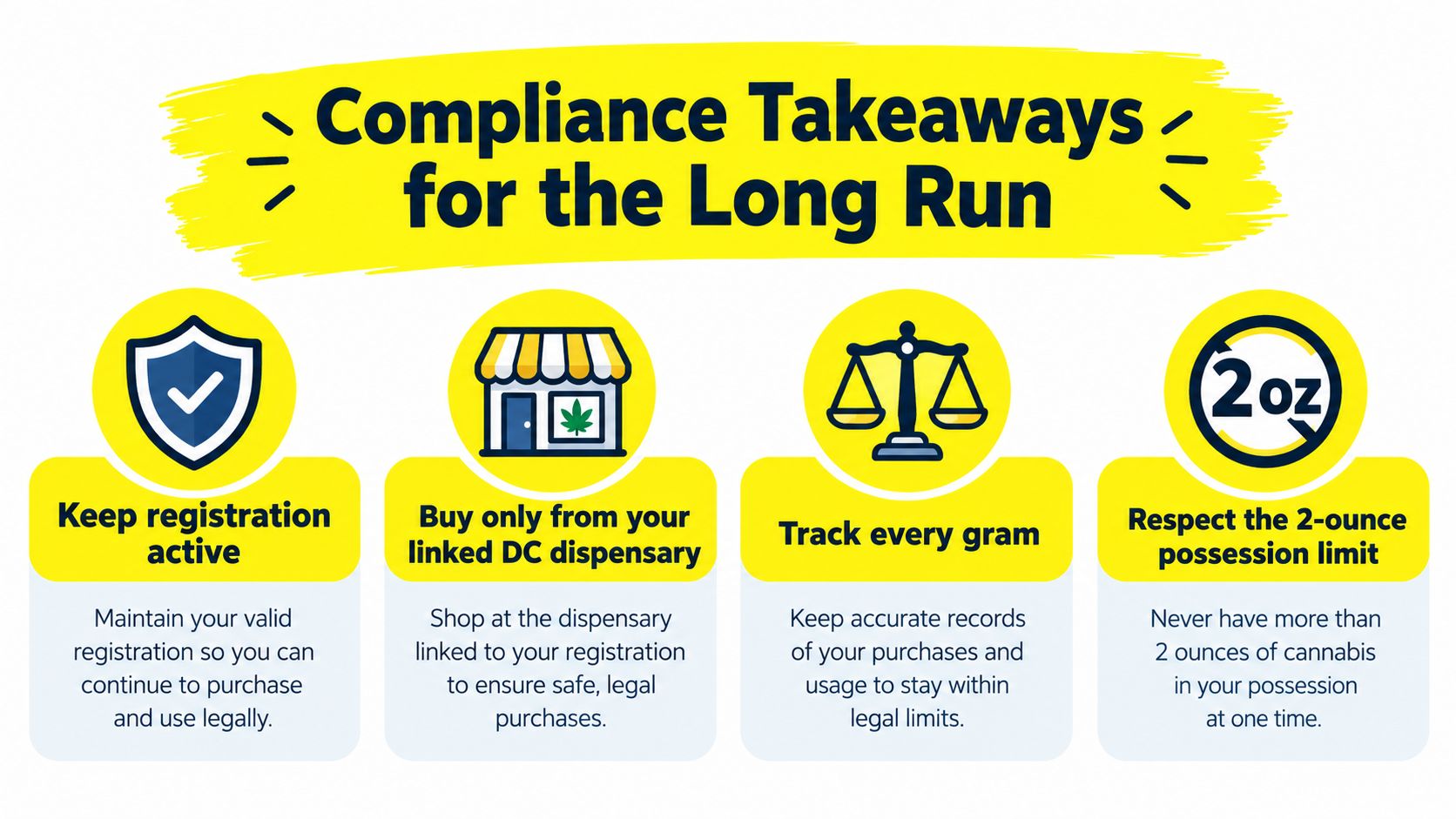
Keep these habits in rotation:
- Keep registration active: Check both the patient card and physician recommendation.
- Use the linked DC dispensary: Don't assume a different retailer is covered by your registration.
- Track the supply: Save receipts and update the running possession log after every purchase.
- Respect the setting: Store cannabis securely and consume only on private property.
- Check travel boundaries: Don't carry cannabis across federal property or through airport checkpoints.
- Verify reciprocity: An out-of-state card doesn't automatically guarantee DC purchasing access.
- Review the record: Use regular check-ins to catch an expired card, an incorrect address, or an unexplained purchase.
Compliance isn't a one-time task. It's a quarterly rhythm of checking authorization, reviewing purchases, confirming the source, and making sure your storage and consumption habits still match the rules. That routine protects your access and keeps small oversights from becoming serious problems.
Mr. Nice Guys DC offers verified medical patient purchasing, in-store pickup, curbside service, delivery, and product guidance for flower, edibles, vapes, pre-rolls, concentrates, topicals, and tinctures. Visit Mr. Nice Guys DC with your current card and identification to make your next purchase clear, documented, and easier to manage.
Mr Nice Guys DC
At Mr. Nice Guys DC, we’re more than just a cannabis delivery service — we’re passionate advocates for quality, convenience, and community. With years of experience in the cannabis industry, our team is dedicated to educating and empowering customers across Washington, D.C. Whether you're a seasoned user or just starting your cannabis journey, our blog delivers trusted tips, product insights, and the latest updates from the world of weed. Stay informed, stay elevated.
