
Must Be 21 To Enter
By entering this site you are agreeing that you are at least 21 Years of Age or older.
I AM 21 OR OLDERCBD Tinctures for Anxiety: A Patient's Guide for 2026
.svg)

.png)
You're probably here because the usual advice hasn't been very useful. You've read that CBD helps anxiety, then read somewhere else that it doesn't. One article tells you to take a tiny amount. Another points to study doses that look nothing like the bottle in your hand. If you've stood at a dispensary counter or scrolled product pages wondering, “How much of this specific tincture am I supposed to take?” you're asking the right question.
That confusion is common with CBD tinctures for anxiety. Research usually discusses milligrams of CBD, while patients shop by bottle size, dropper size, and product type. Those are not the same thing. A bottle can look gentle and still be concentrated. Another can look strong and deliver less CBD per dropper than you expect.
The practical answer isn't to chase the biggest number on the label. It's to understand the bottle, start with a measured amount, watch your response, and adjust slowly. That's how people avoid underdosing, overbuying, and taking a product in a way that doesn't match what they need.
Navigating Anxiety with a New Approach
A lot of people looking into CBD tinctures for anxiety are not looking for a dramatic experience. They want the edge taken off. They want to get through a crowded Metro ride, a tense meeting, a night of racing thoughts, or that familiar feeling where the mind keeps spinning even when the day is over.
In practice, that often looks like this: someone has heard tinctures may be easier to control than edibles, but the internet makes it harder than it needs to be. One article talks about “a few drops.” Another talks about hundreds of milligrams. Neither helps much when you're standing there with a bottle and a dropper.
Why tinctures keep coming up
CBD didn't enter anxiety conversations by accident. A 41-patient case series reported that after two months of CBD treatment, 78.1% (32/41) reported improvement in anxiety symptoms, according to The Permanente Journal case series on CBD for anxiety and sleep. That kind of real-world result helps explain why CBD moved from niche wellness product to a serious point of discussion for patients and clinicians.
That said, popularity and clarity are not the same thing. People hear “CBD for anxiety” and assume the next step is obvious. It isn't.
Most first-time mistakes with tinctures come from guessing instead of converting the label into milligrams.
What patients usually need, not what marketing says
For anxiety, individuals often don't need a heroic dose or a complicated routine. They need a product they can measure, an approach they can repeat, and expectations that match reality.
A useful guide has to answer questions like these:
- How fast should I expect it to work: Fast enough for a stressful stretch of the day, or more like a slow background effect?
- How much is in one dropper: Not the whole bottle. One actual serving.
- When should I increase: The same day, after a few days, or only if nothing changes?
- What should I avoid: Especially if you already take something for anxiety, panic, or sleep.
That's where tinctures can make sense. They're one of the easiest formats to titrate with intention instead of guesswork.
Understanding CBD Tinctures and How They Work
You're standing at the counter with a 30 mL bottle in your hand, trying to answer the question that matters more than the marketing copy. How much of this bottle would I take if anxiety is the goal?
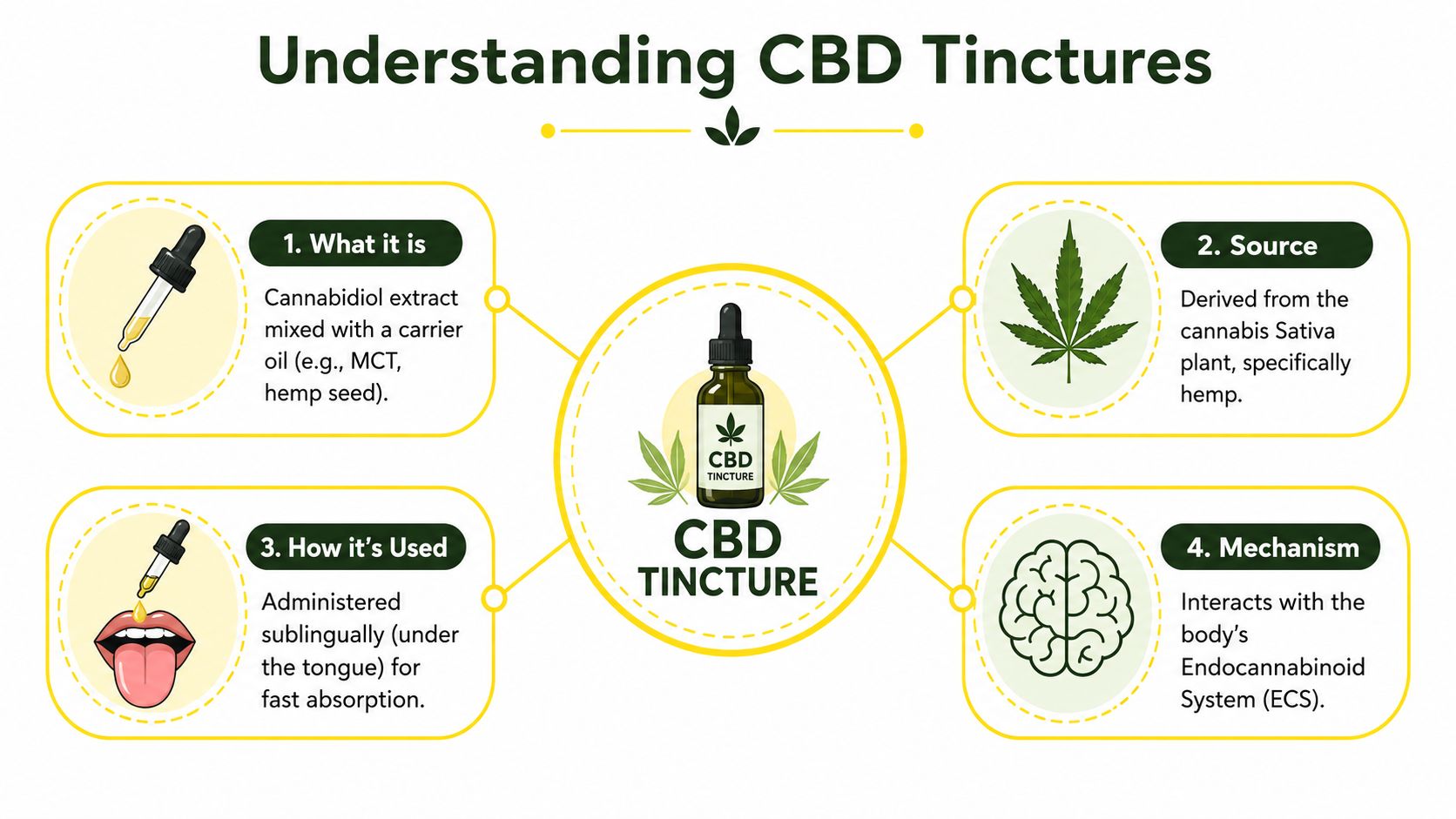
A CBD tincture is a liquid CBD extract suspended in a carrier oil, usually sold with a measured dropper. That format matters because it lets you work from the label backward. You can figure out how many milligrams are in one full dropper, then decide whether a half dropper or quarter dropper makes more sense as a starting point. For anxiety, that kind of control is often more useful than a gummy with a fixed dose.
Why people choose tinctures
Tinctures are commonly used sublingually, meaning you place the liquid under the tongue, hold it briefly, then swallow. Guidance on how CBD tinctures are used sublingually explains that this method allows part of the dose to absorb through oral tissues before the rest passes through digestion.
In practice, patients usually choose tinctures for one reason. They are easier to adjust in small steps.
That matters if one person feels calmer with a modest dose while another needs more, or if the same person wants a lighter daytime amount than they would use in the evening. A capsule gives you a fixed number. A tincture gives you a measuring tool.
If the label language feels confusing, this guide to CBD tincture vs. oil can help you sort out what you're looking at before you choose a bottle.
What using one feels like in real life
Tinctures work like a dimmer switch, not a light switch. The goal is not to flood your system and hope for the best. The goal is to find the smallest amount that takes the edge off without making you feel flat, sleepy, or off-balance.
A simple first-use routine looks like this:
- Check the label for total CBD and serving size.
- Shake the bottle if the product directs you to.
- Measure less than a full dropper for your first trial unless the label gives a very low per-dropper amount.
- Hold it under your tongue for the suggested time.
- Give it time and pay attention to how your body responds before taking more.
At Mr. Nice Guys DC, this is usually the point where patients realize the bottle size is not the dose. A 30 mL bottle might contain 300 mg total CBD or 1500 mg total CBD. Those are very different products, even if the bottles look nearly identical.
A tincture is easiest to use well when you read it like a measuring label, not like a wellness slogan.
One trade-off deserves a clear warning. CBD can add to drowsiness and sedation when combined with medications or other products used for anxiety or sleep, according to FDA consumer guidance on CBD. If you already take something calming, the safer approach is a lower starting amount and a conversation with your prescriber before layering in a tincture.
What Research Says About CBD for Anxiety
A patient reads that CBD helped anxiety in a study, then walks into the dispensary holding a 30 mL tincture and asks the question that research papers rarely answer clearly: how does that study translate to this bottle?
The short answer is that the evidence is encouraging, but limited. CBD is widely discussed for anxiety, yet it remains an off-label use. The FDA approval for purified CBD applies to certain seizure disorders, not anxiety. That gap matters because clinical studies can point to a real effect without giving a first-time tincture user a practical serving plan.
Where the human evidence is most convincing
Human research looks strongest in short, stressful situations rather than long-term daily use. A clinical review of CBD and anxiety evidence found that oral CBD lowered self-reported anxiety in some stress-based settings, including public speaking tests, while other trials found little or no difference from placebo.
That mixed result is normal in anxiety research. Anxiety is not one single condition, and study designs vary a lot. Some trials measure a one-time stress response. Others look at ongoing symptoms. Some use purified oral CBD in amounts far above what a first-time patient would usually try from a retail tincture.
One point from that review deserves practical context. Research has often clustered around relatively high oral amounts in study settings. That does not mean a person standing at the counter should try to copy those numbers with a dropper bottle. It means the research is useful for direction, not for direct one-to-one dosing.
What patients may actually notice
Research suggests CBD may help more with the felt experience of anxiety than with every physical sign of stress. In plain terms, a patient may still notice a racing body or tense shoulders, but feel less mentally trapped by the moment.
That distinction helps set realistic expectations.
| What a patient may notice | What they may not notice |
|---|---|
| Less looping worry | A heavy sedative effect |
| More ease during a stressful event | Instant relief |
| Better ability to stay present | A dramatic drop in every physical stress signal |
| Less mental overreaction | The same result every day at the same amount |
For a closer look at how tinctures behave in the body, the science behind marijuana tinctures and their effects gives helpful background.
Why the research still feels hard to use
The main problem is translation. Studies talk in milligrams of oral CBD. Patients shop by bottle size, dropper markings, flavor, and label claims. A paper may report a result at a specific amount, but it does not tell you whether your bottle provides 10 mg, 25 mg, or 50 mg in a full dropper.
That is the gap patients run into every day at Mr. Nice Guys DC. The research can tell you CBD may reduce anxiety for some people under some conditions. It does not tell you how to read a label, how much is in a quarter dropper, or when a tincture is strong enough that a full dropper is too much for a first trial.
Used the right way, research gives guardrails. Practical dosing does the essential work.
A Practical Guide to Dosing CBD Tinctures for Anxiety
This is often the first part needed.
The biggest practical problem with CBD tinctures for anxiety is that dosing advice is all over the place. One review may discuss very low amounts, another mentions moderate starting ranges, and many anxiety studies use much higher oral doses. As summarized by Innerbody's guide to CBD for anxiety, advice can range from 6 mg to over 400 mg, which is exactly why a start low, go slow approach makes more sense than copying a random number online.
First, read the label like a calculator
When a bottle says 1500 mg / 30 mL, that usually means the entire bottle contains 1500 mg of CBD.
If the dropper is filled to 1 mL, then:
| Label info | What it means |
|---|---|
| 1500 mg per 30 mL bottle | Total CBD in the whole bottle |
| 30 mL total volume | Bottle size |
| 1 mL full dropper | One full serving, if the dropper is marked that way |
| 1500 ÷ 30 | 50 mg per 1 mL dropper |
Now the bottle makes sense.
A half dropper would be about 25 mg.
A quarter dropper would be about 12.5 mg.
That's how you turn packaging into a usable plan.
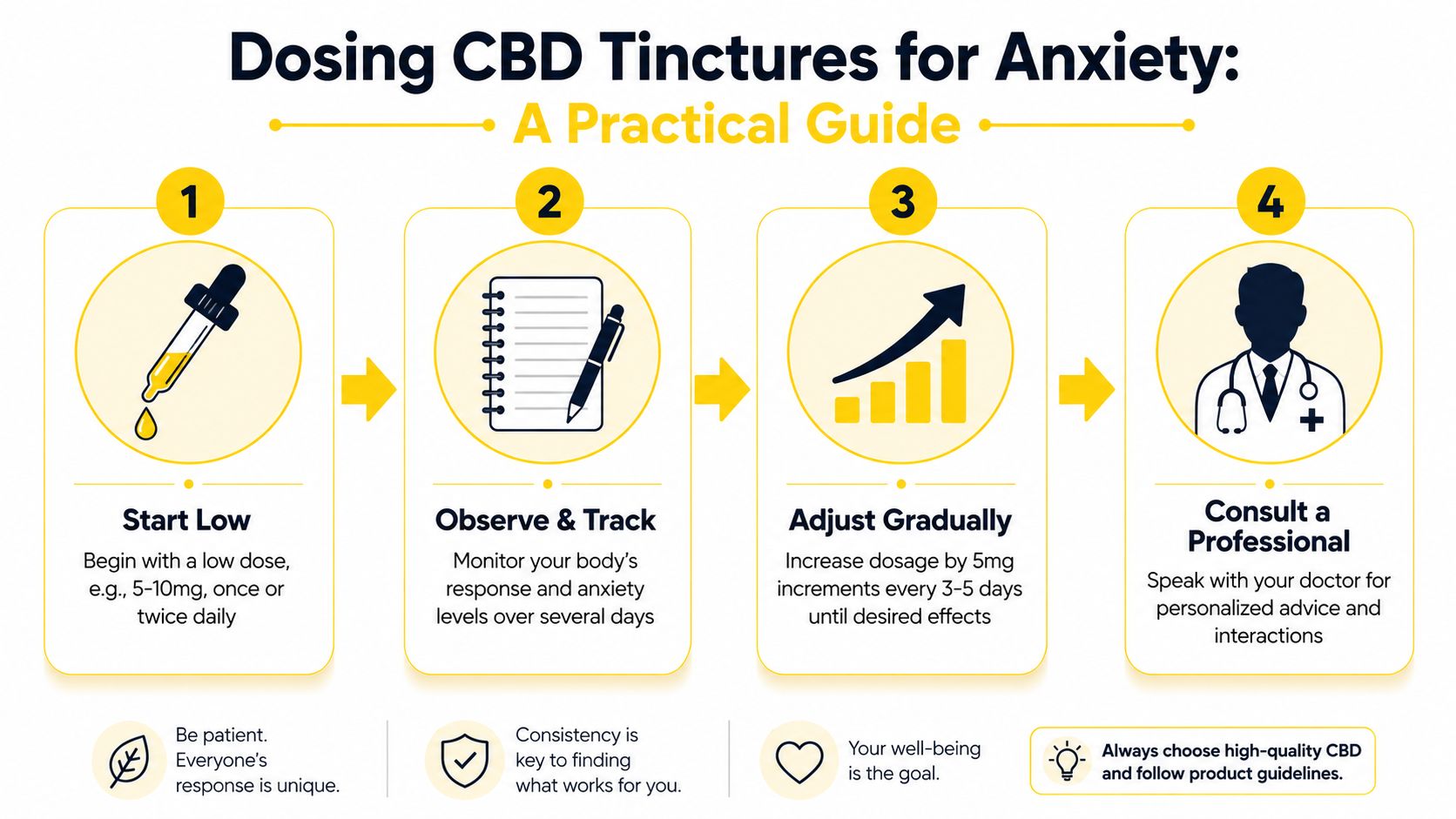
A simple starting method
For many first-time users, especially those who want a controlled trial rather than a dramatic jump, a partial dropper is the safest practical entry point.
A cautious routine could look like this:
- Pick a time when you can pay attention to your response. Not before driving, not before a high-stakes obligation.
- Start with a small measured amount. Using the example above, a quarter dropper would deliver 12.5 mg.
- Hold it under the tongue as directed on the product.
- Stay at that amount for several days instead of changing it hour to hour.
- Increase gradually only if needed. Move from a quarter dropper to a half dropper, not from a quarter to a full one.
Here's the key. Don't confuse “I didn't feel a dramatic wave” with “it did nothing.” For anxiety, what works is often subtle. You may notice you're less reactive, less mentally noisy, or less likely to escalate.
The dosing video below gives another helpful visual on how patients think through tincture amounts in practice.
What usually doesn't work
People run into trouble when they do one of these:
- They dose from the bottle total, not the dropper amount. “This is a 1500 mg tincture” tells you almost nothing about one serving.
- They increase too fast. If you change the amount constantly, you can't tell what was effective.
- They assume higher is better. It often isn't. Anxiety responses to CBD don't always improve in a straight line.
- They buy a weak bottle expecting study-like dosing. Then they have to take large volumes of oil just to approach a meaningful amount.
Practical rule: Pick one bottle, convert it to mg per dropper, start with a small fraction of that dropper, and adjust slowly enough that you can actually learn from the experience.
If you want more help translating bottle labels into usable servings, this tincture dosing guide is worth keeping open while you shop.
How to Choose a Safe and Effective Tincture
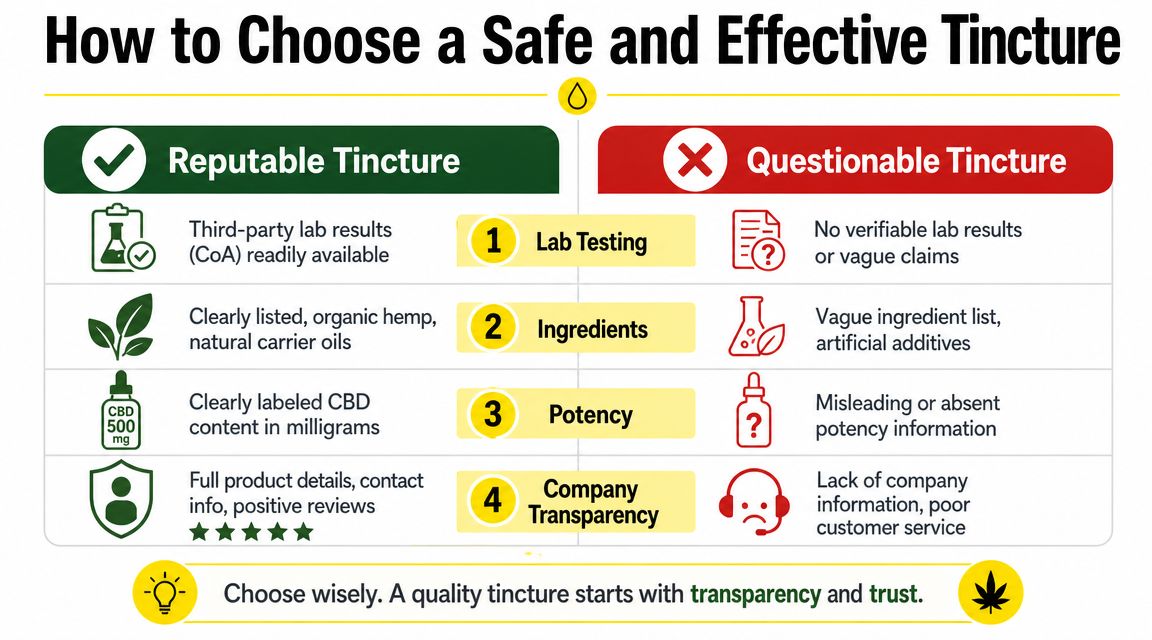
A good tincture is easier to dose because the label tells the truth. A questionable tincture creates problems before you even open it.
Start with potency and testing
Human studies on anxiety often use oral CBD doses in the 300 to 600 mg range, and a review noted CBD had been tolerated in oral doses up to 1,500 mg/day without psychomotor slowing, negative mood effects, or vital sign abnormalities, according to this review of CBD's anxiolytic evidence and tolerability. That doesn't mean you should aim high. It means reliable potency matters because you can't dose carefully if the label is vague or inaccurate.
A solid product should give you:
- Clear total CBD content on the front or side panel
- A serving size you can interpret, ideally tied to the dropper
- Third-party lab testing, usually through a Certificate of Analysis
- A short ingredient list, not a pile of extras with unclear purpose
If you want background on extraction quality, CO2 extracted CBD oil is a useful concept to understand when comparing products.
Full-spectrum, broad-spectrum, and isolate
Shoppers often get stuck here, so keep it simple.
Think of the formula like music.
Full-spectrum is the full orchestra. You get CBD plus other hemp compounds, including up to 0.3% THC in hemp-derived products when they meet that federal threshold discussed in the earlier clinical context. Some patients prefer this because the formula feels more rounded.
Broad-spectrum is the orchestra without THC. You still get multiple hemp compounds, but THC is removed or minimized depending on the product.
Isolate is the soloist. It's just CBD by itself. Cleaner and simpler, but without the extra compounds some people want.
A quick comparison helps:
| Type | Best fit for |
|---|---|
| Full-spectrum | Patients comfortable with trace THC |
| Broad-spectrum | Patients who want multiple hemp compounds without THC emphasis |
| Isolate | Patients who want only CBD and the simplest formula |
What I'd tell a first-time buyer
If you're new, don't shop by branding language like “advanced,” “max,” or “ultra.” Shop by usability.
Look for a tincture that lets you answer these questions immediately:
- How many milligrams are in one full dropper?
- Can I measure a half or quarter dropper easily?
- Is the product type clear?
- Are lab results available before purchase?
One practical option for patients comparing formats is the tincture selection available through Mr. Nice Guys DC, where menus and staff guidance can help match label strength to a microdosing approach rather than pushing a one-size-fits-all amount.
Safety Legality and Buying Tinctures in DC
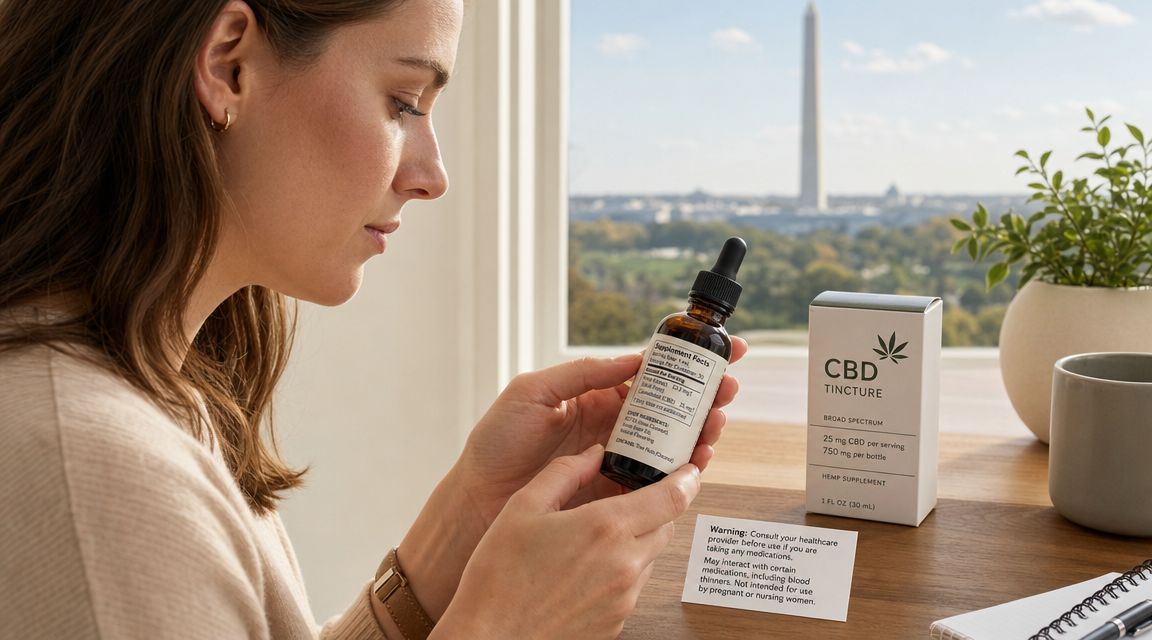
Safety comes before shopping. If you take medication for anxiety, panic, stress, or sleep, don't treat CBD as automatically separate from that routine. CBD can add to sedation and drowsiness when combined with other sedating drugs, which is why it makes sense to check with a clinician who knows your medication list.
Why buying context matters
A tincture is only as useful as the information that comes with it. In a regulated dispensary setting, patients can usually review the product type, strength, and usage guidance before making a decision. That's very different from buying something online with vague labeling, unclear testing, or promises that sound stronger than the evidence.
For DC patients, it also helps to understand how the local market is structured. This overview of how D.C. regulates medical cannabis dispensaries gives the legal context behind why dispensary sourcing matters.
A better way to buy
When you buy tinctures through a compliant dispensary channel, the process is straightforward:
- Check the menu carefully. Focus on total milligrams, bottle size, and whether the formula is full-spectrum, broad-spectrum, or isolate.
- Ask how the dropper is marked. A product is much easier to use when the serving tool matches the label.
- Choose the lowest complexity first. A first tincture should be easy to read and easy to repeat.
- Use available pickup or delivery options. Convenience helps, but the bigger advantage is getting a product with a clearer chain of information.
For anxiety, “safe and effective” usually means boring in the best way. Clear label. Measurable serving. No guesswork.
Frequently Asked Questions and Your Next Steps
The simplest takeaway is this: buy a tincture you can understand, convert the bottle into mg per dropper, start low, and increase slowly enough to notice patterns. That's a better approach than chasing somebody else's dose or assuming the strongest bottle is the smartest purchase.
How long should I hold a CBD tincture under my tongue?
Most product guidance recommends holding it under the tongue for 60 to 90 seconds before swallowing. That gives the tincture its intended sublingual use rather than treating it like a standard edible oil.
How often should I take it for anxiety?
That depends on why you're using it. Some people prefer a steady routine once or twice daily. Others use it around predictable stress points. What matters most at first is consistency. Use the same amount for several days before deciding whether it's too little, enough, or more than you need.
What should I feel if it's working?
For anxiety, the effect is often subtle. You may feel less mentally crowded, less reactive, or more able to move through a stressful moment without spiraling. If you're expecting a heavy body sensation or a dramatic “switch off,” you may miss the actual benefit.
If a tincture is working, many people notice they handle stress better before they notice they “feel” something big.
What if I bought the wrong strength bottle?
That happens all the time. A very concentrated bottle may still work well if you use a small fraction of a dropper. A lower-strength bottle may be fine for microdosing but inconvenient if you need larger servings. The fix is to do the math once, write your personal dose down, and use the dropper the same way each time.
When should I stop and ask for medical advice?
Ask before starting if you already take sedating medication. Ask after starting if you feel too drowsy, foggy, or unsure how CBD fits into your broader treatment plan. Tinctures are a tool, not a replacement for medical judgment.
If you want help reading tincture labels, comparing formulas, or choosing a bottle that fits a cautious dosing plan, Mr. Nice Guys DC offers a regulated dispensary setting where patients can review options for in-store pickup, curbside, or delivery and make a more informed choice.
Mr Nice Guys DC
At Mr. Nice Guys DC, we’re more than just a cannabis delivery service — we’re passionate advocates for quality, convenience, and community. With years of experience in the cannabis industry, our team is dedicated to educating and empowering customers across Washington, D.C. Whether you're a seasoned user or just starting your cannabis journey, our blog delivers trusted tips, product insights, and the latest updates from the world of weed. Stay informed, stay elevated.
