
Must Be 21 To Enter
By entering this site you are agreeing that you are at least 21 Years of Age or older.
I AM 21 OR OLDERBest THC Tincture: A Practical Buyer's Guide
.svg)

.png)
You're standing in front of a dispensary shelf with a row of amber dropper bottles, and every label seems to promise something different: stronger effects, better sleep, calm, relief, or a “full-spectrum” experience. The problem is that the highest THC number rarely tells you which bottle will fit your day.
The right choice comes down to three practical questions. How much THC do you need? How quickly do you need it to work? What does the rest of the label tell you about the extract, carrier, ratio, and testing? This guide answers those questions without treating potency as a contest.
| Tincture priority | What to compare | Best fit |
|---|---|---|
| Precise daytime use | Lower mg/mL, measured sublingual dose | New or sensitive users |
| Evening relief | Moderate THC or balanced THC:CBD ratio | Swallowed or sublingual use |
| Rapid, familiar effects | Higher mg/mL with reliable dosing | Experienced users |
| Reduced intoxication | CBD-dominant ratio | Daytime calm or THC-sensitive users |
| Predictable quality | Batch-specific COA and clean ingredients | Every buyer |
Why Choosing the Right THC Tincture Feels Harder Than It Should
A first-time buyer usually starts by comparing the largest number on each bottle. One label says 300 mg THC, another says 600 mg, and a third claims 1,500 mg. The instinct is understandable: more must mean better. In practice, that number may describe the entire bottle, while the detail that controls your actual experience is milligrams of THC per milliliter.
A dispensary educator would ask you to ignore the front label for a moment and answer three questions.
- How strong should each measured dose be?
- How fast should the effects arrive?
- Will you hold the tincture under your tongue, or swallow it?
Those choices matter more than the bottle's headline claim. A smaller bottle with a higher concentration can deliver more THC in each measured portion than a larger bottle with a lower concentration. A swallowed dose can also behave more like an edible, with slower and less predictable absorption than a carefully held sublingual dose. The science behind marijuana tinctures and their effects helps explain why the same liquid can feel different depending on how you use it.
Match the bottle to your routine
Consider two shoppers. The first wants a modest daytime dose before errands and doesn't want a long, heavy effect. The second wants sustained evening relief and has no problem waiting for the dose to develop before bed. They shouldn't buy the same tincture because one bottle has a larger total THC figure.
For daytime use, a lower concentration and a CBD-forward ratio can make measured adjustments easier. For evening use, a balanced formula or stronger THC profile may make more sense, especially when the user already understands their tolerance. Neither choice is automatically the best THC tincture. The better choice is the one that matches the schedule.
Practical rule: Buy for the dose you'll measure, not the number printed largest on the package.
A good tincture should make that decision easy. The label should show THC per milliliter, serving guidance, cannabinoid ratios, ingredients, and batch testing. If you have to guess how much THC sits in one dropper, the product has already failed its most important job.
What a THC Tincture Actually Is and How It Works
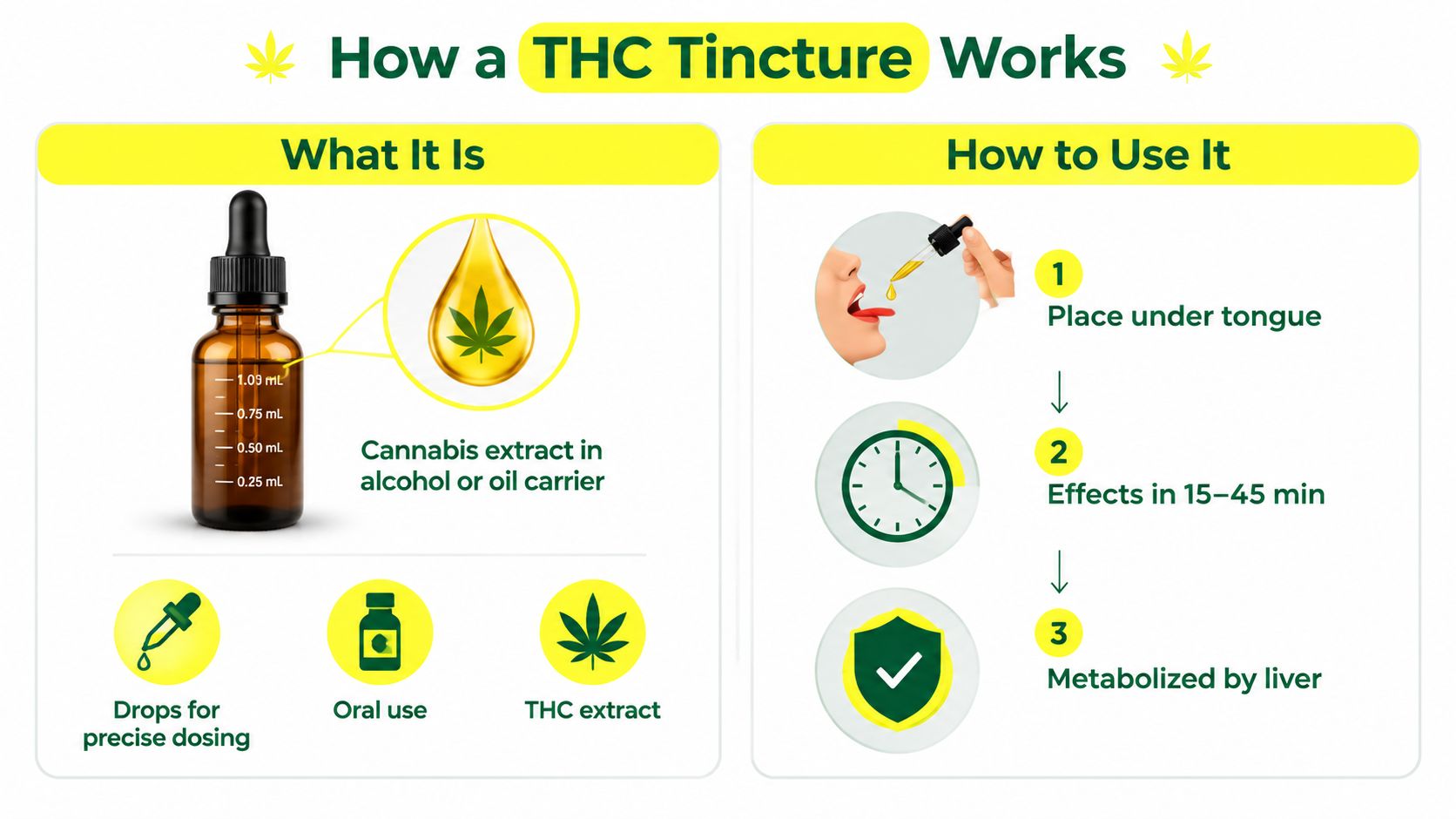
A THC tincture is a cannabis extract suspended in an alcohol or oil carrier, packaged in a bottle with a graduated dropper for measured oral use. The dropper gives you control over volume, but it doesn't automatically tell you the THC amount. You still need to connect the dropper marking to the product's milligrams per milliliter.
Choose your route first
Sublingual use means placing the liquid under your tongue and holding it there before swallowing. The mucous membranes can absorb part of the dose, which is why this route is commonly chosen when the user wants a more responsive daytime format. A swallowed dose travels through the digestive system and liver, so it behaves more like an edible and generally takes longer to develop.
Independent pharmacokinetic literature reports that oral THC products commonly reach peak plasma levels in 60 to 120 minutes, although delays of 4 to 6 hours have been reported, with estimated average bioavailability of about 6%. These figures vary with dose, food, and first-pass metabolism, so don't redose because the first swallowed dose feels quiet. Review the WHO discussion of cannabis extracts and tinctures for the pharmacokinetic context.
Understand the spectrum
Full-spectrum formulas contain THC alongside other cannabinoids and terpenes from the cannabis extract. Many buyers choose them because they want the plant's broader chemical profile rather than isolated THC.
Broad-spectrum formulas retain multiple cannabinoids while removing most THC. They can suit shoppers who want a broader extract but need to limit psychoactive exposure. Check the actual cannabinoid panel instead of trusting the phrase alone.
THC isolate is purified THC without the wider plant profile. It gives you a simpler ingredient story and can make titration more predictable, particularly for someone introducing very small doses.
A straightforward rule works well. Choose full-spectrum when you want the broader cannabis profile and don't have a reason to avoid trace cannabinoids. Choose broad-spectrum when reducing THC exposure matters. Choose isolate when simplicity and controlled titration matter most, including situations where drug testing is a concern. No spectrum guarantees a particular feeling, so the batch report still matters.
Potency, Concentration, and Bottle Size Explained
The number that matters most for dosing is THC per milliliter, not total THC in the bottle. Calculate it by dividing total THC by total liquid volume.
A 10 mL bottle containing 300 mg THC equals 30 mg/mL. A 30 mL bottle containing 300 mg THC equals 10 mg/mL. The second bottle contains more liquid, but each milliliter is one-third as concentrated. Bottle size affects how long the supply lasts. Concentration determines how much THC you receive in a measured volume.
The dispensary math
Use this mental model:
- Total THC ÷ total milliliters = mg/mL.
- mg/mL ÷ 20 = approximate mg per drop, when one drop is treated as 0.05 mL.
- mg/mL × measured milliliters = THC in the dose.
A 300 mg bottle in 30 mL contains 10 mg/mL. A 0.25 mL dose therefore contains 2.5 mg THC. That's a practical starting measurement for someone following a low-dose plan.
The comparison below shows why total bottle THC can distract buyers from the actual dose.
| Bottle Size | Total THC | mg/mL | mg per Drop (0.05 mL) |
|---|---|---|---|
| 10 mL | 300 mg | 30 mg/mL | 1.5 mg |
| 30 mL | 300 mg | 10 mg/mL | 0.5 mg |
| 20 mL | 600 mg | 30 mg/mL | 1.5 mg |
| 30 mL | 600 mg | 20 mg/mL | 1 mg |
A 300 mg bottle at 30 mg/mL delivers roughly 1 mg per 0.05 mL drop under the supplied approximation, while a 600 mg bottle at 20 mg/mL delivers about the same amount per drop. The larger bottle contains more total cannabinoid, but it isn't automatically stronger per dose.
Read the dropper correctly
A 1 mL dropper on a 600 mg bottle doesn't mean one dropper holds 600 mg. You must know the bottle's total volume. If the liquid is 30 mL, the concentration is 20 mg/mL, so a full 1 mL dropper contains 20 mg THC. That's a substantial difference from the amount in one small drop.
Look for a clearly marked dropper and a label that states both total THC and concentration. If either value is missing, you can't dose with confidence.
Comparing Onset, Duration, and Effects
The same tincture can suit different situations depending on the route you choose. A sublingual hold is generally the more practical option when you want a measured daytime dose and don't want to wait through the slower digestive process. Swallowing the liquid makes the experience more edible-like, which can suit a longer evening window.
The pharmacokinetic review cited earlier lists a low-dose THC tincture at 10 mg THC/mL, with maximum bioavailability of about 13% and an absorbed dose of roughly 1.3 mg from 1 mL. That's why concentration, measured volume, and route matter more than bottle size alone. You can read more about weed tincture effects when comparing the practical differences between formats.
| Format | Typical Onset | Duration | Best For |
|---|---|---|---|
| Sublingual hold | Often quicker than swallowing | Shorter, easier to adjust | Measured daytime use |
| Swallowed tincture | Slower and more variable | Longer-lasting effects | Evening or sustained use |
| CBD:THC ratio blend | Depends on route and ratio | Smoother psychoactive profile | THC-sensitive users |
Choose by schedule
For a workday, a carefully measured sublingual dose gives you more control over when you reassess the effects. For example, someone testing a low dose before an evening appointment might prefer a lower-concentration tincture because small volume changes produce smaller THC changes.
Before bed, a swallowed dose may be more appropriate for someone who wants a longer arc and can wait for the effect. The trade-off is that food, digestion, tolerance, and individual metabolism can shift the timing. Don't treat a quiet first hour as proof that the dose failed.
High-CBD ratio tinctures can make sense for people who experience unwanted intensity from THC. A CBD-forward product doesn't eliminate individual sensitivity, but it changes the balance of cannabinoids and lets the buyer pursue a less intoxicating profile.
A Practical Dosing Plan for First-Time and Returning Users
A dosing plan should be boring, measurable, and repeatable. Start by confirming the product's mg/mL and calculating the amount in your intended volume. Never assume that a full dropper equals one serving, especially when the bottle contains concentrated THC.
Four steps for titration
1. Calibrate the dropper.
Find the total THC, total liquid volume, and mg/mL. A 600 mg bottle may contain 20 mg/mL if it has 30 mL of liquid. In that example, a full 1 mL dropper holds 20 mg THC, not 20 mg per individual drop.
2. Pick a conservative starting point.
A true beginner can start with 1 to 2.5 mg THC. A returning user with some tolerance may choose 5 mg THC. A CBD-leaning protocol can pair 2.5 mg THC with equal or higher CBD. These starting points align with common cannabis dosing guidance for tinctures, including the examples in this cannabis tincture dosing guide.
3. Respect the wait window.
For sublingual use, wait about 20 minutes before judging the first effect. If you swallowed the dose, wait 90 minutes before redosing. Oral THC absorption can be delayed and variable, so patience is part of accurate dosing.
4. Adjust gradually.
Increase by 1 to 2.5 mg across two to three sessions, not all at once during one night. Record the route, amount, time, food context, effects, and unwanted effects before making the next change.
A worked example
A 300 mg tincture in a 30 mL bottle delivers 10 mg/mL. A 0.25 mL dose equals 2.5 mg THC. A beginner could measure that amount, hold it under the tongue, wait, and record the result. A returning user might measure 0.5 mL for 5 mg, while a CBD-forward user would choose a product that pairs the selected THC amount with equal or greater CBD.
Dose before feelings: The dropper measurement comes first. Your subjective response determines the next adjustment, not the product's marketing language.
Don't drive, operate equipment, or combine cannabis with alcohol while learning your response. If you use prescription medicines, manage a medical condition, are pregnant, or are caring for an older adult, discuss cannabis use with a qualified clinician.
Lab Testing, Extraction Method, and What to Ignore on the Label
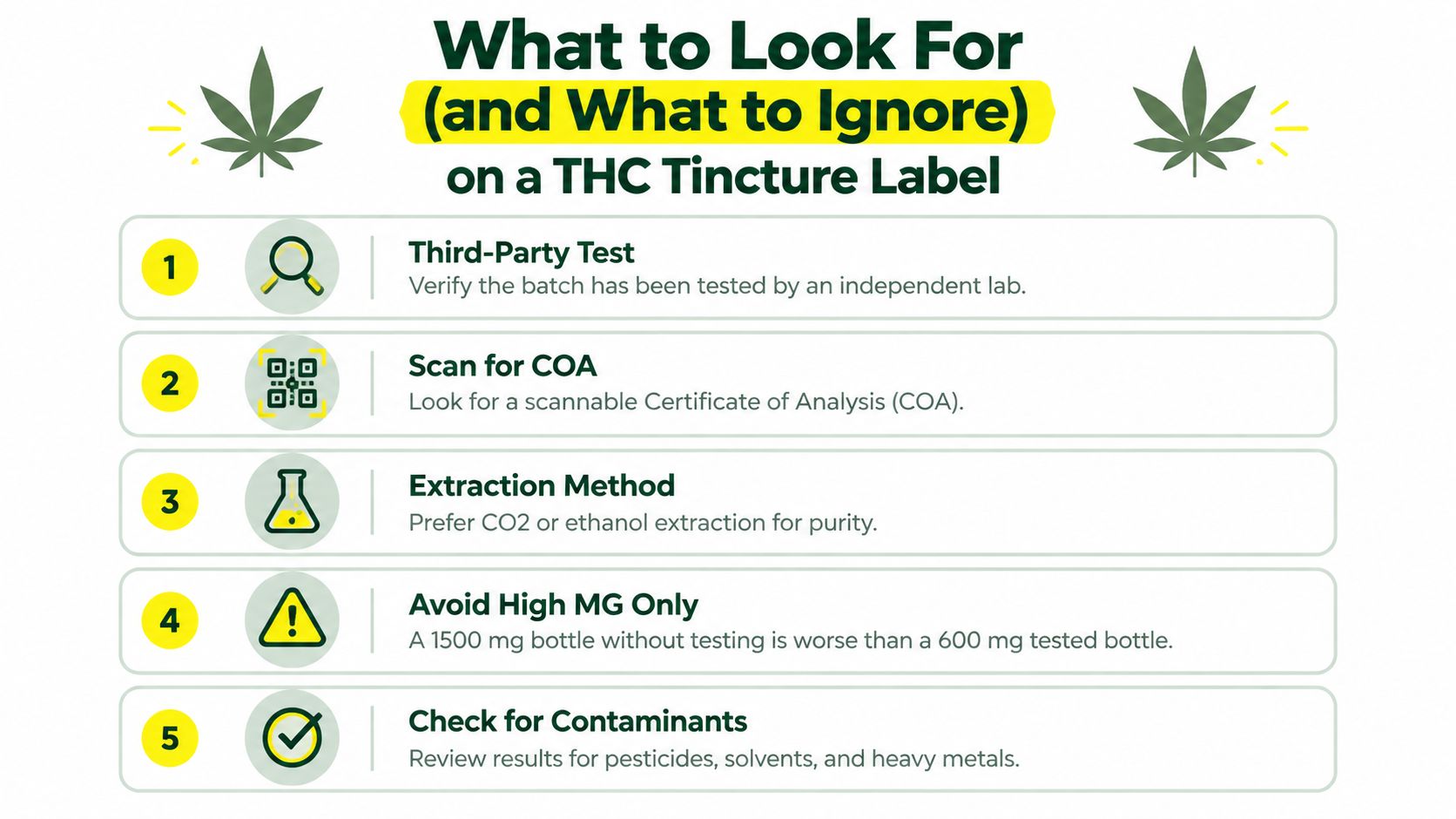
A high milligram count isn't a quality certificate. A 1,500 mg bottle without independent testing is a worse purchase than a 600 mg bottle with a scannable Certificate of Analysis, because the tested product gives you a way to verify its cannabinoid profile and contamination results.
The batch number is the critical link between the bottle and the lab report. Scan the QR code or enter the batch information before checkout, then confirm that the report matches the product in your hand.
What deserves your attention
Look for these details in this order:
- Batch-specific testing: Confirm the report identifies the exact batch, not just the brand's general formula.
- Cannabinoid profile: Check THC, CBD, and other listed cannabinoids rather than relying on a front-label phrase.
- Contaminant panels: Review results for heavy metals, pesticides, residual solvents, and microbial contamination.
- Extraction method: CO2 and ethanol extraction appeal to buyers prioritizing familiar solvent processes. A NIH review found cannabinoids were best extracted with 60% to 90% ethanol from flowers, while different plant compounds favored different strengths. Read the NIH review of cannabis extraction methods for the underlying comparison.
- Carrier and inactive ingredients: MCT oil and alcohol carriers have different taste and handling characteristics. Choose a short ingredient list over a bottle loaded with artificial flavoring.
Ignore label theater
“Nano” and “water-soluble” can sound impressive, but the phrase alone doesn't establish how the formula performs. Ask for supporting bioavailability information instead of assuming the claim translates into a better experience.
Be equally skeptical of “full-spectrum” without a clear cannabinoid panel, unusually neat potency figures with no batch report, and vague extraction language. The product testing standards guide can help you build a more disciplined label-checking habit.
Here's a short visual walkthrough of the label checks that matter:
Matching Tincture Types to Real-World Goals
The best tincture depends on what you need the bottle to do at a specific time. A formula for winding down after dinner shouldn't be judged by the same criteria as one intended for a low-intensity daytime routine.
The matrix below gives you a starting framework. “Potency range” describes a practical product profile to look for, not a promise about the amount your body needs. Start at the low end and use the measured titration process rather than jumping directly to a larger dose.
| Goal | Recommended Spectrum | Ratio | Potency Range | Administration |
|---|---|---|---|---|
| Sleep routine | Full-spectrum or balanced formula | THC-forward or 1:1 THC:CBD | Low to moderate | Swallowed 60 to 90 minutes before bed |
| Daytime focus | Broad-spectrum or balanced formula | CBD-forward with modest THC | Low | Sublingual |
| Anxiety relief | Broad-spectrum or THC-light formula | 20:1 or 10:1 CBD:THC | Low THC | Sublingual |
| Low-dose introduction | Isolate or mild full-spectrum | THC-only or CBD-balanced | Low, such as 5 mg/mL | Sublingual first |
Sleep and evening use
A swallowed tincture can fit an evening schedule because the slower onset and longer tail may be easier to accommodate before bed. A balanced 1:1 product is a reasonable starting style for someone who wants both cannabinoids represented. Someone experienced with THC may prefer a THC-forward formula, but the bottle still needs clear mg/mL labeling.
Daytime focus and calm
Daytime buyers usually benefit from control rather than maximum intensity. A lower-THC, CBD-forward tincture used sublingually lets you measure a small amount and reassess without committing to a long edible-style window.
For anxiety-focused use, common dosing guidance gives an example of a 20:1 CBD:THC ratio with 15 to 25 mg CBD and about 1 mg THC. That example illustrates the principle, not a universal prescription. If even small THC doses feel uncomfortable, choose a formula with less THC and discuss persistent symptoms with a healthcare professional.
Introducing THC
Isolate or a mild full-spectrum tincture can make first experiments easier to track. The goal is not to find the strongest effect. It's to identify the smallest measured amount that fits your routine without unwanted impairment.
Choosing Your Next Tincture From the Mr. Nice Guys DC Menu
Start with the goal, not the brand name or the biggest bottle. On the Mr. Nice Guys DC menu, filter products by spectrum first, then compare the THC:CBD ratio, and only then examine potency per milliliter. That order prevents a strong product from winning because its total THC number is larger.
Three useful product profiles
A balanced 1:1 THC:CBD tincture fits symptom-led evening use when you want both cannabinoids in the formula. Take it sublingually if you want a more adjustable routine, or swallow it when a longer evening window suits you.
A high-THC sublingual tincture is better reserved for experienced users who already understand their THC response and want a more concentrated format. Verify the mg/mL before measuring, because a small volume can contain a substantial dose.
A low-dose, CBD-forward tincture is the sensible entry point for newcomers, daytime users, and people who are concerned about intoxication. A CBD-dominant ratio can also help you test the routine while keeping THC exposure modest.
The publisher offers tinctures among its cannabis product selection, including options for registered medical patients. The broader Mr. Nice Guys DC cannabis product guide can help you compare tinctures with other formats, but the same purchasing discipline applies to every bottle.
Use this checkout sequence
- Name the goal: daytime calm, evening use, sleep routine, or low-dose introduction.
- Select the spectrum: full-spectrum, broad-spectrum, or isolate.
- Confirm the ratio: THC-forward, balanced, or CBD-dominant.
- Calculate potency: divide total THC by total milliliters.
- Review the lab report: match the batch number and inspect contaminant results.
- Check the carrier: choose an ingredient profile you can tolerate.
- Start with the smallest practical bottle: test the routine before committing to a larger supply.
That sequence is more reliable than searching for a single universally superior product. The best THC tincture is the one you can measure, understand, tolerate, and use consistently for the purpose you have.
Mr. Nice Guys DC offers cannabis tinctures and patient-focused guidance for adults 21 and older, with menu options that can be compared by ratio, concentration, and intended use. Visit Mr. Nice Guys DC to review current tincture options, check availability, and choose a product that fits your routine rather than chasing the highest THC number.
Mr Nice Guys DC
At Mr. Nice Guys DC, we’re more than just a cannabis delivery service — we’re passionate advocates for quality, convenience, and community. With years of experience in the cannabis industry, our team is dedicated to educating and empowering customers across Washington, D.C. Whether you're a seasoned user or just starting your cannabis journey, our blog delivers trusted tips, product insights, and the latest updates from the world of weed. Stay informed, stay elevated.
