
Must Be 21 To Enter
By entering this site you are agreeing that you are at least 21 Years of Age or older.
I AM 21 OR OLDERBest Edibles for Anxiety: A 2026 Buyer's Guide
.svg)

.png)
You're probably here because the menu looks crowded, your mind already feels busy, and you don't want to guess wrong with something as personal as anxiety. That's a common spot to be in. A lot of people know they want an edible, but they're stuck on the key questions: Which kind makes sense, what should the label look like, and how do you avoid taking too much?
The short answer is this. The best edibles for anxiety usually aren't the loudest products on the menu or the highest-THC options. They're the ones that give you control, predictability, and a gentler cannabinoid profile, especially if you're sensitive to feeling too high.
This guide keeps the focus on the why behind the what. You'll see how edibles behave in the body, why CBD-rich and balanced THC:CBD products tend to make more sense for anxiety, how to choose the right format, and how to titrate safely so you can find your own comfort zone instead of chasing somebody else's favorite gummy.
Finding Calm in a Complicated Aisle
A customer walks into a dispensary after a hard week. Sleep has been spotty. Social plans feel heavier than usual. The menu shows gummies, chocolates, mints, tinctures, and drinks, all with different ratios and strain names. One package says “relax.” Another says “euphoric.” A third says “maximum strength.” For someone with anxiety, that can feel less like shopping and more like taking a pop quiz while your heart is already racing.
That's why the best edibles for anxiety usually start with a simpler question than “What's strongest?” Ask, “What gives me the most steady, manageable experience?” Often, this entails looking for products that are easier to dose in small steps and less likely to tip into an uncomfortable high.
What most people get wrong
A lot of first-time shoppers assume cannabis for anxiety should feel immediate and powerful. In practice, anxiety-friendly edibles usually work better when they feel measured. Consider adjusting room lighting: you want a dimmer switch, not a stadium spotlight.
Here's where confusion often starts:
- More THC isn't always better: For some people, stronger intoxication can feel mentally noisy instead of calming.
- A “sleepy” product isn't automatically an anxiety product: Sedation and calm aren't the same thing.
- Flavor tells you almost nothing: A blueberry gummy can be excellent or terrible for anxiety depending on the cannabinoid ratio.
Practical rule: If a product sounds built for intensity, it probably isn't the first place to start when anxiety is the main concern.
A better shopping mindset
A calmer approach is to shop in layers. First, choose the effect profile you want. Then choose the format that gives you the easiest control. Then confirm the label supports that goal.
A practical example helps. If you're deciding between a THC-only chocolate and a gummy with much more CBD than THC, the second option is usually easier to work with for anxiety because it's built around a softer experience. If you're choosing between a large baked edible and individually portioned gummies, the gummies usually give you cleaner dosing.
That's the big shift. Don't shop by hype. Shop by how easy the product makes it to stay comfortable.
How Edibles Work Differently for Anxiety
Edibles don't act like smoking or vaping. They take the long route. You eat them, your digestive system gets involved, and the effects show up later. That slower path matters a lot for anxiety because it changes both the timing and the feel of the experience.
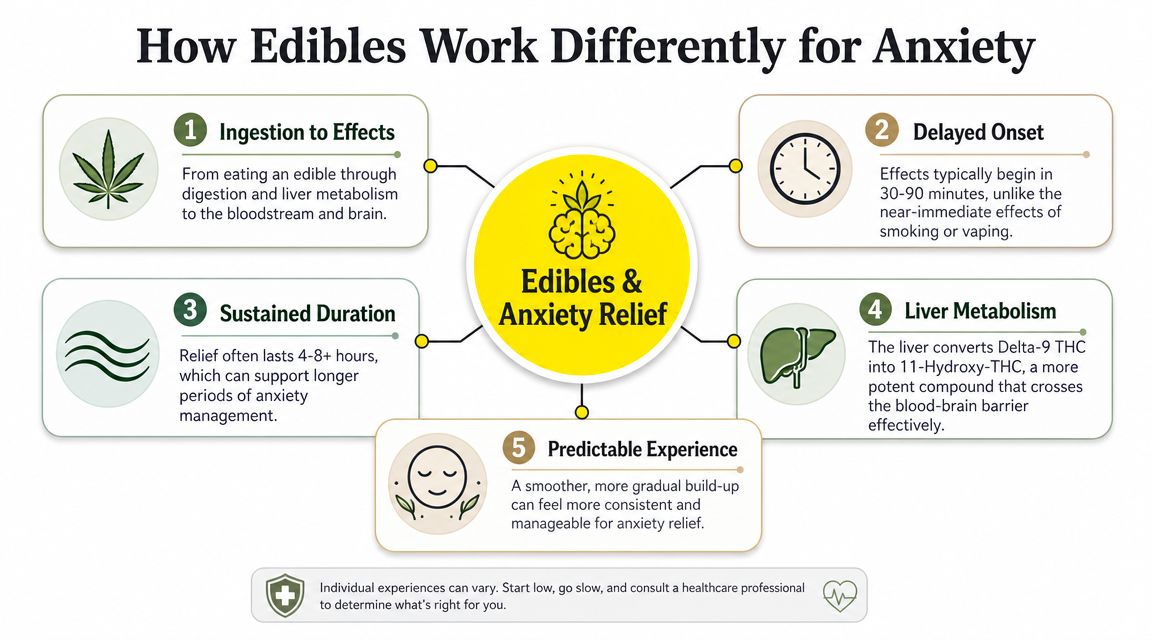
The slow route changes the experience
Think of inhaled cannabis like flipping a faucet on. You feel it quickly, and you can react quickly. Edibles are more like filling a bathtub. It takes longer, but once the water level rises, it tends to stay there.
One consumer guide notes that edible effects typically begin 30 minutes to 2 hours after ingestion and can last 6 to 8 hours, sometimes extending to 12 to 24 hours depending on dose and formulation, which is why anxiety-focused products tend to favor controlled, incremental dosing formats such as gummies and balanced edibles (Mellow Fellow's guide to edible timing and anxiety-friendly formats).
That delayed onset is exactly why some people get into trouble. They take one gummy, feel nothing after a while, take more, and then both doses arrive together. With anxiety, that can turn a calming plan into an overstimulating one.
Why the body feel can be different
Your body has an endocannabinoid system, which is a network involved in balance. A simple way to think about it is a lock-and-key system. Your body makes its own signaling molecules, and cannabinoids from cannabis can interact with that system too.
Edibles feel different because digestion and liver processing change the pace of that interaction. The result often feels more gradual on the front end and more sustained afterward. That longer runway can suit people who want relief that doesn't disappear quickly, but only if the dose is conservative.
If you want a deeper look at timing expectations, this guide on how long edibles last is a useful companion when you're planning your first trial.
A calm edible routine depends less on chasing fast relief and more on respecting the clock.
What this means in real life
For anxiety, edibles are often better for planned use than impulse use. If you know a stressful evening, social gathering, or restless night is coming, an edible can fit nicely because it builds slowly and stays with you.
Three practical examples:
- Evening unwind: A low-dose gummy taken well before bedtime may suit someone whose mind speeds up at night.
- Social support: A balanced edible used cautiously before a gathering may feel smoother than repeated inhalations.
- Background steadiness: A CBD-forward product can make more sense for daytime use when you want calm without feeling notably altered.
The key isn't speed. It's predictability.
Understanding Cannabinoids and Terpenes for Anxiety
When people talk about cannabis for anxiety, they often throw around initials and strain names without explaining what matters. For buying decisions, you can simplify the chemistry into two main buckets: cannabinoids and terpenes. Cannabinoids drive most of the big-picture effects. Terpenes can help shape the overall feel.
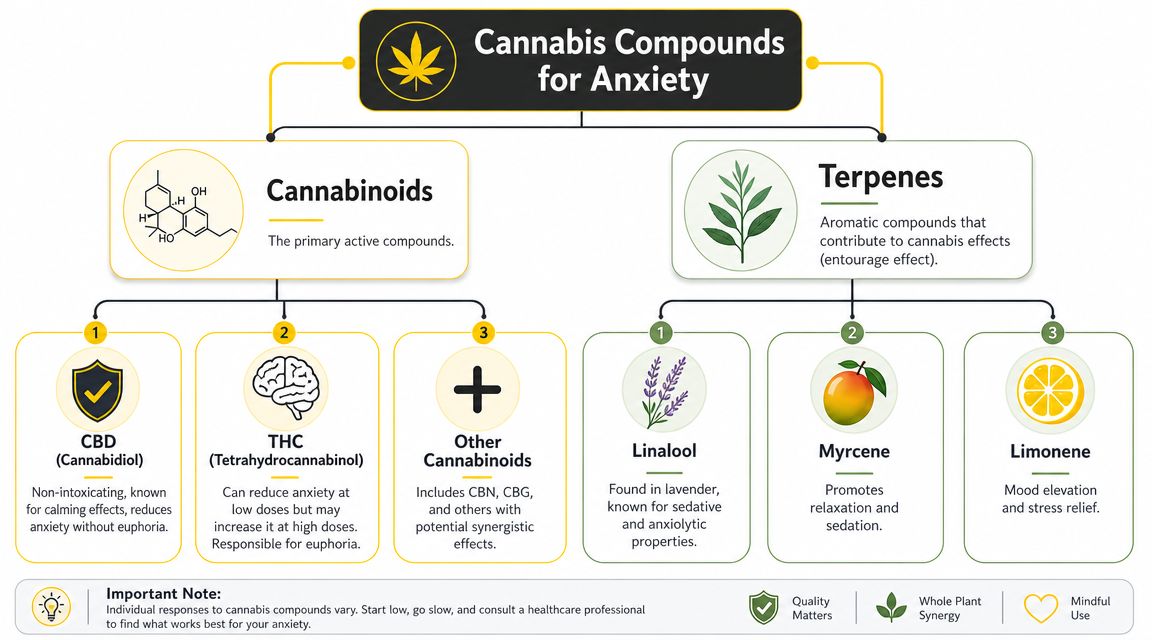
CBD and THC play different roles
A helpful analogy is this. THC can act like an accelerator. CBD can act like a brake. That doesn't mean THC is bad or CBD is magic. It means the balance between them matters, especially for people who are prone to racing thoughts, self-consciousness, or a jumpy body response.
The strongest clinical signal for anxiety relief is for CBD. A review in Cannabis and Cannabinoids in Mood and Anxiety Disorders reported that 9 cohort studies with 20,288 participants found no significant association between cannabis use and future anxiety disorder or anxiety symptoms, while a controlled study cited in that same review found that a one-time CBD dose significantly reduced anxiety and discomfort during a public-speaking test in people with social anxiety disorder (review on cannabinoids in mood and anxiety disorders).
That's a big reason many anxiety-focused edibles lean toward CBD-dominant formulas or balanced ratios rather than THC-heavy products.
Why balanced ratios make sense
A 1:1 THC:CBD edible means the product contains equal amounts of THC and CBD. Many shoppers like that middle lane because CBD may soften some of the sharper edges that THC can create for sensitive users.
In plain terms:
- CBD-dominant products often fit people who want the least intoxication.
- 1:1 products can fit people who want noticeable relief but a more anchored feel.
- THC-heavy products may be better left for people who already know they tolerate THC well.
A practical example: if you're comparing a CBD-rich gummy with a potent THC-only candy, the CBD-rich option is usually the more sensible starting place for anxiety because it leaves more room for caution.
The most useful ratio is the one that lets you feel calmer without feeling trapped inside the experience.
Where terpenes fit in
Terpenes are aromatic compounds found in cannabis and many other plants. They're part of why lavender smells like lavender and citrus smells bright. In edibles, terpene information can help you understand whether a product leans more soothing, heavy, or uplifting, though the cannabinoid profile should still do most of the decision-making work.
If you'd like a plain-English primer, this guide to terpenes in weed breaks down how these compounds can influence the feel of a product.
Common calming terpene names you may see include:
- Linalool: Often associated with a softer, more floral profile.
- Myrcene: Often described as relaxing or heavier.
- Limonene: Sometimes chosen by people who want stress relief with a brighter mood.
Terpenes are useful. They're just not the first thing to shop by. For anxiety, the cannabinoid ratio usually matters more.
Choosing the Right Edible Format
Format matters more than many people expect. Two products can contain similar cannabinoids but still feel very different to shop, dose, and live with. When anxiety is the concern, the right format is usually the one that creates the fewest surprises.
The easiest formats for most beginners
Gummies are often the cleanest starting point. They're portioned, portable, and simple to split if needed. If you want half now and half later, that's usually easier with a gummy than with a brownie.
Tinctures appeal to people who want finer dose control. They're especially useful if you prefer to measure carefully instead of committing to a full piece of candy.
Capsules are great for routine-minded users. They remove the temptation to eyeball a portion and can feel more like a standard wellness product.
What can make some formats trickier
Chocolate and baked goods can be enjoyable, but they're not always the easiest for anxious beginners. Portions can feel less obvious, and people sometimes treat them like snacks instead of cannabis products. That can lead to casual overconsumption.
Drinks and mints can work well for some shoppers, but they require the same label-reading discipline as any other edible. The more “normal” the product feels, the easier it is to forget that dosing still matters.
Here's a side-by-side comparison to make the decision easier.
| Format | Dosing Precision | Typical Onset | Best For |
|---|---|---|---|
| Gummies | High | Slower onset typical of standard edibles | Beginners, microdosing, easy portion control |
| Tinctures | Very high | Can vary by use method | Careful titration, custom dosing |
| Capsules | High | Slower onset typical of swallowed products | Routine use, no flavor preference |
| Chocolates | Moderate | Slower onset typical of standard edibles | People who prefer a familiar treat |
| Baked goods | Lower to moderate | Slower onset typical of standard edibles | Experienced users who can portion carefully |
| Mints or lozenges | Moderate to high | Can feel more flexible depending on product | Discreet, smaller daytime use |
For a broader comparison across categories, this overview of edibles vs. vapes vs. flower helps place edibles in context.
A simple way to choose
If you want the shortest path to a safe first purchase, use this shortcut:
- Pick gummies if you want simplicity.
- Pick tinctures if you want fine control.
- Pick capsules if you value routine and consistency.
- Skip oversized or loosely portioned treats until you know your response.
The best edible format for anxiety is usually the one that makes cautious dosing feel easy, not annoying.
A Practical Guide to Dosing and Microdosing
Edible experiences can be good or ruined, depending on one critical aspect. The main risk with edibles and anxiety isn't that they can't help. It's that people often get impatient.
A practical dosing guide for anxiety-focused edibles notes that oral cannabinoids have a delayed onset of 30 minutes to 2 hours and a long duration of 6 to 8 hours, which is why low-dose, balanced formulations and slow titration are the standard approach (Stoops NYC's dosing overview for anxiety edibles).
Start with the smallest amount that gives you useful information. You're not trying to prove anything. You're trying to learn how your body responds.
A visual step-by-step can help keep the process grounded.
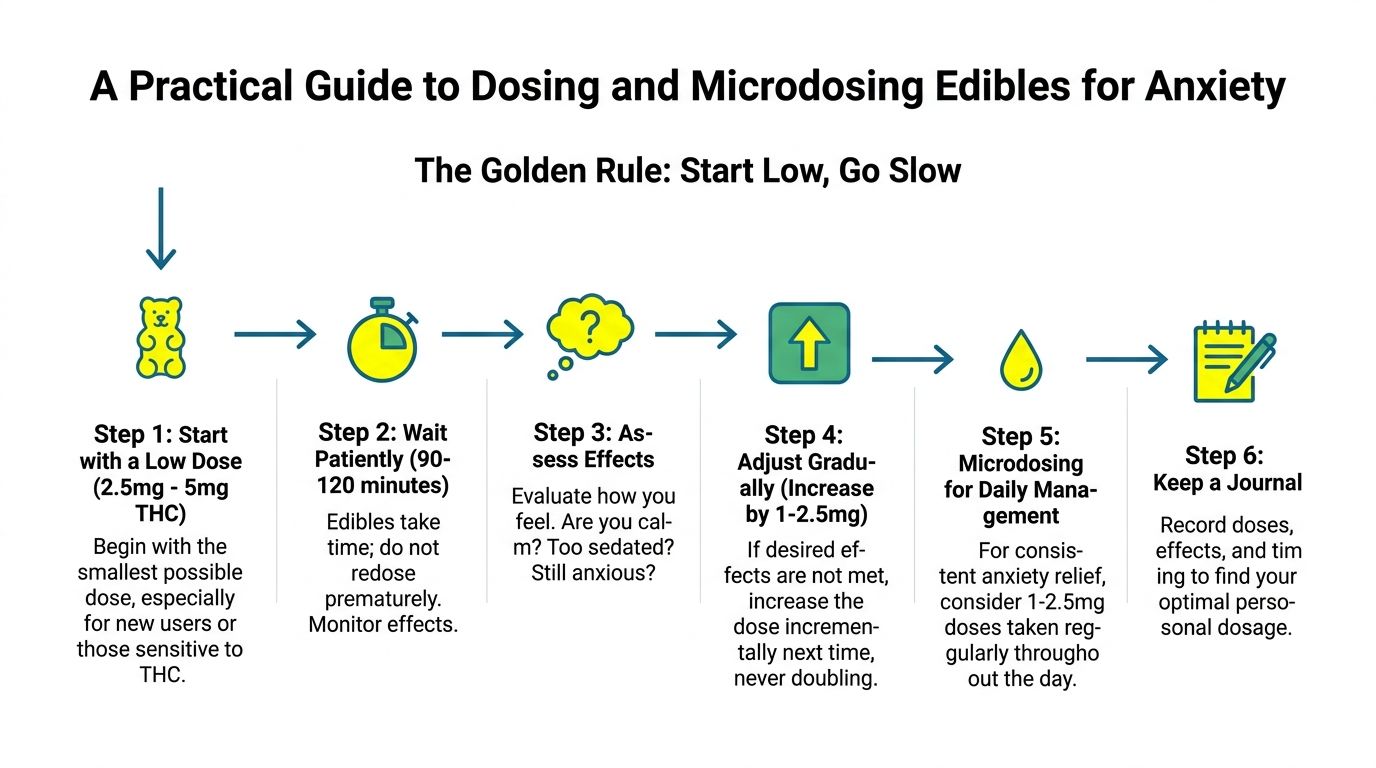
A simple self-titration framework
Use a structured routine instead of improvising.
Choose a low-dose product
A gummy that's easy to split is often ideal. If the product is stronger than you want, divide it before you start.
Take your first dose when you have nothing urgent to do
Your first trial shouldn't happen right before a crowded event, a family dinner, or a stressful errand.
Wait fully before judging it
Don't stack doses because you're nervous it isn't working.
Write down what happened
A short note is enough. Time taken, how much, when effects started, and how you felt.
Here's a practical example. If a gummy is scored into pieces, one small portion may be enough for a first trial. If you use a tincture, start with a measured amount that keeps the experience conservative rather than ambitious.
Later, if you want more precision with liquid products, this cannabis tincture dosage guide is worth keeping open while you compare labels.
What microdosing looks like
Microdosing means using a very small amount with the goal of subtle support instead of a strong psychoactive effect. People often choose this route when they want to stay clear-headed, functional, and less emotionally reactive.
That can look like:
- Daytime support: A tiny amount from a CBD-rich gummy before a stressful work block.
- Social easing: A very conservative balanced dose before a low-stakes gathering.
- Evening decompression: A small amount taken early enough that the build feels predictable.
This video gives a useful visual companion to the process:
Keep this in your notes app: dose, time taken, whether you ate beforehand, time effects began, and whether you felt calm, foggy, sleepy, or overstimulated.
How to know you've found your dose
Your ideal dose is not the one that makes you feel the most. It's the one that gives the most relief with the least friction.
Signs you may have found a workable range:
- You feel steadier, not pinned to the couch
- Your thoughts feel less sharp-edged
- You can still hold a normal conversation
- You don't feel pressure to “fix” the experience by taking more
That's the target. Gentle, repeatable, and boring in the best way.
What to Look for When Buying Edibles
Shopping gets much easier once you know what deserves your attention on the package and what's just marketing glitter. For anxiety, the label should answer one question clearly: Will this product let me control the experience?
Your label-reading checklist
Use this checklist every time:
- Cannabinoid ratio first: Look for CBD-rich or balanced formulas before anything THC-heavy.
- Milligrams per piece: You want to know the amount in each gummy, capsule, or serving, not just the total in the package.
- Serving clarity: Individually portioned pieces are easier to manage than vague “break and share” formats.
- Ingredient transparency: Especially important if you're sensitive to sugar, gelatin, or common allergens.
- COA access: A reputable product should have lab testing available.
- Brand consistency: Choose products from regulated, transparent sellers rather than mystery packaging.
A practical comparison makes this easier. If you're deciding between a CBD-forward gummy and a THC-only chocolate with a bold potency pitch, the gummy is generally the more defensible anxiety choice because it gives you a lower-intoxication starting point and usually cleaner portion control.
Why high-THC labels deserve caution
A major review notes that high quantities of Δ9-THC can produce anxiety, agitation, and other aversive effects, especially when CBD and other cannabinoids are low, which is why higher-CBD and lower-THC products are generally the safer starting point for anxiety-focused shoppers (review on THC, CBD, and anxiogenic effects).
That doesn't mean every THC product is a bad fit. It means anxiety shoppers should be especially skeptical of products that frame intensity as the main selling point.
Questions worth asking before you buy
Ask a budtender or ask yourself:
- Is this product easy to split or measure?
- Does it lean CBD-forward or balanced?
- Would I feel comfortable waiting out the full duration if it feels stronger than expected?
- Am I taking any medications that deserve a pharmacist or physician check first?
If you're unsure between two products, choose the one with the clearer label and the gentler ratio.
That's usually the smarter buy.
Find Your Edibles at Mr. Nice Guys DC
For most shoppers, the hard part isn't wanting relief. It's translating all this into an actual purchase that feels safe and sensible. That's where a curated menu helps.
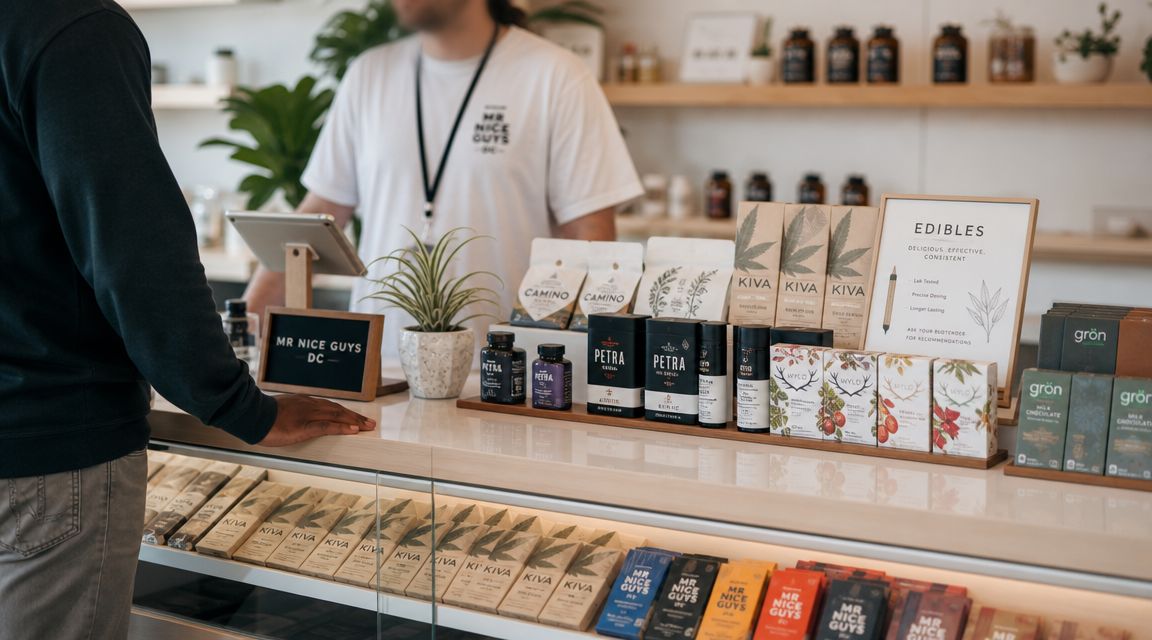
A practical dispensary experience should make it easier to sort by CBD-rich options, balanced ratios, low-dose formats, and clear labeling. That matters for anxiety because the whole goal is reducing uncertainty. If you can quickly compare gummies, tinctures, and other edible formats by their cannabinoid profile and serving structure, you're already making a better decision than someone buying based on packaging alone.
For shoppers who want to confirm what kinds of edible and vape categories are available before visiting, this overview of whether Mr. Nice Guys DC offers edibles or vape products gives a simple starting point.
A few practical ways to shop more confidently:
- Filter for ratio, not hype: Start with CBD-forward and balanced products.
- Favor portioned formats: Gummies, capsules, and measured tinctures usually make safer first picks.
- Ask for education, not just recommendations: A good conversation should include onset, duration, and how to titrate.
- Think about your actual use case: Daytime calm, social ease, and bedtime settling may point you toward different products.
If you're comparing menus, one useful option is Mr. Nice Guys DC, which carries edibles as part of its cannabis selection and provides patient guidance for people looking at formats that may support anxiety-related goals.
The most reliable outcome comes from matching the product to your sensitivity, schedule, and tolerance. That's what turns a confusing menu into a manageable choice.
If you want help narrowing down a CBD-rich gummy, a balanced edible, or a low-dose option you can titrate carefully, visit Mr. Nice Guys DC. A clear label and the right ratio can make all the difference.
Mr Nice Guys DC
At Mr. Nice Guys DC, we’re more than just a cannabis delivery service — we’re passionate advocates for quality, convenience, and community. With years of experience in the cannabis industry, our team is dedicated to educating and empowering customers across Washington, D.C. Whether you're a seasoned user or just starting your cannabis journey, our blog delivers trusted tips, product insights, and the latest updates from the world of weed. Stay informed, stay elevated.
