
Must Be 21 To Enter
By entering this site you are agreeing that you are at least 21 Years of Age or older.
I AM 21 OR OLDERWhat Is Medical Certification for Cannabis in DC


In DC cannabis, medical certification is the self-certification or registered-practitioner recommendation plus government registration that authorizes a patient to buy, not a specialty medical diploma and not a diagnosis alone.
If a doctor says cannabis may help, what still has to happen before a dispensary can complete the sale? That's the missing piece in many explanations of what medical certification means. A clinical recommendation and legal purchasing access aren't interchangeable, and booking a provider appointment isn't always your first step.
The practical starting point is your age and residency. From there, you can choose the right application path, gather the documents that support it, and arrive with a registration staff can verify.
What Medical Certification Means in DC Cannabis
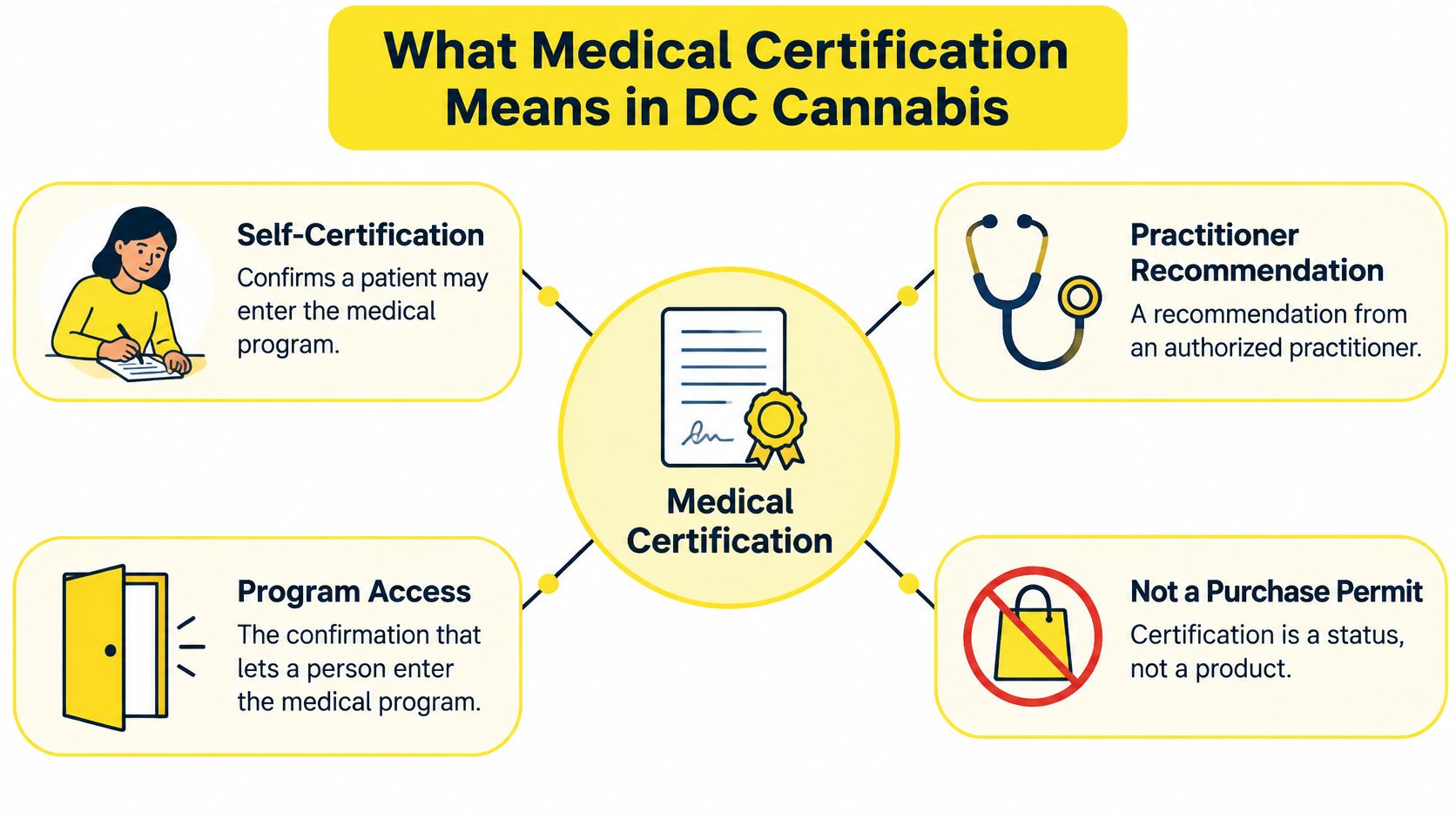
A clinical recommendation and a dispensary-ready registration are two different things. In DC's medical cannabis program, certification works as an eligibility chain: a patient either self-certifies or obtains a recommendation from an authorized healthcare practitioner, then completes government registration before buying.
The Alcoholic Beverage and Cannabis Administration, or ABCA, administers that registration process. Where a recommendation is required, the practitioner establishes medical eligibility. ABCA registration supplies the authorization to purchase through the regulated medical program.
The phrase causes confusion because certification means something else in other settings. In professional medicine, it can describe a physician's specialty credentials, separate from a license to practice. Nobody at a DC dispensary is checking for that kind of credential. Staff verify your program registration.
Who needs a recommendation in DC
According to ABCA's patient registration guidance, adults 21 and older may self-certify, applicants 18 to 20 must provide a healthcare recommendation number, and minors need a recommendation and a registered caregiver. The guidance also describes a temporary digital registration issued while staff review the application, followed by a full digital registration.
| Who you are | What you need | Registration result | Doctor required |
|---|---|---|---|
| DC resident 21 or older | Self-certification, or an optional provider recommendation | Temporary digital registration, then full registration after staff review | No |
| Adult 18 to 20 | Healthcare recommendation number plus the patient application | Temporary digital registration, then full registration after staff review | Yes, an authorized practitioner recommendation |
| Minor | Practitioner recommendation and a registered caregiver | Registration tied to the caregiver | Yes, an authorized practitioner recommendation |
| Non-resident 21 or older | Non-resident self-certification pass and required ID | Non-resident registration with its own validity rules | No |
Doctor is shorthand in that table, not a restriction to physicians alone. Eligible recommending practitioners include physicians, naturopathic physicians, advanced practice registered nurses, physician assistants, and dentists in good standing who are registered with ABCA.
For a practical comparison, consider an adult Shaw resident who qualifies for self-certification and a younger adult who needs a practitioner recommendation. Even if they describe identical symptoms, their application requirements aren't identical. Age determines the certification route, not the similarity of their medical concerns.
Instead of self-certifying, an eligible adult can still consult a licensed healthcare provider for a recommendation. That may be useful for discussing symptoms, medications, or treatment questions, even when a provider visit isn't required for access.
Keep the paperwork separate
Don't put every document into the mental category of medical card. Each record serves a different purpose:
- Clinical documentation records the assessment supporting a practitioner's recommendation.
- The patient application supplies the information and supporting documents the government needs to register you.
- The digital registration is the program record you need for purchasing access.
Say you attend a medical appointment on Monday and leave with a visit summary. That summary may explain your symptoms and treatment discussion, yet it doesn't prove you completed registration. Even a valid recommendation isn't a substitute for the government application.
Visitors need a different application route. At Mr. Nice Guys DC, nonresidents must buy a non-resident self-certification pass to purchase through our medical program, rather than use the resident path.
ABCA's medical cannabis patient page distinguishes resident and nonresident registration requirements and explains the extension of temporary registrations from 30 to 90 days. Visitors shouldn't assume the resident registration duration applies to their pass.
Practical rule: Bring evidence of your registered status, not just evidence that you spoke with a clinician.
The distinction also helps explain medical versus recreational shopping in DC. The relevant question at a medical dispensary isn't whether cannabis is involved. It's whether you've completed the patient-access process for that regulated program.
Fees Photos and Proof to Upload
| Item | Standard | Reduced | What counts |
|---|---|---|---|
| New registration | $100 | $25 with income or benefit verification | Photo, government photo ID, and residency proof for DC residents |
| Renewal registration | $100 | $25 with income or benefit verification | Updated application and the same identity and residency evidence |
| Replacement card | $90 | $20 | Replacement request after an existing registration |
| Face photo | Required | Required | Current 2-by-2-inch photo |
| Photo identification | Required | Required | Government-issued photo ID |
| DC residency evidence | Required for residents | Required for residents | DC REAL ID, residential lease, recent utility bill, DC vehicle registration, or pay stub under 45 days showing DC income-tax withholding |
These fees and document specifications appear in ABCA's adult patient application: standard new and renewal registrations are $100, the qualifying reduced fee is $25, and replacement cards cost $90 or $20 at the reduced rate. The application specifies a current 2-by-2-inch face photo and accepts a qualifying pay stub issued less than 45 days before application.
Treat the table as a government-fee budget, not an all-inclusive quote for obtaining cannabis. A private practitioner may charge separately for a consultation. Products and transportation are separate expenses, too, and you should confirm the applicable registration charge before paying.
Build a packet a reviewer can follow
Start with a clear face photograph and a readable copy of your government-issued photo ID. Check the uploaded files before submitting them. Cropped names, obscured document edges, or glare over important information can leave a reviewer unable to verify what you intended to provide.
If you're applying as a resident, add accepted residency evidence. Choose a document that clearly connects your identity to your District address rather than relying on a mailing address typed into the application.
Reduced-fee applicants also need the supporting benefit or income evidence. A Medicaid card, DC Alliance card, or qualifying income documentation supports a different part of the application than a lease does. Proof of residency and proof of reduced-fee eligibility aren't interchangeable.
A reduced-fee packet in practice
Suppose a qualifying resident has a government photo ID, a residential lease, and a Medicaid card. They would prepare the face photo and ID for identity verification, the lease for residency, and the Medicaid card for the reduced-fee request. The reviewer can then evaluate each requirement without guessing what a document is meant to establish.
- Identity packet: A current face photo and readable government photo identification.
- Resident packet: Accepted evidence showing the applicant's District residency.
- Fee-support packet: Benefit or income evidence when requesting the reduced rate.
- Recommendation record: The required practitioner information when the applicant's path calls for it.
A complete upload packet can't fix a recommendation from an unauthorized or unregistered practitioner. Likewise, a proper recommendation can't replace missing identity or residency evidence. Assemble the packet that matches your application category and fee tier before opening the form.
Whether Certification Stays Worth the Cost
Certification is worthwhile when it gives you usable, compliant access at a cost you can maintain. That's a more useful test than asking whether having a diagnosed condition automatically makes registration a good financial decision.
Start with the access benefit. Registration lets an eligible patient purchase through the regulated medical program, but it doesn't promise lower total spending or a particular treatment result. A practitioner recommendation, when required, supports eligibility rather than guaranteeing that every product will help.
Compare the whole expense
Your government fee is only part of the calculation. Add any practitioner consultation, future recertification appointments, product purchases, and the practical cost of getting to a dispensary.
The New York Office of Cannabis Management's 2025 annual report identifies out-of-pocket certification and recertification consultations, lack of insurance coverage for cannabis products, high prices, and dispensary distance as reasons patients may leave a medical program. About one-third of surveyed patients considered leaving, with dispensary distance cited as a main factor.
That finding describes New York patients, not a forecast for DC. Its practical lesson still helps: access on paper isn't necessarily convenient or affordable access in daily life.
| Budget question | What to put in your calculation |
|---|---|
| Do I need a practitioner? | The consultation charge, if your path requires or you prefer a recommendation |
| What must I pay the government? | The applicable registration category and any reduced-fee eligibility |
| What will I buy? | Expected product spending, without assuming insurance reimbursement |
| How will I obtain it? | Travel time, transportation costs, and available fulfillment arrangements |
Compare different patient situations
An adult resident eligible to self-certify can avoid an optional clinic expense. Their budget still needs room for registration, products, and the trip or fulfillment arrangement. Skipping the appointment doesn't make the rest of the process free.
A younger applicant whose path requires a recommendation has a different calculation. They should include the consultation before deciding what they can comfortably spend on products. If the appointment is remote, they should still confirm the provider's authority and the total charge before booking.
A useful registration is one you can both obtain and keep using without overlooking the recurring costs.
Understanding what a medical dispensary does also helps set expectations. Registration establishes program access; choosing a suitable product and maintaining a manageable budget remain separate decisions.
How to Get Certified Step by Step
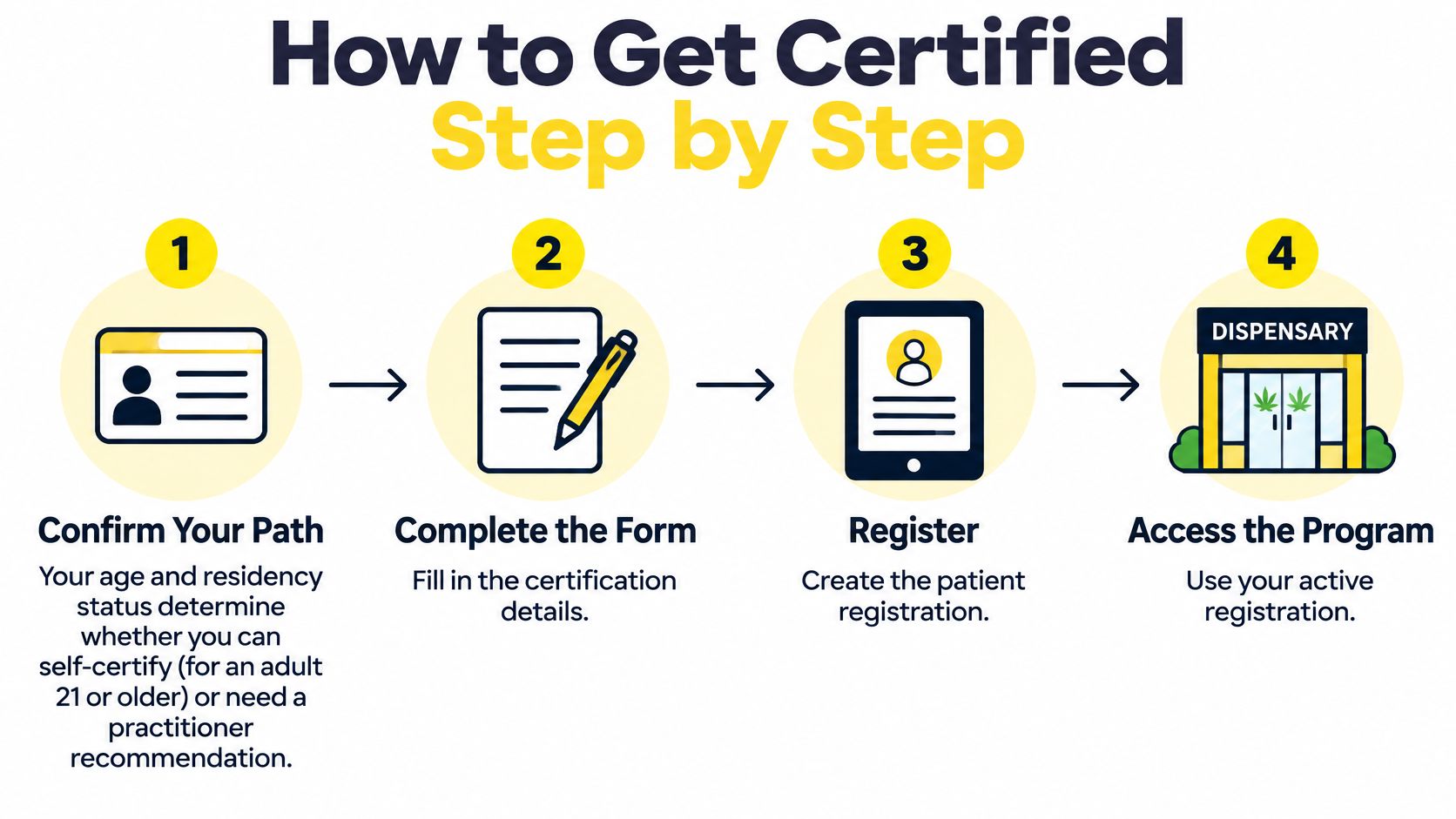
Build the application around one outcome: an active ABCA registration you can show at check-in with matching ID. In DC the path is an eligibility chain, not a single doctor's document. A resident age 21 or older can often self-certify without a healthcare provider's recommendation. A patient who needs or prefers clinical oversight uses a DC-licensed practitioner registered with ABCA. A nonresident must buy a nonresident self-certification pass. Proof of age and registration come before any purchase is finalized.
A clinic receipt, a booked appointment, and a saved draft can all feel like progress. None of them is the finished credential. The finished credential is the government registration record that dispensary staff can verify.
Prepare before you submit
Choose your age and residency path. Decide whether you're applying as a self-certifying DC resident, a patient using a healthcare recommendation, a minor with a caregiver, or a nonresident purchasing a pass. Do not choose the resident form merely because you're staying in DC during your visit.
Obtain a recommendation if required or preferred. Use an eligible DC-licensed practitioner in good standing who is registered with ABCA. Before paying for an appointment, confirm that the service supplies the recommendation information needed for the patient application, not just a general visit summary.
The common slip here is treating a clinician's receipt as certification paperwork. A receipt proves payment; it does not establish practitioner authority or supply a missing recommendation detail.
Prepare readable documents. Gather the face photo, government photo ID, and accepted residency proof for a resident application. Add benefit or income evidence if requesting the reduced fee, and save each file under an obvious name so you can select the right upload.
Complete the government registration online. Use ABCA's official patient-registration process for the route that matches your path. A provider portal may collect visit details, while the registration status comes from the government record. For the resident path, have a valid ID and proof of residency ready before submitting.
Finish the registration process
Pay the applicable government fee. Select the correct registration category and submit the supporting evidence for any reduced-fee request. Keep the payment confirmation with your application records so you can distinguish a paid submission from a saved draft.
Save the temporary digital registration. Approved applicants can receive their medical cannabis card within minutes. Read the registration you receive, confirm its status and expiration, and retain the actual document rather than only the email subject line.
Keep the reviewed registration and plan renewal. After successful staff review, save the resulting longer-term digital registration and put its expiration in your calendar. Use the expiration shown on your own record, especially if you're applying through the nonresident route.
A telehealth appointment may supply a required recommendation where permitted. It does not upload your documents, pay the government fee, or submit the patient application unless those services are expressly included and completed. Mr. Nice Guys DC supports both self-certification and certification through a traditional healthcare provider, so bring questions about the counter process before you buy.
Before heading out, use our first-visit medical cannabis guide to prepare for check-in. Save your registration where you can retrieve it quickly, and bring the matching ID.
Renewal Limits and Rules That Can Void Access
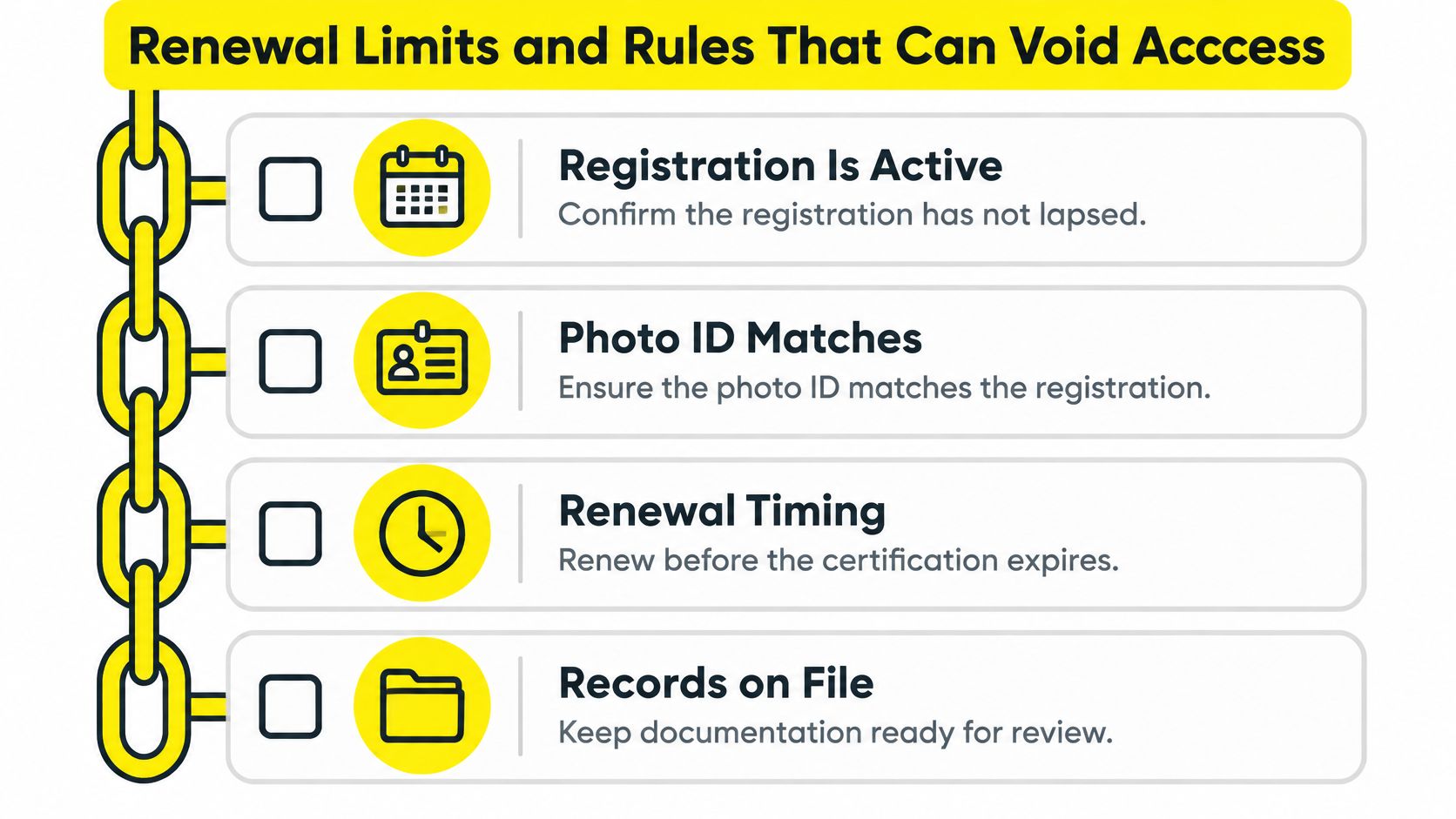
A registered patient may purchase up to 8 ounces within a rolling 30-day period, according to ABCA's adult patient application and eligibility requirements. Registration therefore isn't unlimited purchasing permission: staff still need to verify active status, matching identity, the correct recommendation path, and remaining purchasing allowance.
Rolling matters. Don't assume a new calendar month automatically resets your allowance. Check your recent purchasing history before planning an order close to the limit.
A medical need doesn't keep a registration active
Your symptoms may remain unchanged after your registration expires. That doesn't extend the government record or let a retailer treat an expired registration as current.
Renew before the expiration shown on your registration, and prepare whatever updated identity, residency, or fee-support evidence the renewal application requires. Reduced-fee eligibility should be supported at renewal where required, not assumed to carry forward without verification.
Telehealth doesn't remove these controls. A video visit can make a practitioner consultation more convenient, but the patient still has to satisfy identity and application requirements. It also doesn't remove government charges, product expenses, or the need for active registration.
Correct the assumptions that cause trouble
- Self-certification isn't universal. Applicants below the adult self-certification threshold need the appropriate recommendation and caregiver arrangements.
- A dispensary can't override inactive status. An old registration or a sympathetic explanation doesn't supply current authorization.
- A short visit doesn't establish DC residency. Bona fide residency requires physical presence and verifiable steps to make the District your indefinite home, not presence solely to obtain medical cannabis.
For example, staying with a friend while visiting DC doesn't automatically make the friend's address acceptable resident evidence. Use the nonresident route when that describes your circumstances rather than trying to fit a visitor's situation into a resident application.
At Mr. Nice Guys DC, we comply with the Medical Cannabis Clarification and Program Enforcement Emergency Amendment Act of 2024. Customers must register for a license before finalizing purchases, and our patient compliance guidance helps explain what that means at check-in.
Before ordering: Confirm active status, matching ID, the correct age-based path, and room in your rolling purchase allowance.
Those checks are more useful than asking whether you still possess the original form. The operative question is whether every part of your eligibility remains valid today.
Confirm Your Path Before You Buy
If you qualify for adult self-certification, choose that route or an optional provider consultation, complete registration, and wait until you have usable digital authorization. Don't schedule a medical appointment solely because you assume every patient needs a doctor-issued cannabis document.
If your age requires a recommendation, wait to shop until that requirement and registration are complete. A minor's caregiver should also resolve caregiver registration before expecting access. Visitors should obtain the nonresident pass and prepare matching identification rather than arrive with an unfinished resident application.
Make check-in straightforward
At Mr. Nice Guys DC, proof of age showing you're 21 or older is required to purchase. At check-in, customers show ID and a medical card or self-certification, and kiosks are available to help customers self-certify.
We're a registered medical cannabis dispensary holding an official medical cannabis retailer license. We provide clear instructions and support for both self-certification and certification through a traditional healthcare provider. That support helps you complete the right process; it doesn't replace the registration requirement.
Before making the trip, have these ready:
- Your correct application category: Resident, nonresident, or the recommendation-based path that applies to you.
- Your usable registration: The actual digital record, not just a clinic receipt or application draft.
- Your matching identification: Ready to present with your patient-access documentation.
No active registration, no purchase, however real the medical need.
Choose the route that matches your circumstances, finish it, and then plan your visit using our guide to where to buy medical cannabis. Once your registration is active, you can arrange pickup, curbside, or available delivery rather than trying to solve eligibility after placing an order.
Mr. Nice Guys DC offers practical guidance on self-certification, provider-based recommendations, and the paperwork needed for compliant check-in. Visit Mr. Nice Guys DC to get help choosing your registration path and prepare your ID and active registration before purchasing.
Mr Nice Guys DC
At Mr. Nice Guys DC, we’re more than just a cannabis delivery service — we’re passionate advocates for quality, convenience, and community. With years of experience in the cannabis industry, our team is dedicated to educating and empowering customers across Washington, D.C. Whether you're a seasoned user or just starting your cannabis journey, our blog delivers trusted tips, product insights, and the latest updates from the world of weed. Stay informed, stay elevated.
