
Must Be 21 To Enter
By entering this site you are agreeing that you are at least 21 Years of Age or older.
I AM 21 OR OLDERWhat Is a Dispensary? Medical and Recreational Guide


A dispensary is a licensed, regulated cannabis retailer that verifies eligibility, records transactions, and sells permitted products to medical patients, qualifying adult consumers, or both, depending on local law. In Washington, DC, registered medical patients may purchase up to 8 ounces during a rolling 30-day period, so shopping involves more than choosing something from a menu.
You might be browsing on your phone, deciding whether to visit a store or request delivery, and wondering what documents you'll need. The useful starting point isn't which product looks appealing. It's understanding who's authorized to sell it, whether you're eligible to purchase it, and what checks happen before you receive it.
Why the Dispensary Question Matters
You've found a DC cannabis menu with flower, gummies, and vape cartridges. Another website advertises delivery, while a nearby storefront looks like an ordinary boutique. As a first-time patient, you might reasonably wonder whether these sellers all operate under the same rules.
A professional-looking website isn't proof of authorization. In DC, medical cannabis retailers must be licensed by the Alcoholic Beverage and Cannabis Administration, or ABCA, before they may dispense, sell, possess, or deliver medical cannabis. The agency's medical cannabis retailer directory gives patients a practical place to check authorization rather than relying on advertising.
Start with the seller, not the shopping cart
Suppose you're choosing between collecting an order after work and having it delivered. Before comparing convenience, confirm the business's status and ask what documentation it requires. A seller's willingness to skip questions shouldn't make the transaction seem easier or more legitimate.
Your initial questions can stay straightforward:
- Authorization: Can I confirm that this business is a licensed medical retailer?
- Access: What patient credentials will I need for this transaction?
- Product information: Can staff explain the label and identify the product's origin?
- Fulfillment: Is my preferred pickup or delivery arrangement permitted and available?
Those questions matter whether you're a longtime patient, a visitor researching access, or someone helping a family member prepare.
Practical rule: Treat licensing as the starting point, not a detail to investigate after placing an order.
The question "what is a dispensary?" therefore has a practical answer beyond a dictionary definition. You're identifying a regulated access point, not a business with cannabis on its shelves. That distinction helps you judge menus, conversations, and ordering options without confusing polished retail service with legal authorization or medical expertise.
Understanding How Dispensaries Work
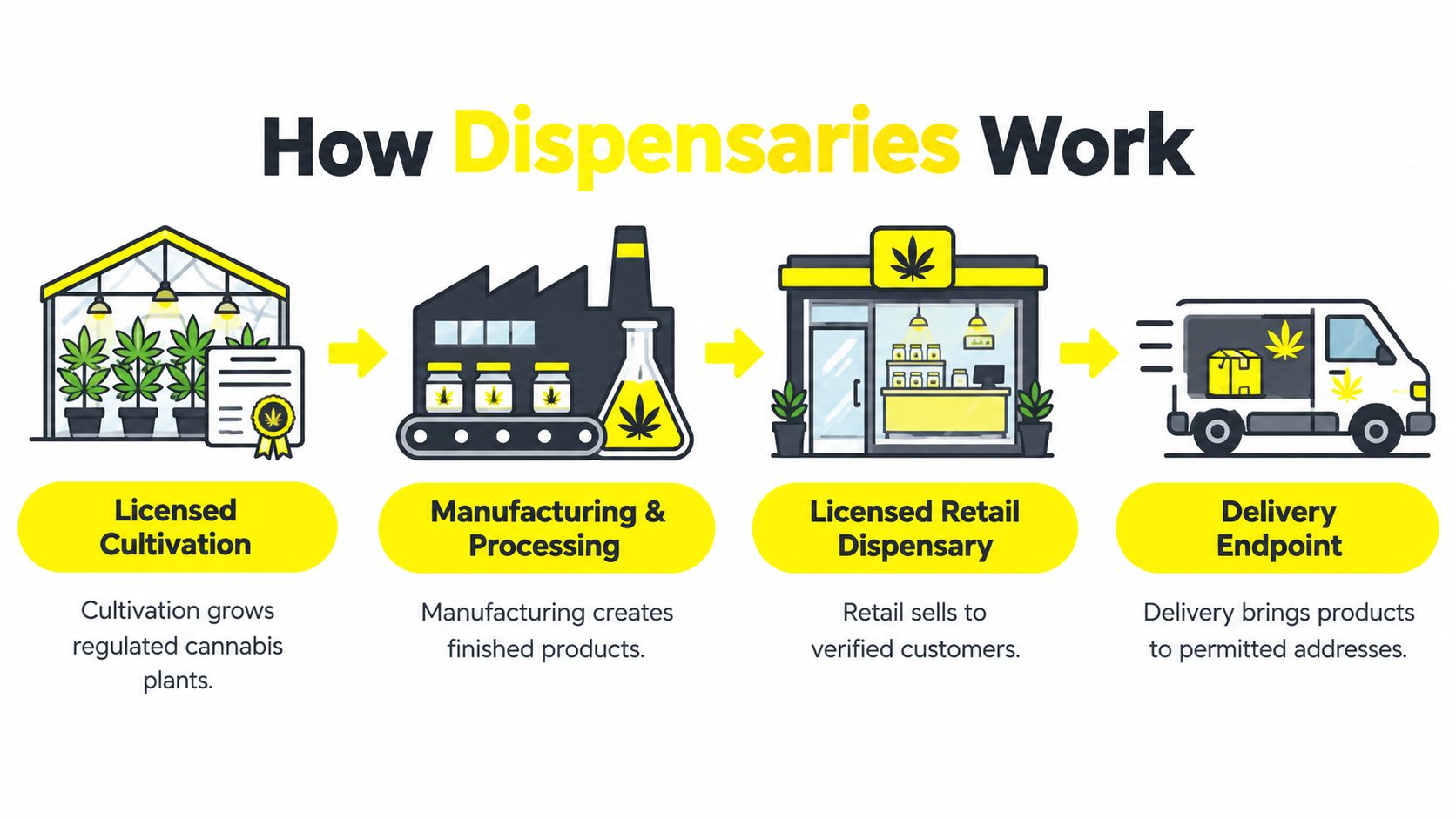
Think of a dispensary as the customer-facing endpoint of a controlled supply system. The package on the counter has a history before you see it: cultivation, processing where applicable, product checks, distribution, and inventory handling.
The storefront is the visible part. The less visible work connects the product to authorized businesses and connects its eventual sale to an eligible purchaser.
This process diagram shows the main business stages, although testing and other regulatory controls also apply between stages.
Follow the package, not just the storefront
Licensed cultivation produces the cannabis plants. Manufacturing and processing can turn that material into finished formats such as concentrates, tinctures, or edibles. The retailer then handles permitted products within the local system and completes the customer-facing transaction.
Product variety makes that oversight meaningful. A peer-reviewed study of dispensary product offerings sampled 8,505 cannabis products from 653 dispensaries across US medical and recreational markets. That illustrates the range of products a regulated retail system may need to distinguish and track.
Consider an edible package and a flower container on the same menu. They aren't interchangeable inventory because both contain cannabis. Each needs product-specific information, and the retailer must handle the sale under the applicable rules.
What the controls mean for your decisions
The practical connections are easier to understand when you separate their purposes:
- Licensing records help establish which businesses are authorized to participate.
- Labels and product records help identify what's being offered.
- Eligibility checks establish whether the customer may complete the purchase.
- Inventory and transaction records connect the product leaving the retailer to the completed sale.
A delivery order doesn't bypass this system. Where delivery is permitted, it extends the authorized retail process to an approved handoff rather than creating a separate, unregulated purchase.
Local law determines the details. Don't assume that a registration document, purchase allowance, or delivery arrangement accepted in one jurisdiction will work elsewhere. Use the supply-chain model to understand the questions, then check the rules that apply to the actual retailer and destination.
Comparing Medical and Recreational Dispensaries
A medical patient and an adult-use customer might browse similar-looking menus, but they enter through different eligibility pathways. Medical access centers on participation in a patient program. Adult-use access centers on qualifying as an adult under local law. Neither label tells you everything about the products or purchasing rules.
For medical access, registration, qualifying conditions where applicable, and healthcare recommendations may be relevant. Don't assume that “medical” means every purchase follows the same process as filling a conventional prescription. The local program determines what documentation and professional involvement are required.
Medical and recreational dispensary models
| Model | Primary Purpose | Common Eligibility Pattern | Purchase Context |
|---|---|---|---|
| Medical | Cannabis access through a patient program | Patient registration and any applicable condition or recommendation requirements | Patient-specific rules, documentation, and product eligibility |
| Recreational or adult-use | Regulated nonmedical access for qualifying adults | Age verification under local law | Adult-use purchase limits and permitted product categories |
| Hybrid | Serving medical patients and adult-use customers | Verification appropriate to each customer's pathway | Different rules may apply within the same business |
“Recreational” doesn't mean unregulated, and “medical” doesn't automatically mean clinically supervised product selection. Those are separate questions.
The distinction reflects policy choices rather than a universal retail model. Colorado and Washington voters approved statewide regulated nonmedical cannabis-distribution systems in 2012, as described in the NORC report on cannabis policy and patient-centered care.
Apply the distinction before you travel
Suppose you normally shop through an adult-use system and then visit DC. Your previous shopping experience doesn't establish eligibility for a DC medical transaction. Ask how the local patient-access process applies to you before building an order.
Likewise, a medical registration elsewhere shouldn't be treated as automatically accepted everywhere. The sensible question is whether the destination program recognizes your status and what additional steps it requires.
For a locally focused explanation, review medical versus recreational shopping in DC. Use that distinction to prepare questions about your own access pathway, not to infer that every cannabis storefront serves every adult.
The most useful comparison isn't which model sounds more welcoming. It's which lawful pathway you qualify for and what that pathway permits you to purchase.
What Happens During a Dispensary Visit
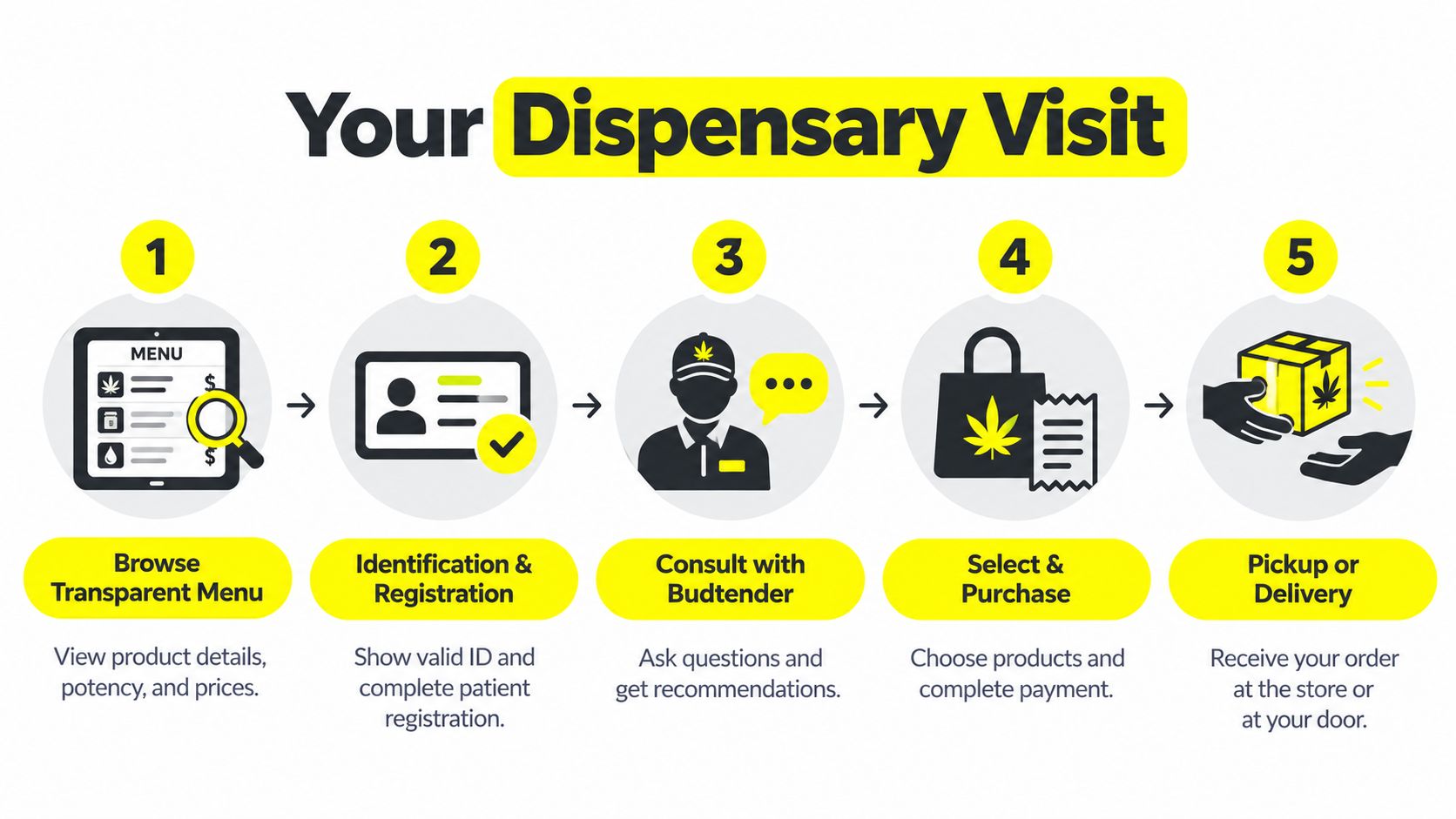
Start by reviewing a menu that makes product details and prices understandable. Confirm availability before making a special trip, and check the retailer's current instructions for identification, registration, payment, and order collection.
The visit follows a simple sequence, but the verification steps remain part of the purchase.
Prepare before checkout
A practical first visit might look like this:
- Before ordering: Confirm the item is available and ask which documents to bring.
- At check-in: Present the required credentials for verification.
- During selection: Ask about ingredients, labeling, and any unclear product details.
- At checkout: Confirm the quantity, applicable purchase allowance, total, and accepted payment method.
- At handoff: Follow the retailer's instructions for collecting or receiving the order.
For example, a patient who recently bought cannabis should check their remaining allowance before assuming a new basket can be fulfilled. An online order confirmation shouldn't be treated as permission to skip the retailer's final compliance checks.
Choose a fulfillment method
In-store shopping, online ordering, pickup, curbside, and delivery describe how you arrange or receive an order, not different eligibility categories. Availability depends on the retailer and applicable rules. A delivery address still needs confirmation, and an online payment option shouldn't be assumed.
Reported market estimates put online ordering at nearly one-quarter of US dispensary sales in 2025, including delivery and curbside pickup, with cash accounting for about 60% of payments; the supplied reference is New York's adult-use retail guidance. For your own visit, checking the store's current options is more useful than relying on a national payment pattern.
For a closer look at visit preparation, use this first-time dispensary visit guide.
This video offers another way to approach the visit process.
Choosing Among Common Cannabis Products
A useful product conversation begins with format and labeling, not a promise about how you'll feel. Bring practical preferences, such as avoiding inhalation or wanting clearer serving information, and ask staff to explain the available options without treating the discussion as a medical assessment.
Use this product map to recognize categories, not as a guarantee of benefits or suitability.

Read different formats differently
| Product format | Practical label question |
|---|---|
| Flower and pre-rolls | What potency information and product details are provided for this inhalable option? |
| Cartridges and pens | What ingredients are listed, and what equipment does the product require? |
| Edibles | Does the label distinguish the serving amount from the whole package? |
| Tinctures | How does the stated cannabinoid amount relate to the measured portion? |
| Concentrates | How is concentration expressed, and what use instructions accompany the product? |
| Topicals | What ingredients and application directions are provided for this non-inhaled format? |
Suppose you're comparing an edible with a tincture. Don't compare only package size or the largest potency number. Ask staff to show you how each label describes a serving or measured portion, then ask what onset and duration information the manufacturer provides.
For a format-focused discussion, explore comparing edibles, vapes, and flower. Your clinician should address whether a format is appropriate for your health circumstances.
Connect the label to testing information
California illustrates how testing fits behind the shelf. Its regulated model requires each batch to pass laboratory testing before retail sale, covering cannabinoids, terpenes, residual solvents, pesticides, heavy metals, microbial impurities, mycotoxins, moisture or water activity, and foreign material. Laboratories issue a Certificate of Analysis, or COA, within the state's cannabis laboratory testing framework.
Where available, ask whether a COA corresponds to the product's batch. That's more useful than accepting a general statement that a brand is tested.
A testing record helps you evaluate product information. It doesn't establish that the product is appropriate for your medications, condition, or treatment plan.
Don't assume California's exact testing requirements apply everywhere. Ask what the local program requires and what documentation the retailer can provide.
Evaluating Dispensary Staff Advice
A knowledgeable staff member can make an unfamiliar label understandable. That's valuable, but retail product education and clinical advice are different services.
Research involving consumers in Chicago and Denver found that they associated dispensaries with better information, higher product quality, safer purchasing, and safer products. The JAMA Network Open discussion of dispensary advice also cautions that commercial interests can conflict with balanced risk-benefit counseling.
Match the question to the right person
Compare these situations. A shopper wants help finding the serving information printed on an edible package. Staff can point to the label, explain package terminology, and discuss the manufacturer's directions.
Another patient takes several medications and wants to know whether cannabis will interact with them. That requires clinical assessment, not a salesperson's reassurance.
- Ask staff about the product: Ingredients, format, available potency information, labeled dosage ranges, and manufacturer-provided onset or duration language.
- Ask a clinician about your health: Drug interactions, pregnancy-related risks, treatment suitability, and whether cannabis belongs in your care plan.
- Ask for the basis of a recommendation: Is the explanation grounded in the label, available testing information, or a general sales preference?
The same boundary applies to personalized product recommendations. Personal attention can improve a shopping conversation without turning it into medical counseling.
Look for transparent limits
An informed employee doesn't need to answer every question. A willingness to say that a clinician should address your concern is a useful sign of appropriate boundaries.
Be cautious if a conversation moves from explaining a product to guaranteeing a treatment result. Ask staff to separate what the package states from what they're inferring.
A useful question: What can you show me on the label, and what should I discuss with my clinician?
You don't need to dismiss staff expertise to protect yourself. Use it for the work it can do well: making product information clearer, identifying unanswered questions, and helping you prepare for a better-informed healthcare conversation.
Following Washington DC Dispensary Rules
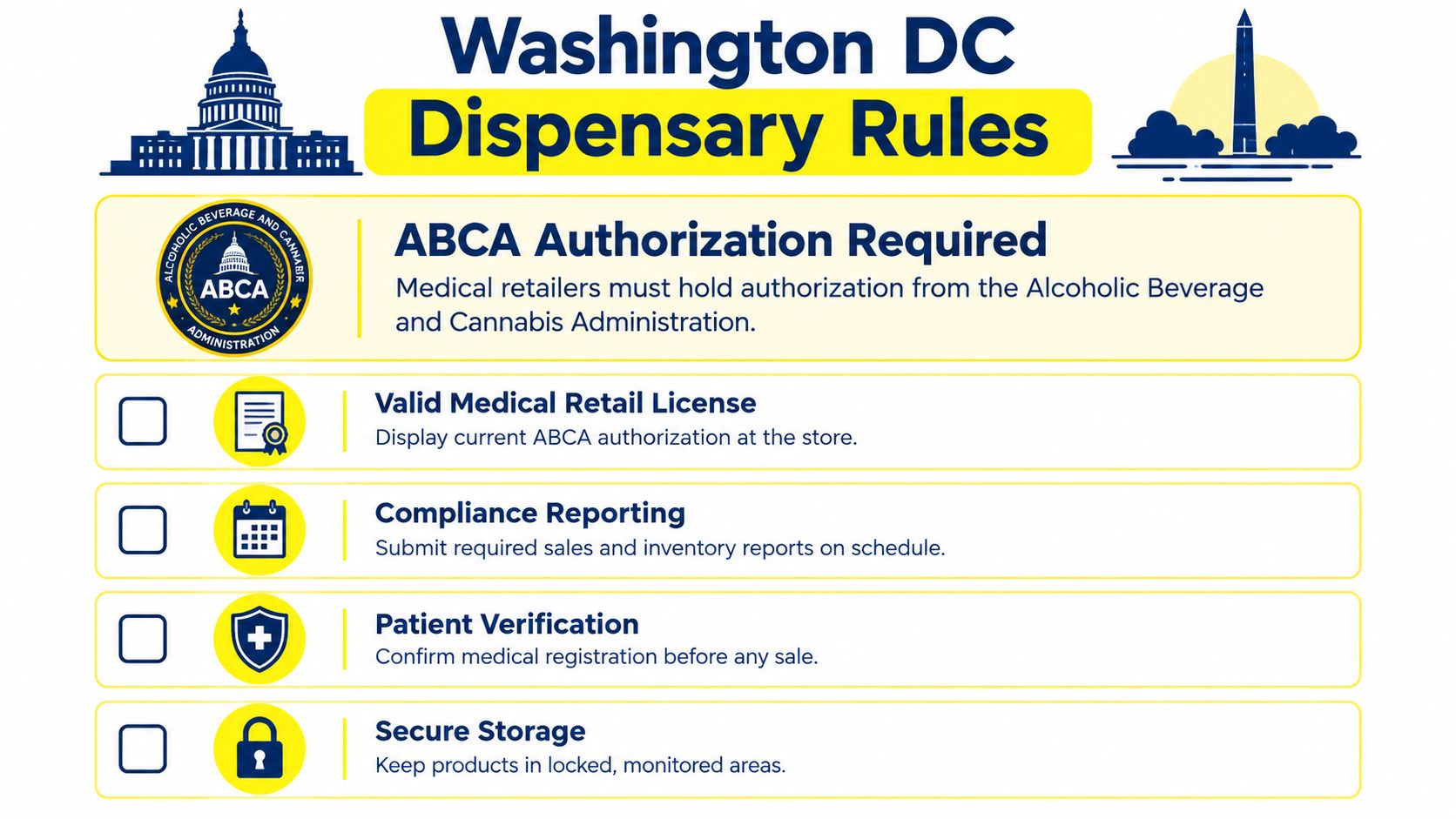
For a DC medical purchase, start with ABCA authorization and prepare both your patient registration credential and government-issued photo identification. The retailer's verification process is part of the transaction, not merely an optional check-in preference.
This checklist highlights the regulated setting in which that purchase occurs.
Understand the rolling purchase window
DC registered patients may purchase up to 8 ounces during a rolling 30-day period. For example, buying 3 ounces on June 1 and 2 ounces on June 15 leaves 3 ounces generally available until earlier purchases fall outside the window, as explained through DC's medical cannabis patient rules.
The allowance doesn't restart with each visit. Before placing a larger order, ask the retailer to confirm what your recent purchase history allows. Don't calculate availability from today's basket alone.
Account for age and product form
DC also distinguishes limits by product form and patient age. For patients at least 21 years old, the maximum is 8 ounces of dried cannabis or up to 240 grams of concentrate; patients ages 18 through 20 are limited to 60 grams of concentrate. Program materials also state a combined product limit of 600,000 milligrams of THC, and higher-dosage edibles require a healthcare recommendation, according to ABCA's patient registration materials.
These figures are legal ceilings, not recommended doses. Don't add the full concentrate allowance to a separate full THC-product allowance and assume the combination is permitted. Ask the retailer to apply the program's rules to your actual basket.
Prepare a compliant order
- Verify authorization: Check the retailer through ABCA.
- Prepare credentials: Have your registration and photo identification available.
- Confirm remaining eligibility: Ask how recent purchases affect the proposed transaction.
- Review product requirements: Check whether additional healthcare documentation is needed.
- Clarify registration support: Ask what administrative help is available without confusing it with medical evaluation.
- Check the destination: Confirm the exact delivery address is permitted before paying.
For more local context, review how DC regulates medical cannabis dispensaries. This is general education, not individualized legal advice. Confirm current requirements with ABCA when your circumstances are unclear.
Planning a First Visit with Mr. Nice Guys DC
A practical first visit starts at home with your documents and a short list of questions. Browse the current menu, choose formats you want to understand, and leave room to revise your selection after reviewing the labels.
This boutique medical dispensary offers flower, edibles, cartridges and pens, pre-rolls, concentrates, topicals, and tinctures. Its service includes product education, transparent menus, registration or certification support, and frequent product rotations, so confirm current availability rather than relying on an older menu.
Turn browsing into a prepared visit
Suppose you're deciding between a pre-roll and a tincture. Note what you want staff to explain about each format, then separate those shopping questions from health questions for your clinician.
Before completing the order:
- Prepare your paperwork: Have the required patient credentials and identification ready.
- Confirm the handoff: Ask about in-store pickup, curbside, or eligible delivery powered by Sweede.
- Check payment: Confirm current arrangements for debit or cash.
- Verify coverage: Ask whether your exact delivery address is authorized and serviceable.
If you're in Alexandria, Bethesda, Rockville, or Silver Spring, don't treat proximity to DC as proof that a cannabis delivery may cross the jurisdictional boundary. Confirm both service availability and legal eligibility.
Ask what certification support involves, who provides any necessary healthcare evaluation, and which steps must be completed before purchasing. Helpful staff can clarify the process, but they shouldn't replace a clinician's judgment.
The aim is a manageable first transaction: verified access, understandable product information, and realistic questions, rather than a rushed choice based on a product name.
Mr. Nice Guys DC offers a varied medical cannabis menu, product education, and pickup or eligible delivery options to help patients prepare for a regulated purchase. Visit Mr. Nice Guys DC to review current products, confirm documentation and fulfillment requirements, and bring your label-specific questions to the team.
Mr Nice Guys DC
At Mr. Nice Guys DC, we’re more than just a cannabis delivery service — we’re passionate advocates for quality, convenience, and community. With years of experience in the cannabis industry, our team is dedicated to educating and empowering customers across Washington, D.C. Whether you're a seasoned user or just starting your cannabis journey, our blog delivers trusted tips, product insights, and the latest updates from the world of weed. Stay informed, stay elevated.
