
Must Be 21 To Enter
By entering this site you are agreeing that you are at least 21 Years of Age or older.
I AM 21 OR OLDERWeed Dispensaries Jobs: Your 2026 Hiring Guide
.svg)

.png)
You're probably staring at a dispensary job post right now, trying to decode whether “$17 an hour plus tips” is worth your time or just another retail grind with a cannabis label on it. That's the right question to ask. In weed dispensaries jobs, the decision isn't just whether you can get hired, it's whether the pay, the schedule, and the compliance load make sense for your life.
Washington, DC is a smart place to use as the benchmark because it's a mature, regulated market where education, ID checks, cash handling, and product knowledge matter every single shift. That's why the people who get hired fast usually aren't the ones with the flashiest resumes, they're the ones who understand the job as a mix of sales, service, and rule-following. The dispensaries that win in markets like DC need staff who can keep pace without making expensive mistakes, and applicants who get that reality tend to move ahead faster.
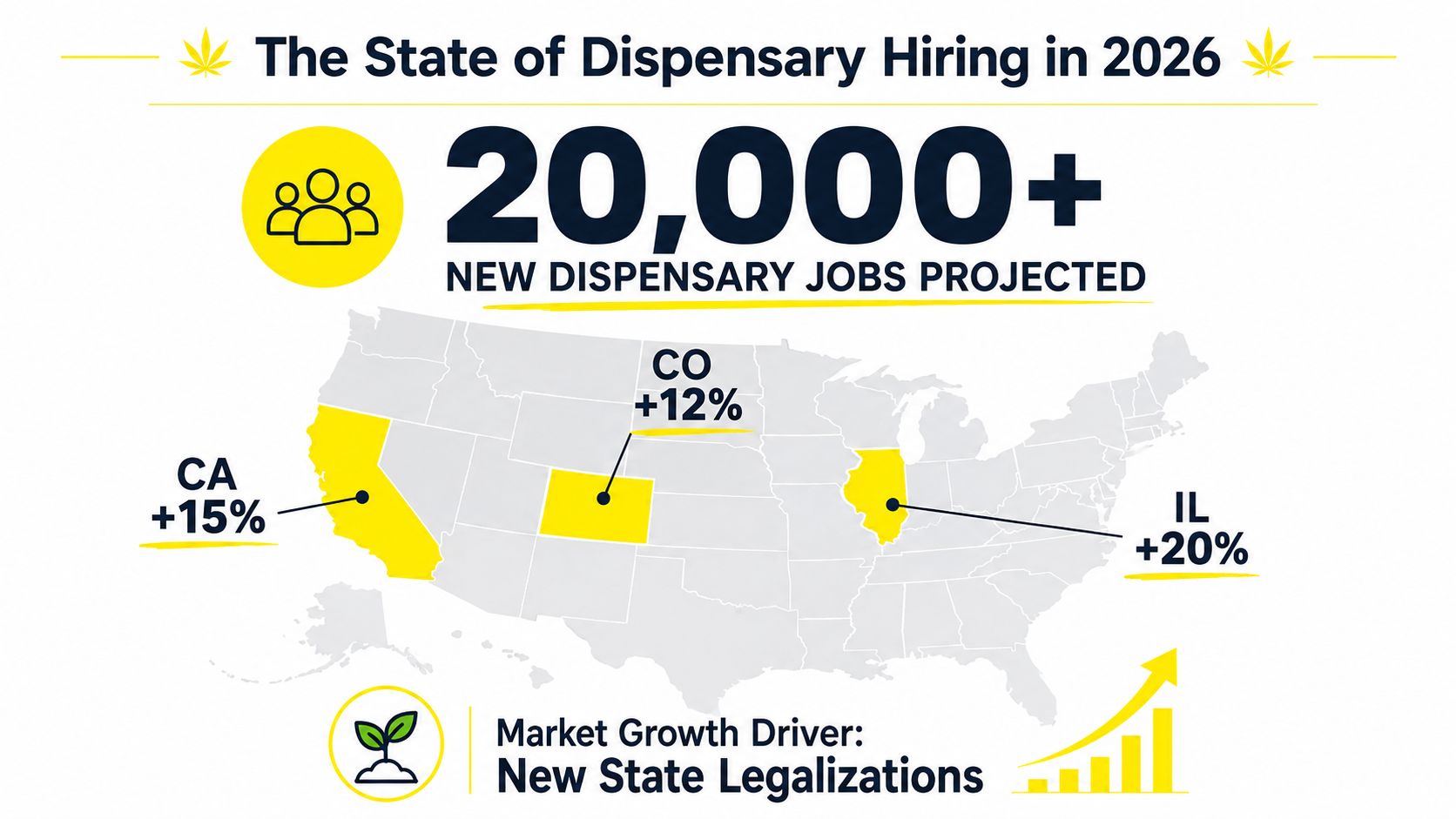
The State of Dispensary Hiring in 2026
The cannabis job market is not some tiny side hustle industry anymore. In 2025, the U.S. legal cannabis sector supported 425,002 full-time equivalent jobs, and that total was down 3.4% from 2024, even as cannabis sales reached $30.1 billion according to the 2025 Vangst Jobs Report.pdf). That matters because it tells you dispensary hiring is real, but it's not sloppy growth anymore. Operators are tightening labor, watching margins, and hiring with more discipline.
At the retail level, the market is still broad enough to matter. IBISWorld estimated 104,213 people worked in U.S. medical and recreational marijuana stores in 2025, up from 90,056 in 2024, which points to a healthy hiring base for storefront roles in weed dispensaries jobs. If you're looking for a door into the industry, that's the door. It's not fringe work.
Why DC applicants should care
DC is a different kind of market. It's boutique, regulated, and compliance-heavy, so the best stores care less about flashy selling and more about calm execution. A shop like how D.C. regulates medical cannabis dispensaries has to think about customer flow, verification, and operational discipline at the same time.
That's the hiring lens in 2026. Shops want people who can sell, but they want people who can stay clean on process even more. If you're applying in DC, don't ask, “How fast can I get in?” Ask, “Can I run this shift without creating problems?”
Dispensary Roles You Can Actually Apply For
Most applicants waste time applying to every cannabis job they see. That's lazy and it usually backfires. A dispensary is not one role, it's a small team with separate functions, and the fastest hires are the people who know where they fit.
The five roles that show up most often
A budtender is the front line. They greet customers, check IDs, explain product differences, and keep the register moving while still sounding human. That's the best entry point for someone with retail or hospitality experience, because the job is mostly conversation under pressure.
An inventory associate lives on the other side of the counter. They receive product, track stock, reconcile counts, and help keep the store compliant. If you're detail-oriented and like structure more than small talk, this is often the better fit.
A delivery driver does more than drive. The job mixes logistics, customer service, and strict process discipline, so a person who treats time windows casually usually doesn't last. This role tends to reward reliability more than charisma.
Practical rule: If you can't handle a quiet checklist without drifting, don't start with inventory or delivery. Start with the sales floor, learn the product flow, then move deeper.
Manager and security roles are not “just retail”
An assistant manager or store manager is where operations start to matter as much as sales. These people solve staffing gaps, coach new hires, and keep service standards from slipping when the floor gets busy. A manager track usually makes more sense after you've proven you can handle customers and compliance at the same time.
Security or asset protection is the least glamorous role, but it's essential. The work is about safety, awareness, and process control, not standing around looking tough. Good security staff are calm, observant, and serious about rules.
For a visual overview, this hierarchy is the right mental model.

If you want a management path later, don't pretend you're ready for it now. Get hired into the role that matches your actual strengths, then build trust from there. That's how people move up in real dispensaries, not by overselling themselves on day one.
Age, Background Checks, and Agent Cards
A lot of applicants treat dispensary hiring like standard retail. That mistake ends the process fast. The first gate is age, identity, and legal eligibility, and managers do not waste interview slots on people who cannot clear those basics. In most frontline cannabis roles, 21 is the standard minimum age, though some states allow 18+ for specific non-frontline or medical-only positions, and that lines up with job listings and state guidance such as Missouri dispensary job requirements.
What applicants should line up before applying
A background check is routine, and in many markets it is fingerprint-based. Missouri shows the process plainly. New facility agents there must be 21 or older, pass a fingerprint-based criminal background check, have a job offer from a licensed cannabis business, and apply for a Facility Agent ID through the state health department before they can work in a licensed facility, as described in Missouri budtender guidance.
That sequence matters in DC too, even though the paperwork is different. If you are applying in the District, read the local age verification process before you walk in, starting with how dispensaries handle age verification. The employer needs to see that you are eligible, the state or district needs the right documentation, and you need to show up with your paperwork already in order.
Keep your documents boring and clean. If a dispensary has to chase you for basic eligibility information, you look unreliable before anyone asks about your experience.
Common hiring prerequisites by role
| Role | Min Age | Credential Needed | Typical Experience |
|---|---|---|---|
| Budtender | 21 in most markets | Background check, local permit if required | Retail, hospitality, or customer service helps |
| Inventory Associate | 21 in most markets | Background check, local permit if required | Stock, reconciliation, or receiving work helps |
| Delivery Driver | 21 in most markets | Background check, local permit if required | Driving record and delivery experience matter |
| Assistant Manager | 21 in most markets | Background check, local permit if required | Supervisory retail experience helps |
| Security / Asset Protection | 21 in most markets | Background check, local permit if required | Security or loss prevention experience helps |
Before you apply, get five things in order. You need an updated resume, a clean and accurate work history, proof that you meet the age requirement, readiness for a background check, and a note to yourself about any state-specific permit or agent card the role requires. Handle that in advance, and interviews get easier because the hiring manager can focus on whether you can do the work.
What Dispensary Jobs Actually Pay in 2026
People love to ask what dispensary work pays, then they only look at the headline hourly rate. That's the wrong way to judge it. In cannabis retail, the answer is total compensation, and that means base pay, tips, schedule quality, and how often you get stuck on late-night or weekend shifts.
The pay range tells you what kind of shop you're joining
Recent postings show budtender pay can start around $17/hour in some markets, while another dispensary role in Los Angeles advertises $20/hour plus tips and says total compensation should be around $50,000/year according to recent dispensary hiring data. ZipRecruiter's Los Angeles data puts the average at $27.37/hour, with most workers between $22.02 and $31.06/hour, which shows how much market and experience can move the number.
That spread matters because a posted wage can look fine until you factor in the schedule. Evening and weekend work is normal in dispensary retail, and that cuts into the flexibility a lot of applicants think they're buying when they leave traditional retail. If you've got childcare, school, or another job, a higher hourly rate may still be a bad deal if the shifts are brutal.
Labor cost is the operator's constraint
Cannabis staffing research says labor typically consumes 18–28% of gross revenue, and operators who want sustainable margins often aim for 20–24%, according to Flowhub industry statistics. That is why some shops pay well and some don't. Managers are trying to balance payroll against sales volume, and they're watching labor efficiency hard.
Here's the blunt rule. A store with weak traffic can't throw money at staffing forever, and a busy store will pay better if the team keeps sales moving without errors. That's why the best applicants think like revenue protectors, not just clock punchers.
If you want a market-level reality check, the best dispensaries in Washington usually succeed by combining service quality with disciplined staffing. That's the model to watch. Pay is part of it, but reliability is what keeps the hours coming.
Writing a Resume and Cover Letter That Gets Read
A dispensary manager doesn't want a fluffy “I love cannabis” letter. They want proof that you can handle customers, cash, and compliance without turning the counter into chaos. If your resume doesn't say that clearly, it gets skimmed and forgotten.
What to put on the page
For a first-time budtender coming from retail or hospitality, your resume needs to translate old work into cannabis-ready language. Write bullets like, “Handled high-volume customer service in fast-paced retail,” “Managed cash drawer accuracy,” or “Resolved customer concerns while maintaining a professional tone.” Those details tell a hiring manager you understand pace and pressure.
For an experienced inventory or compliance candidate, be more direct. Mention seed-to-sale systems, stock counts, receiving procedures, audit prep, or inventory reconciliation if you've done them. If you've touched METRC or another tracking system, say it plainly. Don't bury the skill behind vague language.
Good cover letters sound useful. Open with the role you want, name one relevant strength, and explain why you can work a regulated retail floor without needing constant supervision.
Three openings that actually get read
Use a short opener like this for customer-facing roles. “I've worked in fast-paced retail and hospitality, and I'm comfortable guiding customers, handling cash, and keeping service steady during busy shifts.”
For inventory or compliance, use this approach. “I'm applying because I've already built habits around accuracy, stock control, and documentation, and I understand how much those habits matter in a regulated dispensary.”
For a stronger general opener, try this. “I'm interested in a dispensary role because I can combine customer service with careful process work, and I'm ready for the pace and accountability that come with it.”
If you want local context, the dispensary jobs in DC conversation usually rewards applicants who sound grounded, not trendy. A clean application beats a clever one. Every time.
Acing the Dispensary Interview
Most dispensary interviews are not trick interviews. They're stress tests. The manager wants to know whether you can explain products clearly, protect the license, and calm customers without sounding fake.
The questions you should expect
The product questions are easy to predict. You'll probably get asked the difference between indica, sativa, and hybrid products, or how you'd explain terpenes to a first-time buyer. Don't act like a chemist if you're not one. Give a simple answer, then show you can translate that into customer language.
Compliance questions matter just as much. A manager may ask what you'd do if a customer presents a suspicious ID, or how you'd behave during a regulatory inspection. The best answer is calm and procedural. Check policy, escalate when needed, and never improvise with the rules.
Customer-service scenarios show whether you can handle pressure. A regular asking for “something stronger” is not a sales challenge, it's a listening challenge. A nervous first-time patient needs reassurance, not a lecture.
A short role-play to practice
Try this with a friend.
Manager, “A customer wants stronger effects than what they usually buy. What do you say?”
You, “I'd ask what they've used before, what they're trying to feel, and whether they want something that acts faster or lasts longer. Then I'd recommend within policy and keep the explanation simple.”
Manager, “What do you do if an ID looks off?”
You, “I stop the sale, follow store procedure, and call a supervisor if needed. I'm not guessing on compliance.”
Manager, “How do you handle a first-time patient who seems nervous?”
You, “I slow down, explain the menu in plain language, and let them ask questions without pressure.”
If you want a broader sense of what customer-facing floor work looks like, dispensary customer experience is the right mindset. The best interview answers sound like someone who already knows the floor is about trust, not just transactions.
Your First 30 Days on the Floor
The first month tells you whether a dispensary is training you properly or just using you as cheap labor. Good onboarding is structured. Bad onboarding is “read the menu and shadow somebody for a shift.” Those are not the same thing, and you can tell the difference fast.
What good training actually feels like
A solid first week starts with shadowing, product walkthroughs, and compliance basics. You should see how the register works, how stock is logged, how the team handles IDs, and how the floor stays organized when traffic picks up. Boutique operators usually spend more time on strain spotlights, customer consults, and policy refreshers because they know those details reduce mistakes later.
By week two, you should be doing parts of the job with supervision. That means greeting customers, learning the POS, understanding where products live, and asking questions when you're not sure. If nobody corrects you, that's a problem, not a compliment.
By the end of the month, you should be able to handle routine flow without panic. You're not expected to know everything, but you should know what to do next, who to ask, and where the compliance lines are.
The employer-side checklist they're using
A good hiring manager is watching for these things:
- Patience with new customers: Can you slow down without sounding condescending?
- Cash-handling comfort: Do you stay accurate when the line gets long?
- Discretion: Do you keep the room professional and don't overshare?
- POS accuracy: Can you ring correctly without constant hand-holding?
- Inventory awareness: Do you notice when something is low or mislabeled?
- Compliance vocabulary: Do you know when to stop and escalate?
If a dispensary is well run, it's also watching your schedule habits. Evening and weekend availability matters in neighborhoods like Georgetown, Shaw, and Bethesda, because those are the shifts that keep the floor covered. It's not glamorous, but it's where new hires prove they can be relied on.
If you're not learning the store's systems by week three, ask for more structure. If the answer is vague, the shop probably is too.
Here are the questions applicants are usually too polite to ask. Are tips pooled? Can budtenders medicate on shift? How do raises work? Ask all three. A serious manager won't flinch, and your willingness to ask directly tells them you think like a professional, not a tourist.
If you want a dispensary job in DC, stop applying like you're trying to disappear into a pile of resumes. Bring a clean application, ask direct questions about pay and schedule, and prove you understand compliance before you ever step on the floor. If you want a shop that takes education, service, and professional standards seriously, visit Mr. Nice Guys DC and see how a real dispensary team handles the work.
Mr Nice Guys DC
At Mr. Nice Guys DC, we’re more than just a cannabis delivery service — we’re passionate advocates for quality, convenience, and community. With years of experience in the cannabis industry, our team is dedicated to educating and empowering customers across Washington, D.C. Whether you're a seasoned user or just starting your cannabis journey, our blog delivers trusted tips, product insights, and the latest updates from the world of weed. Stay informed, stay elevated.
