
Must Be 21 To Enter
By entering this site you are agreeing that you are at least 21 Years of Age or older.
I AM 21 OR OLDEROnline Weed Game: Play Safely, Avoid Scams
.svg)

.png)
You’re probably here because you typed online weed game into a search bar and got a weird mix of results. Some looked like harmless mobile games. Some looked like business simulators. A few may have seemed like a shortcut to real cannabis. That mix confuses a lot of people, especially patients in DC who are trying to stay safe and compliant.
The simplest way to think about it is this. Sometimes an online weed game is just a game. Sometimes it’s a marketing layer around a legal cannabis business. And sometimes it’s a sketchy service dressed up to look playful, casual, or harmless.
That difference matters. If you’re a medical cannabis patient, a game can be a low-stakes way to learn about strains, cultivation, and how cannabis businesses work. But if a “game” starts asking for payment, personal info, your location, or a meetup, you’re no longer in entertainment territory. You’re in risk territory.
Your Guide to the Online Weed Game Phenomenon
A common DC scenario goes like this. You’re scrolling late at night, you see an ad or app listing for an online weed game, and you wonder what it is. Is it like FarmVille with cannabis plants? Is it a delivery app trying to sound fun? Is it some gray-area thing you should avoid?
That confusion makes sense because the phrase itself is broad. It can describe a real simulation game, a casual mobile app, or something designed to blur the line between play and purchasing. For a patient, that blur is the problem.
Consider the word “clinic” on a sign. Sometimes it’s a real medical office. Sometimes it’s just a wellness shop using medical language. The label alone doesn’t tell you enough. You need context.
For adults trying to understand DC cannabis rules, it helps to separate the legal market from internet slang and app-store culture. If you need a clear baseline on local rules, this overview of Washington DC recreational cannabis helps explain the difference between curiosity and compliance.
Practical rule: If you can’t tell whether something is a game or a real transaction service, pause before you click, pay, or share personal details.
A lot of readers also ask whether these games have any real value. Some do. They can teach basic ideas like strain selection, cultivation timing, or business decision-making. That doesn’t replace dispensary guidance, but it can make cannabis feel less mysterious.
The key is knowing what bucket you’re looking at. Once you can classify it, the confusion drops fast.
What Exactly Is an Online Weed Game
Online weed game isn’t one single format. It’s a loose category. The easiest way to understand it is to sort what you see into three groups.
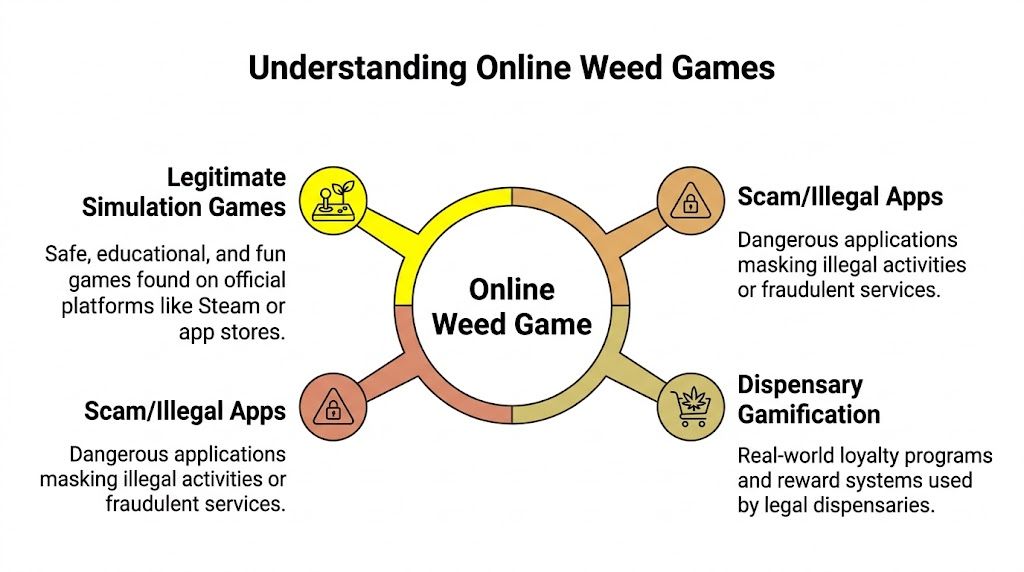
Legitimate simulation games
These are normal games on recognized platforms. They let you manage a grow, run a cannabis business, or experiment with virtual strains. They’re entertainment first, with some educational value built in.
A good analogy is a flight simulator. You’re not flying a real plane, but you are learning the logic of how things connect. In cannabis games, that might mean seeing how strain choices, timing, staffing, or cultivation decisions affect outcomes.
Some players use them to get familiar with concepts they hear in dispensaries, like genetics, effects, or market demand. If strain labels already feel confusing, a plain-language guide to the difference between indica and sativa can help ground those ideas in real-world terms.
Dispensary gamification
This isn’t a video game in the usual sense. It’s when a legal business uses game-like features to make the customer experience easier or more engaging. Think rewards, points, special drops, badges, or menu browsing that feels interactive.
That’s similar to how fitness apps turn walking into a challenge system. The activity is real. The game layer just makes it more intuitive and motivating.
Scam or illegal applications
This is the category people need to watch most carefully. These aren’t harmless games. They use playful branding, cartoon design, or vague language to make an unregulated service feel casual.
A good vehicle analogy helps here. A driving simulator is a game. An arcade racer is also a game. But a shady app pretending to be a ride service while asking you to send money to a stranger is something else entirely.
A quick sorting test
If you’re unsure what you’re looking at, ask:
- Where is it hosted: Official gaming platforms and mainstream app stores are very different from random links in DMs.
- What is the goal: Entertainment, learning, and strategy feel different from “donate now” or “meet here.”
- What happens after you sign up: Real games ask you to play. Scam services ask you to pay, message off-platform, or share private details.
If the “game” becomes a transaction before it becomes entertainment, treat it with suspicion.
Exploring Legitimate Cannabis Simulation Games
Some online weed games are exactly what they claim to be. They’re simulations. No handoff, no meetup, no hidden delivery arrangement. Just gameplay.
That’s the safe lane. It’s also the lane where patients can pick up a surprising amount of cannabis vocabulary without any real-world risk.
Weedcraft Inc and the business side of cannabis
Weedcraft Inc is a strategy game built around the economics and decision-making of the cannabis industry. On its Xbox listing, the game’s mechanics include balancing political lobbying and staff management, and that system can reduce raid risk by 40% in-game according to the Weedcraft Inc Xbox page.
What does that teach in plain English? Cannabis isn’t just about the plant. It’s also about rules, operations, and judgment. A player quickly sees that one bad business choice can create a chain reaction.
For a patient, that’s useful because it demystifies why legal cannabis businesses take compliance seriously. The game simplifies reality, but it still shows something true. Safe access depends on systems, not just products.
Weed Shop 3 and the grow-room mindset
Weed Shop 3 leans more toward cultivation. Its minimum system requirements are unusually demanding for this kind of game. It calls for an Intel i7-4770k CPU or AMD Ryzen 5 1600, 8 GB RAM, and a NVIDIA GeForce GTX 770 or AMD Radeon R9 270X, according to System Requirements Lab’s Weed Shop 3 page.
That matters because the game is trying to model complex grow cycles in real time. In practical terms, it treats cultivation like a chain of connected decisions. Light, timing, and care don’t sit in separate boxes. They interact.
For someone new to cannabis, that’s a helpful mental model. It’s like learning to cook. You don’t need to become a chef to understand that heat, ingredients, and timing all shape the final result.
If you’re still getting comfortable with cannabis basics before visiting a dispensary, this primer on medical cannabis basics before your first visit is a strong companion to what games can’t fully explain.
What these games can and can’t teach
These titles can help with:
- Vocabulary: Terms like strain, genetics, cultivation cycle, and supply chain become less abstract.
- Cause and effect: You see that cannabis outcomes come from decisions, not magic.
- Expectation-setting: Not every strain or product works the same way.
They can’t tell you how a product will affect your body. They also can’t replace advice about dosage, onset time, storage, or safe use.
A practical example
Say you keep hearing strain names like Gelato, Blue Dream, or OG Kush and feel like everyone else somehow already knows what they mean. A simulation game can make those names feel less intimidating by placing them inside a system. One strain may be treated as easier to manage, another as more valuable, another as more finicky.
That doesn’t make the game a medical guide. It does make cannabis culture easier to read.
Games are good for learning the map. They aren’t the same as getting directions for your own trip.
How to Spot Scams and Unregulated Services
Some listings use the phrase online weed game because it sounds harmless. That’s exactly why patients need a red-flag system.

A legitimate game wants you to download, play, and maybe make an in-app purchase through a standard platform. A scam or illegal service wants to move you out of that environment fast. It tries to shift the interaction into private messages, direct payments, or location sharing.
That’s a major difference.
Red flags that should stop you
If a so-called game does any of the following, back out:
- Pushes you to Telegram or Instagram: Real games don’t need a side chat to function.
- Asks for CashApp, Zelle, or Venmo: That’s not how a normal game purchase works.
- Promises real cannabis through vague “gifts” or “donations”: That wording often signals an attempt to dodge clear legal language.
- Requests your location early: A game may ask for permissions. It shouldn’t need to arrange a meetup.
- Uses pressure: Countdown timers, “driver waiting,” or “last chance” language are classic manipulation moves.
- Looks unfinished or inconsistent: Broken menus, copied images, and weird spelling often signal that the service was thrown together quickly.
If your real question is whether delivery itself can be legal in DC, read a straightforward breakdown of whether Washington DC pot delivery is legal. That gives you a better filter than anything a random app says about itself.
Legitimate game vs potential scam
| Feature | Legitimate Game (e.g., Weedcraft Inc.) | Potential Scam/Illegal Service |
|---|---|---|
| Main purpose | Entertainment and simulation | Real-world transaction disguised as play |
| Payment flow | Standard storefront or app-store checkout | Direct payment requests through peer-to-peer apps |
| Communication | In-game menus or official support | DMs, private chat apps, disappearing messages |
| Location use | Limited to device permissions or not needed | Asked for early to set up a handoff |
| Outcome | Virtual rewards, progression, gameplay | Pressure to exchange money or personal information |
A useful contrast comes from Weedcraft Inc, where the game simulates real business challenges like political lobbying and staff management. The Xbox listing notes that lobbying can reduce raid risk by 40% in-game, which shows how a legitimate title uses rules and consequences as gameplay rather than as a cover for a real unregulated transaction.
When a “game” turns into a scheme
Here’s the pattern that catches people. The app looks playful. The branding feels modern. The language stays vague enough to avoid sounding openly illegal. Then, after you engage, the actual ask appears.
That’s when many people realize too late that they weren’t downloading a game. They were being funneled into an off-platform deal.
This quick explainer is worth watching because visual examples often make the pattern easier to spot.
Bottom line: If the experience starts as “play” but quickly becomes “send money and wait,” treat it as unsafe.
The Real-World Game Dispensary Gamification
There is a safer version of the “game” idea, and it lives in the regulated world. That’s dispensary gamification.

A legal cannabis experience borrows the best parts of game design. It might use reward points, easier menu navigation, product discovery, or limited-time offers that make the process feel interactive instead of intimidating.
That matters for new patients. Shopping for cannabis can feel like entering a game world where everyone else already knows the controls. Gamified tools reduce that friction. They make the process more readable.
Why this works better than random apps
Games are good at one thing in particular. They teach by feedback. You click, compare, learn, and adjust. A well-designed dispensary experience does something similar, but in a legal and practical setting.
A reward system, for example, can feel like leveling up. Product menus can feel like inventory screens. Rotating selections can feel like new content drops. The difference is that the outcome is real, regulated, and supported by actual patient education.
That last part is the most important. Many gaming titles normalize responsible use, but there’s still a gap between virtual growing and real-world guidance. As noted on the Weed Firm RePlanted app listing, games may let people virtually grow strains like Northern Lights, while dispensaries are the ones educating patients on the effects and safe use of strains like Gelato or Blue Dream available for purchase.
A simple analogy
Think of a game tutorial versus a real coach.
The tutorial shows you the buttons. The coach helps you make smart choices based on your own needs. In cannabis, that means the digital layer can make you comfortable, but real education still comes from regulated, human guidance.
What patients usually gain from a gamified retail experience
- Less overwhelm: Menus and categories feel easier to use.
- More confidence: Repetition helps patients understand formats and effects.
- Better habits: Educational prompts can encourage slower, safer choices.
A helpful cannabis experience should feel easy to use without making the rules feel optional.
Your Safe Playbook for Cannabis in DC
If you remember only one thing, remember this. Play digitally if you want. Purchase carefully if you need cannabis in real life. Don’t blur those two worlds.
Do this
- Enjoy real simulation games: If you like business strategy or cultivation mechanics, recognized game platforms are the safest place to explore.
- Use games as vocabulary builders: They can help you get comfortable with terms before talking with a professional.
- Verify any real cannabis service: Check that it operates in a compliant, transparent way.
- Protect your information: Stick to official apps, official storefronts, and secure payment flows.
- Learn how legal ordering works: A practical guide to how weed delivery works in Washington DC helps separate convenience from risk.
Don’t do this
- Don’t send money to strangers from social media: That’s one of the fastest ways to get burned.
- Don’t assume playful branding means safety: Cartoon icons and game language can hide bad intentions.
- Don’t share your location casually: A normal game doesn’t need to know where to meet you.
- Don’t expect to win real cannabis from a random app: That’s not a safe assumption.
- Don’t treat a game as medical advice: It can teach concepts, not your personal tolerance or wellness needs.
A quick self-check before you click
Ask yourself three questions:
- Am I here to play or to buy?
- Is this on a trusted platform or in someone’s DMs?
- Would I still trust this if the weed language were removed?
If the answer to the last question is no, step away.
Frequently Asked Questions About Online Weed Games
Are online weed games legal to play
In general, a legitimate game is just a game. If it’s sold through normal gaming channels and functions as entertainment, you’re usually looking at standard digital content, not a cannabis transaction.
The issue isn’t usually the game itself. The issue is when something uses the look of a game to pull you into an unregulated real-world exchange.
Can you win real cannabis in an online weed game
You should not assume that. A legitimate cannabis simulation gives you virtual progress, not real product. If an app starts hinting that gameplay can turn into a real cannabis reward, slow down and verify what’s happening.
That kind of promise is often where confusion starts.
Why would a game ask for my location
Some apps ask for permissions for technical reasons. But if a so-called weed game wants your location so it can coordinate delivery, a handoff, or a meetup, that’s no longer behaving like a normal game.
That’s a sign to stop and reassess.
Can these games help first-time patients
They can help with comfort and vocabulary. A game may make strains, cultivation, or business terms feel less foreign. But it won’t replace personalized guidance about effects, formats, dosage, or safe consumption.
That’s why it helps to treat games as practice space, not as your final source of truth.
If you want cannabis guidance that’s grounded in DC rules, real product knowledge, and patient education, Mr. Nice Guys DC is a reliable place to start. Their team helps patients sort through flower, vapes, edibles, pre-rolls, and more with a focus on safety, clarity, and a smoother buying experience.
Mr Nice Guys DC
At Mr. Nice Guys DC, we’re more than just a cannabis delivery service — we’re passionate advocates for quality, convenience, and community. With years of experience in the cannabis industry, our team is dedicated to educating and empowering customers across Washington, D.C. Whether you're a seasoned user or just starting your cannabis journey, our blog delivers trusted tips, product insights, and the latest updates from the world of weed. Stay informed, stay elevated.
