
Must Be 21 To Enter
By entering this site you are agreeing that you are at least 21 Years of Age or older.
I AM 21 OR OLDERThe Real Difference Between Indica and Sativa Explained
.svg)

.png)
The big difference between indica and sativa has always come down to how they supposedly make you feel. The old-school rule of thumb is that indica strains bring on a relaxing, full-body high, while sativa strains deliver an energizing, more cerebral experience. Your choice usually depends on whether you’re looking for a relaxing evening with a movie or a creative boost for an afternoon project.
Debunking The Classic Indica vs Sativa Myth

When you first get into cannabis, the conversation almost always kicks off with one simple question: indica or sativa? For decades, this has been the main way people and dispensaries have sorted cannabis, creating a simple—if a little too simple—system. It's an easy concept to grab onto, and it’s become totally baked into cannabis culture.
The common wisdom you've probably heard paints a really clear, black-and-white picture. Indicas are your go-to for deep relaxation, famously inspiring the phrase "in-da-couch" for their sleepy, sedative qualities. Sativas, on the other hand, are sold as the key to unlocking creativity, energy, and social vibes.
The Traditional Story
For example, a budtender might point you toward an indica like Granddaddy Purple if you're having trouble sleeping, promising a heavy, calming effect that’s perfect for winding down. Or, they might suggest a sativa like Sour Diesel to an artist looking for a spark, expecting it to kickstart an uplifting, head-focused buzz. This traditional model is like ordering coffee: you choose 'decaf' for relaxing or 'espresso' for a jolt, without considering the specific beans or brewing method.
This two-sided model gives you a decent starting point, especially when you're new to all this. It offers a basic language to explain what you're after, turning what could be an overwhelming wall of options into a simple choice between two paths. But here's the thing: modern science tells us the real story is way more complicated.
While the indica and sativa labels are great for marketing, they aren't reliable for predicting a strain's actual effects. It’s the chemical profile—specifically cannabinoids and terpenes—that truly shapes your experience.
This traditional view is a useful foundation, but it's so important to look past these simple labels to find what really works for you. To give you a clear picture of the old-school thinking, here’s a quick breakdown of the classic (though often inaccurate) beliefs that have defined the indica vs. sativa debate for years.
Quick Guide to Traditional Indica vs Sativa Beliefs
As we’ll get into, these classifications are more of a historical guide than a scientific guarantee. Today's cannabis world is all about hybrids, where a strain’s genetic past matters a lot less than its unique chemical makeup. This guide will help you see past the myth so you can make choices based on predictable, reliable results.
Understanding Cannabis Origins and Plant Traits
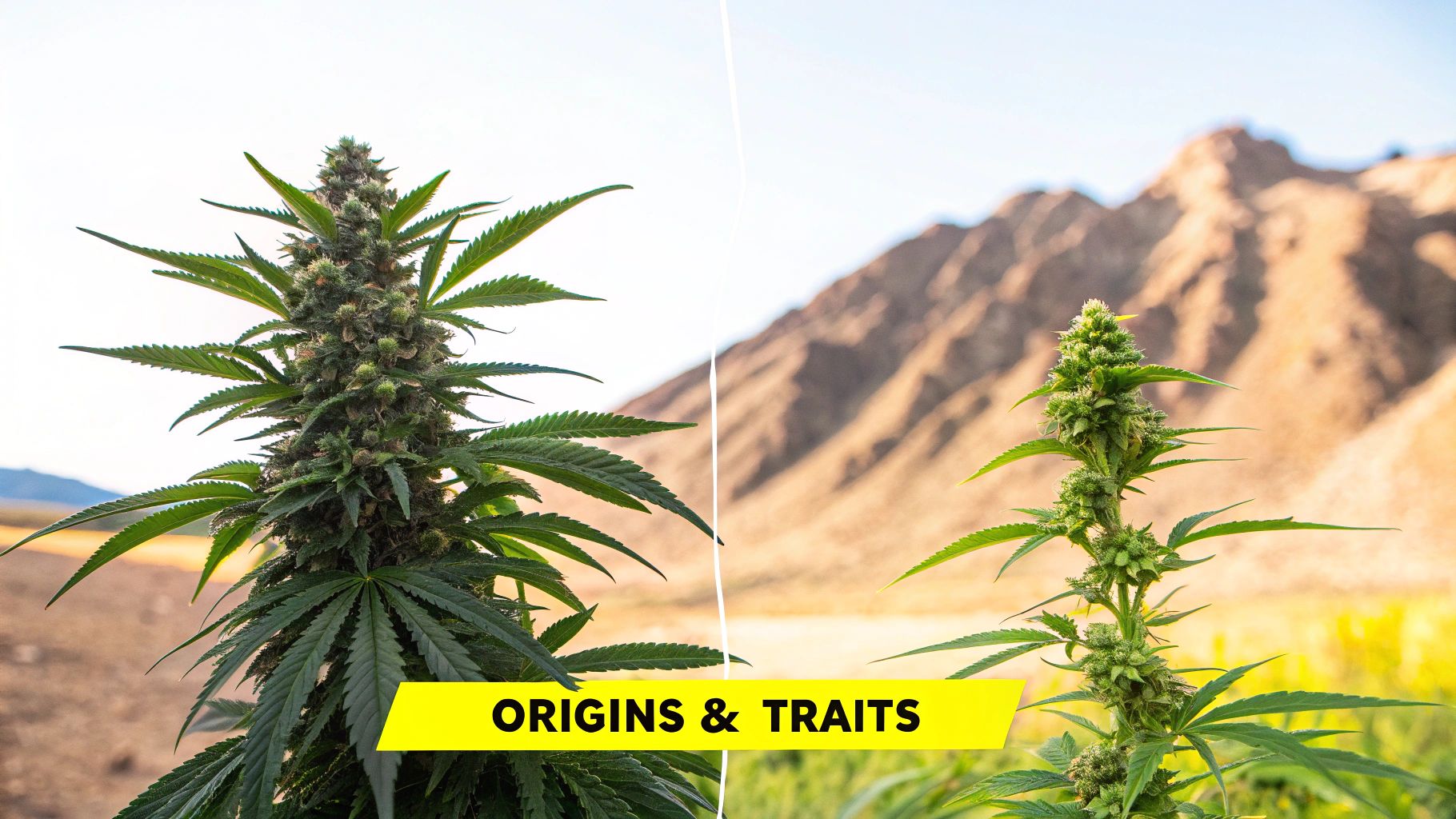
To really get what separates indica from sativa, you have to go back to their roots—literally. These names weren't just made up; they describe two unique subspecies of cannabis that grew up in totally different parts of the world. How they look is a direct result of them adapting to their native climates over thousands of years.
This botanical history is more than a fun fact. It's the key to understanding why the plants are built so differently and why, traditionally, they were used for different things. Knowing this stuff gives you a solid foundation for finding your way around today's cannabis market.
Indica: The Mountain Dweller
The story of Cannabis indica starts in the rugged, dry, and often chilly climates of the Hindu Kush mountains, a region covering parts of Afghanistan, Pakistan, and India. To make it through short growing seasons and unpredictable weather, these plants evolved a specific look.
Indica plants are famously short and dense, almost like a little Christmas tree. That compact shape helps them fight off strong winds and hold onto warmth. Their leaves are wide and a deep, dark green, designed to soak up as much sun as possible during the short bursts of intense light you get at high altitudes.
This adaptation also shaped their life cycle. Indicas have a much quicker flowering time, usually wrapping up in 6 to 9 weeks. It's an evolutionary rush job, letting the plant pump out its sticky flowers before the first autumn frost shows up.
Take a classic strain like Northern Lights, for example. Its small size is perfect for indoor grows where space is tight, and its speedy flowering cycle lets growers get more harvests in a year. That kind of efficiency is a big reason why so many popular strains have indica genetics.
Sativa: The Equatorial Native
On the flip side, Cannabis sativa evolved in the warm, humid areas near the equator—places like Southeast Asia, Central America, and Africa. Here, the growing season is long, and plants have to fight for sunlight among all the other lush greenery.
To win that fight, sativa plants grew tall and lanky, often shooting up over 12 feet. Their structure is more open and spread out, which helps with airflow and keeps mold away in the sticky climate. Their leaves are thin and a lighter shade of green, often described as "finger-like."
This long growing season means sativas can afford to take their time. Their flowering period is way longer than indicas, often lasting 10 to 12 weeks or even more. This extended cycle gives them plenty of time to develop really complex aromas.
A practical example is growing a pure sativa like Thai. A farmer in a region with long, sunny summers can let the plant stretch towards the sky outdoors, but an indoor grower would need a warehouse with high ceilings and powerful lights to mimic its natural environment and accommodate its height.
The core physical difference between indica and sativa plants is a direct evolutionary response. Indica's short, bushy form is for survival in harsh mountains, while sativa's tall, slender build is for thriving in humid, sunny climates.
The split between Cannabis indica and sativa goes back thousands of years, tied to where they grew and how early humans cultivated them. Indica plants, with their short, bushy stature growing 2-4 feet tall and broad leaves, were built for tough, high-altitude environments. Meanwhile, sativa strains from warmer, equatorial climates could reach 5-18 feet or more, with narrow leaves and longer flowering periods of 8-12 weeks. You can find more insights into these botanical histories at CBD Alchemy.
Why Chemical Profiles Matter More Than Strain Labels
For years, the cannabis world has leaned on two simple words: indica and sativa. It was an easy way to guess what you were getting into. But let's be real—those lines have blurred so much that the old rules just don't work anymore. Thanks to modern breeding, what really dictates your experience isn't some ancient lineage, but the unique chemical cocktail inside the plant.
This cocktail is called a chemotype. It's the specific mix of compounds, mainly cannabinoids and terpenes, that team up to create the effects you feel. Honestly, understanding these is way more useful than knowing if a plant's great-great-grandparent was from the mountains of Afghanistan. Focusing on the actual chemistry gives you the power to find what truly works for you.
Beyond THC: The Role of Cannabinoids
When most people think of cannabis, THC (tetrahydrocannabinol) is the star of the show. It’s the compound that gets you "high," for sure, but it’s just one player on a much bigger team. The plant actually produces over 100 different cannabinoids, and a lot of them have a say in how a strain ultimately feels.
CBD (cannabidiol) is the second-most-famous cannabinoid, and it's known for its non-intoxicating effects. It can actually balance out THC's intensity and brings its own set of therapeutic benefits to the table. We’re also learning more about minor cannabinoids like CBG (cannabigerol) and CBN (cannabinol), which each add their own unique twist to a strain's profile.
Think about it this way: a strain with 20% THC and virtually no CBD will deliver a radically different experience than a strain with 10% THC and 10% CBD. Even with half the THC, that second option will likely feel more balanced and less anxiety-inducing. For example, a high-THC strain like Gorilla Glue might be overwhelming for a new user, while a balanced strain like Harlequin could provide clear-headed relief.
Terpenes: The Aromatic Architects of Your High
If cannabinoids are the engine, terpenes are the steering wheel. These are the aromatic compounds that give plants their distinct smells—like the citrusy burst from a lemon or the fresh scent of a pine forest. In cannabis, terpenes do a lot more than just create flavor and aroma; they actively shape the effects.
This teamwork between cannabinoids and terpenes is what people call the "entourage effect." It’s the idea that all these compounds working together produce a better, more nuanced result than any single one could alone. And this is where the old indica vs. sativa model completely falls apart.
A strain's terpene profile is a far better predictor of its effects than its indica or sativa label. A 'sativa' rich in a relaxing terpene can feel sedating, while an 'indica' high in an uplifting terpene can be energizing.
For example, a classic sativa like Jack Herer is famous for its energetic buzz. People often point to its high levels of terpinolene, a terpene with a fresh, floral scent. But what if you came across a batch of Jack Herer that was unusually high in myrcene—a terpene also found in mangoes that’s known for its relaxing properties? You'd probably find yourself feeling surprisingly chilled out.
Practical Examples of Chemotypes Defying Labels
So, how does this play out when you're actually trying to pick something out? Let's say you walk into a shop looking for something to help you unwind after a rough day. The old wisdom says to grab an indica. But what if the "indica" you pick is loaded with limonene, a citrusy terpene known for boosting mood and energy? You might end up feeling more wired than relaxed.
This is why looking at the actual compounds is so crucial. Here’s a quick breakdown to show you what I mean:
This table makes it clear how misleading those old labels can be. Someone choosing "Indica" Strain A for sleep would be out of luck, while a person avoiding sativas because of anxiety might miss out on the genuinely calming effects of "Sativa" Strain B.
The key is to shift your focus from the plant's supposed ancestry to its actual ingredients. By checking lab reports and asking about terpene profiles, you put yourself in the driver's seat, ready to find the perfect product for whatever you need.
How to Choose Cannabis Based on Your Desired Effects
Navigating the world of cannabis can feel a little overwhelming, right? But picking the right product gets a whole lot easier when you stop thinking in terms of strain names and start focusing on your own wellness goals. Instead of just asking, "Indica or Sativa?" the better question is, "What do I want to feel?" This simple shift puts you in the driver's seat, letting you choose products based on their actual chemical makeup for more predictable, effective results.
When you prioritize cannabinoids and terpenes, you can zero in on a product that perfectly matches what you’re looking for—whether that’s relaxation, focus, or relief. It’s all about matching the active compounds to the outcome you want. This method takes you way beyond the often-unreliable Indica vs. Sativa labels and lets you take control of your experience.
This decision tree gives you a great visual of how to approach cannabis selection in a modern way, putting the chemical compounds first instead of relying on old-school labels.
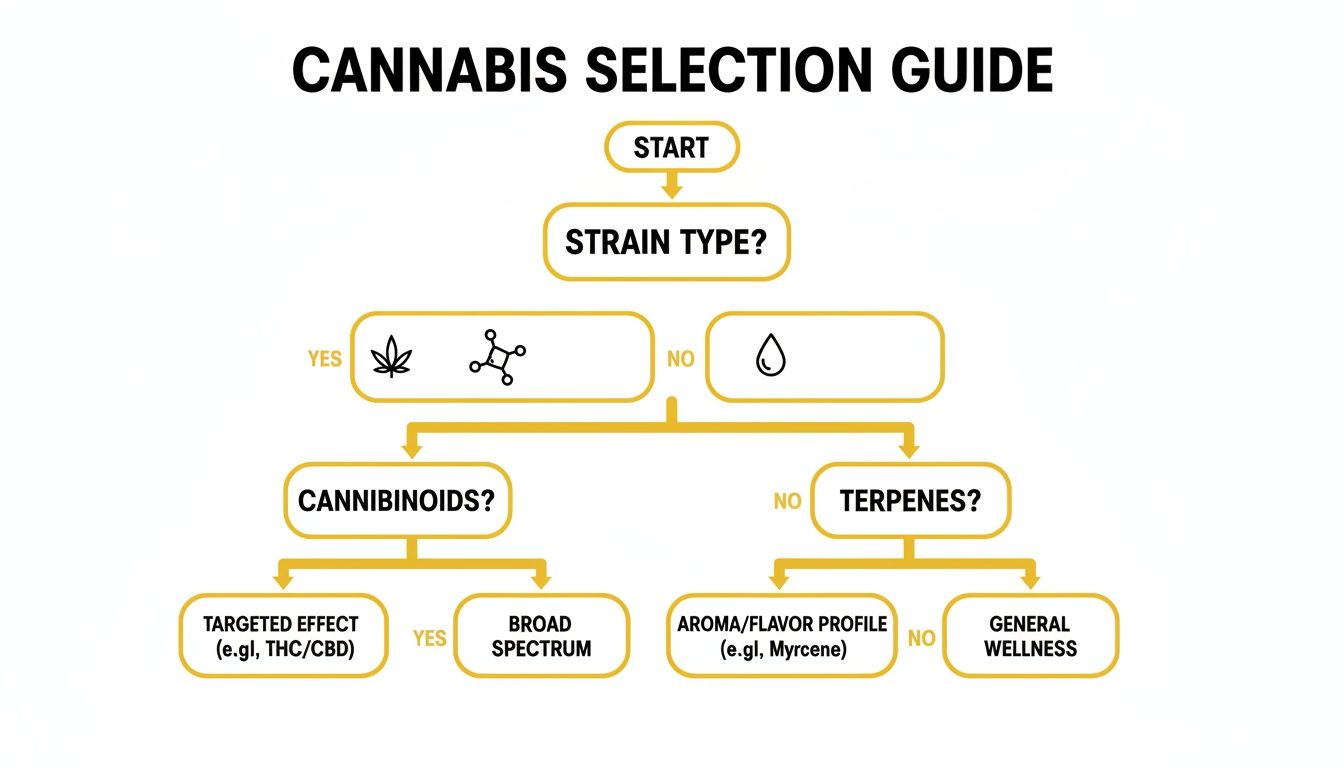
As the flowchart shows, while a strain name can be a decent starting point, digging into the specific cannabinoids and terpenes is a much more accurate way to get the effects you’re after.
A Practical Framework for Choosing Cannabis
Let's break down how this works in the real world. By figuring out your goal first, you can then look for the specific cannabinoids and terpenes known to deliver those effects. Trust me, it’s a far more reliable method than just grabbing a strain because of its classification.
Scenario 1: You Need to Focus and Be Productive
Instead of just reaching for any "sativa," you'll want to get more specific about the product's chemical profile.
- Cannabinoids: Look for strains with moderate THC levels and a good amount of CBG (cannabigerol). CBG is often called the "mother of all cannabinoids" and is being looked at for its potential to sharpen focus without the heavy psychoactivity that can come with high-THC products.
- Terpenes: Seek out uplifting terpenes like Limonene (think citrus) and Pinene (pine). Limonene is well-known for its mood-lifting properties, while Pinene can help offset some of the short-term memory fogginess sometimes associated with THC.
So, a practical choice might be a vape cart with a lab report showing high levels of Limonene and maybe a 3:1 THC-to-CBG ratio for a clear-headed, productive day.
Scenario 2: You Need to Unwind and Sleep Better
The classic answer here is "indica," but a more precise approach gets you much better results.
- Cannabinoids: Products that combine THC with CBN (cannabinol) are fantastic for this. CBN is a cannabinoid that forms as THC ages and is quickly gaining a reputation for its powerful sleepy-time properties. A balanced ratio of THC and CBD can also be a game-changer, as CBD can help calm any anxiety that might be keeping you up.
- Terpenes: The terpene Myrcene, with its earthy, herbal scent, is famous for its relaxing effects. Another great one is Linalool, which has a floral aroma (just like lavender) and is known for its calming, anti-anxiety benefits.
For example, you could look for an edible or tincture formulated with a 1:1 ratio of THC and CBN, rich in Linalool, to really encourage a restful night's sleep. To get deeper into this, check out our guide on cannabis for sleep, pain, and anxiety.
The smartest way to pick a cannabis product is to define your goal first, then find the specific cannabinoids and terpenes that support that outcome. This turns shopping from a guessing game into a confident, informed decision.
Matching Cannabinoids and Terpenes to Your Goals
This goal-first approach works no matter what kind of product you prefer. Whether you're into flower, edibles, or concentrates, it's the chemical profile inside that really counts.
Here's a handy table to help you match different compounds to common wellness goals. Think of it as your cheat sheet for making smarter choices at the dispensary.
Matching Cannabinoids and Terpenes to Your Goals
This practical guide is designed to help you select cannabis products based on their chemical profile and the therapeutic outcome you're looking for.
By using this framework, you're no longer just a passive consumer—you're an educated one. You don't have to rely on a simple, and often inaccurate, label anymore. Instead, you can confidently read product info to find exactly what you need for any situation.
Why Indica and Sativa Labels Aren't Going Away Anytime Soon
If science says chemical profiles are what really drive effects, you might be wondering why every dispensary still sorts its menu by indica, sativa, and hybrid. The short answer? It’s less about botanical accuracy and more about powerful marketing and deeply ingrained customer habits. For decades, these simple labels have been the language of the cannabis world.
This straightforward system is an incredibly effective sales tool. It gives budtenders an easy way to guide people and gives buyers a simple framework to make a choice. The terms are familiar and don't require a science degree to understand, which makes the whole shopping experience less intimidating for everyone.
Think about it: people have been taught for years to ask for "an uplifting sativa" or "a relaxing indica." That creates a powerful market demand that directly influences what growers cultivate and how dispensaries categorize their products. The industry is simply responding to what customers already know and ask for.
The Power of What We Believe
The belief in the indica-sativa binary is so strong it’s almost become a self-fulfilling prophecy. When you buy a product labeled “indica” expecting to feel relaxed, you’re already psychologically primed for that exact effect. It’s a classic example of the placebo effect, which just reinforces the old belief system and keeps the cycle going.
Marketing language just hammers these ideas home. Product descriptions are full of words like “couch-lock,” “cerebral buzz,” “energetic,” and “sedating,” all tied directly back to the indica or sativa label. This constant repetition makes these categories feel like hard facts instead of the marketing shortcuts they often are.
The stubborn persistence of 'indica' and 'sativa' is a masterclass in marketing. These words provide a simple, accessible language for an incredibly complex product, even if that language glosses over the real science.
This system is built on decades of shared culture. From movies and music to recommendations from friends, the idea that indicas are for chilling and sativas are for energy is a core piece of cannabis lore. Changing a belief that widespread isn't just about showing people new scientific evidence; it’s about shifting the entire cultural conversation around cannabis.
The Sales Data Doesn't Lie
Market data shows exactly how these perceptions drive what people buy. Sales trends in major U.S. cannabis hubs, including Washington, DC, clearly reflect how influential the indica-sativa divide still is, despite what the science says. In most legal states, indicas consistently make up about 45-50% of flower sales, bought specifically for their promised relaxing effects. Meanwhile, sativas grab 30-35% of the market from users looking for daytime creativity, leaving hybrids to fill the remaining 20-25%. User surveys tell the same story, with over 70% of consumers saying they pick indica to relax and sativa for a boost. You can dive deeper into these findings in the Frontiers in Plant Science journal.
Because these labels drive sales, there’s a strong financial reason for growers and dispensaries to keep using them. A product labeled as a classic "indica" is way more marketable to someone looking for a sleep aid than one described by its complex terpene profile of myrcene and linalool—even if both descriptions point to the exact same effect. The simpler story just sells better.
The growing popularity of hybrids, however, shows that the market is slowly starting to get it. As people become more educated, they often start looking for more nuanced experiences. You can check out some of our most popular balanced options in our guide to the top hybrid strains at Mr. Nice Guys DC.
While the indica-sativa system has its flaws, it’s still a practical tool for navigating a dispensary menu. The key is to see it for what it is: a starting point. Use the labels as a general guide, but always be ready to ask about a product’s chemical profile to make a choice that’s truly right for you.
Making Informed Choices at the Dispensary

So, now that you know what's really going on under the hood, your next dispensary visit can be a whole lot more productive. The game is no longer about picking a team in the indica vs. sativa rivalry. It's about finding a product with a chemical makeup that actually matches what you're trying to achieve.
This simple shift in perspective puts you in the driver's seat. It lets you see past the old-school labels and choose something that will give you the consistent, helpful effects you’re looking for.
It all boils down to flipping your script. Don't start with a strain name or a category. Start with your goal. Are you hoping to quiet down chronic pain, find a creative spark, or just get a solid night's sleep? Figuring out your "why" is always the best first move.
Your Action Plan for Smarter Shopping
Once you have your goal locked in, you can walk up to the counter with some real confidence. The conversation with your budtender shouldn't just be about the difference between indica and sativa; it should be about the specific compounds that are going to get the job done for you.
Here’s a quick checklist to guide your next trip:
- Be Specific About Your Goal: Instead of asking for "a sativa," try something like, "I'm looking for something that will help me focus during the day without making me feel jittery." That gives the budtender something real to work with.
- Ask About the Terpenes: Don't be shy to ask about a product's dominant terpenes. You could ask, "Do you have anything high in linalool for relaxation?" or "Which strains have a strong limonene profile for a mood boost?"
- Look Beyond the THC Percentage: High THC isn't everything. Always see if other cannabinoids like CBD, CBG, or CBN are in the mix. A more balanced profile often creates a much smoother and more pleasant experience.
If there's one thing to take away from all this, it's to treat the indica and sativa labels as a general starting point, not a guarantee. The best results will always come from digging into a product's full chemical profile—its cannabinoids and terpenes.
Putting It All Together
Let's run through a quick example. Say you're trying to ease some social anxiety before heading out. The old way of thinking might have you steering clear of all sativas. The new, smarter approach is to ask for a product with a 1:1 ratio of THC to CBD and a good amount of the terpene linalool, which is known for its calming effects.
This way, you're not just a passive customer—you're an active participant in your own wellness. When you start prioritizing the chemical profiles, you can find the right product for any situation, whether you're looking at flower, edibles, or carts.
And if you’re curious about how these ideas play out in different formats, you can learn more by exploring the varieties of carts indica sativa and hybrid in our other guide.
A Few Lingering Questions About Indica and Sativa
Even as we get smarter about chemotypes, some of the old questions about indica and sativa still hang around. Let's clear the air on a few of the most common ones so you can feel confident in your choices.
Is Indica Really 'In-Da-Couch'?
That old "in-da-couch" line is catchy, but it's a massive oversimplification. Sure, a strain labeled as an indica can be relaxing, but only if its chemical profile is built for it. If that same indica is packed with an energetic terpene like limonene, you might find yourself feeling more uplifted than ready for a nap.
Think of the label as a hint, not a hard-and-fast rule. Always check the terpene profile for relaxing compounds like myrcene or linalool if you're truly after that classic "in-da-couch" vibe.
Will Sativa Always Make Me Anxious?
This is a really common fear, and for good reason—some people have had bad experiences. Sativa strains can feel a bit racy or spark anxiety, especially when they have super high THC levels with very little CBD to balance things out. But it's definitely not a guarantee.
A sativa with a more balanced cannabinoid profile and calming terpenes can actually be pretty gentle. For instance, a sativa-labeled strain that's rich in linalool (a terpene also found in lavender) and has a bit of CBD can give you a clear-headed, focused feeling without any of the jitters. It all comes back to the plant's complete chemical makeup, not just one word on the package.
The best way to predict an effect is to ignore the indica/sativa label and focus entirely on the cannabinoids and terpenes listed on the product’s lab report.
So, What's the Deal with Hybrids?
Hybrids are just what they sound like: strains made by crossbreeding indica and sativa plants. In today's market, you'd be hard-pressed to find a strain that isn't a hybrid to some degree. They're usually classified as "indica-dominant," "sativa-dominant," or "balanced," which gives you a clue about their lineage and intended effects.
- Indica-Dominant Hybrids: People often grab these when they want to relax without the heavy sedation a "pure" indica might bring. Think OG Kush.
- Sativa-Dominant Hybrids: A great choice for a focused, creative buzz that isn't overwhelmingly energetic. Blue Dream is a perfect example.
- Balanced Hybrids: These aim for a nice mix of head and body effects, which makes them super versatile for almost any time of day. Wedding Cake is a classic in this category.
But even with hybrids, the real story is told by the specific blend of cannabinoids and terpenes in that particular batch.
Ready to stop guessing and find a product that's actually right for you? The team at Mr. Nice Guys DC knows their stuff and can walk you through our curated menu. Explore our selection online and place an order for convenient pickup or delivery today.
Article created using Outrank
Mr Nice Guys DC
At Mr. Nice Guys DC, we’re more than just a cannabis delivery service — we’re passionate advocates for quality, convenience, and community. With years of experience in the cannabis industry, our team is dedicated to educating and empowering customers across Washington, D.C. Whether you're a seasoned user or just starting your cannabis journey, our blog delivers trusted tips, product insights, and the latest updates from the world of weed. Stay informed, stay elevated.
