
Must Be 21 To Enter
By entering this site you are agreeing that you are at least 21 Years of Age or older.
I AM 21 OR OLDERNational Holistic Center: Services & DC Guide
.svg)

.png)
If you're trying to figure out whether the center is a good fit, the short answer is yes for patients who want a licensed Washington, D.C. dispensary with an education-first approach, more than 100 marijuana products, and clear access rules including purchases of up to 1/2 lb. every 30-day period. It's built for people who want guidance, structure, and a broad menu rather than a quick in-and-out retail experience.
Many readers consider this question when they're faced with two distinct needs. One need is clinical clarity: “What should I buy for sleep, pain, or daytime calm?” The other is shopping confidence: “Where in D.C. can I get compliant access without guessing my way through the process?” National Healing Center, often shortened in conversation to the National Center, sits squarely in that first camp.
It's a licensed medical marijuana dispensary in Washington, D.C., known for pairing product access with patient education. That matters because cannabis works well for some people only when the format, dose, and timing line up with the reason they're using it. Good service in this space isn't just about having flower on the shelf. It's about helping someone choose between a tincture for steady evening use, a topical for localized discomfort, or an edible when discretion matters more than fast onset.
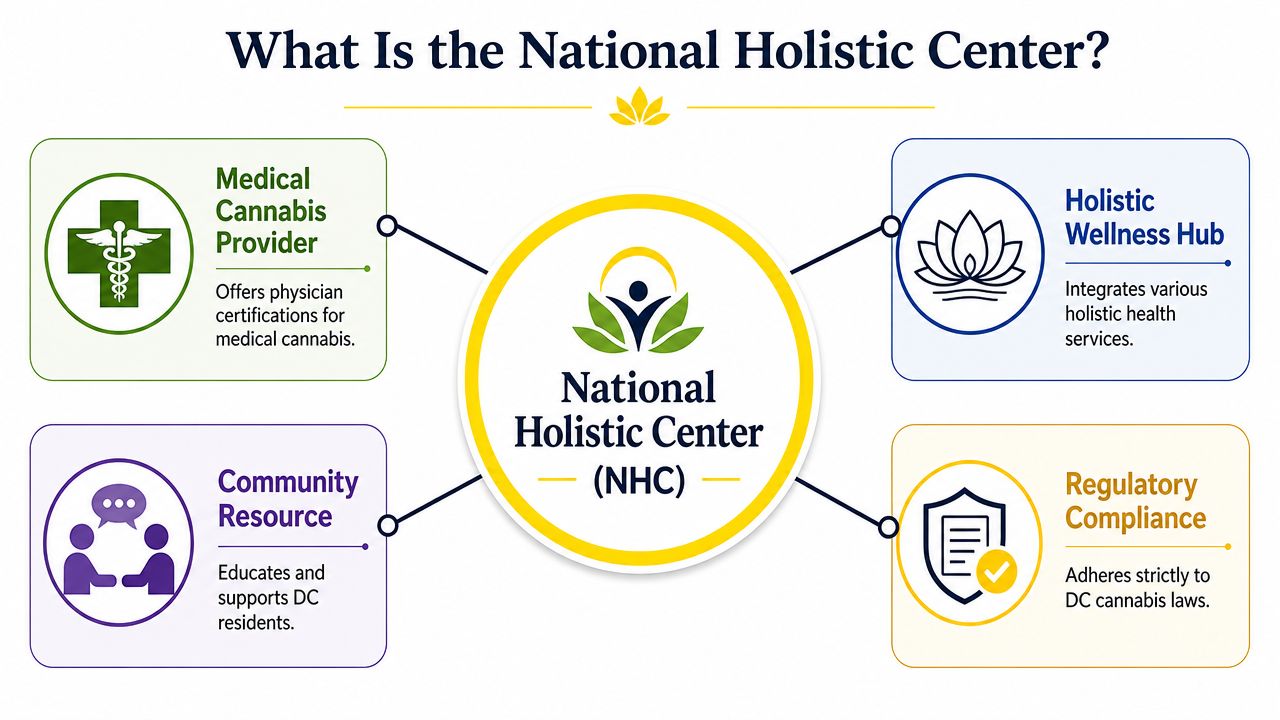
What Is the National Holistic Center
A common D.C. patient scenario goes like this. You want a licensed dispensary near Dupont Circle, but you also want staff who can explain why a tincture may fit better than flower, or why a topical may be the better call for localized discomfort. In that situation, the National Center is best understood as a patient-centered medical cannabis dispensary with a strong education focus.
Its public-facing materials describe a shop built around guidance as much as inventory. The center carries a wide menu of cannabis products, including flower, cartridges, tinctures, topicals, edibles, and concentrates. That matters for a simple reason. A broader menu gives staff more room to recommend by use case, tolerance, and preferred onset time instead of steering every patient toward the same few formats.
What people usually want to know
For local patients, the question is less “what is it?” and more “what kind of dispensary experience does it offer?”
National Center is a licensed medical cannabis dispensary in Washington, D.C. with a long-running presence in the local market. Its current location is on Connecticut Avenue NW near Dupont Circle, which makes it a practical option for patients who want a central, easy-to-reach pickup point.
From a service-model perspective, it tends to appeal to patients who want structure. That usually means help comparing product formats, clearer explanations around dosing, and a less rushed buying process than you get from a convenience-driven retail setup.
Why that model matters in practice
A large menu can help, but only if staff know how to narrow it well.
Newer patients often walk in asking for “something strong” or “something for sleep.” Those are understandable starting points, but they are not specific enough to produce a good match. Good dispensary guidance usually gets more precise. It separates fast onset from long duration, body relief from head-heavy effects, and flexible dosing from set-dose formats.
The National Integrative Center positions itself as an education-first dispensary, according to the National Holistic Healing Center about page. That approach tends to work well for patients who want to compare trade-offs before they buy.
Here is what that looks like on the ground:
- A tincture may fit better than flower for someone who wants measured dosing and a smoke-free routine.
- A topical may make more sense for localized soreness when full-body effects are not the goal.
- A cartridge may suit a patient who values faster onset, while an edible may suit someone who wants longer-lasting effects and does not mind waiting.
That is the practical difference between a menu-heavy shop and a guidance-heavy one. One gives you options. The other helps you sort the options into choices that fit real life.
There is also value in comparing service models across D.C. dispensaries before choosing where to shop regularly. If you want another reference point, this guide to Takoma Wellness Center shows how another established provider presents its patient experience.
Its place in the D.C. cannabis market
National Holistic Center has been part of the regulated D.C. medical cannabis market for years. A public court filing states that the business previously operated on Benning Road before relocating to Dupont Circle in 2021, as reflected in the Cannabliss v. National Holistic Healing Center filing. For patients, that kind of operating history usually signals a dispensary that has had time to build repeatable systems around intake, compliance, and patient support.
If you are comparing premium cannabis options in D.C., that is the useful lens. National Holistic Center is not defined only by product count or neighborhood. Its main distinction is the service model. It is a fit for patients who want explanation, comparison, and a more guided path to the right product.
How It Supports Medical Cannabis Patients
A medical dispensary proves itself in the first real conversation. Not at the logo, not at the menu, not at the front desk. It proves itself when a patient says, “I need help, but I don't know where to start.”
A typical patient journey
Take a common scenario. A patient comes in dealing with nighttime pain and stress. They've tried cannabis before, but the last product made them feel too foggy the next morning. They don't want to gamble again.
At an education-driven dispensary like the national wellness center, the useful conversation usually starts with three questions. What symptom are you trying to address? When do you need relief? How functional do you need to remain while using it?
From there, staff can narrow options by format. A tincture may make sense if the patient wants more controlled dosing. A topical may come up if the discomfort is localized and the patient wants to avoid stronger whole-body effects. An edible might fit if longer-lasting effects matter more than rapid onset.
Start with the symptom and the schedule, not with the strain name. That habit leads to better product matches for most medical users.
What good guidance looks like
Good guidance is specific. It doesn't stop at “this one is strong” or “this one is relaxing.” It explains why one format may fit better than another and what trade-offs come with each.
For example:
- For evening use: A patient who wants to stay home and wind down may accept a slower-onset product if it lasts longer.
- For daytime use: A patient with meetings or errands often needs a format that's easier to control in smaller increments.
- For body-focused discomfort: Topicals and other non-inhaled formats may be worth discussing before jumping straight to high-THC inhaled options.
Private appointments and classes also support this kind of care model. The center says it offers both, which can help patients who need more than a quick counter recommendation. If you're still sorting out paperwork or visitor eligibility, this overview of medical card requirements is a practical companion before you shop.
Who tends to benefit most
The people who usually get the most value from this model are not necessarily heavy consumers. Often, they're the opposite. They're people who need reassurance, dosing clarity, and a setting where asking basic questions doesn't feel awkward.
That includes:
- First-time patients who don't yet know how flower, tinctures, and edibles differ.
- Returning patients who used cannabis years ago and find today's products stronger or more varied.
- Visitors who want compliant access and don't know how D.C. handles reciprocity and intake.
- Patients with narrow goals such as sleep support, calming routines, or body-focused relief.
What doesn't work as well for these patients is speed-shopping without context. A broad menu only becomes useful when someone helps narrow it to two or three realistic options.
National Holistic Center vs Mr Nice Guys DC
A patient in D.C. often ends up choosing between two very different buying experiences. One shop may suit someone who wants time, structure, and product education. Another may suit someone who already knows their preferred format and wants a tighter menu with faster decision-making.
That is the core comparison here. National Holistic Center and Mr. Nice Guys DC can both serve cannabis shoppers well, but they do it in different ways.
Service model and shopping style
National Wellness Center presents itself as a medical dispensary first. That model tends to fit patients who want a more formal conversation about product type, intended use, and how to avoid a poor first trial. If someone is deciding between flower, tinctures, topicals, or edibles, that extra discussion can matter.
Mr. Nice Guys DC reflects more of a curated dispensary model. The focus is usually a selected menu, clearer product categories, and direct guidance at the counter. For shoppers who already know they prefer premium flower, pre-rolls, vapes, or edibles, that can feel more practical than a longer consult. A good reference point is Mr. Nice Guys DC's comparison of other weed shops in D.C., which shows how that service style is positioned locally.
Product breadth vs curated selection
In this situation, many shoppers misjudge what they need.
A broad menu helps when the customer is still testing formats or narrowing a routine. If someone is unsure whether they want faster onset, longer duration, easier dose control, or non-inhaled relief, a larger inventory gives the staff more room to make practical recommendations.
A curated menu works better for a shopper with established preferences. If they already know they want a dessert-leaning flower profile, a dependable evening edible, or a vape that fits a specific part of the day, fewer options can make the choice easier.
Local shoppers see this trade-off all the time. More options help with discovery. Fewer options help with confident repeat buying.
Atmosphere and ideal customer
Atmosphere changes the quality of the decision. Some patients ask better questions in a structured medical setting. Others feel more comfortable in a polished retail environment where the conversation stays focused and concise.
Here's the clearest side-by-side view:
| Attribute | National Holistic Center | Mr. Nice Guys DC |
|---|---|---|
| Primary feel | Medical, education-first, consultation-driven | Boutique, curated, direct |
| Best for | Patients who want product guidance tied to symptoms and format selection | Shoppers who value a selective menu and a polished dispensary experience |
| Inventory approach | Broad range across multiple delivery formats | Hand-picked assortment across key categories |
| Consultation style | Better suited to longer questions and therapeutic matching | Better suited to concise guidance with curated options |
| Typical shopper | New patient, cautious patient, visitor needing structure | Experienced consumer or patient who already knows preferred formats |
| Decision advantage | More room to compare forms and dosing styles | Less menu clutter and faster narrowing |
What works and what doesn't
National Integrated Care Center usually makes more sense for patients who want more explanation before they buy. That includes people who are still figuring out dose sensitivity, product form, or how cannabis fits into a wider care plan.
Mr. Nice Guys DC often makes more sense for shoppers who value selection quality over menu size. If the goal is to get in, compare a few strong options, and leave with something that fits a known preference, that model is often easier to use.
Neither approach is automatically better. The better fit depends on whether you need discovery, or whether you need curation.
Your Next Steps for Accessing DC Cannabis
You arrive in DC, pull up a menu on your phone, and realize the hard part is not finding cannabis. The hard part is choosing a legal access path that fits how you shop. For some patients, that means booking enough time to ask questions at the center. For others, it means getting the paperwork handled first so the purchase itself stays simple.
Start with compliance, then choose the service model that matches your needs. Convenience matters, but it should come after legal access and product fit.
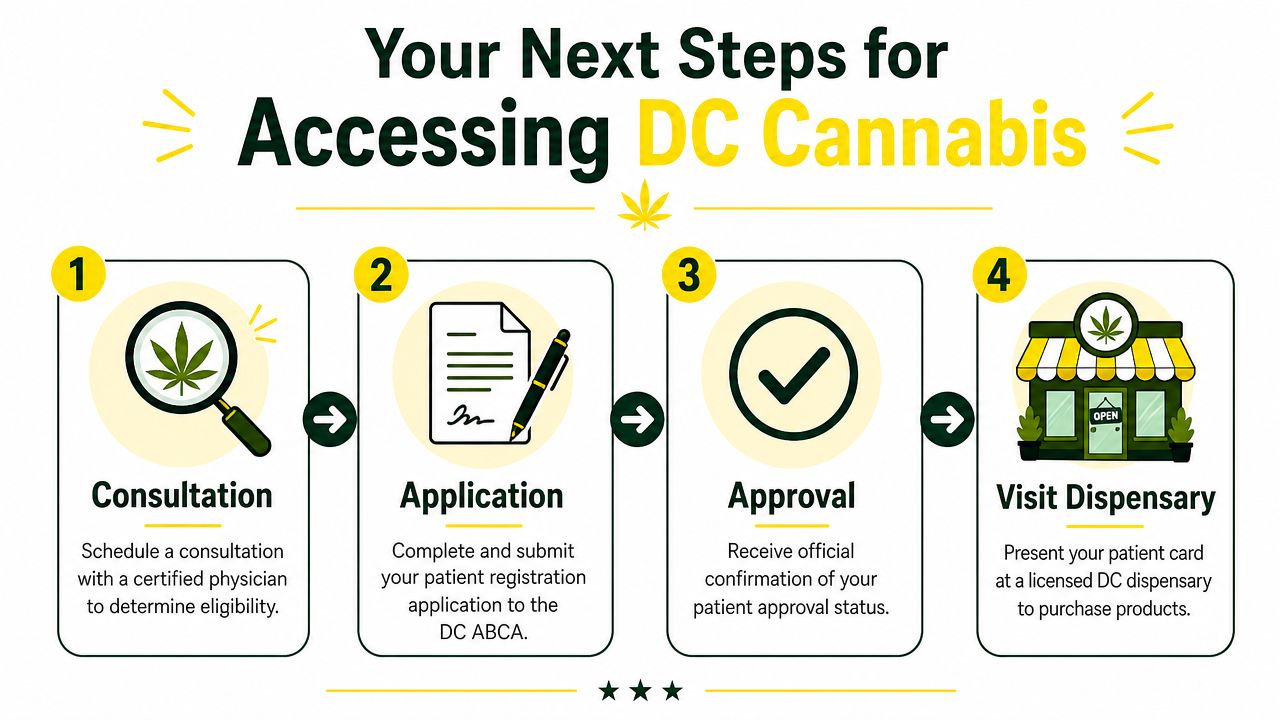
Step through the process carefully
Get your paperwork in order
Bring valid identification and confirm your registration path before you shop. Residents and visitors usually lose time here, not at the checkout counter.Check whether the dispensary fits your situation
A patient who wants more guidance may prefer a medical-style visit with time for questions. A shopper who already knows their preferred format may care more about speed, menu clarity, or delivery options.Review purchase rules before you place an order
Purchase limits and visitor access rules affect how you plan your trip, your reorder timing, and whether one visit is enough. As noted earlier, National Center accepts out-of-state medical cards, which can make the process easier for visitors who want a more structured dispensary experience.Choose in-person help or delivery based on where you are in the process
Delivery works best once you already know what product type, dose range, and timing work for you. In-person shopping is usually the better call if you are still comparing flower, vapes, edibles, tinctures, or topicals.
If you want a wider legal overview before choosing a dispensary, this guide on how to buy weed in DC gives a clear starting point.
Use convenience features wisely
Patients often overvalue speed on the first purchase. I usually recommend the opposite. Slow down on visit one, especially if you are sensitive to THC, trying to avoid smoking, or shopping for a specific goal like sleep, daytime function, or body discomfort. A fast order is only useful if the product fits.
This short video gives a helpful overview of access and process:
A practical checklist before purchase
- If you're a visitor: Confirm card acceptance and intake steps before you leave your hotel or head across town.
- If you're new to cannabis: Leave enough time for questions. First visits go better when you are not rushed.
- If you're reordering: Delivery can be the easier option after you have already found a product and routine that work.
- If you're comparing formats: Shop with a clear goal. Sleep support, daytime calm, and body-focused relief often call for different product types and different dosing conversations.
Choosing Your Cannabis Partner in DC
You have two real choices in DC. One offers a medical setting with more room for questions and treatment-focused guidance. The other gives you a tighter retail experience built around product quality, speed, and familiarity. The better fit depends on how you shop and how much support you still need.
National Wellness Center fits patients who want a more education-led visit. That matters if you are still sorting out dose, comparing formats, or trying to avoid another purchase that misses the mark. A shop with stronger consultation can save money and frustration, even if the process takes longer.
A curated dispensary model works better for plenty of shoppers too. If you already know you prefer flower over edibles, or a low-dose edible over a vape, you may not need a long consult. In that case, clean menus, consistent inventory, and staff who can answer direct product questions may be the better service model.
Ask yourself a few practical questions
These usually point people in the right direction:
Do you want product guidance tied to a specific goal?
Choose a dispensary where staff make time to talk through options for sleep, daytime use, body relief, or THC sensitivity.Do you already know your go-to format and range?
A more selective retail shop may be easier if you are mostly reordering what already works.Do you tend to react strongly to THC?
Pick a place where the staff will explain trade-offs clearly, including onset time, duration, and dose control.Are you trying to save time?
Fast ordering helps after you know your products. It is less useful on a first visit if you still have basic questions.

What usually works best
In practice, the right partner often depends on where you are in your cannabis routine.
Newer patients usually benefit from more explanation, slower product selection, and better side-by-side comparisons across tinctures, vaporizers, edibles, flower, and topicals. Experienced shoppers often want the opposite. They want a shorter path to reliable products they already trust.
That is why this decision is really about service fit. National Center makes more sense for people who want a medical-first process and time for discussion. A curated dispensary can be the stronger choice for shoppers who value a more focused menu and a smoother reorder experience.
A good dispensary relationship should reduce guesswork. If you keep leaving with products that do not fit your goals, the problem may be the service model, not just the product.
If you are still comparing local service styles, this guide to the best dispensaries in Washington is a useful place to compare your options.
The simplest way to decide
Choose National Holistic Center if you want a compliant medical experience with more guidance and more time to ask questions.
Choose a curated dispensary if you already know your preferences and want a more efficient shopping flow centered on product selection and consistency.
If you want a curated D.C. dispensary option with premium flower, edibles, cartridges, pre-rolls, concentrates, topicals, and tinctures, you can explore Mr. Nice Guys DC and compare its service style with the medical-first model discussed above.
Mr Nice Guys DC
At Mr. Nice Guys DC, we’re more than just a cannabis delivery service — we’re passionate advocates for quality, convenience, and community. With years of experience in the cannabis industry, our team is dedicated to educating and empowering customers across Washington, D.C. Whether you're a seasoned user or just starting your cannabis journey, our blog delivers trusted tips, product insights, and the latest updates from the world of weed. Stay informed, stay elevated.
