
Must Be 21 To Enter
By entering this site you are agreeing that you are at least 21 Years of Age or older.
I AM 21 OR OLDERMedical Dispensary Delivery: How DC Patients Order Safely
.svg)

.png)
You're on your phone, menu open, thinking about whether to place an order now or wait until later. The question isn't just what looks good on the screen, it's whether the delivery will be handled the right way at the door, with the right ID, at the right address, and inside the right legal boundaries.
Medical dispensary delivery in DC is a regulated handoff, not a casual drop-off. That matters because the process is built to protect the patient, the product, and the retailer's records all at once.
What Medical Dispensary Delivery Means in DC
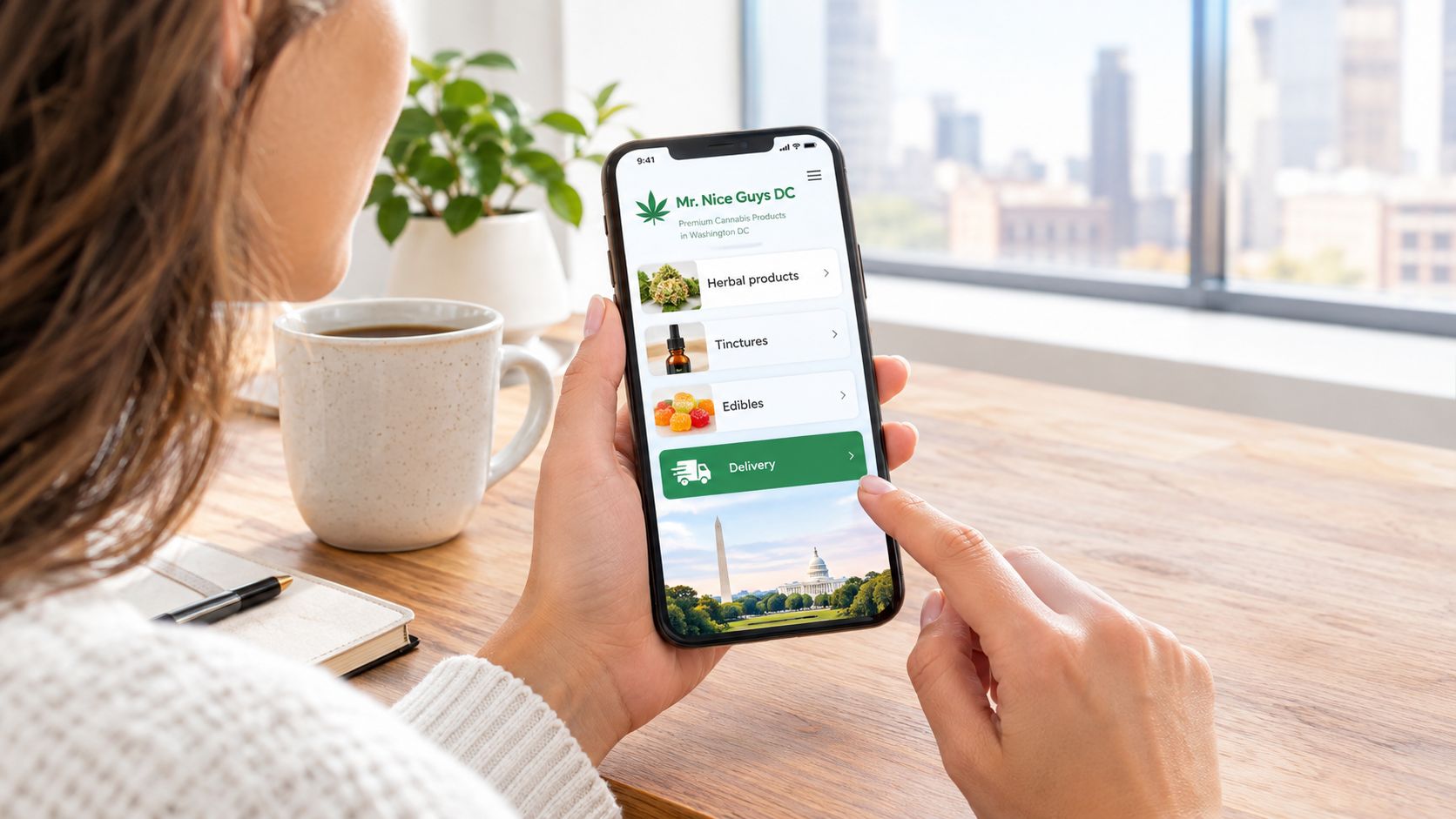
A patient opens the menu, chooses a product, and waits for it to arrive. In DC, that handoff only works because the retailer or courier treats it as a controlled transfer, with the product, the paperwork, and the recipient all matching at the door.
The point is custody, not convenience
The legal model behind DC delivery is built around verification, documentation, and controlled transfer. A delivery moves from inventory into a manifest, then from the driver to the verified patient or caregiver, with each step recorded. DC requires real-time electronic records, and vehicles must carry cannabis in a locked compartment, not in a back seat or loose in a bag. DC retailer delivery rules
That is why medical delivery works differently from ordinary retail delivery. A package does not just get left at a door and forgotten. The recipient has to be the qualifying patient or caregiver, and the handoff has to be verified at the address tied to the order. DC delivery and pickup rules
Practical rule: if the identity does not match, the delivery does not complete. That is the system working.
Who benefits most from delivery
Delivery fits patients who cannot easily get to a dispensary, do not want to deal with traffic or parking, or prefer privacy. It also helps caregivers managing orders for someone else, as long as the caregiver is properly verified. National legal analysis
For a DC patient ordering from Mr. Nice Guys DC, the point is simple. Delivery is a regulated access path that keeps traceability intact while getting medicine to the right person. The faster question is not the right one. The key question is whether the order can be handed off cleanly and legally.
How DC Delivery Works From Order to Doorstep
Start with the order itself. A patient or caregiver places it remotely, usually through a menu or online checkout, and the retailer checks whether the order can be fulfilled before anything leaves the store. That early check matters because the system has to confirm the recipient, the address, and the quantity before the driver is ever dispatched.
Step by step from screen to handoff
- Order comes in remotely. The patient or caregiver submits the request without walking into the store.
- Eligibility gets checked. The address has to be a qualifying District location, and the recipient has to be eligible.
- Inventory gets allocated. Product is assigned to the delivery manifest and tied to the order.
- Driver is dispatched. The vehicle leaves with products secured in a locked compartment.
- ID and registration are checked at the door. The driver verifies the person receiving the order.
- Proof of delivery is captured. The handoff is logged, and the transaction is recorded.
That sequence is the compliance spine of the whole operation. If identity or quantity doesn't match, a compliant team should hold the delivery and reconcile the issue rather than forcing a handoff. For a plain-English explanation of this workflow, see how weed delivery works in Washington, DC.
DC rules also make the vehicle itself part of the control system. Delivery vehicles must stay within the District, which means route planning has to respect jurisdictional boundaries, not just map distance. Drivers can't treat the city like a pass-through on the way to somewhere else.
A compliant delivery feels calm because the messy parts were handled before the driver arrived.
What to have ready at the door
Have your government ID ready, and have the registered patient or caregiver present. If the courier has to hunt for a recipient, or the building access is unclear, the handoff slows down fast. That's not the driver being difficult, it's the platform protecting the chain of custody.
This is also where auditability matters. DC law requires complete, real-time electronic records for transactions, including the patient or caregiver details and the quantities delivered or dispensed. That's why a serious delivery workflow depends on timestamped updates, role-based access, and exception logging, not just a driver with a smartphone. DC retailer information
Pickup, Curbside, or Delivery, Choosing What Fits Your Day
A lot of patients don't need just one option. They need the right option for the day they're having. If you're close enough to come in, pickup gives you the most direct in-person experience. If you want less time at the storefront, curbside keeps the visit short. If you can't, or don't want to, travel, delivery is the move.
How the three options differ
Pickup works best when you want to browse, ask questions, and leave with your order in one visit. It's the easiest option if you're already nearby and don't mind stepping inside.
Curbside is the middle ground. You still use the storefront, but the handoff stays brief and discreet. It's useful if you're short on time, have limited mobility, or don't want a longer indoor visit.
Delivery is for patients and caregivers who need the order brought to them. It still requires verification at the door, so it's not a casual drop-off. It's just the most practical option when travel is inconvenient or impossible.
For a storefront comparison of those options, the curbside pickup and delivery guide gives a straightforward overview.
A simple decision rule helps. If you're already out running errands, pickup may be easiest. If weather, parking, or mobility is the problem, curbside or delivery is smarter. If someone else is managing access for you, delivery with proper caregiver verification is usually the cleanest path.
Choose by friction, not by hype
Don't pick the channel that sounds fastest on paper. Pick the one with the fewest points of failure for your situation.
The right format is the one that gets you the order without creating a problem at handoff.
If you're in a building with tight access control, if you're working late, or if you're handling a patient's care schedule, delivery removes a lot of friction. If you want to speak with staff face to face, pickup still wins. Different days call for different formats, and there's no reason to force one channel into every situation.
Where DC Delivery Can and Cannot Reach
DC delivery is limited by geography, and that catches people off guard all the time. Being close to the city isn't the same as being inside the authorized delivery zone. Alexandria, Bethesda, Rockville, and Silver Spring may be a short drive away, but they're outside DC delivery authorization.
The address has to be inside the District
The delivery itself must go to an eligible residential or commercial address inside DC. That means the map matters more than the driving time. A patient across the line can still visit the dispensary in person when they're inside District boundaries, but they can't have a DC delivery routed to an outside address. DC delivery and pickup rules
DC also blocks delivery to certain places inside the city. Federal property, District government property, and school grounds are off-limits. That restriction exists even when the location is otherwise easy to reach, because the legal destination rules are tied to property type, not just street address. DC code on delivery limits
Qualifying adults 21 and older can receive deliveries at colleges and universities, which is a real exception many people miss. So the rule isn't “no campuses ever,” it's more specific than that.
Why nearby doesn't mean eligible
Border neighborhoods create confusion. A patient may live close enough to a District shop to think delivery should be routine, but if the address sits outside DC, the courier can't complete the route. That's why delivery is best understood as a legal service area, not a loose radius on a map.
Practical example. A registered patient can order to an apartment in Shaw, but not to a federal office building. The package can't be left in a lobby, and the driver can't treat an outside-District address as close enough to count. That keeps the handoff clean and the business compliant.
DC's Delivery Framework in a National Context
A DC delivery order only works if the handoff stays controlled from the first verification step to the final receipt. That is the key difference between a regulated medical delivery and a casual courier drop.
DC's rules are tighter than the marketing language around delivery often suggests. The recipient has to be verified, the route has to stay inside the District, and the transfer has to be documented. That adds friction, but it is the right kind of friction because it keeps custody clear and reduces diversion risk.
The national context helps explain why this model exists. Medical cannabis delivery developed through a long legal shift that began with a federal compassionate-access program in 1976, moved through state medical laws, and expanded after California's 1996 Proposition 215. By April 24, 2023, StatPearls counted 38 states, three territories, and the District of Columbia as allowing medical cannabis products. Historical overview
That is why DC's framework feels stricter. It treats delivery as a compliance system first and a convenience feature second.
DC delivery is more controlled than casual, and that is exactly why many patients can trust the handoff.
What that means for patients
If you have mobility limits, transport problems, or privacy concerns, DC delivery gives you a safer access path without loosening the rules around who receives the product. That balance matters. You want convenience, yes, but not at the cost of losing custody, traceability, or confidence in what arrives at the door.
For patients ordering from Mr. Nice Guys DC, the practical value is straightforward. The order moves through a documented chain of custody, and that structure matters more than speed alone.
A Patient Checklist Before the Driver Arrives
A smooth delivery starts before the driver leaves the shop. If you get the basics right first, the handoff is cleaner and there is less chance of a delay at the door.

Check the basics before checkout
- Have your government ID ready. The courier will inspect it at the door.
- Make sure the registration details match the order. The recipient information has to line up with what was submitted.
- Confirm the address is inside DC. Nearby addresses outside the District do not qualify.
- Know your purchase history. DC rules limit dispensing to 4 ounces over a rolling 30-day period for the patient-level allotment described in the District's delivery guidance, and a retailer or internet retailer cannot dispense more than 8 ounces to one qualifying patient during a 30-day period. Delivery guidance from DC DC dispensing limit
- Be available when the driver arrives. If you are not the person meeting the courier, make sure the caregiver is documented and ready.
- Review the age check process ahead of time. The age verification process guide shows what staff look for at the door.
The two most common problems are simple. The driver reaches the address, and the verified recipient is not there. The address is wrong, or the handoff cannot be completed. Both are easy to prevent.
Keep the handoff clean
Do not ask the driver to leave product with a concierge, a neighbor, or in a lobby. That breaks the chain of custody and puts the order at risk.
If anything about the address, the recipient, or the quantity looks off, fix it before dispatch. Once the driver is already on the way, the problem gets harder to solve.
For patients ordering from Mr. Nice Guys DC, that is the point of the process. Delivery is not casual drop-off service. It is a regulated handoff, and the paperwork has to match the person at the door.
Keeping Your Care Routine on Track Between Deliveries
Delivery solves the access problem. It doesn't solve the care problem. If your routine changes every time a favorite item sells out, or if you can't tell what worked last week, the convenience starts to work against you.
Track the product, not just the package
Write down the batch or product name, the format, and how it felt. If you switch from flower to an edible, or from a cartridge to a tincture, don't assume the effect will feel the same. Those are different tools, and your notes should reflect that.
Keep a simple log, product, dose, time, and response. That's enough to make your next order smarter.
First-time patients often need to slow down here. A smooth delivery doesn't mean you should experiment recklessly. It means you have a reliable supply line, so use it to learn what helps you feel better.
Plan for substitutions without guessing
A boutique menu changes, and your preferred strain won't always be on the shelf. If something like Gelato or Wedding Cake is out, ask for a comparable format and note what changed. Similar names don't guarantee similar effects, so focus on what you wanted the product to do, not just the label.
That's where education matters. A good dispensary team doesn't just move product, it helps you compare options and think through effect, onset, and fit for your routine. That support matters for older adults, new patients, and anyone trying to keep cannabis use predictable rather than improvised.
If adverse effects show up, stop guessing and escalate. Delivery can keep the supply consistent, but it doesn't replace clinical follow-up when something feels off.
Ordering With Confidence From Mr. Nice Guys DC
A good order starts before you tap checkout. Check your ID, registration, and delivery address, then choose the format that fits your day. If you are choosing between flower, edibles, cartridges, pens, pre-rolls, concentrates, topicals, or tinctures, focus on the effect you want and where you plan to use it.
Make the order easier on yourself
Pick pickup, curbside, or delivery before you place the order. Have cash or debit ready if that is how you pay. First-time patients should ask staff what the handoff looks like so the delivery does not turn into a guessing game.
Mr. Nice Guys DC keeps the process straightforward for patients who want clear menus and direct guidance on product format. For a full walkthrough of placing an order online, see this guide to ordering weed online in DC. Use the menu like a patient, not a browser. Check the category, confirm the delivery details, and have your documents ready before the driver arrives.
If you want help choosing the right format, Mr. Nice Guys DC can walk you through the menu, the verification step, and the handoff that fits your schedule. Visit Mr. Nice Guys DC to browse the live menu and place an order with the right documents ready.
Mr Nice Guys DC
At Mr. Nice Guys DC, we’re more than just a cannabis delivery service — we’re passionate advocates for quality, convenience, and community. With years of experience in the cannabis industry, our team is dedicated to educating and empowering customers across Washington, D.C. Whether you're a seasoned user or just starting your cannabis journey, our blog delivers trusted tips, product insights, and the latest updates from the world of weed. Stay informed, stay elevated.
