
Must Be 21 To Enter
By entering this site you are agreeing that you are at least 21 Years of Age or older.
I AM 21 OR OLDERCannabis Tincture Review: A Beginner's Guide for 2026
.svg)

.png)
You're standing at a dispensary menu, looking at a row of little dropper bottles. Some say THC. Some say CBD. Some say full-spectrum. One bottle lists a big number on the front, another lists milligrams in tiny print, and suddenly a simple purchase feels more like reading a chemistry label.
That reaction is common. New patients often tell me tinctures seem appealing because they look cleaner, quieter, and easier to control than smoking, but they also feel mysterious. How much do you take? Do you swallow it? Hold it under your tongue? What does “full-spectrum” change?
A good cannabis tincture review should make all of that feel simpler, not more confusing. If you're new to dispensaries in general, it also helps to know what the first visit feels like before you even start comparing products. This first-time dispensary guide gives a helpful overview of that experience.
Your First Foray into Cannabis Tinctures
A lot of first-time tincture shoppers want the same thing. They want a cannabis product that feels manageable.
Maybe smoking isn't your style. Maybe edibles have felt unpredictable. Maybe you want something you can measure with more confidence than “a few puffs” or “half a gummy.” Tinctures sit right in that middle ground. They're discreet, easy to store, and built around measured liquid dosing.
Here's where many people get tripped up. They assume the number on the bottle tells them everything. It doesn't. A bottle can look strong on the shelf and still be hard to compare if you don't know how much cannabinoid is packed into each milliliter. That's why a useful cannabis tincture review doesn't stop at flavor notes or vague effect descriptions. It asks practical questions about concentration, intended use, and how the product fits your routine.
Practical rule: Don't shop for a tincture the way you'd shop for candy. Shop for it the way you'd shop for cough syrup or vanilla extract. Concentration matters, and the dropper is part of the experience.
Think about two shoppers. One wants daytime calm and clear-headed function. The other wants something for evening wind-down. They might both buy tinctures, but they shouldn't review those products by the same standard. The first person cares about staying sharp. The second may care more about a smoother transition into rest.
That's the primary goal here. Not just “pick a product,” but learn how to judge whether a tincture is doing the job you intended it for.
What Exactly Is a Cannabis Tincture
A cannabis tincture is a concentrated liquid extract of the cannabis plant. If you've ever used vanilla extract in baking, you already understand the basic idea. You take plant material, pull out the key compounds into a liquid, and end up with something small, potent, and easy to measure.

The simple version
Users don't need a lab-level explanation. They need a useful one.
A tincture starts with cannabis plant material and a liquid that can carry the extracted compounds. The important compounds are cannabinoids such as THC and CBD. Those cannabinoids end up suspended in a liquid base, often in a bottle with a measured dropper.
That's why tinctures feel different from products like flower or vapes. You're not inhaling them. You're measuring a liquid dose.
If you want a deeper background on how these extracts work, this overview of the science behind marijuana tinctures and their effects is a helpful companion read.
Why source material and extraction matter
Two tinctures can both say “cannabis tincture” and still be very different in real potency. A foundational quality-control study found that tinctures made from female flowering tops contained ten-fold more cannabinoids than tinctures made from leaves, and tinctures prepared with 80%–90% ethanol also contained ten-fold more cannabinoids than lower-strength preparations, according to the study on cannabis tincture quality control.
That matters because a thoughtful cannabis tincture review shouldn't treat every bottle like it's interchangeable. Extraction choices influence what ends up in the dropper.
What tinctures are not
A lot of shoppers confuse tinctures with other concentrates. Here's the easiest way to separate them:
- Tinctures are liquid extracts made for measured dosing, often taken under the tongue or swallowed.
- RSO is a thick cannabis concentrate that usually feels more like a heavy extract than a light dropper-based product.
- Edibles are foods or drinks infused with cannabinoids.
- Vape oils are formulated for inhalation, not oral use.
Think of tinctures as the “measuring spoon” format of cannabis. They're built for controlled amounts, not guesswork.
That's why they appeal to people who want a more methodical experience.
Decoding Tincture Types and Spectrums
When people read a tincture label, they often focus on THC or CBD first. That makes sense, but the spectrum type also shapes how a product is designed.
The easiest way to remember it is with music. A full-spectrum tincture is like a full orchestra. A broad-spectrum tincture is more like one section of the orchestra playing together. An isolate is the solo violinist. Same performance category, very different composition.
Spectrum types in plain language
If you've seen “full-spectrum” and nodded without really knowing what it means, you're not alone. This explainer on full-spectrum cannabis helps if you want the longer version, but here's the practical version for shopping.
| Spectrum Type | Contains THC? | Key Feature | Best For |
|---|---|---|---|
| Full-spectrum | Sometimes, depending on the product | Includes a wider range of cannabis compounds | Shoppers who want a more plant-like profile |
| Broad-spectrum | Usually formulated to avoid THC or minimize it, depending on labeling | Includes multiple cannabis compounds without the same THC emphasis as full-spectrum | People who want more than a single-compound formula |
| Isolate | May be THC isolate or CBD isolate, depending on the product | Focuses on one cannabinoid | Shoppers who want a simpler, single-cannabinoid option |
Matching the bottle to the goal
Spectrum is one layer. The cannabinoid profile is another.
A tincture can be:
- THC-dominant, often chosen by people looking for stronger psychoactive effects or evening use
- CBD-dominant, often preferred by shoppers who want a non-intoxicating or less intoxicating option depending on formulation
- Balanced, such as a product that combines THC and CBD in a more even way
Here's where a smart cannabis tincture review gets personal. You're not only asking, “What's in this bottle?” You're asking, “Why would someone choose this bottle over another one?”
A few practical examples:
- Daytime use: A CBD-focused tincture may suit someone who wants to stay functional and avoid a heavy head change.
- Evening use: A THC-forward tincture may fit someone who wants stronger relaxation.
- Middle-ground use: A more balanced formula can make sense for someone who wants a blended experience rather than an all-THC or all-CBD product.
A tincture review becomes useful when it connects the label to a real-life routine. Morning, workday, after dinner, bedtime. The same bottle can feel “great” or “wrong” depending on when and why you use it.
This is why one person's favorite tincture can be another person's mismatch.
Mastering Tincture Dosing and Administration
The biggest confidence boost for a new tincture user usually comes from one skill: learning how to read the label and turn it into a real dose.
How to calculate milligrams per milliliter
A tincture label often shows a total amount for the whole bottle. That's useful, but it's not enough by itself. What you need for dosing is milligrams per milliliter.
Modern tincture guidance emphasizes this kind of precise dosing. For example, a bottle with 100 mg THC in 20 mL works out to 5 mg THC per 1 mL, according to this tincture dosage guide.
Use this simple formula:
- Find the total cannabinoids in the bottle
- Find the bottle size in milliliters
- Divide total milligrams by total milliliters
So if a bottle has 100 mg THC and the bottle size is 20 mL, then:
- 100 mg ÷ 20 mL = 5 mg per mL
That gives you something actionable. If your dropper is marked for 1 mL, you now know what a full dropper contains.
If you want more help interpreting bottle math and practical serving choices, this guide to cannabis tincture dosing can help.
Sublingual versus swallowed
How you take a tincture changes how it behaves.
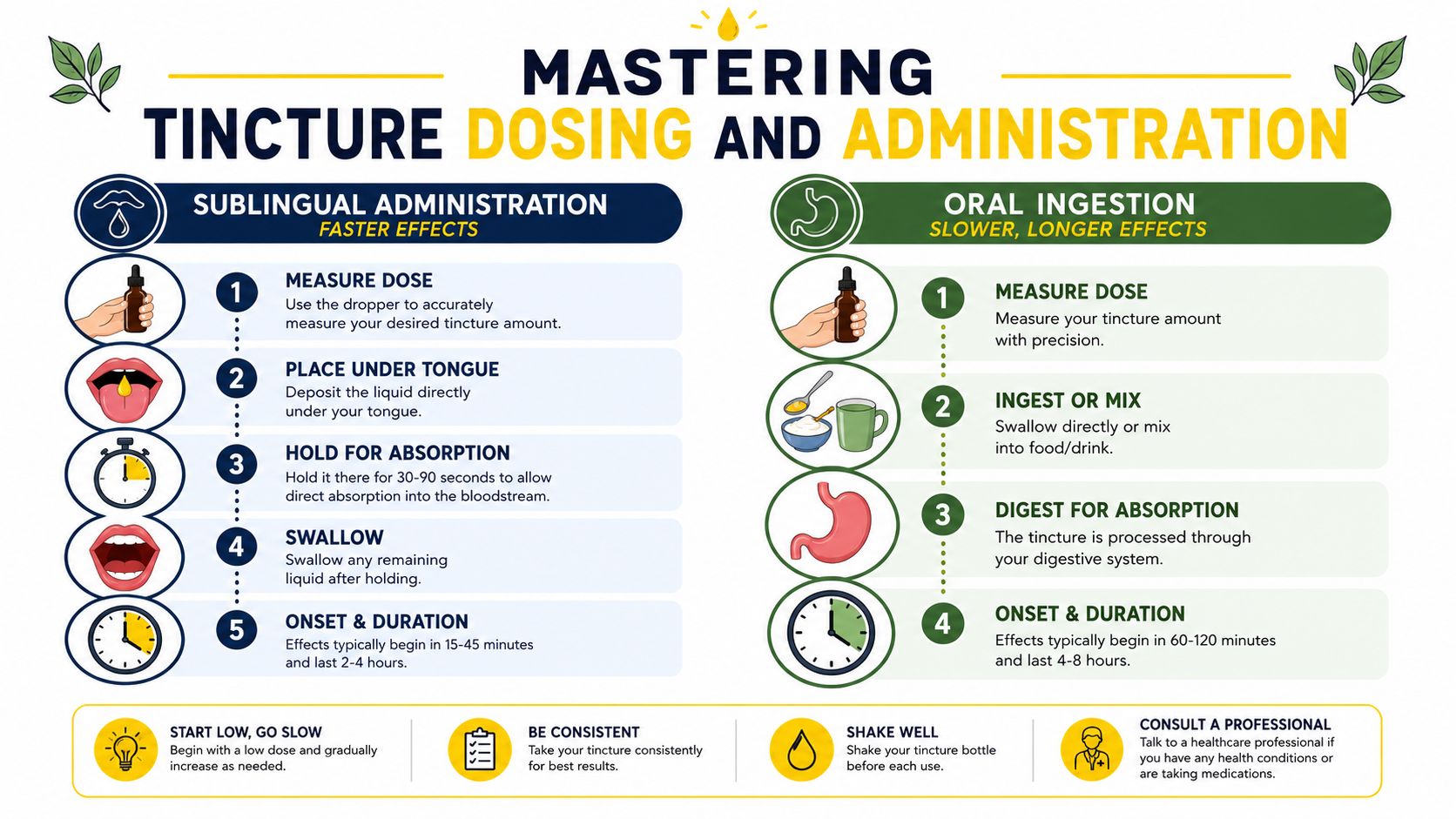
With sublingual use, you place the liquid under your tongue and hold it there briefly before swallowing what remains. According to the same dosage guide above, sublingual use often begins working in 15–30 minutes, while swallowed tinctures typically take 45–90 minutes to take effect.
That difference matters a lot in reviews. If someone says, “This tincture took forever,” I always want to know whether they used it sublingually or just swallowed it.
Here's a quick video walkthrough that helps make the process more concrete:
A beginner-friendly routine
If you're trying tinctures for the first time, keep your process boring and consistent. That's a good thing.
- Pick one method: Use it the same way each time so you can judge the product fairly.
- Measure carefully: Don't guess by eye if the dropper has markings.
- Write it down: Note the amount, the time you took it, and how it felt.
- Be patient: Don't stack doses too quickly just because the first few minutes feel quiet.
Hold your method steady before you judge the tincture. If you change the amount, the timing, and the route every time, you're reviewing your own inconsistency more than the product.
That note-taking habit is what turns a first try into a real cannabis tincture review.
The 5 Point Framework for Your Cannabis Tincture Review
Most reviews online are too fuzzy to be useful. “Tasted nice.” “Hit smooth.” “Pretty relaxing.” Those comments might be honest, but they don't help a new patient compare one tincture to another.
A better cannabis tincture review uses the same checklist every time.
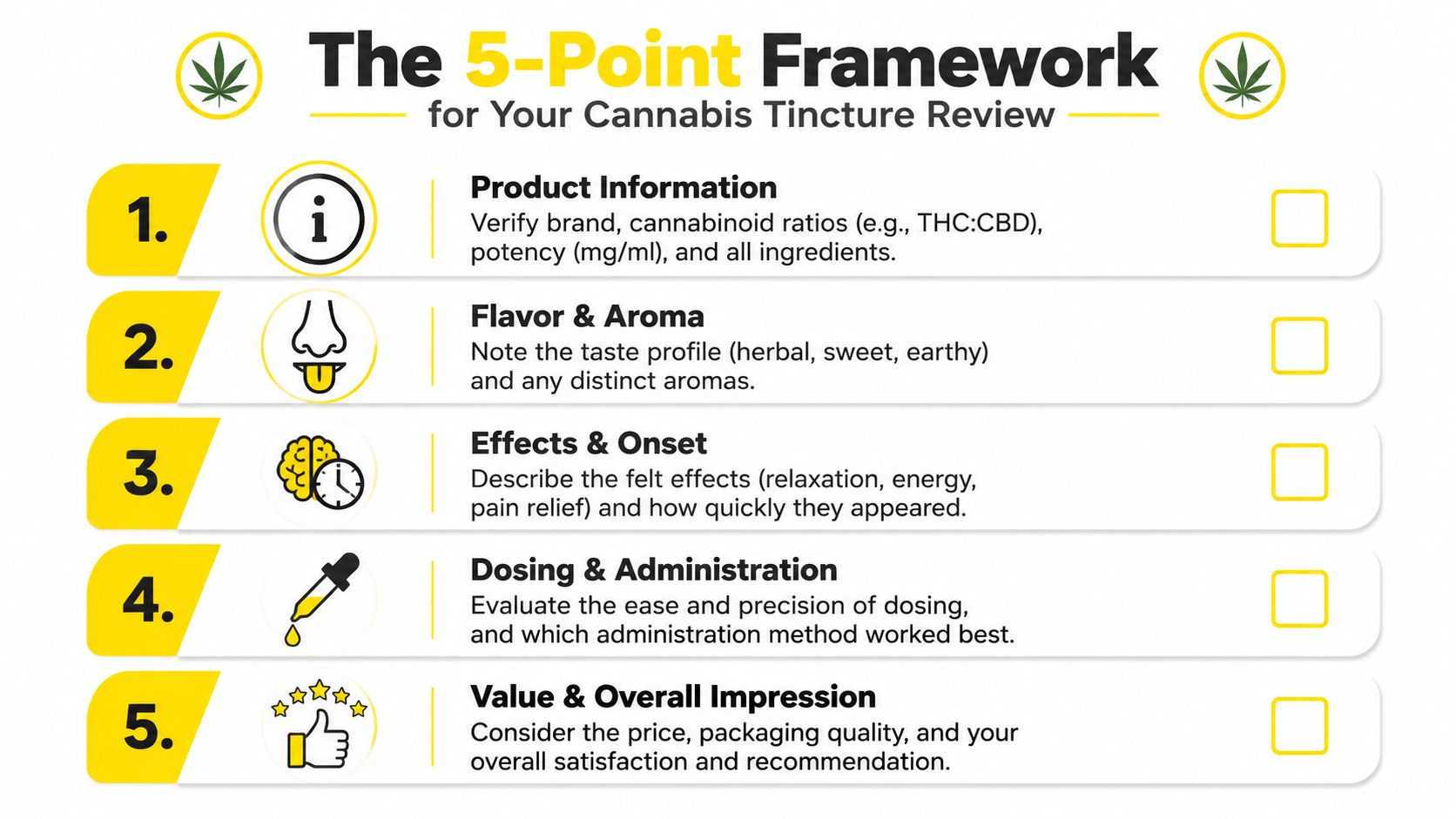
Point one, potency and consistency
Start with the label, then compare that to your actual experience.
Ask yourself:
- Does the bottle clearly state the cannabinoid content and ratio?
- Is the dropper easy to read and measure?
- Did similar doses feel reasonably consistent from one use to the next?
A tincture doesn't have to feel strong to be good. It has to feel predictable.
Point two, onset and duration
A strong review answers when tinctures are the better choice versus edibles or vapes for a specific goal. Typical sublingual onset of 15 to 30 minutes and a duration of 4 to 8 hours make route choice highly goal-dependent, as noted in this discussion of common tincture mistakes and route choice.
That means your review should mention context. Did you use it before bed, before a movie, or before trying to stay productive? “Worked well” means very different things in each setting.
Point three, flavor and formulation
Some tinctures taste earthy. Some feel peppery, herbal, or mildly sweet depending on the ingredients. This part matters more than people think.
If a tincture tastes so harsh that you dread using it sublingually, that changes the review. If it has a smoother carrier and sits comfortably under the tongue, that's worth noting too.
Consider:
- Taste: herbal, bitter, neutral, or flavored
- Mouthfeel: thin, oily, warming, or heavy
- Ingredient fit: simple formula or lots of extras
Point four, effects and experience
Your intention is what matters most.
A useful note might sound like this: “I wanted a balanced evening option. This felt calming without pushing me straight into couch-lock.” Another might be: “I bought this for daytime use, but it made concentration harder than I wanted.”
Those comments are much more helpful than broad praise.
Don't ask whether the tincture was “good.” Ask whether it matched the job you hired it to do.
Point five, transparency and safety
The final part of a review is trust.
Check whether the product listing or packaging gives clear information about ingredients, cannabinoid content, and product details. If you can't tell what's in the bottle or how to dose it, that should lower your confidence.
A short review template can help:
- Product and ratio
- How much I took
- How I took it
- How long it took to notice
- How it felt
- Would I use it for the same purpose again
That turns a vague impression into something repeatable.
How to Find the Best Tincture at Mr Nice Guys DC
A menu can look crowded until you know what to scan for first. Once you do, tinctures become much easier to compare.

What to look for on a menu page
Start with the product title, but don't stop there. True comparison work usually happens in the details.
Cannabis tincture potency is primarily determined by the cannabinoid concentration per milliliter. A practical framework is to divide total milligrams by total milliliters to derive mg per mL, which makes products easier to compare on a menu, according to this tincture dosage chart.
So if you're browsing a menu and see two tinctures, don't just compare the large total number on the front image. Compare how concentrated each bottle is.
For a wider look at categories you may see while shopping, this overview of cannabis products available at Mr. Nice Guys DC gives useful context.
A practical shopping example
Let's say you're shopping for daytime use. You'd likely want to narrow the menu toward a CBD-forward or more balanced tincture and then review the details with your framework:
- Goal fit: Is this meant for calm, balance, or heavier relaxation?
- Concentration: How much cannabinoid is in each mL?
- Format comfort: Does the bottle look easy to measure?
- Formula style: Is it full-spectrum, broad-spectrum, or isolate?
- Your routine: Are you planning to use it under the tongue or swallow it?
Now take a different shopper looking for evening support. That person may prioritize a THC-forward option and care less about staying sharp. Same category, different review standard.
Questions worth asking before checkout
A smart purchase often comes down to a few basic questions:
- “How concentrated is this per mL?” This is the clearest comparison point.
- “What's the cannabinoid profile?” THC-dominant and CBD-dominant tinctures are built for different goals.
- “How do you recommend using it?” The route changes the experience.
- “Does this fit daytime or nighttime better?” Staff can often help translate labels into routines.
That's the secret. The “best” tincture isn't the bottle with the flashiest label. It's the one that makes sense for how you plan to use it.
Your Path to Confident Tincture Use
By the time someone feels comfortable with tinctures, they usually stop asking, “What's the strongest bottle?” and start asking better questions. “What's the concentration per mL?” “How will I take it?” “Is this better for daytime or for winding down?” That shift is what makes your cannabis tincture review more accurate.
Tinctures reward a calm, methodical approach. Read the label. Match the spectrum and cannabinoid profile to your goal. Measure carefully. Use the same review framework each time. When you do that, the category gets much less intimidating.
You also don't need to find your forever tincture on the first try. Learning often involves comparing a few different styles, then noticing patterns. Maybe you prefer balanced formulas in the evening. Maybe you like a simpler CBD option during the day. A good review process helps you spot those preferences sooner.
Keep the five points close: potency and consistency, onset and duration, flavor and formulation, effects and experience, transparency and safety. That checklist turns “I think I liked it” into a useful judgment you can build on.
If you're ready to put that framework to work, browse the tincture options at Mr. Nice Guys DC and compare each bottle the same way you'd review any other wellness product: by concentration, intended use, and how well it fits your routine.
Mr Nice Guys DC
At Mr. Nice Guys DC, we’re more than just a cannabis delivery service — we’re passionate advocates for quality, convenience, and community. With years of experience in the cannabis industry, our team is dedicated to educating and empowering customers across Washington, D.C. Whether you're a seasoned user or just starting your cannabis journey, our blog delivers trusted tips, product insights, and the latest updates from the world of weed. Stay informed, stay elevated.
