
Must Be 21 To Enter
By entering this site you are agreeing that you are at least 21 Years of Age or older.
I AM 21 OR OLDERMake Cannabis Oil at Home with a Cannabis Oil Infuser
.svg)

.png)
Without decarboxylation, cannabis oil won't deliver active cannabinoids, and the most reliable activation benchmark is about 240°F to 248°F for 30 to 40 minutes before infusion. A gentler flavor-preserving cycle sits closer to 220°F for 45 to 60 minutes, but the point stays the same, raw flower has to be heated first or your finished oil is mostly flavored fat.
A patient standing at the counter in DC usually wants the same thing, something they can trust, dose, and afford. The problem is that a bottle bought pre-made rarely tells you enough about the carrier oil, the extraction method, or how much active compound ends up in each spoonful, so home infusion becomes the practical way to take control of the batch.
Why Home Infusion Changes the Game
A patient at the dispensary counter often gets a small bottle, a price, and maybe a rough suggestion to “start low.” That's not nothing, but it leaves the biggest questions unanswered, how strong is it really, what oil is inside, and will the next bottle feel the same as this one? If you've ever stood there trying to compare a tincture, an edible oil, and a topical, you already know how fast confusion sets in.
Home infusion changes that because you decide the carrier oil, the batch size, and the dose target. A cannabis oil infuser gives you a repeatable way to make oil for brownies, massage balm, or a measured tincture-like preparation, instead of relying on guesswork and whatever a shelf product happens to contain. For patients who want to match their oil to a specific recipe or wellness routine, that control matters more than marketing claims.
The other shift is chemistry. Raw flower doesn't become useful oil just because it's soaked in fat, it has to be activated first. That's why the earliest practical methods of oil delivery became possible only after reliable non-combustion heating systems matured in the 1990s and 2000s, alongside milestones like Joseph Robinson's 1927 patent, the Volcano's development in 1996, its patent in 1999, and its U.S. release in 2003.Cannabis vaping history Those systems helped establish the heating logic that home infusers now apply to oil.
Practical rule: If you skip activation, you haven't made potent infused oil, you've made hot plant fat.
That's why a patient who learns the process once can make better choices every time afterward. They can compare edible recipes, topicals, and tincture-style oils with a clear sense of what's inside the jar, instead of trusting a label alone. For a broader look at oil use cases, this DC guide to cannabis oil uses is a useful companion.
What a Cannabis Oil Infuser Actually Does
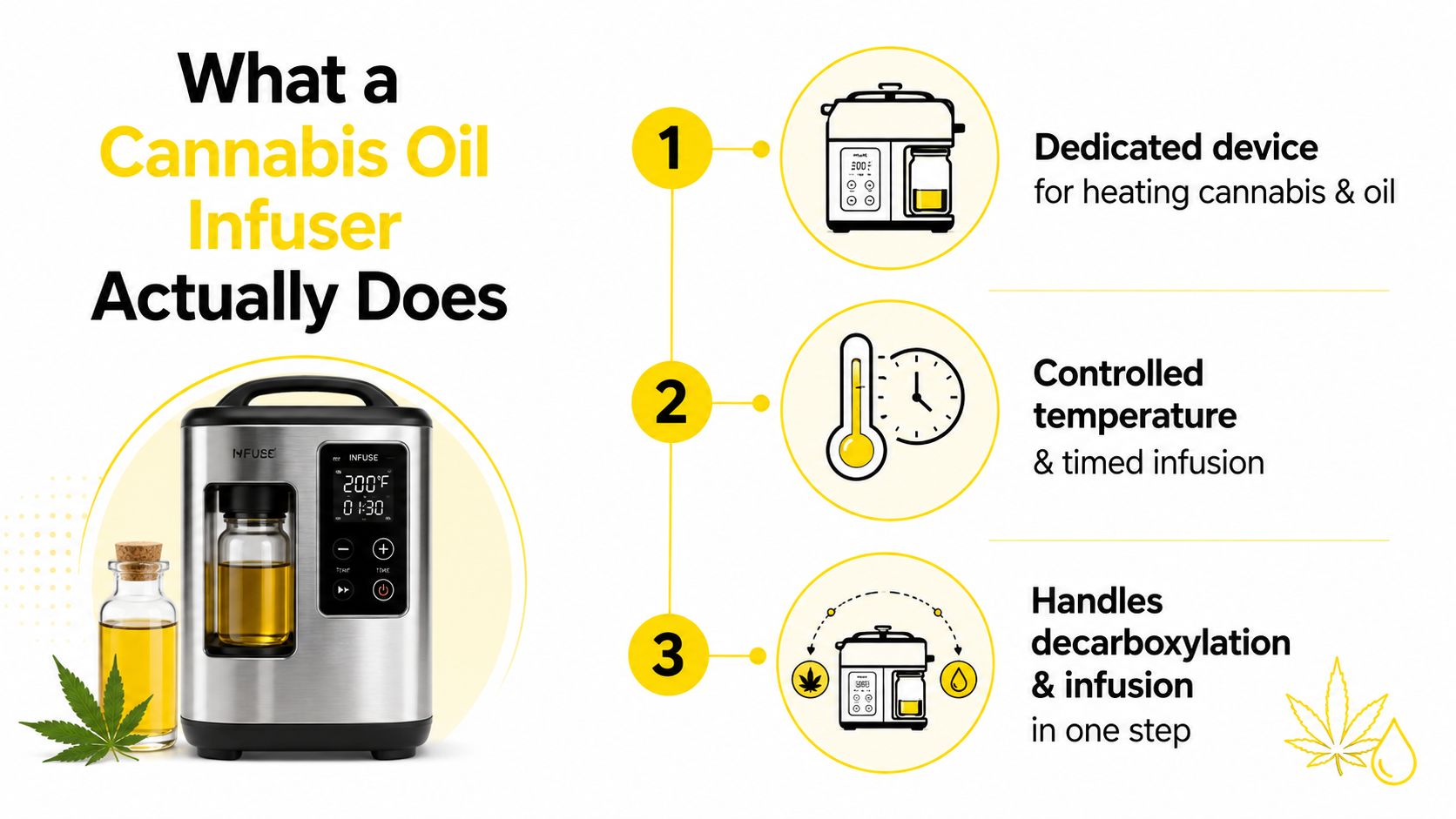
A cannabis oil infuser is a controlled kitchen device that heats cannabis and carrier oil at steady temperatures for a set period. That sounds simple, but the value is in consistency, because the difference between a useful batch and a disappointing one usually comes down to heat management, not exotic ingredients. Dedicated machines can handle activation and infusion in one chamber, while simpler methods rely on a separate oven or stovetop step for decarb.
Why the device category matters
The concentrate market pushed this category forward. Historical potency data show why, older hash oils seized in the 1970s typically measured 10% to 30% THC, while cannabis oil products in the 2010s reached THC concentrations as high as 90%, with some reported even higher.Hash oil history Once concentrates got that strong, people needed repeatable heating instead of improvising on the stove.
The same logic sits behind countertop infusion units today. Commercial models commonly advertise activation presets at 110°C, 113°C, 116°C, 119°C, and 122°C, with infusion ranges from 20°C to 100°C and chamber sizes from 300 to 700 mL.Hydroponics equipment specs Those numbers matter because a patient making a small test batch needs precision, while a caregiver or small producer needs repeatability.
What the infuser does best is remove uncertainty. A pan on the stove can scorch, a slow cooker can run unevenly, and a sealed machine can help hold the process inside a tighter window. One widely used consumer model also lists 1.2 L capacity and staged processing, while another reports up to 41 fl oz and separate drying, activation, and infusion cycles.Royal Queen Seeds machine overview
Practical rule: If you want your next batch to taste and feel like the last one, use a device that separates activation from infusion.
For patients comparing options, that usually means choosing between simplicity and control. Simpler methods can work. Dedicated machines just make the results easier to repeat, especially when you care about odor, cleanup, and the amount of plant material you're processing at once.
The Essential First Step Is Decarboxylation
Raw cannabis contains acidic cannabinoids, and those acids don't give you the same effect profile as activated THC and CBD. Heating changes the chemistry, which is why skipping decarb is the most common reason a homemade batch feels weak. If a patient tells me the oil “did nothing,” the first thing I ask is whether they activated the flower properly.
The benchmark that actually works
A practical home benchmark is 240°F to 248°F, or about 115°C to 120°C, for 30 to 40 minutes.Step-by-step cannabis oil guide That's a range a home user can manage without expensive equipment, and it's strong enough to activate the flower before it goes into oil. If you care more about flavor retention, a gentler path is 220°F, or about 105°C, for 45 to 60 minutes.Potency and storage guide
The visual cue matters as much as the thermometer. Properly decarbed flower should look yellow or light brown, not bright green, and it should smell toasted rather than burnt.Step-by-step cannabis oil guide Burnt flower doesn't just taste bad, it can leave you with a flat, harsh oil that's harder to use in foods or topicals.
Here's the practical home example most beginners can follow: 1 ounce of decarboxylated flower to 2 cups of oil is a common batch ratio.Potency and storage guide That doesn't mean the finished oil will all feel the same, because strain strength, decarb quality, and filtration losses all change the final result. It does give you a sane starting point for planning.
What beginners get wrong
- Rushing the heat: Too much heat scorches the plant before activation finishes.
- Skipping the color check: Green, raw-looking flower usually means the process wasn't finished.
- Grinding too fine: Powdery material strains badly and can cloud the oil.
- Treating decarb like a side note: It's the step that separates active oil from inert plant matter.
If you want the cannabinoid chemistry explained in plain language, this DC patient guide to THCA and THC is a smart place to start. The key is simple, activate first, infuse second, and don't assume time alone will make the batch stronger.
Infusion Methods Compared
Once the flower is activated, the next question is how much control you want over heat, odor, and cleanup. A patient making a small batch for occasional use has different priorities than someone preparing a topical base on a regular schedule. The right method depends on whether you want simplicity, precision, or repeatability.
Stovetop, slow cooker, sous-vide, and machine use
A double boiler is the most accessible option because it needs very little special equipment. Keep the oil between 160°F and 200°F, stir it occasionally, and give it time to move through the plant material before straining it well.Potency and storage guide It works, but it still asks you to pay attention, since direct heat can creep up faster than expected.
A slow cooker gives you more forgiveness and less hands-on monitoring. Standard guidance puts that method at 4 to 6 hours on low, which is why many home cooks use it for larger batches.Step-by-step cannabis oil guide The trade-off is speed, because you get steadier heat, but you also commit to a longer session at the counter.
Sous-vide-style infusion is the precision route. A water bath held around 185°F keeps temperature stable and can reduce odor in shared spaces.CRX Magazine guide That matters in apartments and other places where smell control is part of the decision, not an afterthought.
A dedicated machine sits at the top end of repeatability. Independent product reviews describe countertop infusers that combine 800 W heating with 150 W motor power, temperature control from 32°F to 250°F, and timers from 30 minutes to 12 hours.Consumer machine review They are especially useful when you want separate decarb and infusion phases without standing over the pot the entire time. For people who would rather skip the setup and use finished products, a practical next read is this canna butter edibles recipe guide, which shows where infused oil usually ends up in the kitchen.
Practical rule: Choose the method that matches how much monitoring you can actually do, not the one with the fanciest name.
For patients who want a storefront option instead of a homemade appliance, Mr. Nice Guys DC also carries cannabis product categories like concentrates and edibles, which can fit into a broader infusion workflow without making every batch start from scratch.
Dosing Math and Storage Basics
Potency gets easier to judge once you do the math before the batch starts. Many beginners skip that step and then blame the device when the actual issue is the starting material, the oil volume, or the amount left behind in the filter. A longer infusion does not automatically produce stronger oil, and guidance on infusion time notes that stretching a batch from 30 minutes to 2 hours may add only modest gains under similar conditions.Why longer infusion doesn't mean stronger oil
A simple serving estimate
If flower tests at 20% THC, one ounce contains roughly 5,600 mg THC in the plant material before losses. If that goes into 2 cups, or 16 tablespoons, of oil, each tablespoon works out to about 350 mg before filtration losses. A teaspoon is one-eighth of a tablespoon, so that's roughly 44 mg per serving before you account for what stays in the plant material or strainer.
That is why careful patients label batches before they ever taste them. A strong-looking oil can still be uneven if the flower was not fully decarbed or if the oil did not fully saturate the plant material. Filtration matters too, because a sloppy strain can leave a lot of active material behind in the pulp.
Carrier oil changes the result
Cannabinoids bind to fat molecules, so coconut, olive, and avocado oil are practical bases instead of water-based liquids.Montclair hemp-infused oil comparison That comparative work also found differences in antioxidant potential, total phenolic content, and cannabidiol content across carrier oils, which is a reminder that the base oil is not just a neutral placeholder. If you want a massage oil, feel and slip may matter most. If you want an edible oil, flavor and kitchen compatibility may matter more.
A useful way to stay organized is to log every batch. Write down the date, flower weight, oil type, and your estimated mg per teaspoon. For dosing help, this edible dosage calculator guide can help you think through servings instead of guessing from the jar.
Store the finished oil in a cool, dark place, ideally refrigerated, because light, heat, air, and humidity all shorten its useful life. Keep every bottle clearly labeled and out of the reach of children and pets.
Real Ways to Use Your Infused Oil
The first batch usually gets used in the simplest place, the one you already know how to handle. Edibles are the most obvious option, but the same infused oil can also work as a topical or as a tincture-style preparation, depending on what you want from it. In practice, the better results usually come from matching the oil to the use case instead of forcing one batch to do every job.
Edibles and cooking
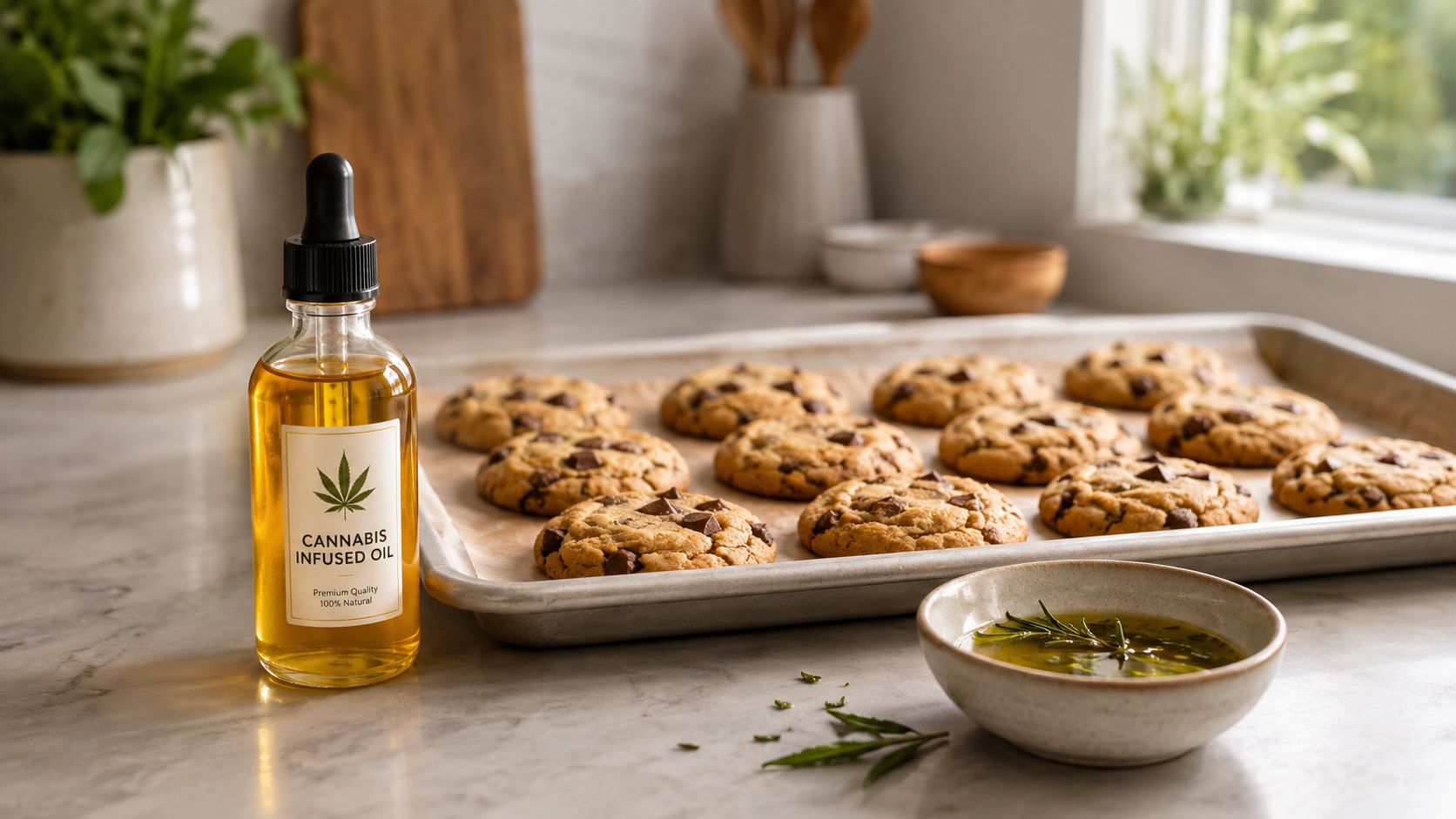
For brownies, cookies, or savory dishes, swap part of the recipe's butter or cooking oil with your infused batch. A straightforward home example is using 1 tablespoon of infused oil in a brownie mix, then cutting the pan into servings based on your dose math. That keeps the result tied to actual potency instead of vague labels like “strong” or “weak.”
Heat control matters. High heat can reduce cannabinoids and terpenes, so add the infused oil at sensible cooking temperatures rather than pouring it into a scorching pan. Many patients get better results by stirring it into batters, sauces, or finished dishes, where the oil spends less time under direct heat.
Topicals and tincture-style use
Topicals fit localized use well. Blend infused oil with beeswax and a carrier like coconut oil to make a balm or salve, then apply it to the skin. Topicals usually stay localized instead of producing a psychoactive effect, which is why they are common for patients who want a non-intoxicating route.
Tincture-style use follows a different pattern. The oil is usually held under the tongue for 30 to 60 seconds before swallowing, which lets absorption begin through the mucous membranes faster than digestion alone. Start with a half-dose the first few times, then wait at least two hours before taking more. A simple log of how much you took and how you felt is often more useful than memory.
A patient who wants a finished topical or edible does not always need to make it from raw flower. In DC, dispensary selection can also include oils, topicals, and other prepared formats, so the better choice depends on whether you are prioritizing control, convenience, or both.
Safety, Storage, and DC Guidance
Cannabis oil is concentrated, so treat it like any potent kitchen ingredient, not a casual drizzle. Keep it sealed, refrigerated, and clearly labeled, and store it away from children and pets. If you're using it as medicine, keep a simple note of dose, timing, and effect so you can spot patterns instead of guessing.
Cannabis can interact with other medicines, especially blood thinners, sedatives, and drugs with a grapefruit warning, so tell your healthcare provider what you're using. Pregnant and breastfeeding patients should avoid cannabis-infused products entirely. Never drive after dosing.
In Washington, DC, medical patients also need to pay attention to compliance and product source. A licensed dispensary is the safer path when you want guidance on product selection, certification, and dosing strategy, especially because cannabis still sits in a complex federal legal environment. If you're comparing a homemade oil with a store-bought tincture or edible, use the same discipline, read the label, check the format, and choose the route that fits your health situation.
If you want a practical conversation about cannabis oil, infusion products, or medical access in DC, Mr. Nice Guys DC can help with product selection and compliance questions through its consultation team. It serves patients across DC and nearby communities, including Alexandria, Bethesda, Rockville, and Silver Spring, with in-store pickup, curbside, and delivery options. Visit Mr. Nice Guys DC to see what's available and choose the format that fits your routine.
Mr Nice Guys DC
At Mr. Nice Guys DC, we’re more than just a cannabis delivery service — we’re passionate advocates for quality, convenience, and community. With years of experience in the cannabis industry, our team is dedicated to educating and empowering customers across Washington, D.C. Whether you're a seasoned user or just starting your cannabis journey, our blog delivers trusted tips, product insights, and the latest updates from the world of weed. Stay informed, stay elevated.
