
Must Be 21 To Enter
By entering this site you are agreeing that you are at least 21 Years of Age or older.
I AM 21 OR OLDERWhat Is the Strongest Indica Strain: Top Picks for 2026
.svg)

.png)
A patient walks in after work, looks at the flower menu for ten seconds, and asks the question we hear all the time: “What's the strongest indica you have?”
That question makes sense. Sometimes you want serious evening relief. Sometimes sleep has been rough for days. Sometimes pain, stress, or racing thoughts have made “relaxing” feel like a joke. In those moments, nobody wants a long lecture. They want the strain that's most likely to work.
The catch is that what is the strongest indica strain doesn't have a one-size-fits-all answer. The strongest strain on paper can still miss the mark if the terpene profile is wrong for your body, your tolerance is high, or your goal is too specific for a simple THC chase.
We've seen this play out plenty of times. One patient wants heavy body relaxation and sleep support. Another wants pain relief but still wants to finish a movie before bed. A third asks for the highest THC flower available, then comes back later saying it felt flatter than expected. That usually means the number was impressive, but the overall profile wasn't the right fit.
The Search for the Strongest Indica
A lot of people use “strongest” as shorthand for hardest hitting. That could mean deep body weight, fast mental quieting, stronger sedation, or a strain that turns down pain enough to make bedtime possible.
Those are not all the same effect.
Someone who's still learning the basics often benefits from starting with a clear explanation of the difference between indica and sativa, because “indica” usually points people toward fuller body effects and more evening-friendly use. But even inside that category, the experience can vary a lot.
What patients usually mean by strong
When patients ask for the strongest indica, they're usually asking for one of these:
- Sleep support: They want something that helps them settle down and stay down.
- Body relief: They want muscle tension, soreness, or general physical discomfort to fade into the background.
- Mental quiet: They don't necessarily want to feel energized or chatty. They want the day to stop buzzing.
- Longer-lasting heaviness: They want effects that don't disappear after a short window.
Here's where practical budtending matters. If someone asks for “the strongest,” the better follow-up question is, “Strongest for what?”
The best indica for sleep is not always the best indica for pain, and neither is always the highest THC flower on the shelf.
A patient dealing with insomnia might love a sedating, myrcene-forward flower. A patient with nighttime anxiety may do better with something calmer and less overwhelming. A high-tolerance consumer may need a very potent cultivar just to feel the same level of relief that a newer patient gets from a more balanced option.
That's why the definitive answer starts with chemistry, not hype.
Decoding Strength Beyond Just THC
THC matters. It's the headline number that viewers often see first, and for good reason. But THC alone doesn't explain why one indica feels dense, sleepy, and body-heavy while another with a similar percentage feels shorter, sharper, or oddly one-dimensional.
Think of a strain like a band. THC is the lead vocalist. It gets the attention and carries the main line. But the full experience depends on the rest of the group playing well together. Terpenes and minor cannabinoids shape the texture, timing, and direction of the effect.
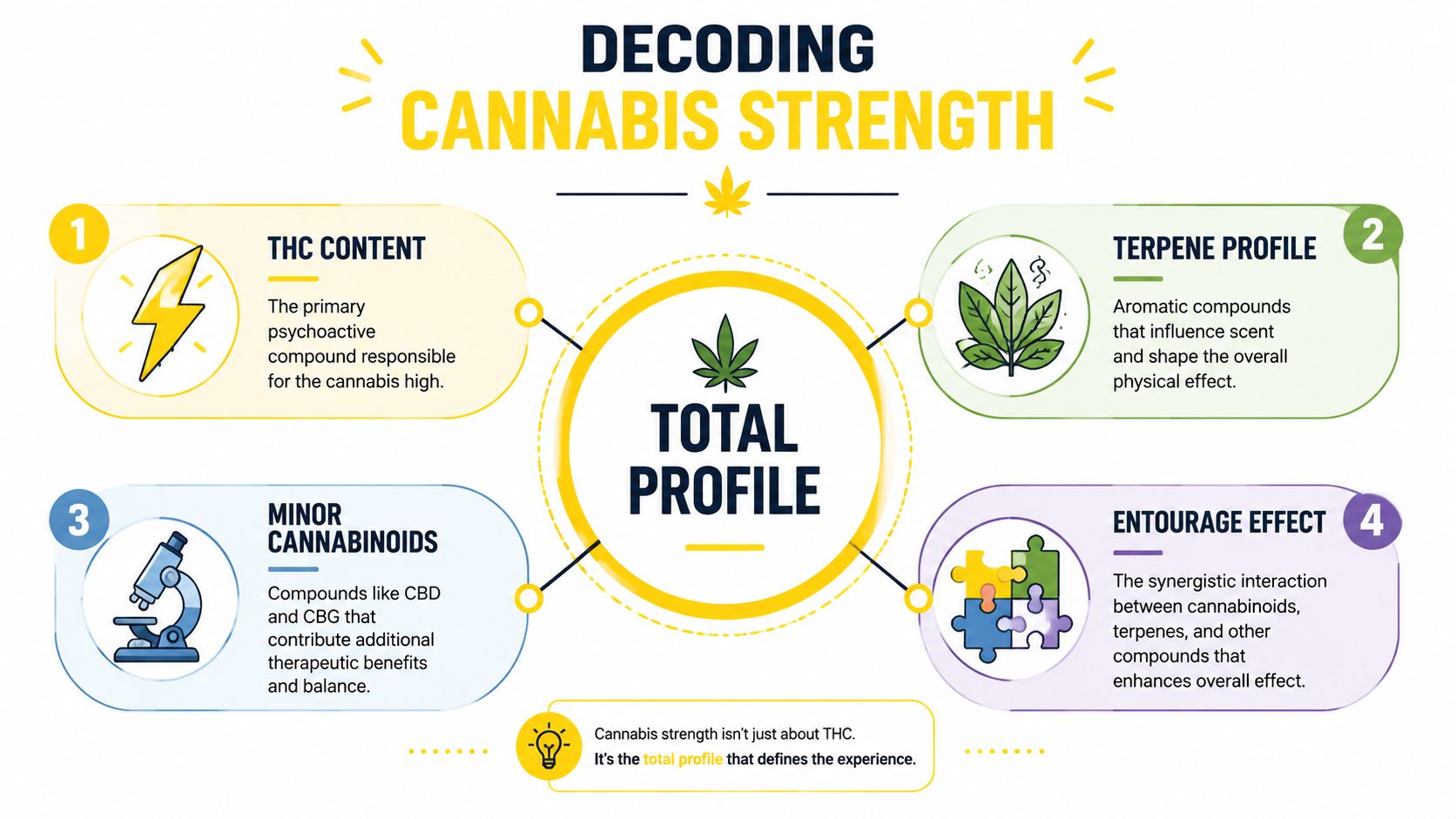
If you've ever wondered why one flower feels fuller and more complete than another, that's the same idea behind full-spectrum cannabis. The profile matters more than any single number.
Why myrcene changes the conversation
For indica shoppers, myrcene is one of the most important terpenes to understand. It's closely associated with the heavy, sedating side of the experience that many patients mean when they ask for “strong.”
According to Sunmed's discussion of potent indica strains, the strength of an indica is significantly enhanced by its terpene profile, particularly myrcene. The same source notes that myrcene can increase the permeability of the blood-brain barrier, making it easier for THC to exert its effects. That's why a 25% THC strain with high myrcene can feel more sedative than a 27% THC strain with low myrcene.
That's a small numerical difference, but in real use it can be the difference between “I'm relaxed” and “I'm not moving from this couch.”
What works and what doesn't
Patients often get better results when they stop shopping by THC alone and start asking better product questions.
One practical method for consideration:
| What you ask for | What you often get |
|---|---|
| Highest THC only | A strong number, but not always the heaviest effect |
| High THC plus myrcene-forward profile | Better odds of body-heavy, evening-friendly relaxation |
| Random strain recommendation from a friend | Mixed results, because their body and tolerance aren't yours |
Here's what usually works better in real life:
- Ask about terpene dominance: If you want sedation, ask whether myrcene leads the profile.
- Match the effect to the time of day: A flower that's great before bed may be too heavy for late afternoon.
- Read the room with your tolerance: If you're sensitive to THC, a very potent cultivar can overshoot the goal fast.
What usually doesn't work is grabbing the biggest number on a menu and assuming that solves everything. That approach can work sometimes, especially for experienced consumers. It can also leave people disappointed, groggy, or too overwhelmed to enjoy the benefits.
Practical rule: If your goal is sleep or full-body calm, look for an indica with a strong overall profile, not just a flashy THC label.
The Numbers Game and Potency Benchmarks
Some readers still want the direct answer, and that's fair. On the THC leaderboard, Future #1 currently holds the title for strongest indica strain with up to 37% THC, surpassing earlier top contenders such as Godfather OG at around 34%. The same source notes that this is a major jump from the 15-20% THC typically seen in landrace indicas in the 1970s. You can read that benchmark in 420 Seeds' overview of the strongest indica strains.
Those numbers show how much breeding has changed the category. Modern growers aren't just selecting for bag appeal or aroma. They're selecting for resin production, cannabinoid expression, and the kind of dense, hard-hitting experience that experienced evening users often seek.
What the top end really means
Big numbers create excitement, but they should also create caution.
A strain near the top of the potency range isn't automatically the best everyday option. For some patients, it's exactly the right fit for intense nighttime use. For others, it's too much. Very potent flower can feel less like “better relief” and more like “I took a wrong turn” if dose, timing, and setting aren't right.
That matters even more once you understand THCA vs THC for DC patients, because the label can tell only part of the story unless you know how to interpret it.
A simple benchmark table
Here's a practical way to read the shelf without overcomplicating it:
| Potency tier | What it usually suggests |
|---|---|
| Lower-end indica potency | May be easier for newer or more sensitive consumers to manage |
| Mid-to-high potency indica | Often where many experienced patients find reliable evening relief |
| Top-shelf extreme potency | Best approached carefully, especially if sedation is the goal |
Even without assigning extra numbers, the pattern is clear. Once you move into elite potency territory, the margin for error gets smaller. One bowl, one pre-roll session, or one heavy vape pull can be enough.
Why cultivation still matters
The strongest expression of a strain doesn't come from genetics alone. The verified growing discussion around Future #1 ties that ceiling to selective breeding and optimized conditions, including light intensity above 1000+ PPFD, temperatures around 68-78°F by day and 55-65°F by night, and flowering humidity in the 40-60% RH range. Under those ideal conditions, Future #1 reaches the 37% THC mark, while most commercial indicas test in the 20-30% range and cultivars like Peyote Zkittlez and Strawberry Canyon consistently test at 28%+ THC.
For patients, the practical takeaway is simple. A strain name tells you something. A reliable lab-backed batch tells you more. Two versions of the same cultivar can feel very different depending on how well they were grown, cured, and stored.
Examples of Top-Tier Potent Indicas
Patients usually don't shop by theory alone. They shop by feel. They want to know what a strain is like at the end of a long day, after dinner, before bed, or when pain starts creeping up.
That's why examples help.
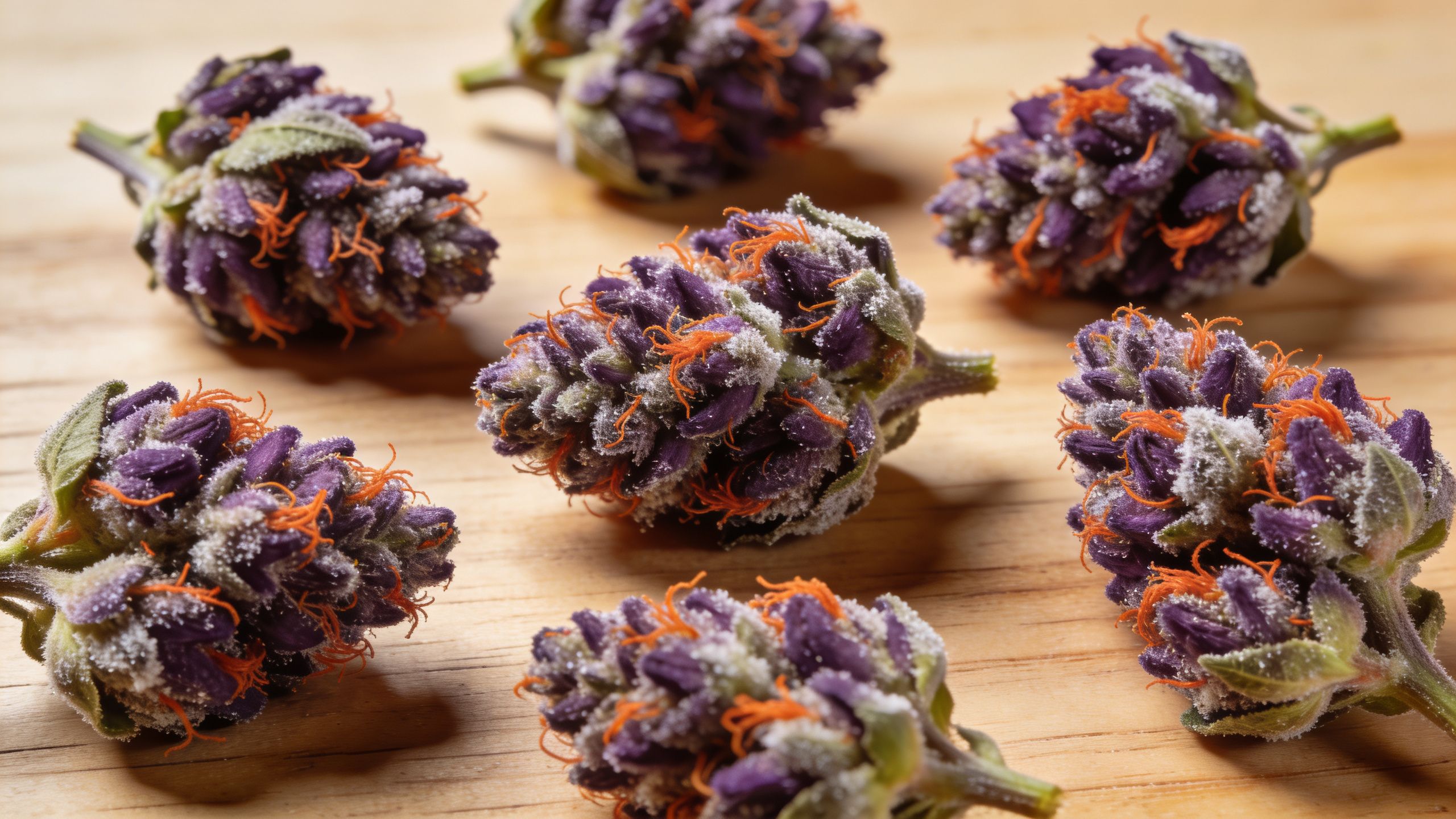
Future #1 for maximum ceiling
If you want the current answer to “what is the strongest indica strain,” Future #1 is the headline name. It sits at the top of the verified potency discussion and represents the outer edge of what modern breeding can do under ideal conditions.
In practical terms, this is not the strain category to approach casually. It fits experienced consumers looking for extreme intensity, especially late at night. For some people, that kind of ceiling is useful when ordinary heavy flower no longer feels heavy enough. For newer patients, it can be too much too fast.
Best fit:
- Severe evening wind-down
- High tolerance consumers
- Patients specifically seeking very intense body effects
Less ideal:
- First-timers
- Anyone trying to stay mentally active
- People who get anxious when THC hits hard
Godfather OG for old-school heavyweight appeal
Before Future #1 took the crown, Godfather OG was the strain many people pointed to first when they wanted serious indica power. It still belongs in the top-tier conversation because it has the reputation and chemical strength to deliver that heavy, end-of-night style effect.
This is the kind of strain that often appeals to patients who say things like, “I don't want to think. I want to melt into the couch.” It's a classic answer for body load and evening use, especially for people who already know they like OG-leaning profiles.
Some strains feel strong because they hit hard. Others feel strong because they stay heavy and steady. Godfather OG is often remembered for the second kind.
Purple Punch for terpene-driven sedation
Purple Punch is a good reminder that “strongest” doesn't always mean “highest number.” It's one of the easiest examples of a strain that can feel especially sedating because the profile supports that outcome well.
If a patient tells us they don't care about bragging rights and just want to feel physically calm, something in this lane often makes more sense than chasing an absolute THC record. Profile-based shopping beats menu-flex shopping in these instances.
A patient who liked dessert-like indicas before bed might also want to read about Ice Cream strain weed, since those flavor families often attract people looking for rich, evening-friendly options.
OG Kush for balanced strength
OG Kush deserves a place in this conversation even when the article focus is “strongest indica” because not every patient needs a knockout. Some need a strain that still feels powerful, grounded, and physically easing without flattening the whole night.
That's a different type of strength. It's useful for the patient who wants pain relief, body relaxation, and mood settling, but doesn't want the session to end their ability to function immediately.
Here's a useful visual breakdown before you compare options further:
A quick way to compare use cases
| Strain example | Type of strength | Better for |
|---|---|---|
| Future #1 | Maximum potency ceiling | Experienced nighttime users |
| Godfather OG | Heavy classic indica force | Deep evening relaxation |
| Purple Punch | Terpene-led sedation | Bedtime calm and body ease |
| OG Kush | Balanced power | Relief with a bit more flexibility |
That's the reason strain examples matter. “Strong” can mean maximum potency, maximum sedation, or best symptom fit. Those are related, but they aren't identical.
How Personal Factors Influence Effects
The same flower can hit two people in completely different ways. One person feels loose, sleepy, and comfortable. Another feels overcooked. That isn't unusual. It's normal.
Your biology, your tolerance, and your method all shape the result.

Tolerance changes what strong means
A daily smoker and an occasional evening consumer are not shopping from the same reality.
For the daily user, a high-potency indica may feel appropriately strong but manageable. For the occasional user, the exact same flower may be far too intense. This is why we tell patients to define “strong” in personal terms, not internet terms.
Try thinking about your own response history:
- If small amounts already work well: You may not need the highest-potency option available.
- If familiar strains feel mild now: You may need either more potency or a better terpene match.
- If THC sometimes makes you uneasy: Chasing the biggest number is usually the wrong move.
Method matters more than people expect
A strong indica in flower form doesn't feel exactly like the same profile in a vape, and it definitely won't feel the same if you consume an edible version built around similar genetics.
Smoking or vaping flower tends to give you quicker feedback. You can pause after a puff or two and decide whether you're where you want to be. That makes it easier to titrate. Edibles are less forgiving because the delay can tempt people to take more before the full effect arrives.
If you're trying a very potent indica for the first time, flower is often easier to control than a format that takes longer to peak.
Your goal should decide your dose
A lot of bad experiences come from using a bedtime dose for a non-bedtime situation.
If your plan is to sleep, heavier may be fine. If your plan is to watch a show, stretch out, and still answer a text, the same dose could feel excessive. Patients who keep a simple journal often learn faster than patients who rely on memory alone.
A useful tracking note can include:
- Which strain you used
- How much you had
- How long before effects showed up
- Whether it helped the actual issue
That kind of note-taking sounds basic, but it quickly reveals patterns. You stop guessing and start choosing with intent.
Finding Your Strongest Strain at Mr Nice Guys DC
The smartest way to shop strong indicas is to stop asking only for the highest THC flower and start describing the result you want. That gives a budtender something useful to work with.
If sleep is the problem, say you want an indica with a sedating profile. If pain relief is the priority, say you want body-heavy effects that won't feel too racy. If you already know you respond well to myrcene-forward flower, say that upfront. That level of detail leads to better recommendations than “strongest thing you've got.”

One reason this matters is that high-potency indicas aren't some tiny side category. They account for over 60% of indica-dominant flower purchases in regulated U.S. markets, according to the verified data provided earlier in this brief. Patients clearly care about potency, but the better results usually come from understanding how to use it.
How to ask for better help
When you shop, lead with the outcome:
- “I need something for sleep.”
- “I want strong body relief, not a heady effect.”
- “I can handle high THC, but I want it smooth and heavy, not edgy.”
- “I'm newer to flower, so I want strong but not overwhelming.”
That gives the team room to narrow by chemistry, effect style, and format. If you want a better sense of what might be available, browse what strains Mr. Nice Guys DC carries.
What we recommend most often
For potent indicas, the practical advice stays simple:
- Start low and go slow: Especially with anything above your usual comfort zone.
- Use strong indicas at the right time: Most are better saved for evenings and late nights.
- Pay attention to profile, not hype: A lower-number batch with the right terpene mix can outperform a higher-number batch for your goals.
Many patients in DC, Alexandria, and Bethesda are looking for the same thing. Reliable relief, not just a flashy label. That's why the strongest indica strain is best understood as the one that gives you the effect you need, at a dose you can manage comfortably.
If you want help finding the right heavy-hitting flower, vapes, edibles, or pre-rolls for your needs, visit Mr. Nice Guys DC. Our team can help you sort through potency, terpene profiles, and product formats so you can choose an indica that feels strong in the way that matters most to you.
Mr Nice Guys DC
At Mr. Nice Guys DC, we’re more than just a cannabis delivery service — we’re passionate advocates for quality, convenience, and community. With years of experience in the cannabis industry, our team is dedicated to educating and empowering customers across Washington, D.C. Whether you're a seasoned user or just starting your cannabis journey, our blog delivers trusted tips, product insights, and the latest updates from the world of weed. Stay informed, stay elevated.
