
Must Be 21 To Enter
By entering this site you are agreeing that you are at least 21 Years of Age or older.
I AM 21 OR OLDERWait Time at Patient First: What to Expect in 2026


Reported waits include about 10 minutes at check-in and roughly 20 to 30 minutes before an exam room, but Patient First publishes no official average wait. If you're taken out of the lobby quickly, does that mean you'll be heading home soon?
Not necessarily. The front-door wait and the total visit length are different measurements. Understanding that difference helps you plan transportation, childcare, work, and any medical cannabis purchases separately from your urgent-care visit.
What a Typical Patient First Wait Looks Like
There's no published average wait time at Patient First that reliably predicts your visit. Patient accounts offer examples, but they don't establish what usually happens at a particular center or hour.
The following figures describe different stages and settings. Don't add every row together, because the patient accounts aren't necessarily describing the same visit.
Reported Patient First waits compared with industry medians
| Visit stage or benchmark | Reported time | Source type |
|---|---|---|
| Check-in and registration | About 10 minutes | Patient testimonial |
| Wait before first clinician contact | About 30 minutes | Patient review |
| Wait for an exam room | About 20 to 30 minutes | Patient testimonial and review |
| Exam room time in a complicated visit | Up to two additional hours | Patient review |
| Urgent care visit, median wait (industry) | 56 minutes | Urgent Care Association |
| Emergency department, median wait (industry) | 150 minutes | Urgent Care Association |
| Patient First published average wait | Not disclosed | Not disclosed by Patient First |
Patient accounts associated with the Patient First urgent-care information include approximately 10 minutes for registration, room-related waits of 20 to 30 minutes, and another account involving roughly 30 minutes before initial contact. These are anecdotes, not a representative timing study.
The account describing up to two additional hours in an exam room illustrates a lengthy visit. It doesn't establish how frequently that happens, so it shouldn't be treated as either the normal experience or a statistically established outlier.
What the benchmarks actually measure
The industry comparison supplied by the Urgent Care Association places an urgent-care visit median at 56 minutes and an emergency-department wait median at 150 minutes. Neither number is a measured Patient First average, and the descriptions don't establish identical start and finish points.
Separately, the CDC's emergency-department waiting-time report found that the mean wait to see a provider increased 25%, from 46.5 minutes in 2003 to 58.1 minutes in 2009. That's historical context, not a current local forecast.
A median is the middle observation when results are ordered. A mean is the arithmetic average and can be pulled upward by unusually long waits. Neither makes comparisons fair unless the measurements cover the same stages.
Planning rule: Ask what an estimate measures before deciding whether it fits your schedule.
For a parent bringing a child with an earache on a weekday evening, an uncomplicated visit may be relatively straightforward. Still, leave flexibility for testing or an unexpected clinical concern rather than treating any industry benchmark as a departure deadline.
Why the Front-Door Wait Is Only Part of Your Visit
Leaving the waiting room means you've progressed through the visit, not that the visit is almost finished. You may still need an examination, testing, a treatment decision, and discharge instructions.
The process below separates those stages so you can ask a more useful question than how much longer it will take.
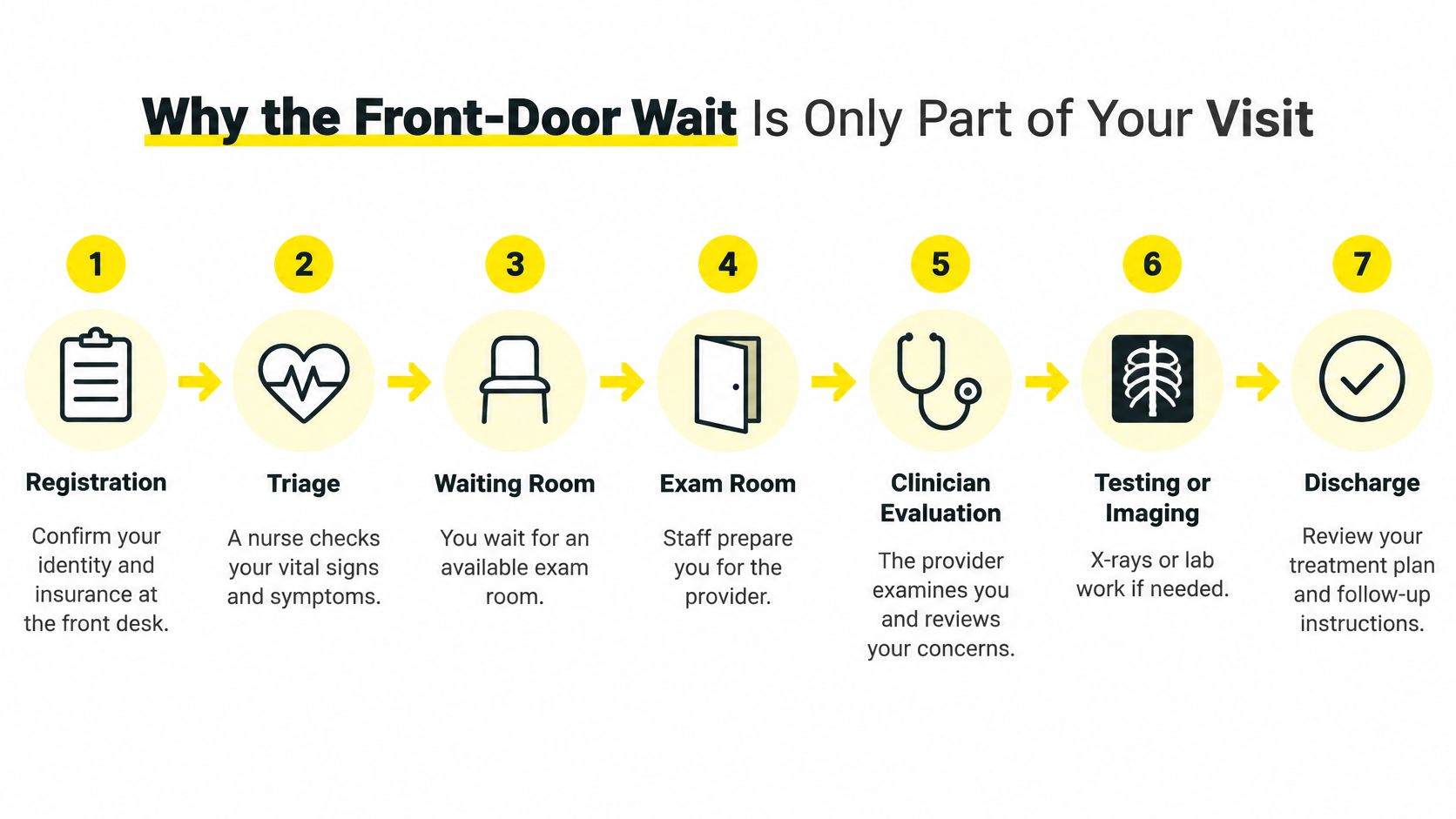
Where time can accumulate
Registration covers administrative information. Triage helps staff assess symptoms and urgency. After that, a patient may wait for an available examination room and then for the clinician's evaluation.
Those aren't interchangeable milestones. Being registered doesn't mean a room is ready, and being roomed doesn't mean the clinician can begin immediately.
- Before evaluation: Staff may still need information about symptoms, medications, or the reason for the visit.
- During testing: Imaging or laboratory work adds a separate stage.
- Before departure: The clinician may need to review findings, decide on treatment, and explain follow-up instructions.
Patient accounts in the earlier table illustrate why measuring only the lobby stage misses part of the experience. They don't provide reliable expected ranges for every step.
A wrist injury shows the difference
Suppose you arrive with a suspected wrist fracture. The Alexandria center's service listing identifies on-site X-ray and laboratory services, allowing appropriate diagnostic work to happen at the same location.
That can avoid a separate imaging appointment. It doesn't eliminate the time required to obtain images and have them reviewed before a treatment decision.
Staffing, the tests ordered, and the urgency of other patients' conditions can also change the sequence. A nearly empty lobby doesn't tell you how much work is already happening behind the examination-room doors.
A useful update identifies both your current stage and the steps still ahead.
Ask whether you're waiting for the clinician, testing, results, or discharge. If you have a transportation deadline, mention it early so staff understand the constraint, without assuming they can safely shorten the clinical process.
Timing Your Visit
There isn't a reliable published busiest-hours chart for Patient First. Isolated testimonials don't establish which evenings, weekends, or seasonal periods will be fastest at your center.
The kind of care you need is often more useful for planning than the day's name. A quiet waiting room can coexist with busy diagnostic services or patients who need more involved care.

Plan around the likely work
Consider a Saturday visit for flu-like symptoms and a Tuesday lunchtime visit for a sprain. The illness visit might require testing, while the injury might require an X-ray. Neither weekday timing nor a quick initial assessment guarantees the earlier departure.
You don't need to decide which tests are medically necessary yourself. Describe the symptoms and ask whether the visit may involve diagnostic services.
- Leave room before closing: If testing might be needed, avoid making arrival near closing your preferred plan.
- Prepare your information: Bring a written symptom history and medication list so you don't have to reconstruct them during intake.
- Ask about testing: At check-in, explain the injury or illness and ask what diagnostic steps might follow.
- Call before traveling: Ask about the current lobby situation and any known service delays.
Don't assume online means priority
Published information doesn't establish that online check-in or a scheduled arrival guarantees faster care. Before relying on either, confirm what it really does.
An online feature might provide information or support registration without promising a clinician start time. A reserved arrival time and a guaranteed treatment time aren't the same thing.
When an Emergency Room Is the Right Call
Don't use a wait comparison to choose care for a possible emergency. Chest pain or pressure, difficulty breathing, stroke signs such as facial droop, arm weakness or slurred speech, severe bleeding, loss of consciousness, or a serious injury need emergency assessment.
A deep wound or a suspected broken bone with visible deformity also warrants emergency care rather than shopping for the shortest lobby queue. Call emergency services when symptoms are severe or transportation may be unsafe.
Safety comes first: Emergency departments prioritize clinical urgency, not simply arrival order.
For example, a child with a high fever, stiff neck, and rash needs immediate emergency assessment. A parent shouldn't delay that assessment to check an urgent-care estimate.
The industry comparison above isn't a prediction of how quickly a critically ill patient will receive attention. Once emergency symptoms are ruled out, walk-in care, telehealth, and checking the current queue become reasonable planning considerations.
Walk-In, Telehealth or Appointment
Access routes at Patient First compared
| Route | Booking needed | Listed hours (DC area) | Start time predictability | Best for |
|---|---|---|---|---|
| Walk-in visit at a center | No | 8 a.m. to 8 p.m., every day | No guaranteed start; depends on the queue | Minor illness or injury during open hours |
| Telehealth visit | Confirm the connection process | 8 a.m. to 6 p.m., daily | No guaranteed start established in the cited information | Non-life-threatening illness when travel is the barrier |
| Scheduled appointment, where offered | Yes | Confirm for the specific service | Priority over walk-ins isn't established | Planned, non-urgent care |
Patient First's no-appointment-needed guidance states that centers accept walk-ins from 8 a.m. to 8 p.m., 365 days a year, including weekends and holidays. That removes the need to secure an appointment before arriving, but it doesn't reserve an immediate examination.
For example, someone with a minor injury on a Sunday evening can seek care during the listed hours rather than first finding an appointment. The visit still depends on the work already underway at that center.
Choose the route that addresses your obstacle
The Washington, DC-area locations page lists 23 centers across Northern Virginia and Maryland, including Alexandria and Silver Spring. It also lists daily telehealth availability from 8 a.m. to 6 p.m.
Those options solve different problems. An in-person visit provides access to examination and on-site services; telehealth removes travel and the physical lobby from the initial encounter. It doesn't guarantee that every concern can be resolved remotely.
- A minor problem during center hours: Consider the nearest suitable walk-in center after checking its current status.
- A non-emergency illness when travel is difficult: Consider telehealth within its listed availability.
- A planned appointment: Confirm the service, hours, and whether the booking changes your place in the queue.
- A severe or life-threatening symptom: Seek emergency care rather than comparing access routes.
For an Alexandria patient considering care late on a weekday afternoon, the practical choice is whether a remote consultation is appropriate or an in-person examination is needed. A suspected sinus infection may prompt consideration of telehealth, while symptoms requiring testing may lead to an in-person recommendation.
What scheduling can and can't tell you
The cited public information doesn't show that booked patients are routinely seen ahead of walk-ins. If an appointment option appears, confirm whether it reserves a clinician slot, an arrival window, or only an administrative step.
Likewise, don't interpret telehealth availability as a shorter clinical queue. It's another access route, not a published speed guarantee.
For medical cannabis access, our separate process at Mr. Nice Guys DC includes clear instructions and support for self-certification or certification through a traditional healthcare provider. That service shouldn't be confused with urgent-care scheduling or emergency treatment.
Before you leave, use this checklist:
- Check the current estimate: Look for center-specific information, and call if none is available.
- Confirm today's hours: Verify the location and service you intend to use.
- Bring identification: Have your photo ID and insurance details ready.
How to Check a Live Wait Estimate Before You Go
Patient First describes shorter waiting relative to hospital emergency care, not a guaranteed number of minutes. Its company information doesn't disclose a standardized average or median by center, hour, condition, or patient volume.
Use the visual below as a planning aid, with an important limitation: tracker availability and online check-in features shouldn't be assumed for every location.
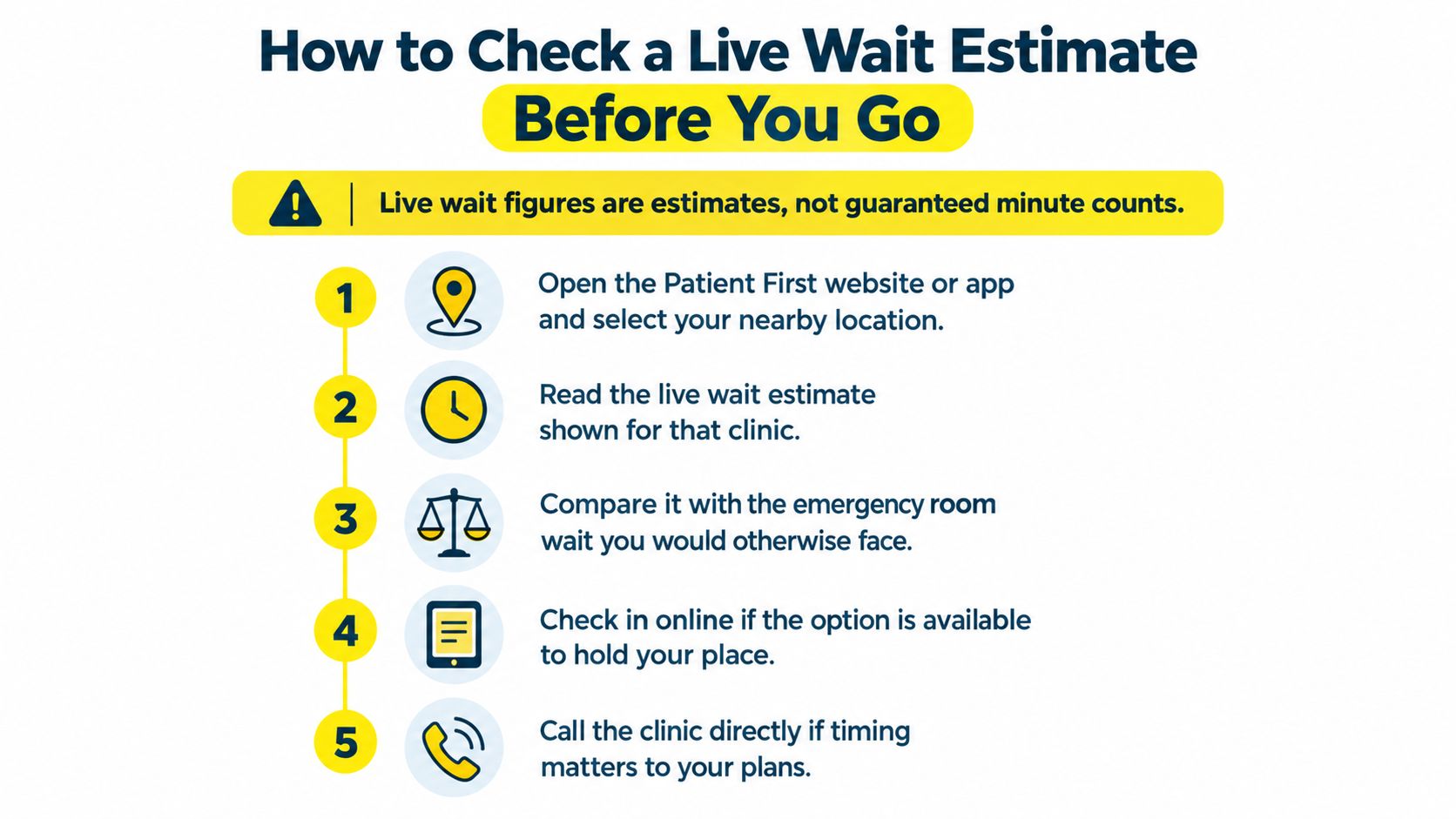
Verify what the display actually means
- Find your center. Use Patient First's DC-area locations directory and select the location you're considering.
- Look for status information. Check whether that center offers a visit tracker or live status. If nothing appears, call instead.
- Check freshness and scope. Note when you viewed it and whether it describes registration, room availability, or something else.
- Phone the center. Ask about the current lobby wait and whether relevant X-ray or laboratory services are available.
- Request an update at check-in. Ask which stage you're entering and what may remain.
- Act on emergency symptoms. Skip queue comparisons and seek emergency care if your condition warrants it.
Don't infer capabilities from a graphic alone. In its Newtown Road visit-tracker explanation, Patient First states, “Once you are in a treatment room, the tracker numbers are no longer relevant.”
That limitation matters: a position tracker isn't a countdown to discharge. Nor should an emergency-room comparison determine where you go when symptoms are serious.
The following video is an additional resource, not a substitute for confirming the center's current situation.
Adjust without delaying necessary care
For example, an Alexandria patient who learns that imaging is delayed should ask what that means for the planned evaluation. Switching to telehealth won't remove a medically necessary imaging step.
If the estimate changes, consider another suitable center or telehealth when clinically appropriate. Change or rebook a visit only when the alternative meets both your timing needs and your care needs.
At Mr. Nice Guys DC, we offer medical cannabis certification support, product guidance, and online ordering for quick pickup upon arrival. Visit Mr. Nice Guys DC to review your options and prepare your order, keeping that errand separate from any urgent medical care you need.
Mr Nice Guys DC
At Mr. Nice Guys DC, we’re more than just a cannabis delivery service — we’re passionate advocates for quality, convenience, and community. With years of experience in the cannabis industry, our team is dedicated to educating and empowering customers across Washington, D.C. Whether you're a seasoned user or just starting your cannabis journey, our blog delivers trusted tips, product insights, and the latest updates from the world of weed. Stay informed, stay elevated.
