
Must Be 21 To Enter
By entering this site you are agreeing that you are at least 21 Years of Age or older.
I AM 21 OR OLDERPot Dispensaries in Washington: A DC Buyer's Guide 2026
.svg)

.png)
You're probably here because you typed something like “pot dispensaries in Washington,” opened a few tabs, and got two completely different answers. One page is talking about Seattle and legal recreational stores. Another is talking about DC medical registration, gifting shops, and temporary patient access. That confusion is normal.
This guide is for Washington, DC, not Washington State. And if you want the cleanest, safest, most compliant path to buy cannabis in the District, focus on the licensed medical dispensary system. That's the route that gives you regulated products, clearer rules, and a real check-in process instead of guesswork.
Your Guide to Pot Dispensaries in Washington DC
A lot of first-time buyers land in the same spot. You're visiting DC for a few days, or you just moved here, and you know cannabis exists in the city. But the rules feel oddly slippery. One friend says adults can have it. Another says you need a medical card. Then you see storefronts that don't look like pharmacies at all.
That's why searches for pot dispensaries in Washington get messy. Some results are about Washington State's established recreational market, while others are about the District's very different setup.
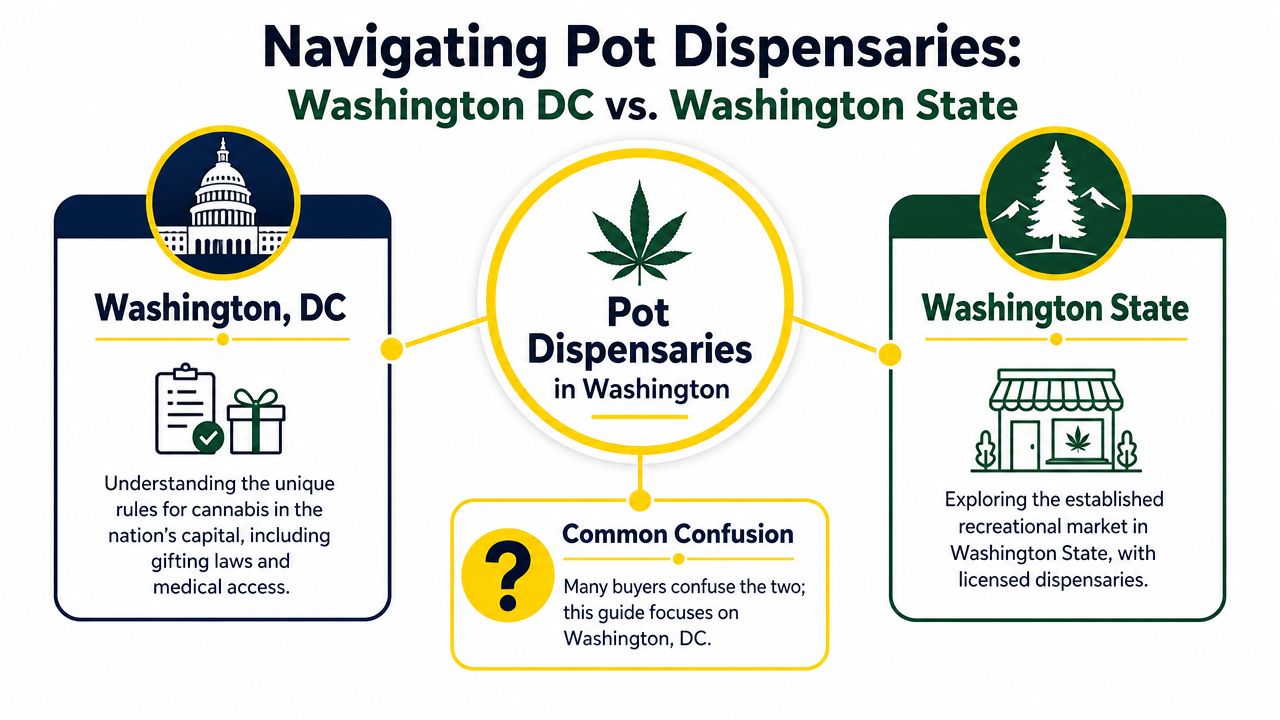
Two cannabis lanes in DC
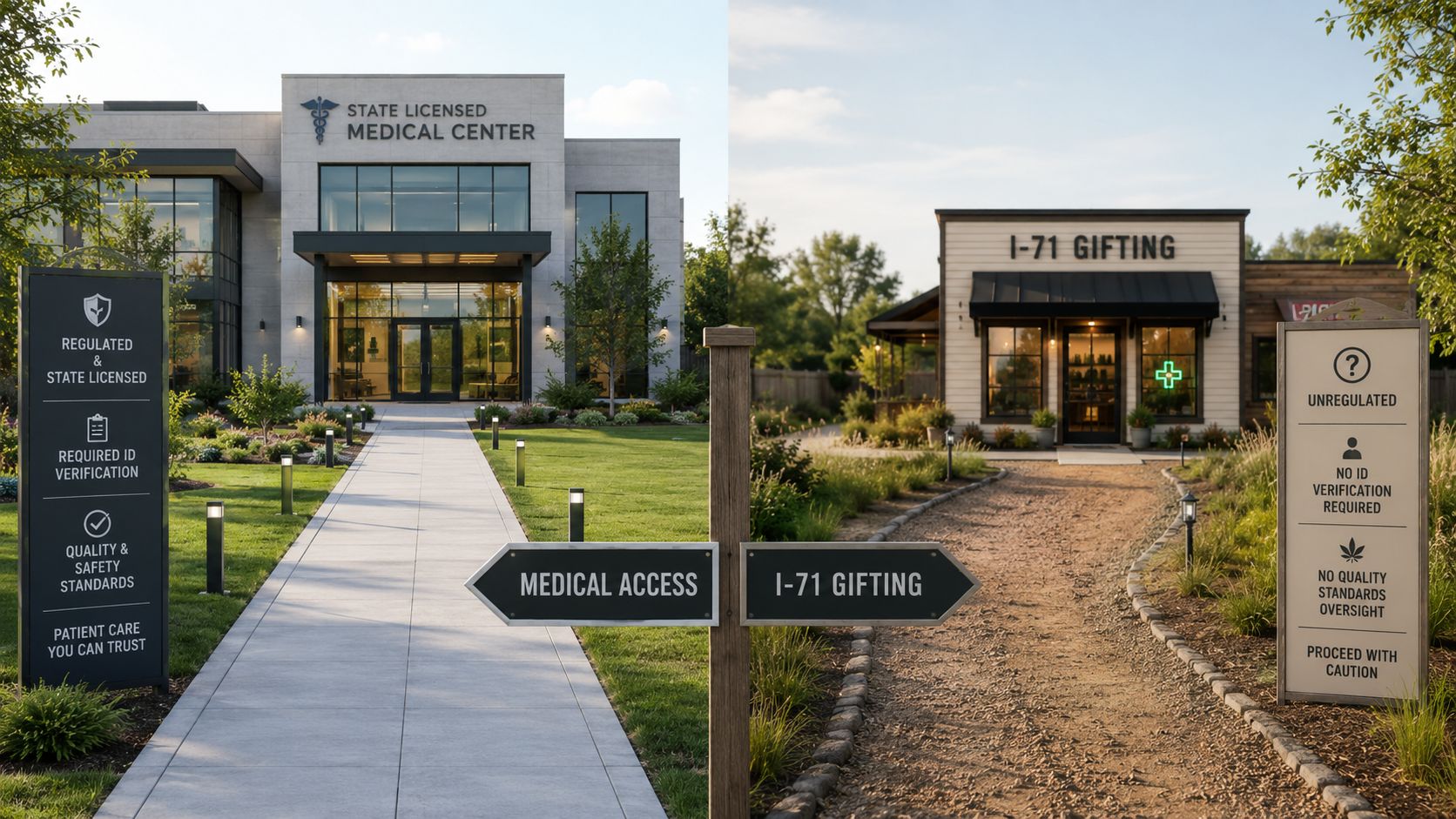
In DC, people usually hear about two parallel ways cannabis shows up in the market:
- The licensed medical dispensary system. This is the regulated path. Products are sold through legal dispensaries to registered patients, including adults who use DC's self-certification pathway.
- The unregulated gifting economy. These are the shops or services that try to operate around the edges of Initiative 71. They're visible, but they aren't the same as buying from a licensed medical dispensary.
If you're new, the difference matters. A regulated dispensary checks identification, follows packaging rules, uses formal menus, and operates inside a compliance structure. An unregulated storefront may feel easier in the moment, but it often creates more uncertainty about product source, labeling, and what you're buying.
Many visitors still struggle to find clear answers about how to buy cannabis legally in DC and how transportation rules apply across DC, Maryland, Virginia, and federal spaces, as noted in this Washington DC dispensary overview.
Why the medical route makes more sense
For a first purchase, the best approach is usually the one with the fewest surprises. That means choosing a licensed DC medical dispensary, even if you're only in town briefly.
Here's the practical version of that advice. If you're buying flower like Gelato or Blue Dream, or trying a low-dose edible for the first time, you want a menu that tells you what you're looking at, a staff member who can explain onset and duration, and a checkout process that doesn't leave you wondering whether the store itself is legitimate.
If you want a broader overview of licensed options, this guide to best dispensaries in Washington is a useful next read.
Medical vs Recreational Access in DC
DC confuses people because the city has legal possession rules that don't look like a standard adult-use retail model. You can't assume “legal cannabis” means a fully open recreational store system like other places.
The clearest way to think about it is this. In DC, licensed dispensary access runs through the medical system.
What people mean by recreational in DC
When locals talk about “recreational” access, they're often referring to the city's gifting scene or to general adult possession rights. That doesn't mean every visible cannabis storefront is part of a tightly regulated retail system.
That's the key point first-time shoppers miss. A place can look like a dispensary without functioning like a licensed medical dispensary.
How adults 21+ can access the medical system
DC's framework is much more accessible than many people assume. Adults 21+ can self-certify for a temporary medical card, which opens the door to legal dispensary shopping in the District. At the same time, detailed independent information about delays, out-of-state card handling, and real-world bottlenecks is still limited, according to this discussion of DC temporary medical access.
Here's what that means in plain language:
- You confirm your eligibility as an adult 21+.
- You complete the self-certification process through DC's medical cannabis pathway.
- You keep your ID and proof of registration ready for dispensary check-in.
- You shop through a licensed medical dispensary, not an unregulated gifting storefront.
A practical example helps. Say you're visiting from a non-legal state for a conference in Dupont Circle. You don't want to guess your way through random “gift” menus and vague payment setups. Self-certifying through the DC medical route gives you a cleaner purchase path with actual patient intake and regulated products.
Simple rule: If you want less confusion, fewer legal gray areas, and a better chance of getting properly labeled products, shop through DC's medical system.
What about out-of-state visitors
Visitors often ask two separate questions at once. First, can they access DC dispensaries? Second, can they carry what they buy back into Maryland, Virginia, or onto a flight?
Those are not the same question.
A visitor may be able to use DC's medical access pathways or potentially present an out-of-state patient credential depending on current rules and dispensary policies. But crossing jurisdictions with cannabis is where people get into trouble. Federal law still treats interstate transport as illegal, even if the purchase itself happened legally in DC.
If you want a straightforward breakdown of the shopping side of that distinction, this article on medical vs recreational in DC shopping the right way lays it out clearly.
How to Choose a Safe and Reputable DC Dispensary
Once you've decided to use the medical system, the next question is where to shop. This matters more than many people think. In dense cannabis markets, dispensary choice and patient education become more important, not less. Research from Washington's recreational market found that a 10% increase in the density of licensed cannabis retailers within a 5-minute driving radius was associated with a roughly 4.2% higher likelihood of past-year cannabis use disorder, which is one reason education and guided purchasing matter so much in crowded markets like DC's, as summarized in this review of dispensary density research.
Start with license and compliance
Before you browse strains or prices, check whether the business is operating as a licensed medical dispensary. That sounds basic, but it's the first filter.
Look for:
- Clear licensing language on the website. If the site avoids saying it's a medical dispensary, pay attention.
- A real intake process. Legitimate operators explain what ID or registration you'll need.
- Professional menus. Regulated stores usually present categories, product details, and purchasing steps more clearly than gray-market shops.
A practical example. If a storefront promises “free weed with purchase” but can't explain patient intake or registration, that's a warning sign. If another shop explains how to shop as a DC patient, lists product categories like flower, pre-rolls, tinctures, and topicals, and gives you a normal pickup or delivery workflow, that's much closer to what you want.
Read the menu like a shopper, not a browser
A good dispensary website should help you make decisions before you arrive. You should be able to tell whether the store carries products that fit your comfort level.
Good signs include:
- Category depth. Flower, edibles, carts, concentrates, topicals, tinctures.
- Useful labeling. Potency, form factor, and product type should be easy to understand.
- Service access. Pickup, curbside, or delivery instructions should be easy to find.
A reputable dispensary should make you feel more informed before checkout, not more dependent on guessing.
One local option in this space is Mr. Nice Guys DC's Washington dispensary page, which shows the kind of category-driven browsing and patient-focused guidance that helps first-time shoppers compare formats before ordering.
Green flags that matter in real life
You don't need to become a regulator to shop smart. You just need a short checklist.
| What to Check | Why It Matters |
|---|---|
| License transparency | Helps confirm you're using a regulated pathway |
| Clear menu categories | Makes first purchases easier and safer |
| Product details | Lets you compare flower, edibles, and vapes without guessing |
| Accessible support | Gives you a way to ask basic questions before ordering |
If a dispensary feels vague about compliance, skip it. There are enough legitimate options that you don't need to gamble on uncertainty.
What to Expect at Checkout Payment and Delivery
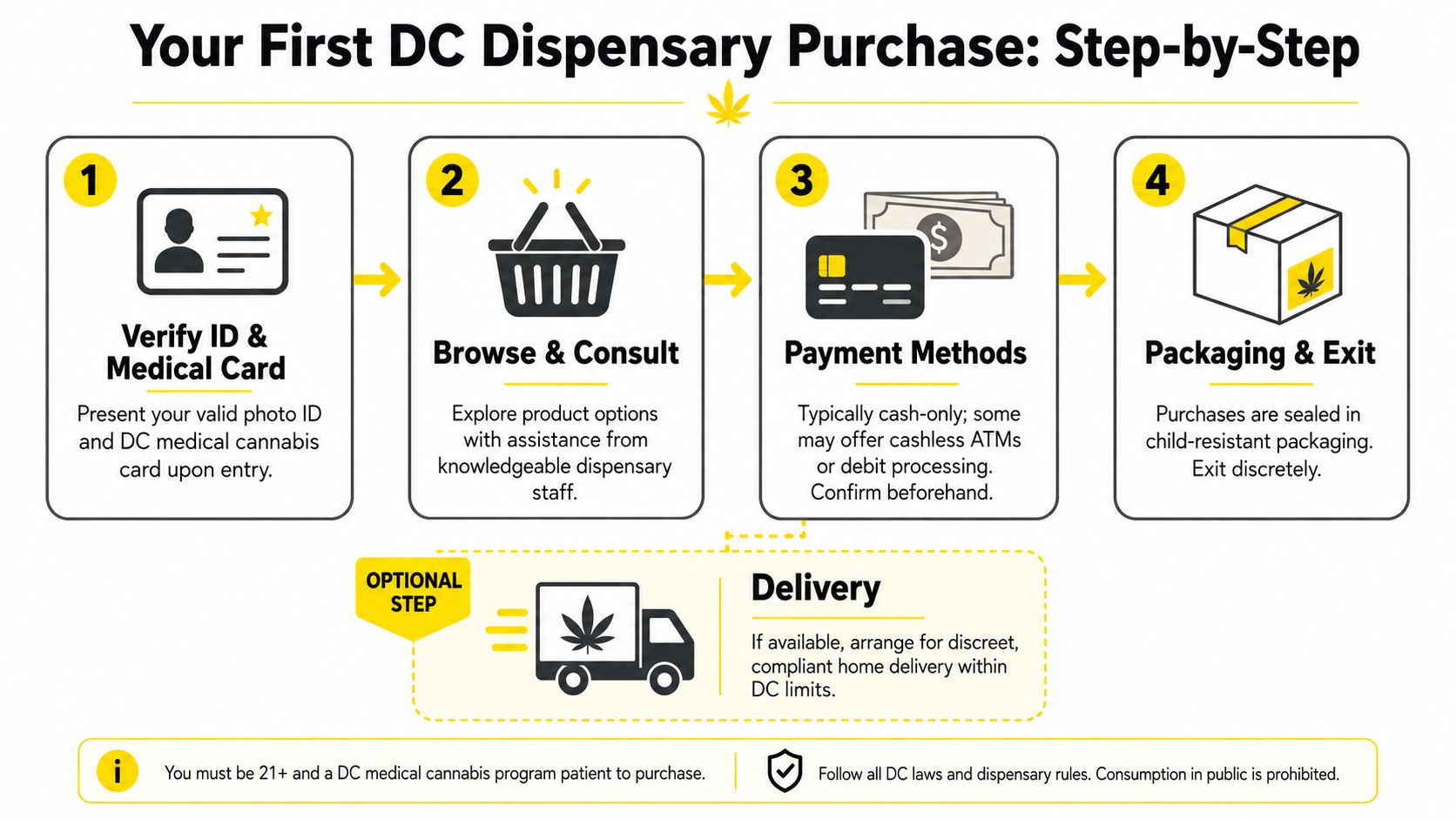
Your first visit usually feels easier once you know the sequence. Visitors sometimes worry about saying the wrong thing at the counter or showing up without the right paperwork. In practice, the process is pretty straightforward when you use a licensed medical dispensary.
A first visit in real life
Say you've already completed your patient registration steps and picked a menu online. You arrive with your government-issued photo ID and whatever proof of medical access the dispensary asks for. At check-in, staff verify your information before you enter the sales area or complete pickup.
Then comes the easy part. You ask questions, confirm your order, and talk through product options if you need help. If you're deciding between a pre-roll, a gummy, or a vape cartridge, this is when a good budtender earns their keep.
A simple example: a first-time buyer might say, “I want something relaxing, but I don't want to be stuck on the couch for hours.” That gives the staff something useful to work with. They can explain why a low-dose edible may feel different from a quick puff of a vape or a small amount of flower.
What to bring and what to expect
Bring these every time:
- Photo ID. A driver's license, passport, or similar government-issued ID.
- Your patient access documentation. Follow the dispensary's current requirements.
- Payment. Many cannabis transactions still lean on cash or debit-based systems.
Payment is one place where new shoppers get caught off guard. Some dispensaries accept cash, some use debit processing, and some rely on a cashless ATM setup. Always check before you leave home.
Don't assume your credit card will work the way it does at a grocery store. Cannabis payment rules still run differently.
Pickup, curbside, and delivery
A lot of patients don't want to stand in line or deal with parking. That's why online ordering and delivery matter so much in DC.
A typical flow looks like this:
- Browse the live menu and add products to your cart.
- Upload or confirm your required documents if the store asks for that.
- Choose pickup, curbside, or delivery depending on the dispensary's service model.
- Wait for confirmation before heading over or expecting a driver.
Some dispensaries also serve nearby areas outside DC through delivery workflows. For example, the publisher of this guide, Mr. Nice Guys DC's weed delivery explainer, outlines ordering support for DC and surrounding areas such as Bethesda, Silver Spring, and Alexandria.
For a first purchase, delivery can be a relief. You still need to handle ID and compliance correctly, but you skip the in-store pressure and can spend more time reading the menu carefully.
Choosing Your First Cannabis Product
The first product question usually isn't “What's the strongest?” It's “What will feel manageable?” That's the right question.
A solid dispensary menu gives you several ways to shop. That matters because people use cannabis differently. Some want something fast and controllable after work. Others want a slower, longer-lasting option for the evening. In mature cannabis markets, that variety becomes a real business and consumer pattern. Research on Washington's market found that as flower prices compressed, sales volumes of higher-margin concentrates and edibles grew, which shows how a diverse product mix helps dispensaries offer value while serving different needs, as noted in this analysis of Washington cannabis pricing and product segmentation.
Cannabis Product Types at a Glance
| Product Type | Typical Onset | Duration | Best For |
|---|---|---|---|
| Flower | Fast | Moderate | People who want a familiar, adjustable experience |
| Vape cartridges and disposables | Fast | Moderate | Shoppers who want convenience and less prep |
| Edibles | Slower | Longer | Evening use, steady effects, people who prefer not to inhale |
| Concentrates | Fast | Can feel intense | Experienced consumers looking for stronger effects |
| Tinctures | Moderate | Moderate | Flexible dosing, especially for cautious beginners |
| Topicals | Varies by product | Localized use | People who don't want a typical intoxicating experience |
Flower for control and familiarity
Flower is often the easiest place to start because the experience is easier to pace. You can take one small inhale, wait, and decide whether that's enough. That makes strains like Wedding Cake, Runtz, or OG Kush easier to explore in a measured way than a product that keeps building after you've already taken it.
Flower also teaches you how your body responds without locking you into a long ride. For many beginners, that's useful.
Edibles for a longer, slower experience
Edibles can be great, but they require patience. New shoppers often make the same mistake. They take an edible, don't feel much quickly, then take more too soon.
That's why budtenders repeat the same advice so often: start low and go slow.
A practical example: if you buy gummies for sleep support or evening relaxation, treat the first session like a test run. Don't stack doses because you're impatient. Edibles often take longer to show up than people expect.
If you're nervous about overdoing it, flower or a low-dose edible is usually a simpler first step than jumping into concentrates.
Vapes, tinctures, and concentrates
Vapes sit in the middle for many shoppers. They're convenient, portable, and fast-acting. If someone wants a discreet format and doesn't want to grind flower or roll anything, a cartridge or disposable can make sense.
Tinctures are useful when you want a more measured routine. Some people prefer them because they feel more structured and easier to incorporate into an evening wellness plan.
Concentrates are usually better left for shoppers with some experience. They're popular for a reason, but a first-time buyer doesn't need to begin there.
If you want a side-by-side breakdown of formats before ordering, this guide on edibles vs vapes vs flower is a helpful companion.
How to Read Labels and Ensure Product Quality
Once you've picked a product type, the label becomes your safety tool. Good labels tell you what the product is, how strong it may be, and whether it has been processed and packaged inside a regulated system.
Start with the basics. Look for the product name, the form (flower, gummy, cartridge, tincture), and the THC and CBD information. You don't need to be a chemist. You just need enough information to avoid buying blind.
What to look for on the package
Check for these details before you buy or use anything:
- Cannabinoid information. This helps you understand whether the product leans more THC-heavy, CBD-forward, or balanced.
- Batch or testing information. Regulated products should give you some way to identify the production lot.
- Serving guidance. This is especially important for edibles and tinctures.
- Ingredient information. Edibles, capsules, and tinctures should clearly list what's inside.
A practical example. If you're holding two gummy packs and one clearly identifies serving size while the other feels vague, choose the one that makes dosing easier. First-timers do better when the product answers basic questions on the package.
Quality also shows up in the sales process
Responsible sales don't start at the label. They start at the door. In regulated markets like Washington, all customers must present government-issued photo ID at the entrance, and staff may refuse service to anyone attempting to purchase for underage companions, according to this overview of Washington dispensary age verification procedures. That's a useful reminder of what legitimate cannabis retail is supposed to look like.
A serious dispensary doesn't just sell products. It slows the process down enough for you to make a safe choice.
Use responsibly from the first session
The best first session is usually the uneventful one. Be at home or somewhere comfortable. Don't mix cannabis with a packed schedule. Don't plan to drive. Keep snacks and water nearby, and give the product time to work before taking more.
If you ever feel unsure, reduce the plan, not your caution. Smaller doses make better first experiences.
Common Questions About Buying Cannabis in DC
Can I buy cannabis in DC without using a gifting shop
Yes. For adults who qualify through DC's medical framework, the more compliant route is the licensed medical dispensary system. That's the cleaner option if you want regulated products and a standard intake process.
Can visitors use the DC system
In many cases, visitors can access DC's medical pathway through self-certification or other accepted patient routes, depending on current rules and dispensary procedures. The safest move is to confirm the store's intake requirements before placing an order.
Can I take cannabis from DC into Maryland or Virginia
You shouldn't treat that as safe or legal just because you bought the product legally in DC. Interstate transportation remains a serious legal issue. The same caution applies to air travel and federal property.
A practical example: buying a gummy pack in DC and tossing it in your bag before a flight can create a very different legal problem from buying it at a licensed dispensary.
Can I use cannabis in public in DC
Public consumption is not the way to go. Even if you're legally in possession of cannabis, using it openly can still create problems. For first-timers, private settings are the smart choice.
What if I'm confused by the term Washington
That's common. Some searchers mean Seattle-style recreational retail. Others mean DC's medical system. If you're shopping in the District, ignore advice that assumes a standard adult-use retail market identical to Washington State.
What should I ask a budtender on my first visit
Keep it simple:
- Tell them your experience level. “I'm new” is enough.
- Say what you want to avoid. Too sleepy, too intense, too long-lasting.
- Ask about onset and duration. That matters more than hype names.
- Ask how to store it. Especially for edibles and cartridges.
The best cannabis purchase usually starts with an honest sentence: “I want something manageable.”
If you want a compliant, straightforward place to start, Mr. Nice Guys DC offers a licensed medical dispensary experience in Washington, DC with online ordering, pickup, curbside, delivery options, and a menu that makes it easier for first-time patients to compare flower, edibles, vapes, concentrates, topicals, and tinctures before they buy.
Mr Nice Guys DC
At Mr. Nice Guys DC, we’re more than just a cannabis delivery service — we’re passionate advocates for quality, convenience, and community. With years of experience in the cannabis industry, our team is dedicated to educating and empowering customers across Washington, D.C. Whether you're a seasoned user or just starting your cannabis journey, our blog delivers trusted tips, product insights, and the latest updates from the world of weed. Stay informed, stay elevated.
