
Must Be 21 To Enter
By entering this site you are agreeing that you are at least 21 Years of Age or older.
I AM 21 OR OLDERNew Leaf DC vs Mr. Nice Guys: A 2026 Patient's Guide
.svg)

.png)
You’re probably making the same decision a lot of DC patients make now. Do you want to go somewhere, talk to staff face to face, and maybe stay awhile? Or do you want a clean online menu, a straightforward checkout, and your order brought to you without turning cannabis into the main event of your day?
That’s where new leaf dc stands out. It represents one style of dispensary experience in Washington, DC. Another style leans harder into speed, privacy, and delivery-first convenience. Both can work well. They just solve different problems.
The mistake I see most often is treating every licensed dispensary like it offers the same patient journey. It doesn’t. In DC, where choices have expanded quickly, the better question isn’t “Which shop is best?” It’s “Which setup fits the way I use cannabis?”
Navigating the DC Cannabis Scene in 2026
A typical patient choice in DC now looks like this. You’ve got a card, or you’re getting your paperwork in order. You know what kind of relief or experience you want, but you don’t want to waste time bouncing between menus, unclear policies, and stores that feel built for everyone except actual medical patients.
That confusion makes sense. DC’s licensed market has become much bigger. Recent figures cited by New Leaf say the city has over 100 licensed retailers, patient registrations exceeding 100,000, and a market that reached $250 million in sales in a recent year, up 25% year over year according to New Leaf’s overview of the DC medical market. More options are good. More options also mean more noise.
If you want a broad starting point for licensed shopping, this guide to where to buy weed in Washington DC is useful because it frames the market by access and shopping style, not just by brand names.
Here’s the fast comparison most patients need early:
| Question | New Leaf DC | Delivery-first boutique option |
|---|---|---|
| Best for | Patients who want an in-person destination | Patients who want convenience and discretion |
| Main draw | Physical dispensary with onsite consumption area | Remote ordering, pickup, and delivery workflow |
| Shopping style | Browse, ask questions, stay awhile | Choose, order, receive with minimal friction |
| Good fit for | Patients who can benefit from a structured out-of-home experience | Busy professionals, homebound patients, and people outside central DC |
What matters is matching the dispensary to the situation.
A patient living near H Street may value a place that feels like a real stop in the day. A patient in Bethesda, Rockville, or Alexandria may care less about ambiance and more about getting a reliable order without crossing the city. Those aren’t minor preferences. They shape whether your buying routine feels sustainable.
The Destination Experience vs Boutique Convenience
The sharpest difference between new leaf dc and a boutique delivery model is philosophical. One says cannabis care can be a place. The other says good cannabis access should fit into the rest of your life with as little disruption as possible.
What New Leaf does best
New Leaf is strongest when you want cannabis to be more than a transaction. It was the first medical dispensary in DC to open a safe use onsite consumption area, which matters because it gives medical users an option if they can’t comfortably consume at home, as noted in New Leaf’s company background. That’s not a small amenity. It changes who can realistically use the dispensary.
The mood here is destination-oriented. You go there because the visit itself has value. You can ask questions in person, look over products directly, and build a routine around the physical space rather than just the cart total.
Practical rule: If your biggest problem is “I need a compliant place where the whole experience feels intentional,” New Leaf makes more sense than a pure order-and-go setup.
Patients who are newer to cannabis often benefit from that kind of environment. So do people who want human interaction before they buy. If you’re unsure about a vape versus a pre-roll, or whether a high-THC cartridge is wise for your tolerance, a face-to-face setting can lower the friction.
For a broader look at why some patients still prefer in-person licensed shops, this article on the benefits of shopping at a dispensary in DC captures the appeal well.
What boutique convenience does better
A boutique convenience model works best when cannabis needs to fit around work, commuting, childcare, or mobility limits. In that setup, the dispensary acts less like a destination and more like a curator.
That changes the entire feel of the process. You browse privately. You compare products without standing at a counter. You place the order from home, from the office, or from the passenger seat while someone else drives. For many patients, that’s not just easier. It’s calmer.
There’s also a discretion advantage. Some patients don’t want to linger in a retail environment. They want a clean menu, clear communication, and a predictable handoff. That’s especially true for repeat buyers who already know their preferred format and aren’t looking for a social setting.
The real trade-off
Neither model is universally better.
New Leaf gives you a stronger place-based experience. That can be more supportive, more educational, and more accessible for patients who need somewhere safe to consume.
Boutique convenience gives you a stronger process-based experience. That tends to be better for speed, privacy, and routine reordering.
What doesn’t work is choosing based on hype alone. If you know you won’t use an onsite space, don’t pay emotional attention to it just because it sounds distinctive. If you know you need guidance and a physical environment, don’t force yourself into a delivery-first habit that feels detached.
Product Selection and Pricing Compared
When patients compare dispensaries, they often overfocus on headline strain names and underfocus on shopping patterns. The better way is to compare by category. What do you buy most often? What format do you trust? And where do the menus make that category easiest to evaluate?
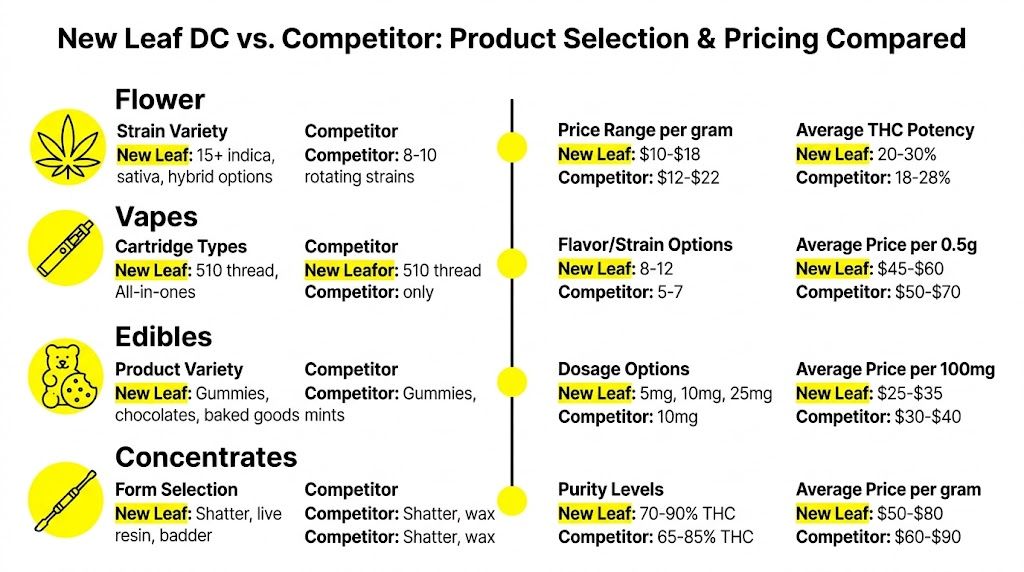
If you want a broad overview of category types before comparing stores, this breakdown of what cannabis products are available at Mr. Nice Guys DC is useful because it frames products by use case rather than just menu labels.
Vapes are where New Leaf has a clear concrete example
New Leaf gives us one verified benchmark product that’s worth paying attention to. Its Alt Sol 91 Octane Half Gram Full Spectrum Cartridge is listed at 82.48% THC with 0.1% CBD for $29.99 per half gram, and that THC level is above the 70% to 75% average for cartridges in the DC market according to the New Leaf Weedmaps menu listing.
That tells you a few practical things.
First, New Leaf’s vape selection can appeal to patients who prioritize potency. Second, it suggests a menu that includes products for experienced users who already know they respond well to concentrated formats. Third, it gives you a pricing anchor for at least one premium cartridge option.
The right takeaway isn’t “higher THC always means better.” The right takeaway is that New Leaf appears comfortable carrying products that serve patients looking for a stronger, more direct effect profile.
What doesn’t work for some patients is jumping straight to a cart like that because the percentage looks impressive. If you’re newer to vapes, a lower-intensity product or slower dosing approach may be smarter. High-potency carts can be efficient. They can also flatten the learning curve in a way that makes overconsumption easier.
Flower depends more on menu behavior than store branding
For flower, the practical comparison is less about a single standout data point and more about how you shop. Some patients browse by strain names they already trust, such as Gelato, Blue Dream, Wedding Cake, Runtz, or OG Kush. Others shop by effect and freshness first.
Here’s where an in-person shop can help. With flower, patients often benefit from asking direct questions:
- Batch suitability: Is this better for evening use or daytime function?
- Moisture and grind feel: Is it likely to work well in a dry herb vape, a pipe, or a cone?
- Tolerance match: Is this a strain you’d hand to a regular consumer or someone easing back in?
A destination dispensary can make those questions easier to ask in real time. A boutique ordering flow can make it easier to compare options and reorder familiar favorites without pressure.
Edibles reward consistency over novelty
Edibles look simple on the menu, but they create more buyer regret than most categories because timing and intensity vary so much from person to person. Patients who value conversation may prefer to buy edibles in person, especially on a first visit. Patients who already know their edible rhythm often prefer reordering from a curated online menu.
What works well with edibles is boring consistency. Same brand family. Same dose style. Same situation of use. What tends not to work is buying whatever flavor sounds good while ignoring onset time and the rest of your evening.
A practical example: a patient who uses edibles for sleep support should care less about novelty and more about whether they can repeat the same routine without surprises. That’s why menu clarity matters more than marketing language.
Concentrates and stronger formats need honest self-screening
Concentrates, stronger cartridges, and heavier evening products are categories where patients should be blunt with themselves. Do you want a stronger effect, or are you reacting to menu language and chasing value by percentage?
That matters at New Leaf because the verified cartridge example already shows a high-potency option. It also matters in any boutique menu because premium curation can make stronger products look approachable even when they aren’t appropriate for your current tolerance.
Buying filter: If you can’t explain when you’ll use the product, how much you’ll use, and why that format suits you, keep shopping.
Pricing is only meaningful if you compare your routine
Patients often compare dispensaries by a single item price. That’s not how your budget behaves. The better comparison is total weekly or monthly routine.
Ask these questions instead:
| Shopping habit | Better lens for comparing value |
|---|---|
| You buy one strong vape at a time | Compare potency, cartridge size, and how long one cart typically lasts you |
| You rotate flower strains often | Compare menu refresh rate and whether the selection feels broad enough for your preferences |
| You use edibles predictably | Compare ease of repeat ordering and whether dosing is easy to identify |
| You mix categories | Compare the whole basket, not the cheapest item on the menu |
If you’re a one-format buyer, price comparison is simpler. If you routinely mix flower, a cart, and an edible, menu organization and ordering convenience can affect value almost as much as the shelf price itself.
The Ordering and Delivery Showdown
The practicality of the choice quickly becomes apparent. Some patients enjoy making a dispensary trip. Others want cannabis access to behave like every other well-run retail service. Search, select, confirm, receive.
Going to H Street versus staying put
New Leaf’s model is naturally stronger for patients who don’t mind traveling to a physical store and may even prefer it. If you live nearby, work nearby, or like tying your purchase to an in-person visit, that’s a real advantage. You can solve questions and purchases in one place.
But if you live outside the core area, the friction changes. Crossing the city for a pickup can be perfectly fine on a light day. It’s much less appealing when you’re dealing with traffic, limited time, bad weather, mobility issues, or a packed schedule.
Delivery covers the wider routine
Delivery-first service wins when your location and schedule matter more than the retail visit itself. Mr. Nice Guys DC offers delivery across Washington, DC, and nearby areas including Alexandria, Bethesda, Rockville, and Silver Spring, using the Sweede-powered delivery ordering system.
That regional reach matters because it turns cannabis access into a home-based routine instead of a destination errand. A patient in Bethesda and a patient on Capitol Hill are solving the same need in very different ways.
For patients comparing options, this overview of DC delivery service helps clarify who benefits most from delivery and what to expect from the process.
What works best for different situations
Here’s the cleanest practical split:
- You want same-day life simplicity: Delivery or curbside usually fits better.
- You want staff interaction in a physical setting: An in-person dispensary visit is usually the better call.
- You’re restocking a product you already know: Ordering remotely is often more efficient.
- You’re uncertain about format, dosing, or comfort level: A physical visit may reduce mistakes.
One common patient scenario makes the difference obvious. If you’re in Bethesda after work and already know the product category you want, delivery is hard to beat. If you’re in DC, want to ask questions face to face, and may benefit from an onsite environment, going to New Leaf can be worth the trip.
Convenience isn’t just about speed. It’s about how many decisions you have to make before cannabis starts feeling useful instead of cumbersome.
Patient Education and Assured Compliance
The DC cannabis market rewards patients who pay attention to licensing. Since July 2024, city authorities have closed over 100 unlicensed cannabis shops, according to New Leaf’s compliance and education content. That changes the buying equation. Compliance isn’t background noise anymore. It’s part of basic consumer safety.
Education looks different in person and online
A place like New Leaf can educate through physical presence. Patients can ask direct questions on the spot, clarify product differences, and get immediate feedback from staff. That’s especially helpful when someone is unsure about a format shift, such as moving from flower to carts, or trying to understand whether an onsite consumption environment suits them.
There’s also a real content gap around onsite use that patients should recognize. New Leaf promotes its safe use area, but practical details such as etiquette, pacing, and how first-time medical patients should approach an onsite session aren’t always explained in depth. That means patients should arrive ready to ask specific questions instead of assuming the process will explain itself.
A digital-first dispensary approach teaches differently. It usually relies on online menus, blog education, phone support, and simpler reordering for familiar products. For many patients, that works well because they can learn before they buy, on their own schedule.
If you want the legal framework behind those safety differences, this article on how D.C. regulates medical cannabis dispensaries gives useful context.
Compliance is practical, not symbolic
Patients sometimes talk about licensed versus unlicensed shops as if it’s just a moral distinction. It isn’t. It affects product confidence, purchasing clarity, and peace of mind.
Use this quick screen before you order from anywhere:
- Check licensing first: If the retailer’s compliance status feels murky, move on.
- Use menu clarity as a signal: Licensed operators tend to present products and purchasing rules more clearly.
- Ask direct questions: If staff can’t explain how ordering, pickup, or patient verification works, that’s a bad sign.
- Avoid improvisation: The more a shop seems to rely on workarounds, the less confidence you should have in the experience.
What works in DC now is straightforward. Choose operators that behave like they expect scrutiny, because they do.
Making Your Choice A Recommendation Framework
Most patients don’t need another generic pros-and-cons list. They need a realistic fit test. Here’s the simplest one I’d use.
If you are a patient who needs a place, choose New Leaf
If consuming at home is difficult, awkward, or not really available to you, new leaf dc has a strong edge. Its onsite safe use model makes it a better match for patients who want the dispensary to solve more than just product access.
This also applies if you prefer face-to-face guidance, want to ask questions before buying, or feel more comfortable making cannabis part of a planned visit rather than a delivery window.
If you are a busy repeat buyer, choose convenience
If you already know your preferred categories and mostly need dependable access, a boutique convenience model is usually the better fit. This is the stronger option for professionals, caregivers, commuters, and patients who don’t want cannabis purchasing to take up half an evening.
A patient in Arlington, Bethesda, or Rockville will often care more about ordering flow and delivery reach than lounge access or the atmosphere of a retail floor.
If you are new to cannabis, choose based on your learning style
Some first-time patients learn best by asking a staff member questions in person. Others hate retail pressure and make better decisions alone with time to read menus and educational material.
If you freeze up at a counter, don’t force the in-store route because it sounds more “serious.” If you know you benefit from live conversation, don’t pretend a menu filter will answer everything.
Pick the dispensary style that makes you more likely to ask good questions and less likely to rush the purchase.
If you are balancing relief with routine, choose the option you’ll actually use consistently
That’s the part people miss. The best dispensary is the one that fits your real life well enough that you’ll keep using it correctly.
A destination model can be excellent, but only if you go. A convenience model can be excellent, but only if you don’t feel under-supported by the distance. The right choice is the one that lowers friction without lowering judgment.
FAQs For New Leaf DC and Mr Nice Guys DC
Do I need to prepare differently for a first visit to New Leaf?
Yes. Go in with a plan. Know whether you’re shopping for flower, a vape, an edible, or a stronger format. If you’re interested in the onsite consumption area, ask staff direct questions about expectations, pacing, and any practical rules before you settle in. Don’t assume lounge-style access means every product is a good first-session choice.
What’s the smartest way to handle a first delivery order?
Keep it simple. Choose a product category you already understand, make sure your patient documentation is ready, and use a clear delivery location with reliable phone access. First orders go smoother when you aren’t experimenting with five new formats at once.
Is in-person or delivery better for first-time patients?
It depends on how you make decisions. If you need live guidance, in-person often helps. If you prefer reading, comparing, and deciding privately, delivery can feel less pressured.
What should I avoid as a new patient?
Avoid shopping by hype alone. Don’t choose the strongest cart, the trendiest strain name, or the fastest ordering option unless it matches your tolerance, setting, and goals.
If you want a compliant, discreet, delivery-friendly option with curated products and a smoother remote ordering experience, take a look at Mr. Nice Guys DC. It’s a practical fit for patients who value convenience, clear menus, and dependable service across DC and nearby areas.
Mr Nice Guys DC
At Mr. Nice Guys DC, we’re more than just a cannabis delivery service — we’re passionate advocates for quality, convenience, and community. With years of experience in the cannabis industry, our team is dedicated to educating and empowering customers across Washington, D.C. Whether you're a seasoned user or just starting your cannabis journey, our blog delivers trusted tips, product insights, and the latest updates from the world of weed. Stay informed, stay elevated.
