
Must Be 21 To Enter
By entering this site you are agreeing that you are at least 21 Years of Age or older.
I AM 21 OR OLDERA DC Patient's Guide to Minimum Order Requirements
.svg)

.png)
You're on a dispensary menu, you add a pre-roll or a tincture to your cart, and everything looks simple until checkout throws up a message about a minimum order requirement. That's usually the moment people wonder if they missed a law, a patient rule, or some special first-time purchase condition.
Most of the time, the answer is much simpler than it seems. The confusion comes from the fact that people use one phrase, “minimum order,” to describe a few different things. Some apply to delivery. Some apply behind the scenes between suppliers and dispensaries. And in DC, some of what patients assume is law is just a delivery logistics policy.
If you're trying to order affordably and without hassle, it helps to separate those pieces clearly. That's especially true if you're comparing pickup, curbside, and delivery, or if you're still learning the benefits of shopping at a dispensary in DC.
Your Guide to Navigating Cannabis Order Minimums
A common real-world example looks like this. A patient wants one item for the evening. Maybe it's a single vape cartridge, one edible pack, or a pre-roll to test a strain before buying more. They open the menu, add the item, choose delivery, and then hit a cart notice saying the order doesn't qualify yet.
That message feels bigger than it is.
It doesn't usually mean you're in trouble, and it doesn't mean cannabis law requires you to spend more money. It usually means the delivery side of the order has its own operating rules. That's what throws people off. They assume every checkout rule is legal compliance, when some are just service logistics.
Where patients usually get tripped up
People often mix up three different questions:
- What the law allows: How little or how much you can legally buy.
- What the dispensary allows: Whether pickup or curbside can be placed for a very small order.
- What the delivery system requires: Whether a driver can bring that small order out on a route.
Those aren't the same thing.
Practical rule: If a small order works for pickup but not for delivery, that usually points to a delivery policy, not a legal minimum purchase rule.
A quick example
Say you want to try a low-commitment product before buying more. Maybe you're new to edibles and want to start with one item instead of building a larger basket. If pickup goes through but delivery doesn't, the issue usually isn't your patient status. It's the delivery threshold attached to that order method.
That distinction matters because it gives you options. You may be able to switch to pickup, add one useful item, or wait until you're ready to restock a couple of basics in one order.
What Are Minimum Order Requirements
At the patient level, minimum order requirements usually mean the smallest dollar amount or product total needed before a business will complete a certain type of order. The easiest analogy is food delivery. You might be able to buy one side dish in person, but a delivery app may require a larger cart before sending a driver.
Cannabis works in a similar way, especially for delivery.
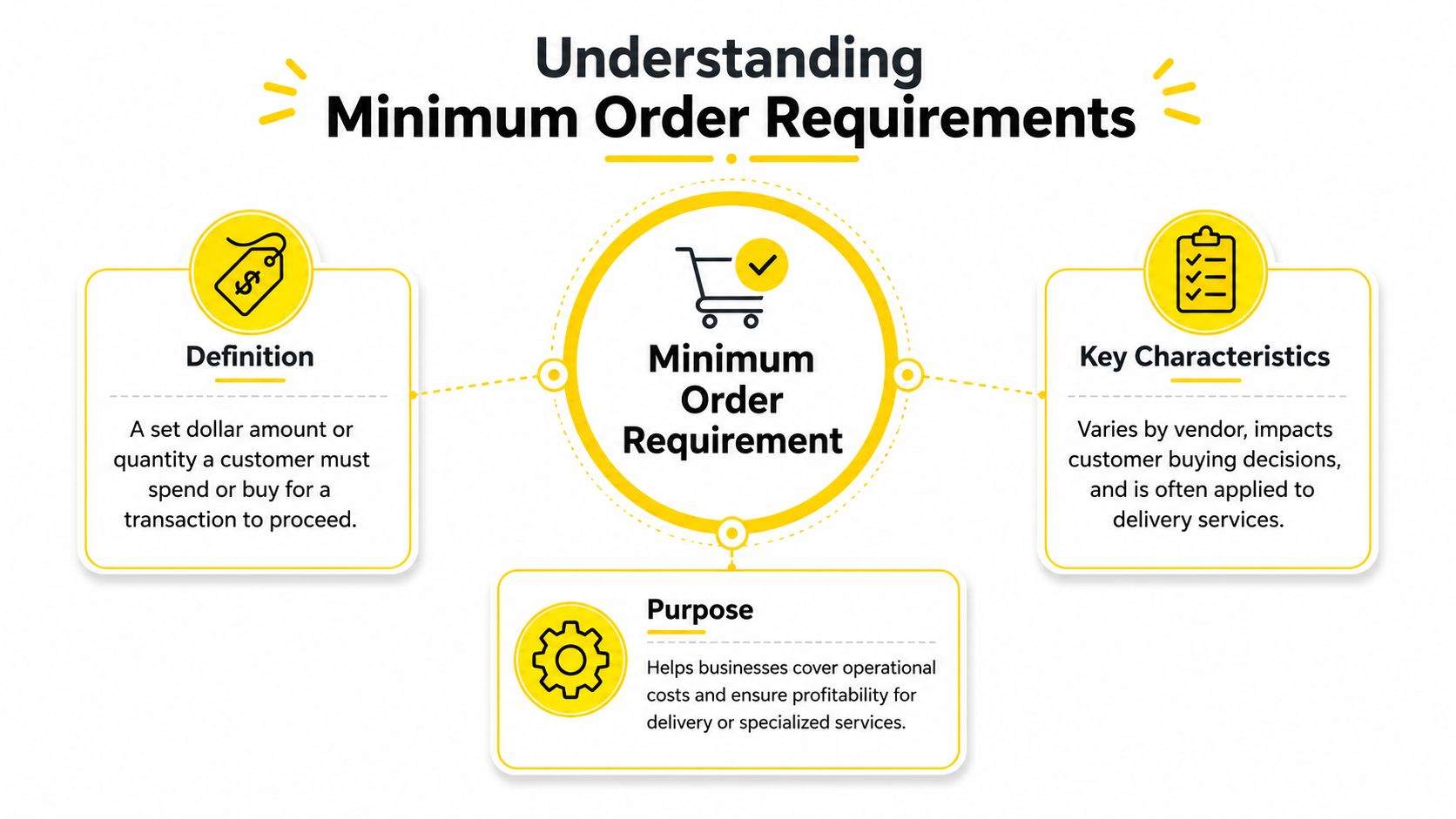
Delivery minimums and wholesale minimums are not the same
The language on this topic often gets messy. Patients usually mean a checkout threshold. Businesses often mean an MOQ, or minimum order quantity, used in supplier relationships.
That wholesale idea is different from what you see on a menu. As this dispensary inventory optimization guide from Cova Software explains, historically, minimum order requirements have largely been absent for retail patients in the U.S. cannabis industry because regulations were designed to support equitable access, while wholesale and vendor-to-dispensary relationships more often use MOQs for inventory management.
So if you've heard someone say “cannabis has minimums,” the first question should be: retail checkout minimums, or supplier purchasing minimums?
What this means when you're ordering
For patients, the practical version is simple:
| Situation | What “minimum” usually means |
|---|---|
| Pickup order | Often no required dollar threshold |
| Delivery order | A service threshold may apply before a driver is dispatched |
| Supplier to dispensary | Bulk purchasing rules used for inventory planning |
If you're still sorting out how those order methods differ in practice, this overview of how weed delivery works in Washington DC helps connect the dots.
A minimum order requirement isn't automatically a law. Often, it's a business rule attached to a specific service.
That's the key idea to carry into the rest of this topic.
Why Dispensaries Set Delivery Minimums
When patients see a delivery minimum, it can feel arbitrary. From the business side, it usually isn't. Delivery takes more labor and coordination than a pickup handoff at the counter.

The order starts costing money before it leaves the building
A small delivery order still has to be prepared carefully. Someone has to review it, pick the products, package it correctly, and hand it off through the delivery process. Then there's the actual trip. Fuel, vehicle wear, route planning, and driver time all exist whether the cart is small or large.
That's why delivery minimums often show up on lower-value orders first. The issue usually isn't the product itself. It's whether the total order supports the work required to move it from menu to doorstep.
Minimums are different from legal purchase limits
This is the point many people miss. Government cannabis rules usually focus on maximums, not minimums.
According to this review of cannabis retail regulation, cannabis regulations across the US and Canada focus on maximum per-transaction purchase limits, not minimums, and in many jurisdictions a customer may buy no more than 30 grams of dried cannabis or its equivalent in one transaction. That framework is about public safety and diversion control.
So the legal system generally asks, “What's the most someone can buy at once?” Delivery operations ask, “What's the smallest order that makes this trip workable?”
Why that distinction helps patients
Once you know the difference, checkout messages make more sense.
- If the issue is legal, you usually can't solve it by changing order method.
- If the issue is operational, you often can solve it by switching to pickup, adding a practical extra item, or waiting until you need a few essentials.
- If you're unsure, check the order method details before assuming there's a patient restriction.
For many people, that makes delivery less frustrating. You can treat minimums as a planning detail instead of a mystery rule. If you're weighing convenience against flexibility, this look at weed delivery in DC and its benefits gives useful context.
Small delivery orders can be the least efficient orders to fulfill, even when the product count is tiny.
That's why minimums exist in the first place. They're usually about making the route and labor side sustainable, not pushing patients into larger purchases for the sake of it.
Minimums in the DC Market and at Mr Nice Guys DC
If you live in DC or you're visiting and using the medical system correctly, the most useful thing to know is this: Washington, D.C. does not set a state-mandated minimum order requirement for medical cannabis purchases.
That means the law doesn't require you to hit a certain spend before you can buy. The practical guidance from the district-facing information is that patients can buy as little as a single gram, while staying within legal possession limits, and that some delivery partners may set their own operational minimums, typically $25 to $35, to cover logistics costs, as noted by DC medical cannabis retailer information from ABCA.

What applies to pickup and curbside
For in-store pickup or curbside, patients are often surprised by how flexible ordering can be. If you only need a small item, those options are usually the first place to look because the district doesn't impose a minimum purchase threshold for that kind of transaction.
That's why a modest order can make sense for someone trying a product type for the first time. Maybe you want one pre-roll to test a strain profile. Maybe you want one tincture instead of committing to several products. Pickup and curbside are often the cleanest route for that kind of purchase.
What changes when delivery is involved
Delivery introduces a separate layer. In DC, the key nuance is that the minimum often comes from the delivery partner's operating policy, not from district law and not necessarily from the dispensary menu itself.
A simple example helps. If your cart total is below the delivery threshold, the same items may still be completely fine for pickup. Nothing about your eligibility changed. Only the order method changed.
Here's the easiest way to approach it:
| Order method | What to expect |
|---|---|
| In-store purchase | No state-mandated minimum order requirement |
| Curbside pickup | No state-mandated minimum order requirement |
| Delivery | Partner logistics may require a minimum cart total |
If your cart is short for delivery, check whether pickup or curbside solves the problem before adding items you don't actually want.
That's usually the most budget-friendly move.
How to check the current policy before checkout
Policies can shift based on order method or delivery workflow, so the safest habit is to confirm the live details on the menu or ordering portal before placing the order. If you're ordering digitally, review the cart notes, delivery selection details, or checkout requirements first.
If you want a walkthrough of the ordering flow itself, this guide on how to order weed online is a good next read.
For patients, that's the big takeaway in DC. There's no state-mandated minimum for the purchase itself, but a delivery service may still require one for the trip.
Smart Tips to Meet or Avoid Minimum Orders
The most helpful way to deal with minimum order requirements is to stop treating them like a surprise and start treating them like a shopping decision. Once you know when they show up, you can work around them without overspending.

A lot of general content explains that minimums exist but leaves people hanging on what to do next. That's one reason patients, especially first-time medical shoppers in unfamiliar markets, often stay unsure about whether they have exemptions or smarter ways to order, a gap discussed in this article on marijuana dispensary delivery questions.
Five practical ways to handle a short cart
Use pickup when the order is intentionally small
If you only want one product to test, pickup is often the cleanest answer. A single edible option, one cartridge, or one pre-roll makes much more sense when you're not trying to meet a delivery threshold.Turn the extra spend into something you were going to buy anyway
Don't pad the cart with random items. Add a staple. If you regularly use flower, a backup pre-roll can be smarter than a novelty purchase. If tinctures are part of your routine, restocking one you already trust beats impulse shopping.Bundle trial and staple products together
A balanced cart works well when you're curious about something new. For example, pair your usual format with one low-commitment add-on. That way, the order still feels useful even if you're adding an item to reach delivery.
“If you need to add to a cart, add something you'd be happy to have next week too.”
Small adjustments that save money
Not every solution has to involve buying more. Sometimes the better move is changing the timing.
- Plan ahead: If you know you'll need a cartridge or flower later in the week, combine today's order with tomorrow's likely restock.
- Ask about curbside: It can give you the convenience of a fast handoff without the delivery requirement.
- Watch the menu before you build the cart: If you're close to the threshold, a single practical item can solve it quickly.
- Check patient perks or menu specials: Some deals can make a larger order feel more efficient, even without changing what you need.
If curbside sounds like the easiest workaround, this guide to curbside pickup near me can help you think through that option.
A sample approach
Say your delivery cart is just under the requirement. Instead of forcing a big jump in spend, try one of these:
- Option A: Switch to pickup and keep the original cart.
- Option B: Add one practical staple you know you'll use soon.
- Option C: Wait until you can combine the order with another needed item.
That keeps the order affordable and intentional.
Frequently Asked Questions About DC Orders
Can an out-of-state visitor buy just one item in DC
Yes, if they complete the proper patient access steps. DC's program allows non-DC residents to get a temporary digital registration card online, and there's no minimum purchase required to activate or use it, which means a visitor can buy one product on a first visit, according to DC Medical Cannabis Program patient information.
Does being a first-time patient automatically waive delivery minimums
Not necessarily. Patients often assume first-time status changes every rule, but delivery minimums are usually tied to the order method and logistics side of the transaction. If a waiver exists anywhere, it would be a service-specific policy, not something you should assume at checkout.
If there's no legal minimum, why did my order get blocked
Because the issue may be delivery, not the purchase itself. A small order can still be legal and still be eligible for pickup, while falling short of a delivery threshold.
What's the fastest way to know the current minimum for my order
Check the live online menu and cart details before completing checkout. If the order is close, compare delivery against pickup or curbside. That usually answers the question faster than guessing.
Does DC use recreational and medical minimums the same way
DC access in this context runs through the medical framework, so the clearest question isn't “medical versus recreational.” It's “pickup versus delivery” and “law versus partner policy.”
If you want a smooth ordering experience, browse the live menu, compare pickup, curbside, and delivery options, and reach out directly to Mr. Nice Guys DC when you want help choosing the most convenient and cost-effective way to place your order.
Mr Nice Guys DC
At Mr. Nice Guys DC, we’re more than just a cannabis delivery service — we’re passionate advocates for quality, convenience, and community. With years of experience in the cannabis industry, our team is dedicated to educating and empowering customers across Washington, D.C. Whether you're a seasoned user or just starting your cannabis journey, our blog delivers trusted tips, product insights, and the latest updates from the world of weed. Stay informed, stay elevated.
