
Must Be 21 To Enter
By entering this site you are agreeing that you are at least 21 Years of Age or older.
I AM 21 OR OLDERDoes Dispensaries Deliver in DC? a 2026 Guide
.svg)

.png)
Yes, licensed DC dispensaries can deliver medical cannabis to qualifying patients, with deliveries operating from 9:00 a.m. to 9:00 p.m., seven days a week. If you're staring at an online menu and wondering whether a driver can bring your order to your door, the answer is yes, but only when your patient status, address, identification, and the retailer's delivery authorization all line up.
The confusing part is that “does dispensaries deliver” isn't really a yes-or-no question in Washington, DC. You also need to know whether you qualify, where the driver can meet you, which payment methods are accepted, how long fulfillment may take, and what happens when you choose delivery instead of pickup. The DC rules make delivery a controlled medical-access channel, not an informal handoff arranged through an unlicensed seller.
A Quick Answer for First-Time Patients
If you already have a DC medical cannabis card, or you're working through the registration process, the practical answer is straightforward: a licensed DC dispensary can deliver to your home when you're a qualifying patient or registered caregiver. The operating anchor is 9:00 a.m. to 9:00 p.m., seven days a week, under the District's retailer delivery rules (DC medical cannabis emergency rules).
That distinction matters because DC has separate access pathways. A DC resident who's 21 or older may self-certify for medical cannabis, but adult-use self-certification doesn't automatically create home-delivery eligibility. Adult buyers may purchase in person or use available pickup options, while home delivery is reserved for registered medical patients and their designated caregivers under the current framework. The DC patient eligibility guidance explains that some medical categories allow all ages, while adult self-certification applies only to people 21 and older.
A simple example helps. Suppose you're a registered patient living in an approved DC residential building. You place an order online, provide the requested card and government identification, and remain available during the delivery window. A compliant driver can bring the order to you, verify your documents at the door, and complete the handoff. If you're an adult-use customer without qualifying medical registration, that same doorstep delivery may not be available even though you can shop at a storefront.
The four questions patients usually have
- Eligibility: Do you have a valid medical cannabis card, and is the recipient the registered patient or caregiver?
- Ordering: Can you use an online menu, or do you need to call or visit the retailer?
- Fees: Does the checkout page show a delivery charge, and which payment methods does the operator accept?
- Timing: Can the order arrive today, or will the next available delivery window work better?
For first-time shopping guidance, you can also review this guide to choosing a dispensary as a first-time patient. The key is to confirm the compliance details before you focus on strains, formats, or product effects.
How DC Delivery Actually Works
A patient's order begins with a properly authorized retailer. A dispensary must hold a retailer delivery endorsement issued through the Alcoholic Beverage and Cannabis Administration, or ABCA, before sending medical cannabis to an address. The District's medical cannabis courier license information describes delivery as a licensed activity with rules for eligibility, geography, hours, and operating duties.
The endorsement makes delivery possible, but it does not make every location acceptable. The order must go to a qualifying patient or caregiver at an approved residential or commercial building in the District. District government property, federal property, and school grounds are excluded. Before completing the handoff, the driver must verify government identification and the patient's ABCA registration under the DC Code delivery provisions.
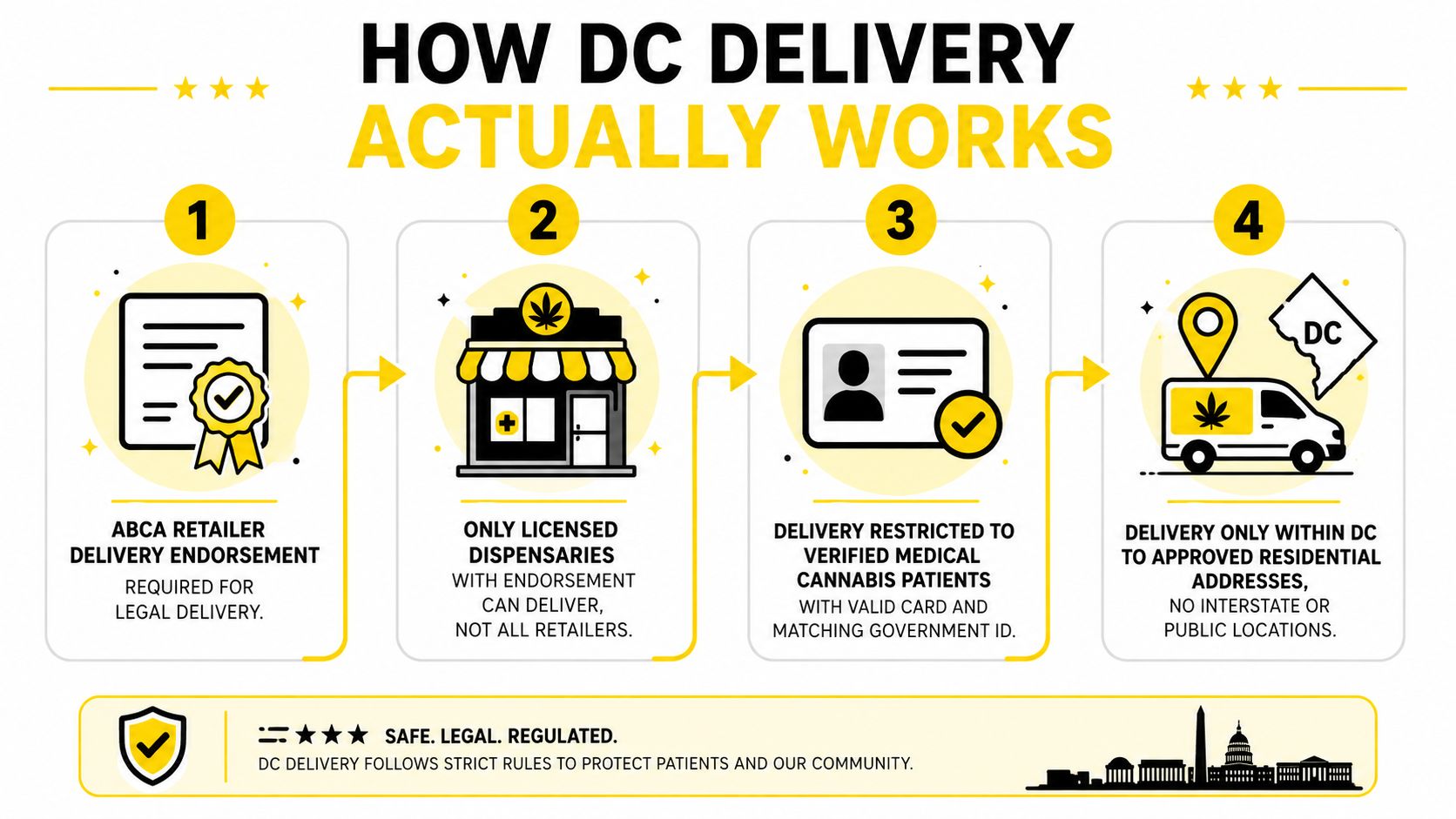
What happens after you place the order
A Sweede-powered service can receive the dispensary order, transmit delivery details, and help coordinate dispatch. The dispensary remains responsible for the compliance record. Staff must connect the order to the correct patient, record the products accurately, keep the route within approved boundaries, and ensure the driver can complete verification at the door.
The process resembles a chain of custody more than a standard courier drop. The driver cannot leave cannabis unattended or give it to a neighbor. The patient or registered caregiver needs to be present, the documents must match, and the address must be permitted.
Practical rule: A delivery order is only as strong as its weakest compliance detail. A valid product order will not correct an expired card, an excluded address, or an unverified recipient.
The combined value of cannabis and cash carried by a driver is capped at $5,000, as described in the DC medical cannabis emergency rules. The limit reflects the security controls attached to this fulfillment method. Delivery is a regulated handoff with records and verification, not an informal package drop.
Patients who want to see the order-to-doorstep sequence can review this overview of how weed delivery works in Washington, DC. The retailer, not the driver, owns the compliance record, so confirm the dispensary holds a delivery endorsement before ordering.
Who Qualifies for DC Delivery
A patient may place an order online, but the delivery is completed only for an authorized recipient at an approved address. Eligibility depends on the person accepting the order, the documents presented, and the location listed for delivery.
The registered medical pathway covers a qualifying patient with a valid ABCA medical cannabis card. A registered caregiver may also place or receive an order within the caregiver framework. The caregiver should be prepared to show the required caregiver documentation and government photo ID. A friend, roommate, or family member who is not registered generally cannot accept the order in the patient's place.
The delivery address creates a separate checkpoint. A single-family home is usually straightforward, while a multi-unit building may require an apartment or unit number, a reachable entrance, and access instructions that let the driver verify the correct destination without leaving the order unattended. A lobby, front desk, or package room does not automatically count as delivery to the authorized recipient.
What the driver checks
Keep these items ready before the scheduled arrival:
- Medical cannabis card: Have the physical ABCA-issued card available for verification.
- Government photo ID: The name and identifying details should match the registered patient or caregiver.
- Delivery address: The address must qualify and fall within the approved delivery geography.
- Authorized recipient: The person receiving the order must be the registered patient or caregiver connected to it.
For a clearer explanation of how medical cards relate to access, review this DC medical card explainer. Delivery eligibility still depends on the retailer's current compliance process and the details shown at handoff.
| Access Path | In-Store Pickup | Curbside Pickup | Home Delivery |
|---|---|---|---|
| Registered medical patient or caregiver | Available when the retailer offers it | Available when the retailer offers it | Available through an authorized delivery retailer |
| Adult 21+ self-certification | Available for eligible purchases | May be available | Not available under the current medical delivery framework |
| Document check | At pickup | At the vehicle | At the door |
| Address requirement | Travel to the dispensary | Travel to the dispensary | Approved delivery address required |
An order can pass online checkout and still fail at the door if the card is expired, the ID name does not match, the unit cannot be confirmed, or the registered recipient is unavailable. Treat verification as the final checkout step.
Pickup, Curbside, or Delivery at a Glance
A patient choosing among these options is really weighing time, contact, and travel. In-store pickup usually works best when the order is ready and you want quick advice from a budtender. You can ask about flower, edibles, vapes, or tinctures before leaving, which helps when a product detail is unclear. If you are already near the dispensary, pickup also avoids waiting for a delivery route.
Curbside pickup keeps the handoff outside. You do not need to park, enter the store, or move through a busy sales floor. It can help when mobility is limited, a child is asleep in the car, or bad weather makes a short handoff preferable. Staff still verify your documents, and you must stay available in the designated pickup area. This DC curbside pickup guide explains how that option differs from entering the store.
Delivery powered by Sweede brings the order to an approved address, so the patient does not handle the trip. That convenience can matter when privacy, home access, or mobility matters more than visiting a storefront. Delivery still depends on the available window, route planning, and any delivery fee. It is often a poor fit for an urgent purchase when the dispensary is close.
| Option | Typical Wait | Extra Fee | ID Check | Best For |
|---|---|---|---|---|
| In-store pickup | Usually the quickest route when the order is ready | Store policy applies | At the counter | Fast purchases and budtender consultation |
| Curbside pickup | Depends on order readiness and arrival at the pickup area | Store policy applies | At the vehicle | Patients avoiding parking or indoor access |
| Delivery | Scheduled around the available delivery window | Delivery fee may apply | At the door | Discretion, convenience, and home access |
Payment methods differ by operator. Cannabis customers may encounter cash, debit with a PIN, or a compliant electronic method because federal banking restrictions limit ordinary credit-card processing (cannabis delivery payment guidance). One dispensary may accept debit while another requires cash or an approved alternative, so check the checkout screen before confirming.
If the store is close and your order is ready, pickup usually wins on speed. Choose curbside when you want a quick outdoor handoff, and choose delivery when avoiding the trip matters more than waiting for a route.
A First-Order Walkthrough
Let's follow a realistic first order from a registered patient living in an eligible DC apartment building.
The patient opens the online menu and checks live inventory before making a selection. They filter by flower, edibles, or vapes, compare product details, and add the preferred items to the cart. Live inventory matters because a product shown online may change availability while other customers are ordering.
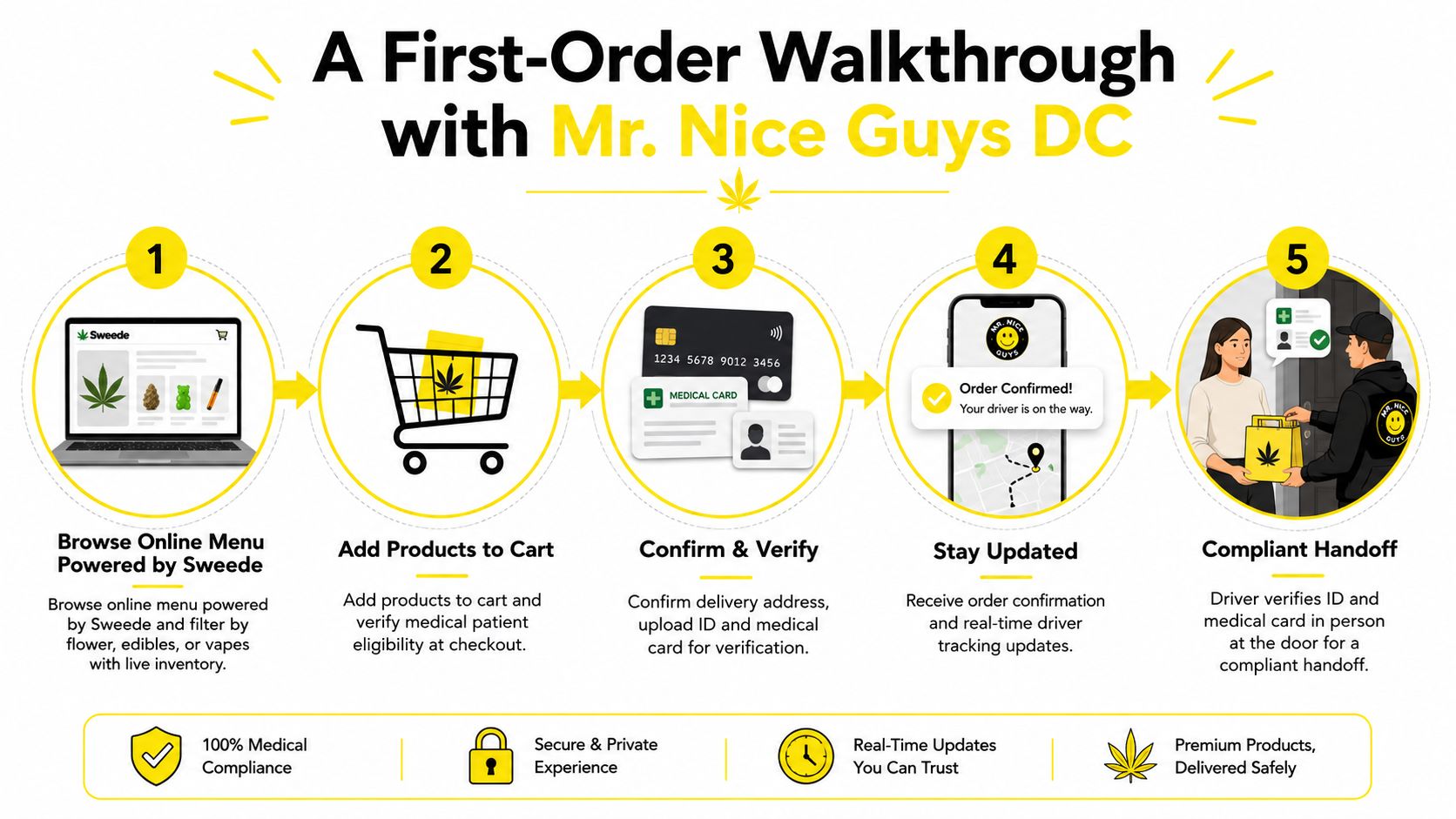
From checkout to dispatch
At checkout, the patient enters the delivery address. The system uses that information to determine whether the location is inside the available service area and whether the order can proceed under the retailer's rules. The patient then uploads or provides the requested government ID and medical cannabis card details for verification.
The checkout page should show the applicable delivery fee, available arrival window, and accepted payment methods before the order is finalized. Depending on the operator, payment may involve cash, debit with a PIN, or a compliant electronic option such as CanPay. Don't assume the method you use at one dispensary will work at another.
After confirmation, the patient receives an order message with the relevant delivery details. The driver may call or message when approaching, especially if the building has a controlled entrance, a confusing lobby, or limited visitor access.
The handoff
At the door, the driver re-checks the patient's government ID and medical card. The patient signs the receipt or completes the retailer's required acknowledgment, then receives the order directly. There shouldn't be an unattended package left in a hallway, lobby, vehicle, or on a doorstep.
What happens if nobody answers depends on the retailer's policy and the driver's route. A driver may wait only for a limited period, attempt to contact the patient, and arrange a redelivery attempt if the operation permits one. The order may also be canceled, returned, or subject to a new delivery charge. Read the no-show and cancellation terms before dispatch, and keep your phone nearby throughout the scheduled window.
A practical example: if you live in a large apartment complex, enter the correct building, unit, buzzer, and parking instructions during checkout. A driver who can't reach the right entrance may have to leave for the next stop even though your address itself is eligible.
Smart Tips Before Your Driver Arrives
A delivery can fail over a small detail, such as an ID in a locked car or an apartment entrance the driver cannot locate. Put your physical medical card and matching government photo ID together before ordering, somewhere you can reach quickly.
Check the delivery address and access instructions as well. Use an approved District residential or commercial building address, then explain the entrance route. A gated community, apartment tower, or office complex may require a call-box code, lobby direction, front-desk note, or agreed meeting point.
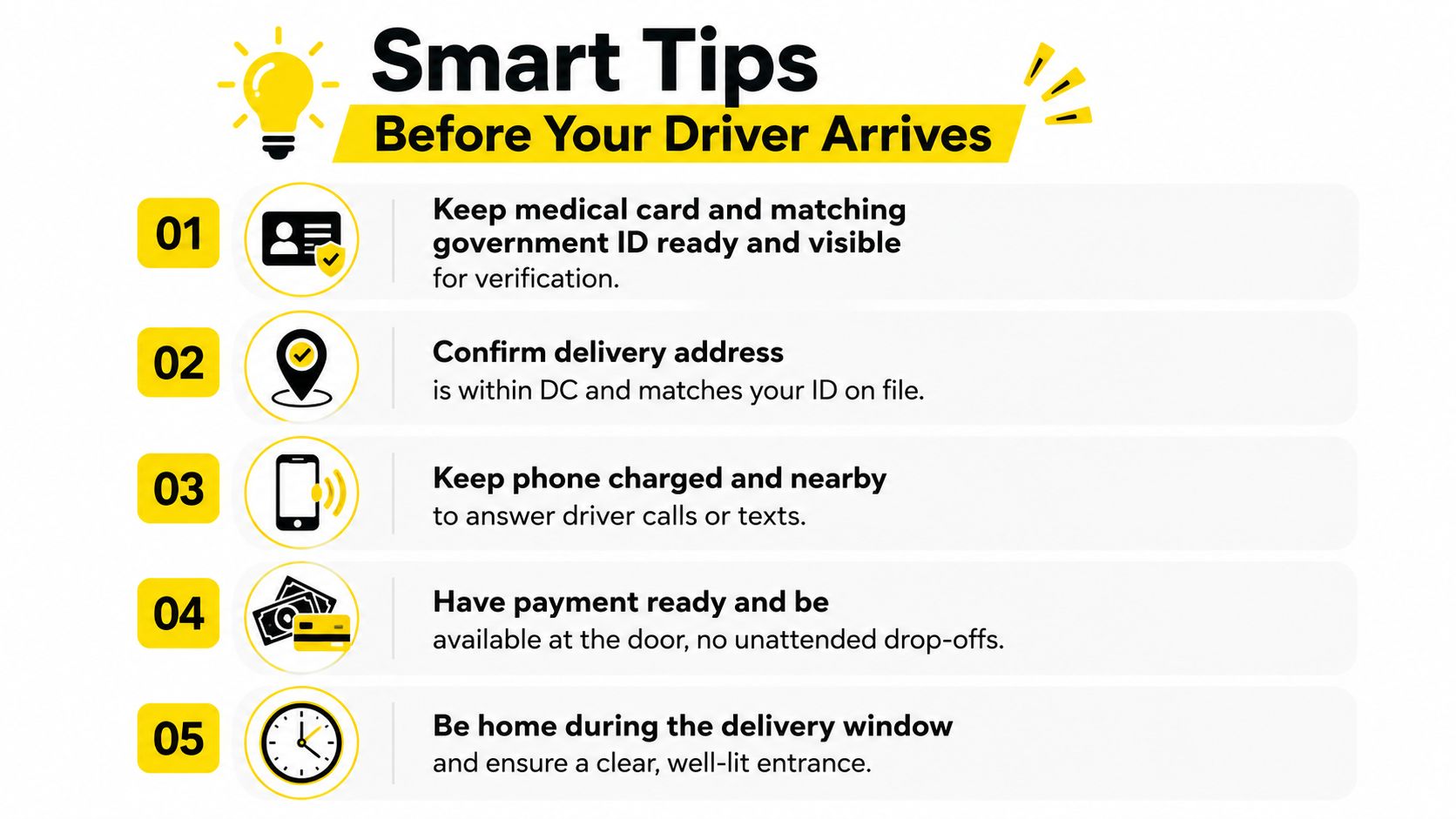
A short pre-arrival checklist
- Plan around the window: DC deliveries run between 9:00 a.m. and 9:00 p.m., seven days a week. An order placed late in the evening may move to the next available morning window instead of arriving right away.
- Confirm the entrance: Write clear apartment, gate, lobby, parking, or front-desk instructions. The driver may not be able to wait while you search for access details.
- Keep your phone available: Charge it and allow calls or messages so you can answer when the route reaches your building.
- Prepare payment: Review the retailer's accepted method before dispatch. For cash orders, exact or near-exact payment can reduce delays because the driver may have limited change.
- Create a safe handoff: Be present, use a clear and well-lit entrance, and choose a discreet location when neighbors or visitors are nearby.
Treat the window as a period when you must remain reachable, not as a guaranteed minute-by-minute appointment. Weekend demand can shift the estimated arrival time. After the handoff, store cannabis securely and away from children and pets.
The ID check follows the same basic logic explained in this cannabis age-verification process. Having both documents ready lets the driver complete that step without searching or delay. Set a reminder for the start of your delivery window so a missed call never becomes a missed delivery.
Key Takeaways for DC Cannabis Delivery
For a first-time patient, the clearest answer to “does dispensaries deliver” starts with compliance. The retailer needs an ABCA retailer delivery endorsement, and its delivery channel must be authorized. The platform and driver handle fulfillment, while the licensed retailer remains responsible for the transaction and required checks.
Delivery also functions as a medical access pathway. The recipient must be a qualifying patient or registered caregiver. At the door, the driver checks a valid medical cannabis card and matching government identification. Adult self-certification may support eligible adults making an in-person purchase, but it does not convert an adult-use order into home delivery.
The practical choice is simpler when you focus on the first-order question: which option removes the obstacle you have today? Pickup avoids a delivery fee entirely and lets you speak with a budtender. Curbside keeps the handoff outside the store. Delivery brings the order to an approved address, provided you can complete the identity check in person.
Before dispatch, verify the address, delivery fee, accepted payment method, and operating window. Cash or compliant electronic payment may be required because ordinary credit-card processing remains constrained by federal cannabis banking restrictions. Review the retailer's payment instructions before the order leaves the store, as explained in this payment method guidance.
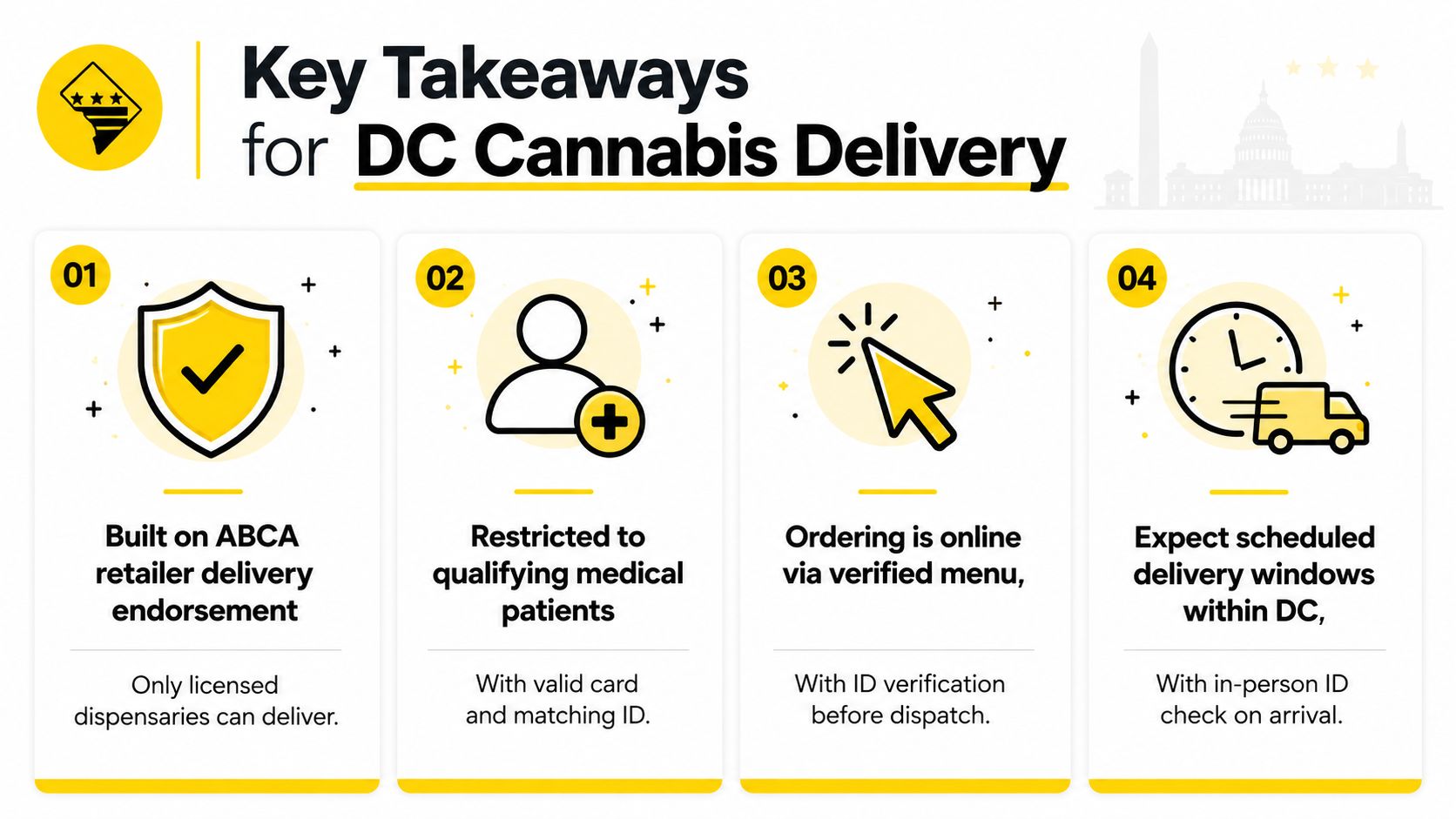
Use the 9:00 a.m. to 9:00 p.m. operating window as your planning anchor. A compliant order still requires an eligible recipient, an approved address, document verification, payment readiness, and an in-person handoff. Keep your phone available and remain present during the window, since the driver cannot complete the delivery without meeting the recipient.
Mr. Nice Guys DC offers in-store pickup, curbside pickup, and Sweede-powered delivery. You can review the menu, select the method that matches your access needs, and visit Mr. Nice Guys DC to begin a compliant DC cannabis order.
Mr Nice Guys DC
At Mr. Nice Guys DC, we’re more than just a cannabis delivery service — we’re passionate advocates for quality, convenience, and community. With years of experience in the cannabis industry, our team is dedicated to educating and empowering customers across Washington, D.C. Whether you're a seasoned user or just starting your cannabis journey, our blog delivers trusted tips, product insights, and the latest updates from the world of weed. Stay informed, stay elevated.
