
Must Be 21 To Enter
By entering this site you are agreeing that you are at least 21 Years of Age or older.
I AM 21 OR OLDERFinding the Best Cannabis for Migraines A Patient Guide
.svg)

.png)
If you’re stuck in the brutal cycle of migraine pain, the hunt for real relief can be completely draining. But the answer to whether cannabis can actually help is becoming clearer every day: yes. The right kinds of cannabis, especially those with a solid balance of THC and CBD, are showing major promise in dialing back both the frequency and intensity of those debilitating attacks.
Finding Hope and a Way Out of Migraine Pain
Anyone who gets migraines knows they’re a whole different beast than a bad headache. They're complex neurological events that can hijack your life with skull-splitting pain, nausea, and an unbearable sensitivity to light and sound. Traditional meds help some people, but plenty of us are left searching for a better, more natural option. This guide is for you.
We're going to dive into how cannabis can offer a new path forward. We'll move past the "I heard it from a friend" stories and get into the real science behind why it works. This isn't just about dulling the pain; it's about taking your life back from the grip of chronic migraines.
The Science is Catching Up
While the research is still picking up steam, the evidence backing cannabis for migraine relief is getting stronger all the time. Studies are showing that cannabinoids can interact with the body's systems that control pain and inflammation—the very things at the heart of a migraine attack. For a lot of people, this scientific proof just confirms what they’ve already discovered for themselves.
In study after study, medical cannabis has shown it can cut down how often and how hard migraines hit. For instance, one major review found that patients using medical cannabis saw their monthly migraine days drop from 10.4 down to just 4.6. That’s a massive 56% reduction. In that same group, around 11.6% of people reported that cannabis stopped an attack completely. You can check out the full study on cannabis and migraine frequency on PMC if you want to dig into the details.
A Local Partner You Can Trust on Your Wellness Journey
Figuring out the world of cannabis can feel like a lot, especially when you're trying to solve a specific health problem. Having someone knowledgeable in your corner makes all the difference. Here at Mr. Nice Guys DC, our whole team is here to give you personalized guidance and help you find the right cannabis for your migraines.
We believe in giving our patients clear, practical information they can actually use. We'll help you understand the real-world differences between products, from a fast-acting vape that can stop an attack in its tracks to a daily tincture aimed at keeping them from starting in the first place.
Think of us as your personal guide. Our goal is to translate the complex science of cannabinoids and terpenes into simple, actionable advice you can use to make confident choices and find the relief you deserve.
By the end of this guide, you’ll have a clear handle on:
- How specific cannabinoids like THC and CBD target migraine pain.
- Which cannabis formats are best for prevention versus acute relief.
- Practical tips for dosing and tracking your results for the best outcome.
How Cannabis Steps in to Disrupt Migraine Pain
To really get why cannabis can be a game-changer for migraines, we need to talk about a system already running inside your body: the endocannabinoid system (ECS). Think of the ECS as your body's master regulator, always working behind the scenes to keep things like pain, inflammation, mood, and sleep in check. It's the crew that ensures everything runs smoothly.
When a migraine attack kicks in, it's like that entire system goes haywire. Pain signals are firing on all cylinders, inflammation is raging, and your internal balance is completely thrown off. This is where cannabis finds its opening. The compounds in the plant, known as cannabinoids, are almost identical to the compounds your own body makes (endocannabinoids) to manage this very system.
Taming the Pain and Inflammation Cascade
Cannabinoids like THC (tetrahydrocannabinol) and CBD (cannabidiol) plug directly into your ECS. They link up with special receptors—called CB1 and CB2 receptors—found all over your brain and body. This connection is like a key sliding into a lock, giving cannabinoids a direct line to influence how your cells are talking to each other.
Here’s a real-world picture: imagine your nerve cells are screaming pain signals during a migraine. When THC connects with CB1 receptors in your brain, it can essentially tell those nerves to quiet down, interrupting the pain message before it becomes unbearable. For example, taking a puff from a vape pen containing a THC-rich strain like OG Kush can feel like turning down the volume on that screaming pain within minutes.
The ECS is all about maintaining balance. By working with it, cannabinoids can help pull your body back from the brink during a migraine, dialing down the pain and calming the fire of neuroinflammation.
Cooling Down Neuroinflammation at the Source
CBD plays a different, but equally crucial, role. It doesn't bind to the receptors with the same force as THC. Instead, it works more indirectly to turn down inflammation—a primary driver of migraine pain. During an attack, inflammation causes blood vessels in the brain to swell and push against sensitive nerves.
CBD helps put a stop to this inflammatory response. This not only eases the immediate, throbbing pain of an attack but can also help reduce how often migraines happen in the first place. It's this one-two punch that makes strains with a good mix of THC and CBD so often recommended for migraine relief. For instance, a patient might take a daily tincture with a 1:1 ratio of CBD to THC to keep their baseline inflammation levels low, potentially reducing the number of migraine days they experience each month.
Cutting Off a Key Migraine Trigger
Newer science is showing that cannabis also works on pain pathways outside the ECS. One of the most promising is its effect on something called Calcitonin Gene-Related Peptide (CGRP). CGRP is a protein that acts like a major trigger for migraines, cranking up inflammation and sending pain signals into overdrive.
- What CGRP Does: When a migraine is brewing, CGRP levels in the brain spike, making the attack more painful and longer-lasting.
- How Cannabis Helps: Research suggests that cannabinoids can actually block the release of CGRP. By lowering the levels of this protein, cannabis takes aim at one of the core mechanisms that fuels a migraine.
This is a huge deal. Why? Because many of the newest prescription drugs for migraines are designed to do exactly that: block CGRP. The idea that cannabis can do something similar, naturally, explains why so many people find it doesn't just dull the pain—it stops the migraine in its tracks. It's not just a mask; it's an interruption of the biological storm itself.
Choosing Your Tools: THC, CBD, and Key Terpenes
Stepping into a dispensary like Mr. Nice Guys DC can feel a bit like walking into a complex pharmacy. To find the right cannabis for your migraines, you need to know the key players inside the plant. Think of it like assembling a band: you've got the lead singer, the rhythm section, and the backup vocalists, all working together to create the perfect sound.
In the world of cannabis, these players are cannabinoids and terpenes. The two most famous cannabinoids are THC (tetrahydrocannabinol) and CBD (cannabidiol). They're the stars of the show, but they do their best work with a strong supporting cast.
THC: The Lead Singer of Pain Relief
THC is the compound most people know, famous for its psychoactive effects. But for migraine sufferers, its most important job is as a powerful analgesic, or pain reliever. When a migraine strikes, THC gets to work with your body’s endocannabinoid system to directly interrupt pain signals heading to your brain.
Think of those pain signals as a loud, blaring alarm. THC can essentially turn the volume down, providing almost immediate relief from the throbbing, relentless pain of an attack. It's the fast-acting component that can stop a migraine in its tracks. While THC is a critical tool, it's just one part of the equation. To learn more about its different forms, check out our detailed guide comparing THCA vs THC and what every DC patient should know.
CBD: The Rhythm Section Providing Balance
If THC is the flashy lead singer, CBD is the steady rhythm section holding everything together. CBD is non-psychoactive, which means it won't get you "high." Instead, its main job is to fight inflammation and bring a sense of calm and balance to the whole experience.
During a migraine, neuroinflammation plays a huge part in the pain you feel. CBD works to cool this inflammation down, getting to one of the root causes of the attack.
A huge benefit of CBD is its ability to smooth out the psychoactive edges of THC. A strain with a balanced ratio of THC and CBD can give you powerful pain relief without the anxiety or paranoia some people feel, making the experience much more comfortable and effective.
This teamwork is a perfect example of the entourage effect—the idea that cannabis compounds work better together than they do alone. For migraine management, the combined action of THC and CBD often delivers far better results.
Terpenes: The Backup Singers Adding Nuance
Beyond the main cannabinoids, cannabis is packed with aromatic compounds called terpenes. These are what give different strains their unique smells and flavors, from earthy pine to sweet citrus. But terpenes do a lot more than just smell good; they have their own therapeutic effects that can be incredibly helpful for migraine relief.
Think of them as the backup vocalists who add depth and harmony to the music. They tweak and enhance the effects of THC and CBD, fine-tuning the experience to target specific symptoms.
Before we dive into the specifics, it helps to see how these compounds stack up. Here’s a quick-glance table to guide you.
Key Compounds for Migraine Management
Knowing these key players helps you read a product label with confidence and ask the right questions. Let's look a little closer at the superstar terpenes.
Here are the ones to look for when choosing the best cannabis for your migraines:
- Myrcene: Often described as having an earthy, musky aroma, Myrcene is known for its sedative and muscle-relaxing properties. It can help ease the tension in your neck and shoulders that often comes with a migraine and promote the deep rest you need to recover.
- Caryophyllene: With its spicy, peppery scent, Caryophyllene is unique because it's the only terpene that also acts like a cannabinoid. It binds directly to your body's CB2 receptors to deliver powerful anti-inflammatory and pain-relieving effects, making it a fantastic ally against migraine pain.
- Linalool: Found in lavender, Linalool has a gentle, floral aroma. It’s prized for its ability to reduce anxiety and stress—both common migraine triggers. Its calming effects can help soothe your nervous system when it's in overdrive during an attack.
When you visit Mr. Nice Guys DC, don't just look at the THC percentage. Ask our budtenders about the terpene profile. A strain like OG Kush might be rich in Myrcene, making it perfect for nighttime relief, while a balanced hybrid like Blue Dream could offer a mix that works well for daytime use without heavy sedation. Understanding these compounds empowers you to choose not just any cannabis, but the right cannabis for your specific migraine needs.
Matching Cannabis Products to Your Migraine Needs
Picking the right cannabis for a migraine is about more than just finding a good strain—it's about choosing the right tool for the job. How you consume it, whether you smoke it, place it under your tongue, or apply it to your skin, completely changes how fast it works and how long you’ll feel the effects. This is a big deal when you're managing something as complicated as a migraine, which has different phases that call for different game plans.
Think of it like building a first-aid kit. You wouldn't use a slow-acting bandage when you need to stop bleeding now. In the same way, your migraine strategy should have options for both immediate, in-the-moment relief and steady, long-term prevention. Matching the product to your specific migraine pattern is the secret to finding consistent relief.
Fast-Acting Methods for Acute Migraine Attacks
When you feel those first warning signs of a migraine coming on—that weird aura, a stiff neck, or sudden sensitivity to light—speed is everything. You need something that can jump in and interrupt the pain before it really takes hold. For that, you want methods that get cannabinoids into your bloodstream as quickly as possible.
- Vaporizers (Vapes): Vaping is a gentle way to heat cannabis flower or concentrate, turning it into a vapor you can inhale. It's incredibly efficient, and you'll typically feel the effects within 5 to 10 minutes. That rapid onset makes vapes a go-to for anyone needing to shut down an attack fast.
- Smoked Flower: Smoking dried cannabis flower is the old-school method for a reason. It works, and it works fast—usually within minutes. The effects are immediate and potent, giving you powerful relief right when you need it most.
The evidence backs this up. One huge real-world study found that inhaled cannabis, mostly flower, cut down migraine severity by an average of 49.6%. You can dig deeper into these findings and see how inhaled cannabis reduces migraine pain on AJMC.com.
This visual guide breaks down the core components you'll find in these products—THC, CBD, and terpenes—and their primary roles.
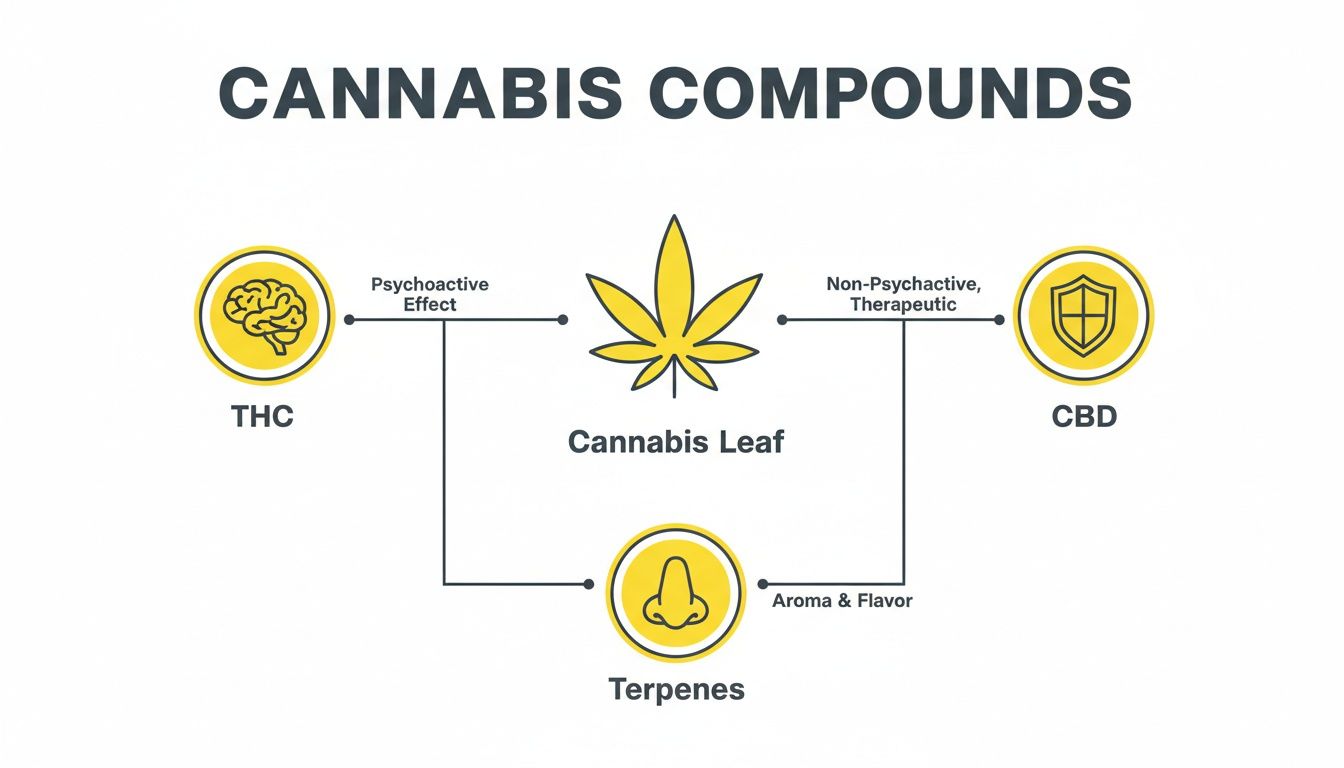
Understanding how these compounds work together is key. You get THC's pain-fighting power, CBD's anti-inflammatory action, and the unique effects of terpenes all teaming up for more complete relief.
Slower Methods for Proactive Prevention
Preventative care is all about cutting down on how often you get migraines and making them less severe when they do happen. For this, you don't want fast, intense effects. You're looking for a slow, steady release of cannabinoids to keep your system balanced throughout the day.
- Tinctures: These are liquid cannabis extracts you drop under your tongue. They're a nice middle ground, with effects kicking in around 15-45 minutes and sticking around for several hours. This makes them perfect for daily use to keep a consistent level of cannabinoids in your system.
- Edibles: When you eat cannabis, your body processes it through your digestive system, which takes time. The onset is much slower—usually 60-120 minutes—but the effects are super long-lasting, often for 6 to 8 hours or more. A low-dose edible can be a great way to get overnight relief or sustained support through a long day.
Here’s how that might look in real life: Someone could keep a vape pen handy to hit the moment they sense a migraine's aura. At the same time, they might take a CBD-dominant tincture every morning to help reduce the total number of migraine days they have each month.
Targeted Relief for Localized Pain
Migraines aren't just in your head; they often bring intense neck and shoulder tension along for the ride. For that kind of localized pain, topicals are an amazing non-psychoactive option.
You can apply cannabis-infused creams, balms, and salves directly to the sore spots. They work with the cannabinoid receptors right there in your skin to calm inflammation and ease muscle tightness without ever entering your bloodstream. For example, rubbing a CBD-infused balm onto your neck and temples when you feel a migraine coming on can help release muscle tension and provide targeted relief right where it hurts, without any intoxicating effects.
Figuring out the right product is a personal journey, but understanding these different formats helps you build a well-rounded toolkit. For more tips on matching products to your needs, check out our guide on choosing cannabis for sleep, pain, and anxiety.
Starting Safely: A Guide to Dosing and Tracking
Jumping into cannabis for migraine relief is a personal journey. There’s no one-size-fits-all answer, so finding what works for you takes a bit of patience and a measured approach. If you remember one thing, make it this: "start low and go slow." This simple mantra is the absolute key to a safe, comfortable, and effective experience.
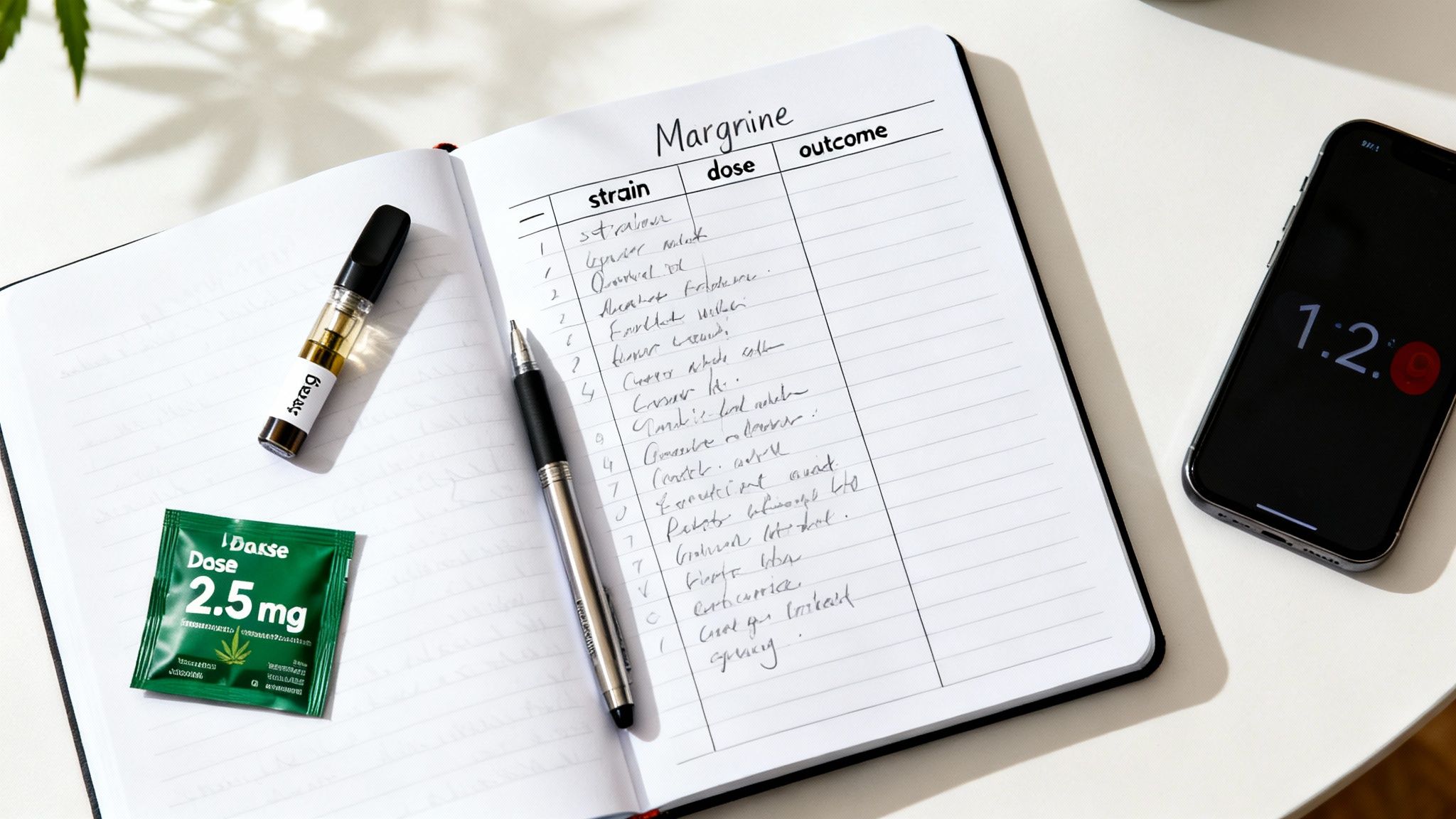
This isn't about holding back; it's about finding the sweet spot. The goal is to pinpoint the smallest amount of cannabis that actually manages your symptoms—what's known as the "minimum effective dose." This way, you get all the benefits without any unwanted side effects.
A Step-by-Step Guide for Beginners
Getting started doesn't need to feel overwhelming. With a clear, structured process, you can confidently figure out which products and doses work best for your body and your specific type of migraine pain.
Here’s a real-world example of how to put "start low and go slow" into practice:
- For Vaping/Smoking: Take just one small puff. That’s it. You’re just trying to get a feel for how your body reacts.
- For Edibles: Start with a tiny dose, like 2.5mg of THC. Since a lot of edibles come in 10mg pieces, you'll probably need to cut one into quarters.
- Wait and Observe: This is the most important part. After inhaling, give it at least 30 minutes before even thinking about another dose. With edibles, you absolutely must wait at least 2 hours, because they take much longer to kick in.
- Check In With Yourself: After that waiting period, see how you feel. Has the throbbing eased up? Is your light sensitivity a little better? If you've gotten some relief but think you need more, you can take another small dose and repeat the whole waiting process.
This patient approach is your best defense against accidentally overdoing it, which is the most common mistake newcomers make.
Your Best Tool: A Migraine Journal
To really dial in the best cannabis for your migraines, you need to become a bit of a scientist, and your most valuable tool is a simple migraine journal. This doesn't have to be anything fancy—a notebook or even a notes app on your phone is perfect.
Think of your journal as a personalized roadmap to relief. Each entry is a data point that helps you identify patterns, refine your approach, and consistently replicate positive results.
When you track your experiences, you move beyond guesswork. You start making informed decisions based on what your body is actually telling you. It's the fastest way to discover which specific products give you the most reliable relief.
What to Track in Your Journal:
- Strain Name: Write down the exact strain, like Blue Dream or OG Kush.
- Cannabinoid Content: Note the THC and CBD percentages.
- Format Used: Was it a vape, tincture, edible, or something else?
- Dose Taken: Be specific (e.g., one puff, 2.5mg).
- Time of Onset: How long did it take to feel anything?
- Symptom Relief: Rate your pain before and after on a simple 1-10 scale.
- Side Effects: Did you feel any dizziness, anxiety, or drowsiness? Jot it down.
Managing Side Effects and Getting Expert Advice
Sometimes, especially when you're new to THC, you might feel a little dizzy or anxious. If that happens, look for products with a higher ratio of CBD to THC. CBD is known to help balance out THC's psychoactive effects, which can really help smooth out the experience.
Most importantly, you don't have to figure this all out alone. The team here at Mr. Nice Guys DC is ready to help with personalized guidance. We can walk you through product labels, suggest strains based on what you've logged in your journal, and make sure you feel confident and supported on your path to migraine relief.
Your Guide to Getting Medical Cannabis in Washington DC
Understanding how cannabis might help with migraines is one thing, but figuring out how to get it safely and legally is the next big step. Luckily, navigating the world of medical cannabis in Washington, DC, is simpler than you might think, especially when you have a trusted partner like Mr. Nice Guys DC showing you the ropes. Our whole goal is to make your path to relief as clear and straightforward as possible.
The journey starts with getting a medical recommendation. In DC, becoming a registered patient opens up a world of high-quality products and gives you access to dispensary staff who really know their stuff. They can help you find the best cannabis for migraines, ensuring you're getting lab-tested, regulated products that are actually suited to your needs.
Your First Dispensary Visit Made Easy
Walking into a dispensary for the first time should feel empowering, not overwhelming. At Mr. Nice Guys DC, we offer in-store consultations where our team can chat with you about your migraine patterns and point you toward specific products. We also offer convenient local delivery, bringing that relief right to your doorstep.
To help make that initial visit feel even smoother, we put together a guide on what to know before your first visit to Mr. Nice Guys DC. It covers everything from what to bring to the kinds of questions you might want to ask our budtenders.
Connecting Theory to Real Products
Okay, let's tie everything you've learned to what you'll actually see on our shelves. Your goal is to find strains with the right combination of cannabinoids and terpenes to fight your specific migraine symptoms. Our team is here to help you pinpoint options that make sense for you, whether you need something that acts fast or something for long-term prevention.
Here are a couple of real-world examples of strains often recommended for migraine management that you might find here at Mr. Nice Guys DC:
- Blue Dream: This is a classic balanced hybrid, loved for its gentle, calming effects. It usually has a good amount of Myrcene, a terpene that can help relax the neck and shoulder tension that so often comes with a migraine, but without knocking you out.
- OG Kush: A heavy-hitter on the Indica side, OG Kush is known for its powerful pain-relieving abilities. It's rich in both Myrcene and Caryophyllene, making it a great choice for tackling that severe, throbbing pain and helping you get the restorative sleep you need to bounce back from an attack.
Remember, the "best" strain is always the one that works for your body. Think of these examples as a starting point, and work with our team to explore different profiles. Your migraine journal will be your best friend here, helping you track which products give you consistent relief. Our mission is to support you on this journey with reliable products and genuine guidance.
Got Questions About Cannabis for Migraines? We’ve Got Answers.
Even after digging into the details, it’s totally normal to have a few more questions pop up. Let’s tackle some of the most common ones we hear, giving you clear, straightforward answers to help you move forward.
Can Cannabis Cause Rebound Headaches?
This is a really important question. The official term is Medication Overuse Headache (MOH), and it’s a valid concern. There's some chatter that frequent, high-THC cannabis use could potentially feed into this cycle. The key to avoiding it? Moderation and mindful use.
Experts suggest not reaching for high-THC products for every single attack. Think of it more like a rescue tool, not a daily crutch. It helps to alternate with other treatments and bring CBD-rich products into the mix, since they carry a much lower risk. This is where your migraine journal becomes your best friend—it’ll help you spot if your headaches are getting worse with more frequent cannabis use.
Will I Feel High When Using Cannabis for Migraines?
Not unless you want to. The psychoactive “high” is all thanks to THC, but you’ve got plenty of ways to manage it or skip it altogether. The real goal here is relief, not a head change.
A great strategy is to pick a product with more CBD than THC, like a 1:1 or even a 5:1 blend. CBD is known to soften THC’s intoxicating effects, giving you pain relief with a much clearer head.
Another method that’s gaining a lot of traction is microdosing. This just means using a tiny amount that offers therapeutic benefits without making you feel noticeably high. For instance, a single small puff from a vape or a 2.5mg edible can often be enough to take the edge off. And don't forget topicals—they can provide powerful, localized relief for neck and shoulder tension with zero psychoactive effects.
Which Strain Is Better for Day vs. Night Migraines?
The cannabis that helps you through a workday migraine is going to be very different from what you’d use to get some sleep. It all comes down to the strain's terpene profile.
- For Daytime Relief: You need something that won’t make you want to crawl into bed. Look for Sativa-dominant or hybrid strains that are rich in uplifting terpenes like Limonene. A classic like Blue Dream is a perfect example; it’s known for providing relief without that heavy, sleepy feeling.
- For Nighttime Relief: When pain is keeping you from sleeping, Indica-dominant strains are usually the way to go. You’ll want strains high in calming terpenes like Myreene or Linalool, which are famous for their sedating properties. A strain like OG Kush can help knock out the pain and usher in deep, restorative rest.
Always check the strain's profile before you buy, and start with a small amount to see how it personally hits your energy levels.
Ready to find the right product for your migraine needs? The team at Mr. Nice Guys DC knows their stuff and is here to give you personalized guidance. We can help you explore our hand-picked selection of flower, vapes, and tinctures. Stop by the shop or browse our menu online to start your journey toward relief.
Mr Nice Guys DC
At Mr. Nice Guys DC, we’re more than just a cannabis delivery service — we’re passionate advocates for quality, convenience, and community. With years of experience in the cannabis industry, our team is dedicated to educating and empowering customers across Washington, D.C. Whether you're a seasoned user or just starting your cannabis journey, our blog delivers trusted tips, product insights, and the latest updates from the world of weed. Stay informed, stay elevated.
